
Payroll Tax Help Victoria: A Strategic Guide for Growing Businesses in 2026
Last quarter, a thriving Melbourne marketing agency celebrated hitting A$1.2 million in annual wages, a huge milestone for their growing team. Their celebration was cut short by a notice from the State Revenue Office: an unexpected payroll tax bill for over A$24,000. It’s a scenario that’s becoming all too common for Victorian businesses. You focus on growth, on hiring the best talent, and suddenly find yourself caught in a complex web of tax obligations you weren’t prepared for, especially when staff are located across state lines.
We understand that navigating these challenges can be daunting. That’s why we’ve created this strategic guide, offering the clear, proactive payroll tax help Victoria‘s businesses need to thrive in 2026. This article will give you the confidence to manage your obligations, protect your cash flow, and avoid costly surprises from the SRO. As your trusted partner, we’ll walk you through the latest thresholds, demystify the rules for interstate employees, and provide actionable advice to ensure you remain compliant and in control of your financial journey.
Key Takeaways
- Understand the 2026 annual and monthly payroll tax thresholds to accurately determine if and when your business needs to register with the SRO.
- Discover how paying even a small amount of wages in another state can unexpectedly trigger a payroll tax liability in Victoria due to complex grouping provisions.
- Identify key wage exemptions and deductions, such as certain types of leave, that can legitimately reduce your taxable wages and lower your overall tax bill.
- Learn how to avoid common errors that trigger SRO audits with proactive payroll tax help victoria, ensuring your business remains compliant and protected.
What is Victorian Payroll Tax and How Does it Work in 2026?
For many Melbourne business owners, payroll tax is one of the most significant and often misunderstood state-based taxes. It’s a tax levied by the Victorian government on the total wages paid by an employer when that wage bill exceeds a specific threshold. The State Revenue Office (SRO) Victoria is the government body responsible for its administration and collection. Unlike PAYG withholding, which is money held for employees, this is a direct cost to your business. The complexity of what constitutes “wages” and when to register often leaves small and medium-sized enterprises needing expert payroll tax help victoria to ensure they remain compliant.
At its core, Victorian payroll tax is a self-assessed liability for employers whose total Australian wages exceed the legislated annual threshold, which for the 2025-2026 financial year is set at A$900,000.
The Definition of “Wages” Under Victorian Law
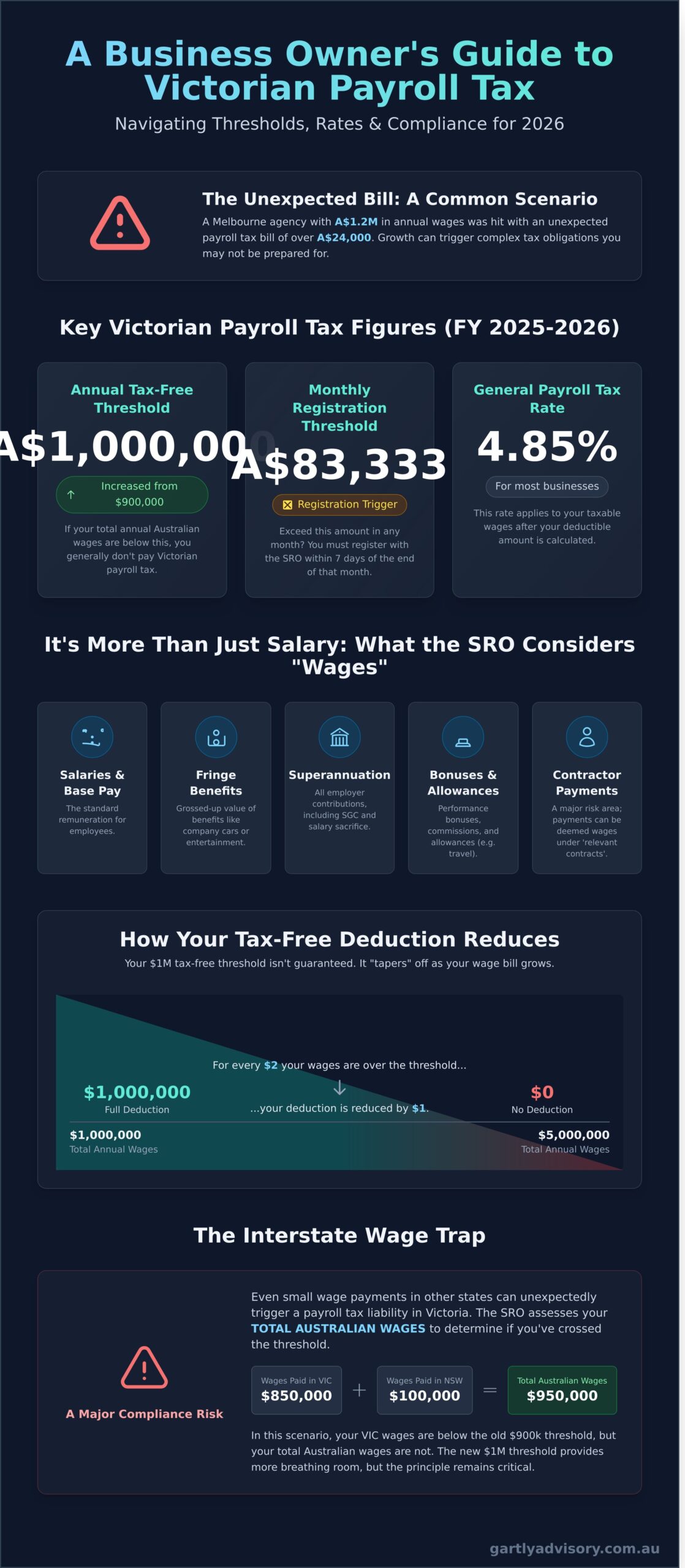
A primary source of confusion is the SRO’s broad definition of “wages”. It extends far beyond an employee’s regular salary or hourly rate. Many businesses are caught out by under-calculating their total wage bill because they overlook key components. Getting this calculation wrong can lead to unexpected tax bills and penalties. A comprehensive Overview of Australian Payroll Tax shows how each state has its own nuances, but Victoria’s rules are particularly detailed. Your total taxable wages include:
- Salaries and Base Pay: The standard component of remuneration for employees.
- Fringe Benefits: The grossed-up taxable value (Type 1 and Type 2) of benefits as reported on your FBT return. This can include company cars, entertainment, or subsidised goods.
- Superannuation Contributions: All employer super contributions, including superannuation guarantee payments and salary sacrifice amounts, are considered taxable wages.
- Bonuses, Commissions, and Allowances: Any performance bonuses, sales commissions, and allowances (e.g., for travel or tools) are part of the total wage calculation.
- Payments to a Contractor: This is a major risk area. If a contractor is deemed to be working under a ‘relevant contract’, the payments made to them can be classified as wages for payroll tax purposes.
Registration Requirements for New Payer Businesses
Understanding when to register for payroll tax is critical for compliance. Your business must register with the SRO within seven days after the end of the month in which your total Australian wages first exceed the monthly threshold (A$75,000 for the 2025-2026 financial year). Delaying registration can attract significant penalties.
Once registered, you’ll be required to lodge monthly returns and make payments, typically by the 7th of the following month. This process culminates in an annual reconciliation, due by 21 July each year. This is where you declare your total wages for the full financial year, reconcile them against your monthly payments, and settle any outstanding balance or receive a refund. Failing to register on time or lodge accurately can result in penalty tax, which can be as high as 25% of the tax shortfall, plus interest. Seeking professional payroll tax help victoria isn’t just about convenience; it’s a proactive step to protect your business from these avoidable costs.
Victorian Payroll Tax Thresholds and Rates for 2026
Understanding your payroll tax obligations begins with knowing the key numbers. For the 2025-2026 financial year, the Victorian government has implemented significant changes designed to provide relief for small and medium-sized businesses. The most critical figure is the annual tax-free threshold, which increases to $1,000,000 from 1 July 2025. This provides a substantial lift from the previous $900,000 threshold of the 2024-25 financial year.
This annual amount breaks down to a monthly threshold of $83,333. If your total Australian wages exceed this in any given month, you must register for payroll tax with the State Revenue Office (SRO). The general payroll tax rate for most businesses remains at 4.85%. However, as we’ll explore, your effective tax liability isn’t always that simple. It’s influenced by your total wage bill and your business’s location.
Calculating Your Deductible Amount
Your tax-free threshold isn’t a simple exemption; it’s a deduction that reduces as your payroll grows. This “tapering” mechanism means that as your annual wages increase above $1,000,000, your entitlement to the tax-free amount diminishes. For every $2 your business pays in wages over the threshold, your deduction is reduced by $1. This continues until your annual wages reach $5,000,000, at which point the tax-free deduction is completely phased out. Businesses with grouped or interstate wages face further complexity, often requiring a pro-rata calculation of their deduction. Getting this calculation right is a common area where businesses seek expert payroll tax help victoria.
Regional Victoria vs. Metropolitan Melbourne Rates
A significant opportunity for cost savings exists for businesses operating in regional areas. The SRO offers a heavily discounted tax rate of just 1.2125% for eligible regional employers, a 75% reduction from the standard 4.85% rate. To qualify as a “Regional Employer,” your business must have its registered ABN address in regional Victoria, and at least 85% of your total payroll must be paid to employees who perform their services primarily in a regional area.
This 85% rule is a frequent source of confusion, especially with flexible work arrangements. If an employee splits their time between a regional office and a home in metropolitan Melbourne, their wages may not qualify as regional. Miscalculating this percentage can lead to an unexpected tax bill and penalties. You can review the core compliance details directly from the SRO’s guide on Victorian Payroll Tax Fundamentals, which outlines the definitions and obligations.
Navigating these rules, particularly the interaction between deductions, grouping provisions, and regional classifications, requires careful attention to detail. An incorrect calculation or classification can easily result in non-compliance. This is precisely where a proactive and experienced advisor becomes a vital partner, ensuring you not only meet your obligations but also leverage every available concession.
The Interstate Wage Trap and Grouping Provisions
For businesses growing beyond Victoria, payroll tax can become unexpectedly complex. A common and costly mistake is assuming that the Victorian tax-free threshold applies exclusively to wages paid within the state. This misunderstanding is the source of the “interstate wage trap,” which catches many successful businesses off guard.
Let’s be perfectly clear about the number one misconception we see: “I don’t pay tax in Vic because my Victorian wages are under $900,000.” This is incorrect. Your eligibility for the tax-free threshold is determined by your total Australian wages, not just those paid to Victorian employees. Even paying one dollar in wages in New South Wales or Queensland reduces your Victorian tax-free threshold. This pro-rata calculation means your national footprint directly impacts your local tax liability, a critical detail that requires expert payroll tax help victoria to manage effectively.
Grouping Rules: When Separate Entities Become One
The State Revenue Office (SRO) looks beyond company names to determine your total taxable wages. If you operate multiple business entities, they may be “grouped” and treated as a single employer for payroll tax purposes. Grouping commonly occurs due to common control, such as when the same directors or shareholders have a controlling interest in several companies. It can also be triggered if there is an inter-use of goods or services between related entities. Once grouped, only one member, the Designated Group Employer (DGE), can claim the tax-free threshold on behalf of the entire group.
Apportioning the Threshold Across States
Once you pay wages in more than one state, you can no longer claim the full Victorian tax-free threshold. Instead, it’s apportioned based on the ratio of your Victorian wages to your total Australian wages. This calculation is a mandatory part of your annual reconciliation.
Understanding the maths is the first step to avoiding a surprise tax bill. Here is a simplified example:
- Total Australian Wages: $1,200,000 (across all states)
- Total Victorian Wages: $800,000
- Full Victorian Threshold (FY25): $900,000
The calculation for your new, reduced Victorian threshold is:
(Victorian Wages / Total Australian Wages) x Full Threshold
($800,000 / $1,200,000) x $900,000 = $600,000
In this scenario, your tax-free amount in Victoria drops from $900,000 to just $600,000. Your taxable Victorian wages become $200,000 ($800,000 – $600,000). As thresholds and rates can change, it’s vital to use the correct figures; the SRO provides the official 2026 Payroll Tax Rates and Thresholds for accurate planning. For businesses expanding outside of Melbourne, this has significant strategic implications. It requires careful cash flow forecasting and proactive tax planning to ensure you remain compliant and aren’t hit with an avoidable liability.
Exemptions, Deductions, and the Mental Health Levy
Understanding Victorian payroll tax goes beyond simply calculating a percentage of your wage bill. A strategic approach involves identifying and applying all available exemptions and deductions, which can significantly reduce your overall liability. Many businesses overpay simply because they aren’t aware of the specific rules that apply to them. From the type of organisation you run to the specific payments you make to staff, several factors can lower your taxable wages. It’s a complex area, but one that offers real savings when managed correctly.
The State Revenue Office (SRO) provides exemptions for certain types of employers and specific categories of wages. For instance, wages paid by non-profit organisations, public hospitals, and many local government bodies are often fully exempt. Beyond these entity-wide exemptions, there are crucial deductions available for specific payments, including:
- Paid Parental Leave: Payments made under the Commonwealth Government’s Paid Parental Leave scheme are not considered taxable wages.
- Volunteer Leave: Wages paid to an employee on leave to volunteer for an emergency service organisation (like the CFA or SES) during a declared state of emergency are exempt.
- Apprentices and Trainees: This is a key area for potential savings. Wages paid to new apprentices and trainees under an approved training contract are exempt from payroll tax for the duration of their training. Proactively identifying these employees is a direct way to reduce your tax bill.
Navigating these rules requires careful attention to detail. For businesses seeking proactive financial management, getting expert payroll tax help victoria is not just about compliance; it’s about optimising your financial position and ensuring you don’t pay a dollar more than you need to.
The Mental Health and Wellbeing Levy Explained
Introduced on 1 January 2022, the Mental Health and Wellbeing Levy is a surcharge that applies to larger businesses to fund Victoria’s mental health services. It applies to employers with annual Australian wages exceeding A$10 million. The rate is 0.5% on Victorian wages for those with a national payroll over A$10 million, with an additional 0.5% (for a total of 1%) applied to businesses with a national payroll over A$100 million. This levy is calculated and paid with your standard payroll tax return via the SRO’s PTX Express portal.
Strategic Use of Exemptions
Effectively managing exemptions means going beyond simple compliance. It involves actively reviewing your workforce to identify every eligible apprentice or trainee and ensuring their wages are correctly excluded from your calculations. Meticulous record-keeping is non-negotiable. You must maintain copies of all approved training contracts and other relevant documentation to justify your exemptions during an SRO audit. This level of diligence is a core principle of effective Small Business Accounting Melbourne and is your best defence against potential penalties.
Misinterpreting the rules or failing to keep proper records can lead to costly reassessments and interest charges down the track. If you’re unsure whether your business is correctly applying all available exemptions and deductions, it’s a sign that a professional review is needed. Let our experienced team provide the payroll tax help victoria your business deserves. Contact Gartly Advisory today for a comprehensive payroll tax assessment and discover where you could be saving.
Navigating SRO Audits and Compliance with Gartly Advisory
Receiving an audit letter from the State Revenue Office (SRO) of Victoria can be an unsettling experience for any business owner. However, it doesn’t have to be a crisis. With a proactive approach and expert guidance, an SRO review can be managed efficiently, protecting your business and ensuring long-term compliance. At Gartly Advisory Pty Ltd, we act as your trusted partner, providing the calm competence needed to navigate these complex matters.
SRO audits are rarely random. They are typically triggered by sophisticated data-matching programs that compare the wages you declare for payroll tax with figures reported to other government agencies. The SRO cross-references your data with information from the Australian Taxation Office (ATO) regarding PAYG withholding and superannuation contributions, as well as premium data submitted to WorkSafe Victoria. A discrepancy, even a minor one, can flag your business for a comprehensive review.
During these audits, our 35 years of experience have shown that a few common errors consistently surface:
- Contractor Misclassification: Payments to individuals classified as contractors are often deemed to be wages for payroll tax purposes, representing the most frequent cause of audit adjustments.
- Omitted Allowances: Failing to include taxable allowances, fringe benefits, and superannuation contributions in your calculations is a common oversight.
- Unaware of Grouping: Businesses with common directors, shareholders, or operational integration are often unknowingly “grouped,” meaning their wages must be combined, pushing them over the tax-free threshold.
- Incorrect Interstate Wage Allocation: For businesses with employees working across Australia, incorrectly apportioning wages to Victoria can lead to significant underpayments.
The smartest strategy is to address potential issues before the SRO contacts you. A proactive “Health Check” on your payroll data can identify and rectify these common errors. We provide thorough payroll tax help victoria by reviewing your contractor agreements against SRO criteria, analysing your payroll ledger for undeclared taxable wages, and assessing your business structure for grouping risks. This puts you in control.
The Audit Process: What to Expect
An audit typically begins with a formal letter of inquiry from the SRO, requesting an extensive list of documents spanning several years. Should we identify an error during our review, making a voluntary disclosure to the SRO before they formalise the audit can reduce penalties by as much as 80%. As your Chartered Accountant, we manage all SRO correspondence, negotiate deadlines, and present your information clearly, insulating you from the stress of the process.
Beyond the Numbers: Growing Your Business Strategically
Effective payroll tax management is more than just compliance; it’s a vital part of strategic business planning. As you expand and hire more staff, we help you forecast when you’ll cross the payroll tax threshold, treating it as a predictable cost of growth. We also provide crucial structuring advice to ensure that as your business evolves, you don’t inadvertently create a grouped entity that triggers a surprise tax liability. Let us be your partner in building a resilient and successful future. Talk to Geoff Gartly and the team for a payroll tax review.
Partner with an Expert to Secure Your Business’s Future
Managing Victorian payroll tax in 2026 isn’t just about compliance; it’s about smart financial strategy. Staying ahead of the tax-free threshold and understanding how grouping provisions affect your business are crucial steps to avoid costly SRO audits. Navigating these complexities is why seeking professional payroll tax help Victoria is a proactive investment in your company’s growth and stability.
At Gartly Advisory, we’re Chartered Accountants who go beyond the numbers. With over 35 years of dedicated experience in Victorian tax law, we provide the strategic guidance that has earned us more than 70 5-star Google reviews from Melbourne SMEs. We understand the challenges you face because we’ve been a trusted partner to businesses just like yours on their journey to success.
You don’t have to manage this alone. Let us provide the clarity and support you need to move forward with confidence. Book a consultation with our payroll tax experts in Ormond and let’s build a secure financial future for your business, together.
Frequently Asked Questions About Victorian Payroll Tax
Is payroll tax the same as PAYG withholding?
No, payroll tax is entirely different from Pay As You Go (PAYG) withholding. They are separate taxes managed by different government bodies for distinct purposes. Payroll tax is a state-based tax paid by an employer on the total wages they pay to employees. It’s calculated on your gross wages and is paid directly to the Victorian State Revenue Office (SRO). The funds collected are used to support state government services like hospitals, schools, and emergency services.
PAYG withholding, on the other hand, is part of the federal income tax system managed by the Australian Taxation Office (ATO). It’s not a tax on the business itself. Instead, it’s the amount of income tax you, as an employer, are required to withhold from an employee’s salary or wages. This amount is then sent to the ATO on behalf of your employee to cover their personal income tax liability. Confusing the two is a common mistake that can lead to compliance issues with both the SRO and the ATO.
How much is the payroll tax threshold in Victoria for 2026?
The payroll tax threshold in Victoria is set to be A$1 million for the 2025-2026 financial year. The Victorian Government has legislated phased increases to provide relief for small and medium-sized businesses. The threshold increased from A$700,000 to A$900,000 on 1 July 2024, and it will rise again to A$1 million on 1 July 2025. This means for the financial year ending 30 June 2026, you will only need to register for and pay payroll tax if your total Australian wages exceed this A$1 million annual threshold.
This translates to a monthly threshold of A$83,333. If your wage bill surpasses this amount in any given month, you are required to register with the SRO within seven days after the end of that month. It’s vital to monitor your wages closely, as rapid growth can push you over the threshold unexpectedly. Planning for this liability is a key part of responsible financial management for any growing Victorian business.
Do I have to pay payroll tax if I have employees in multiple states?
Yes, you will likely have a payroll tax obligation in Victoria if your total Australian wages exceed the Victorian threshold, even if some employees are located interstate. Payroll tax liability is determined by your national wage bill, but the tax itself is paid to the state where the employee performs their duties. If your Australia-wide wages are over A$1 million (from 1 July 2025), you must register for payroll tax in every state where you employ staff.
The amount of tax you pay in Victoria is calculated only on the portion of wages paid to your Victorian-based employees. For example, if your total national wages are A$1.5 million, with A$600,000 paid to Victorian staff, you are liable for Victorian payroll tax on that A$600,000. Navigating these multi-state ‘nexus’ provisions and potential grouping rules can be complex, so seeking professional guidance is essential to ensure you are compliant in all jurisdictions.
What happens if I forget to register for payroll tax in Victoria?
Forgetting to register for payroll tax in Victoria can result in substantial financial penalties from the State Revenue Office (SRO). The SRO actively identifies non-compliant businesses through data-matching programs with other agencies like the ATO and WorkSafe. Once discovered, the SRO will issue a default assessment for the unpaid tax liability stretching back as far as five years. On top of the unpaid tax, they will apply penalty tax, which can be as high as 75% of the outstanding tax, plus interest charges.
The most effective strategy is to be proactive. If you realise you should have registered, making a voluntary disclosure to the SRO before they contact you can lead to a significant reduction in penalties, sometimes as low as 20% or less. Managing this process correctly is critical to minimising the financial impact. Getting professional payroll tax help victoria is crucial to navigate the disclosure process and negotiate a favourable outcome with the SRO.
Are contractor payments included in Victorian payroll tax?
Yes, payments made to certain contractors are often deemed taxable wages under what are known as the ‘relevant contract’ provisions. The rules are designed to prevent businesses from avoiding payroll tax by engaging individuals as contractors when they are effectively working in a similar capacity to an employee. A payment to a contractor is generally taxable unless one of several specific exemptions applies. This is one of the most complex areas of payroll tax law and a common trigger for audits.
Common exemptions include if the contractor provides the same services to the general public, works for your business for 90 days or less in a financial year, or engages other workers to perform the contracted work. For example, hiring a plumber for a one-off repair is clearly exempt. However, engaging a consultant who works exclusively for you three days a week is almost certainly taxable. A careful review of every contractor arrangement against the SRO’s criteria is essential for compliance.
Can I get a refund if my annual wages end up under the threshold?
Yes, you are entitled to a full refund if you have paid payroll tax during the financial year but your total annual wages ultimately fall below the tax-free threshold. This situation often occurs for businesses with fluctuating wage costs, such as those in seasonal industries or those that undertake large, short-term projects. You might exceed the monthly threshold in some months and pay tax, but if your annual total is below A$1 million (from 1 July 2025), you have overpaid.
The refund is processed as part of the annual reconciliation, which every registered business must complete and lodge with the SRO by 21 July each year. During this process, you declare your total wages for the financial year. The SRO’s online system, PTX Express, will automatically calculate your annual liability. If it determines you’ve paid more than what was required, a refund will be issued directly to your nominated bank account. This ensures you only pay the tax you are truly liable for.
How does the Mental Health and Wellbeing Levy affect my business?
The Mental Health and Wellbeing Levy is an additional surcharge that applies to larger businesses on top of their standard Victorian payroll tax. This levy was introduced to provide a dedicated funding source for Victoria’s mental health services. Your business is liable for the levy if your total annual Australian wages exceed A$10 million. If your national wages are below this A$10 million threshold, the levy does not apply to you at all, regardless of the size of your Victorian operations.
For businesses with national wages between A$10 million and A$100 million, a levy of 0.5% is applied to the portion of their Victorian wages that exceeds the A$10 million threshold. For very large businesses with national wages over A$100 million, an additional 0.5% surcharge applies, bringing the total levy to 1.0%. This is a separate calculation from your regular payroll tax and is declared and paid as part of your monthly and annual returns.
Does the SRO share data with the ATO?
Yes, absolutely. The Victorian State Revenue Office (SRO) and the Australian Taxation Office (ATO) have robust and sophisticated data-sharing agreements in place. They regularly exchange and match information to ensure businesses are meeting their obligations at both the state and federal levels. This is a critical point for all employers to understand, as inconsistencies in your reporting are a major red flag that can trigger audits from either or both agencies.
For example, the SRO will compare the total gross wages you declare for payroll tax with the total gross wages you report to the ATO for PAYG withholding and superannuation purposes. Any significant discrepancy between these figures will likely lead to an investigation. Ensuring your records are accurate and consistent across all government reporting is paramount. This is where expert payroll tax help victoria becomes invaluable, providing the guidance needed to maintain seamless compliance and avoid costly audits.