
Late Tax Return Help for Business: A Step-by-Step Guide to Getting Back on Track
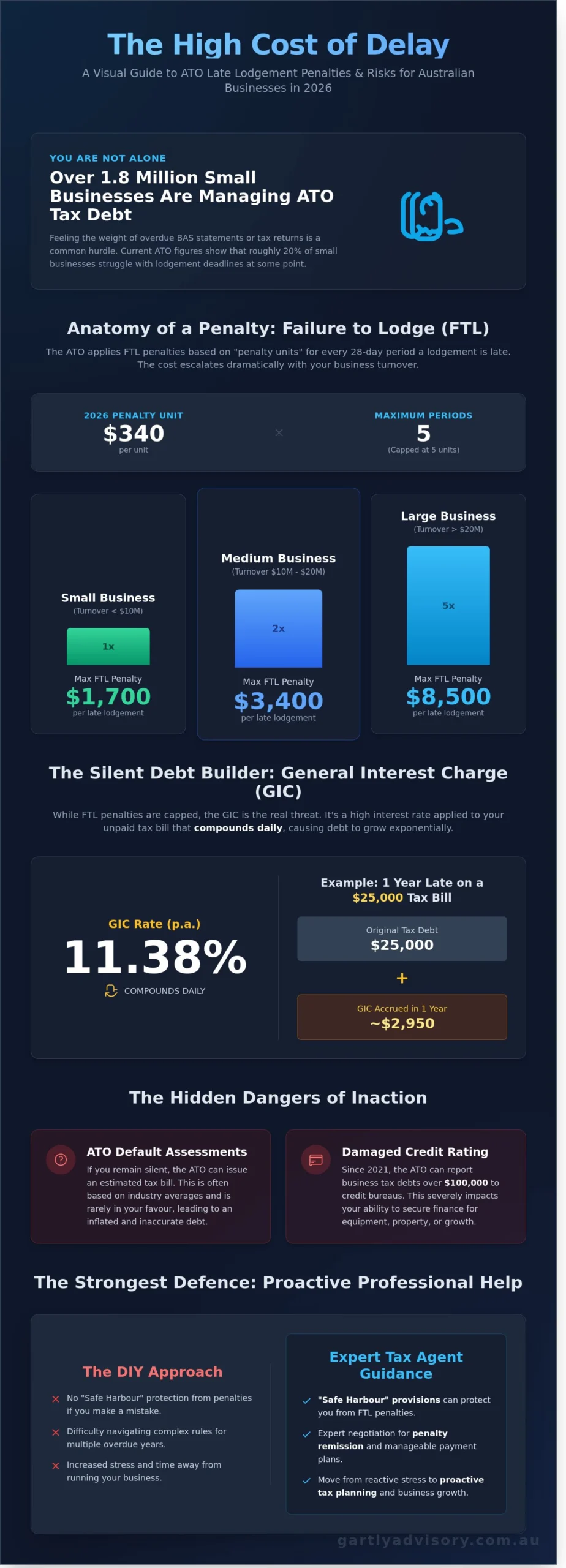
Last Tuesday morning, a Melbourne business owner sat at his kitchen table staring at a three year backlog of BAS statements while his phone buzzed with another “Private Number” call from the ATO. It’s a crushing weight to carry, especially when you feel like the paperwork has grown into an unsolvable mountain. Seeking late tax return help for business isn’t just about ticking compliance boxes; it’s about reclaiming your sleep from that constant, low level hum of financial anxiety. You’re not alone in this. Current ATO figures show that over 1.8 million small businesses are currently managing some form of tax debt.
We know you’re likely worried that the penalties will be insurmountable or that an audit is already lurking. It’s a common fear, but being behind doesn’t have to mean the end of your company. This guide shows you how to resolve overdue returns, minimize ATO penalties, and move from stress to proactive growth with expert Melbourne based guidance. We’ve spent 25 years being a safe pair of hands for businesses in this exact position. We will walk you through the process of securing a manageable payment plan and achieving full compliance so you can finally focus on your future again.
Key Takeaways
- Understand how the ATO views late returns for companies, trusts, and sole traders, and why falling behind is a common hurdle many Australian business owners overcome.
- Get clear on the 2026 penalty unit rates and how daily compounding interest works, helping you quantify the cost of delay and the value of taking immediate action.
- Learn why seeking professional late tax return help for business is your strongest defense, offering “Safe Harbour” protections that DIY methods simply cannot provide.
- Discover our step-by-step reconstruction process that uses tools like Xero to turn messy records into clean, compliant lodgments through a supportive, no-judgment approach.
- Move beyond the stress of overdue compliance by implementing proactive tax planning strategies that protect your cash flow and secure the future growth of your business.
The Reality of Late Business Tax Returns and the ATO in 2026
Life moves fast. Sometimes your tax obligations move faster. If you’re feeling overwhelmed by a growing pile of paperwork, you aren’t alone. Roughly 20% of Australian small businesses struggle with lodgement deadlines at some point in their journey. Whether you’re a sole trader who missed the 31 October cutoff or a company director who missed the 15 May tax agent extension, the ATO’s view is clear. A return is late the moment the clock strikes midnight on your specific due date. Different structures face different timelines, but the pressure to remain compliant is universal.
In 2026, the ATO’s compliance strategy has shifted into high gear. Their data matching systems now cross-reference your business activity against bank feeds, property titles, and share registries with surgical precision. This makes seeking late tax return help for business a strategic priority rather than a task for “next month.” We act as your trusted partner in this environment. Our team provides a safe pair of hands to navigate these digital complexities, ensuring you can stop looking over your shoulder and start focusing on your business growth again.
The Failure to Lodge (FTL) Penalty Explained
The ATO applies FTL penalties automatically using a points-based system. For small entities, the penalty is one unit, currently $313, for every 28 days a return is late. This caps at five units, or $1,565. If your business turnover exceeds $1 million, these costs double. For the largest entities, penalties hit $7,825 per lodgement. Beyond these fines, the General Interest Charge (GIC) is the real threat. Currently sitting at 11.38% annually, it compounds daily on any unpaid tax debt.
Why Ignoring the Problem Only Increases the Risk
Silence is expensive. If you stay off the grid, the ATO may issue a “default assessment.” This is their estimate of your tax debt, often based on industry benchmarks or previous years, and it’s rarely in your favour. Since 2021, the ATO has also been empowered to report tax debts over $100,000 to credit reporting bureaus like Equifax and Illion. This directly damages your credit rating and your ability to secure equipment finance or commercial loans. Proactive disclosure is always the better path. When you step forward, we can often negotiate the remission of penalties and establish sustainable payment plans. Getting late tax return help for business now prevents a manageable hurdle from becoming a permanent roadblock to your success.
Calculating the Cost: ATO Penalties and Interest Charges
Falling behind on tax obligations isn’t just a paperwork headache; it’s a direct drain on your cash flow. The ATO uses two primary financial levers to encourage compliance: Failure to Lodge (FTL) penalties and the General Interest Charge (GIC). These costs accumulate quickly, often turning a manageable tax bill into a significant financial burden if left unaddressed for multiple years.
Understanding Penalty Units and Business Size
The ATO calculates fines based on “penalty units.” For the 2026 financial year, the projected penalty unit rate is $340 per 28-day period. Your business size determines how many units apply. A small business with a turnover under $10 million is charged one unit per period, capped at five units. This makes the maximum FTL penalty for a single late return $1,700.
Medium entities with a turnover between $10 million and $20 million see these penalties doubled. Large entities, such as those with turnovers exceeding $20 million, face a multiplier of 500, leading to massive fines. It’s common for a business to have multiple overdue forms, including Income Tax Returns, Business Activity Statements (BAS), and Instalment Activity Statements (IAS). If you’re three years behind, you aren’t just looking at one fine; you’re looking at penalties for every single missed lodgment cycle.
The General Interest Charge (GIC): The Silent Debt Builder
While penalties are static caps, the GIC is a moving target that compounds daily. As of late 2024, the GIC rate sits at 11.38% per annum. The ATO sets this rate significantly higher than standard bank interest to ensure businesses don’t use the tax office as a cheap source of credit. Because it compounds daily, the interest grows exponentially rather than linearly.
- One Year Late: On a $25,000 tax debt, you would accrue approximately $2,950 in interest alone.
- Three Years Late: That same $25,000 debt snowballs to over $10,100 in interest because of the daily compounding effect.
In many cases, the accumulated interest eventually exceeds the original tax bill. However, these costs are often remissible. We frequently assist clients by applying for “Interest Remission” or penalty waivers. The ATO is often willing to reduce or cancel these charges if we can demonstrate a genuine attempt to rectify the situation. Seeking professional late tax return help for business allows you to present a compelling case for why these costs should be lowered, potentially saving your business thousands of dollars in unnecessary debt.
DIY vs. Professional Help: Why a Tax Agent is Your Best Defense
You might feel that calling the ATO yourself shows initiative. In reality, a DIY approach often leads to rigid payment plans or immediate demands for full payment. When you call the general business line, you’re often speaking to a call centre operator following a rigid script. We take a different route. As registered agents, we use the practitioner priority line and the Online Services for Agents portal to talk directly to decision-makers. This isn’t just about avoiding a long wait on hold. It’s about using the Taxation Administration Act 1953 to your advantage. We understand the specific terminology required to secure late tax return help for business owners who feel stuck in the system.
One major advantage of working with us is the Tax Agent Lodgement Program. While a DIY lodger generally faces a deadline of 31 October, our clients often benefit from extended deadlines reaching as far as 15 May the following year. This extra time is a legal right for clients of registered agents, providing the breathing room needed to reconstruct messy books without the immediate threat of new penalties. We act as your professional buffer, translating complex tax law into a clear plan of action while keeping the ATO’s automated debt collection systems at bay.
The Safe Harbour Rule: Your Legal Protection
The Safe Harbour provision is a vital legal shield for your company. Under Australian law, you aren’t liable for Failure to Lodge (FTL) penalties if you can prove you provided all necessary info to your agent in a “timely manner,” even if the agent missed the deadline. Currently, FTL penalties for small entities can reach $1,565 per return. At Gartly Advisory, we document every interaction to ensure these legal protections apply to you. If you’ve handed over your bank feeds and receipts by the date we agreed upon, the law protects you from those $313-per-period fines.
This protection only works if your agent is registered and diligent. We ensure your “reasonable care” is documented. By letting us manage the lodgement process, you shift the compliance burden off your shoulders and onto our professional systems. It’s a layer of security that simply doesn’t exist when you try to manage late filings on your own.
Negotiating with the ATO: The Power of Representation
We don’t just ask for favors; we build a formal case for the remission of penalties. If your business maintained a “clean” compliance history for the previous 3 years, we leverage that record to ask the ATO to wipe the slate. Our team in Ormond understands the Victorian business climate and how local economic shifts affect your cash flow. We use this context to argue against General Interest Charges (GIC), which currently sit at a rate of 11.34% for the April to June 2024 quarter. Reducing this interest can save a business thousands of dollars in dead money.
- Penalty Remission: We write formal submissions to have FTL penalties waived based on your specific circumstances.
- GIC Reduction: We negotiate to lower the interest rates applied to your outstanding debt.
- Payment Frameworks: We establish sustainable payment plans that don’t cripple your weekly operating capital.
Our proactive approach goes beyond the numbers. We look at the “why” behind your late lodgement, whether it was a health issue, a partnership dispute, or a software failure. We present these facts to the ATO as a professional narrative, which carries significantly more weight than a standard phone request from a stressed business owner.
Step-by-Step: How to Catch Up on Multiple Overdue Returns
Facing a mountain of paperwork feels overwhelming, but you aren’t alone. We’ve helped hundreds of Melbourne business owners through this exact scenario over our 25 years of practice. The process isn’t about looking back with regret; it’s about moving forward with a clear strategy. If you need late tax return help for business, following a structured path is the only way to clear the fog and regain control.
Gathering Records and Reconstructing Data
Lost invoices from 2021 aren’t the end of the world. We lean heavily on Xero’s automated feeds to find the evidence we need. This phase is where our “Advice Beyond the Numbers” philosophy shines. We don’t just plug in figures; we look for missed deductions and opportunities to reduce your overall liability while we reconstruct your history. Using bank data matching allows us to satisfy ATO requirements even when paper trails have gone cold.
Setting Up an ATO Payment Arrangement
The ATO doesn’t expect you to pay a massive debt overnight. They want to see a commitment to future compliance. We help you distinguish between a short-term deferral and a long-term arrangement. Keeping the plan active requires you to lodge all future BAS and tax returns on time. If you miss one future deadline, the whole deal usually collapses, so we ensure the monthly amount fits comfortably within your budget.
Don’t let the fear of the ATO stop your business from growing. Get expert late tax return help for business and let’s get your records straight today.
Beyond Compliance: How Gartly Advisory Secures Your Business Future
You’ve done the heavy lifting by addressing the backlog. Now, the focus shifts from fixing the past to protecting your future growth. While getting late tax return help for business owners provides immediate relief, the real value lies in building a resilient financial structure. We help you transition from a state of constant catch-up to a position of total control. This isn’t just about ticking boxes for the ATO; it’s about giving you the clarity to make better decisions for your company’s expansion.
Proactive Tax Planning and Support
Our team doesn’t wait for June 30 to start thinking about your obligations. We’ve spent 35 years supporting Melbourne SMEs by implementing systems that make compliance feel invisible. By using cloud-based automation and real-time data feeds, we ensure your financial information flows correctly throughout the year. This reduces the risk of human error and keeps your records audit-ready at all times. You’ll know exactly what you owe well before the deadline hits, which eliminates the “tax time shock” many directors face.
Quarterly reviews are a cornerstone of our service. These regular check-ins allow us to catch potential issues before they turn into expensive penalties. For a small business, a single “Failure to Lodge” penalty from the ATO can cost $313 per 28-day period, capping at $1,565 per return. Our proactive oversight prevents these avoidable costs. We use Geoff Gartly’s decades of experience to look beyond the numbers, identifying tax-saving opportunities and R&D incentives that others might miss. It’s about being your eyes and ears in the complex world of tax law.
Your Next Steps to Peace of Mind
It’s never too late to start the resolution process, regardless of how many years you’ve missed or how messy you think the records are. We understand the stress that comes with tax debt, and we’re here to carry that burden for you. Our 70+ 5-star Google reviews reflect our commitment to being an approachable, supportive presence during difficult times. We don’t judge your situation; we simply provide the practical roadmap to fix it. Our 25 years of trust in the local community is built on this very foundation of reliability.
Take the first step toward a stress-free future by booking a complimentary consultation at our Ormond office. We’ll sit down, look at your specific needs, and create a plan to get you back on track. Let us be your trusted partner on your journey towards success, providing the late tax return help for business you need to finally move forward. Contact our team today to schedule your appointment and regain the peace of mind you deserve.
Take Control of Your Business Compliance Today
The ATO is currently ramping up efforts to close the $33 billion small business tax gap. With the tax office increasing its data-matching capabilities for the 2026 financial year and general interest charges sitting at 11.38% per annum, delaying your lodgments only makes the mountain steeper. You’ve seen how a structured approach breaks down years of overdue paperwork into manageable steps. Getting your returns up to date isn’t just about avoiding penalties; it’s about reclaiming the mental focus you need to run your company. You don’t have to face the tax office alone when you’ve got a safe pair of hands ready to step in.
Our team brings 35 years of Melbourne business experience to your side. As Chartered Accountants and trusted partners, we’ve helped business owners navigate these exact hurdles, earning us 70+ 5-star Google reviews. We provide the expert late tax return help for business you need to secure your financial standing and move forward. It’s time to stop worrying about past mistakes and start focusing on your next big opportunity. We’re ready to help you clear the slate and get back to what you do best.
Talk to us and let us help you resolve your late tax returns today
Let’s start the journey toward your business success together.
Frequently Asked Questions
What is the ATO penalty for a late business tax return in 2026?
The ATO penalty for a late business tax return in 2026 is calculated using penalty units, which are currently valued at $313 each for small businesses. If your lodgement is late, the ATO applies one penalty unit for every 28 days the return remains outstanding, up to a maximum of five units, which equals a total of $1,565 for a small entity. For medium entities, which the ATO defines as having an assessable income between $2 million and $20 million, these penalties are doubled to $626 per 28 day period, reaching a maximum of $3,130. Large entities with a turnover above $20 million face a fivefold increase, while Significant Global Entities can be charged up to $782,500 for failing to lodge on time. These figures are indexed periodically, so the 2026 rates may reflect slight adjustments for inflation based on the Consumer Price Index. When you’re looking for late tax return help for business, understanding these potential fines is the first step toward resolution. We’ve seen how these costs can snowball quickly, so it’s vital to act before the 28 day cycles reset and add more to your debt. Our team focuses on helping you avoid these unnecessary outgoings by establishing a clear timeline for your 2026 obligations. We believe in being a safe pair of hands to navigate these complex matters and ensure your business stays profitable.
Can the ATO waive penalties for late lodgement?
Yes, the ATO has the authority to waive or remit penalties if you can demonstrate that you have a fair and reasonable excuse for the late lodgement. This process is known as a penalty remission, and it’s something we frequently assist our clients with when unexpected life events or business disruptions occur. To be successful, you generally need to show that the delay was due to circumstances beyond your control, such as a natural disaster, serious illness, or a major system failure. The ATO also looks at your compliance history; if you’ve been a reliable taxpayer for the last 3 years, they’re much more likely to show leniency. In addition to the base penalty, you might be facing a General Interest Charge, which is currently sitting at 11.38% per annum. While getting the base penalty waived is common, remitting the interest charge is more difficult and requires a very strong case backed by financial evidence. We’ll work with you to gather the necessary documentation and present a professional submission to the ATO that highlights your commitment to getting back on track. Our goal is to protect your cash flow by minimizing these extra costs through proactive negotiation and clear communication with the tax office.
How many years of back tax returns can I file at once?
You can file as many years of back tax returns as necessary, and there’s no technical limit on how far you can go back to rectify your records. While the ATO typically focuses on the last 2 to 4 years for standard reviews, they expect every outstanding year to be lodged eventually to ensure your business remains in good standing. If you have a decade of missing returns, the best approach is to start with the most recent years first to stop current penalties from mounting, then work backwards to fill the gaps. We’ve helped businesses catch up on 5, 7, or even 10 years of lodgements by systematically rebuilding their financial history from bank statements and invoices. It’s a journey that requires patience, but lodging multiple years at once shows the ATO that you’re taking proactive steps to fix the situation. This proactive stance often puts you in a better position when we negotiate for the remission of old penalties or set up a long term payment arrangement. Our experience shows that the ATO is far more cooperative with businesses that come forward voluntarily rather than waiting for the tax office to start an investigation. We provide the guidance and support needed to handle this backlog without it overwhelming your daily operations.
What happens if I can’t afford to pay the tax debt once I lodge?
If you can’t afford to pay your tax debt after lodging, the ATO offers various payment plans that allow you to settle the balance over a period of 12 to 24 months. For businesses with a total debt under $100,000, these arrangements can often be automated through the ATO’s online portals, provided you can meet certain criteria. You’ll usually be required to pay an upfront deposit of 10% or 20% of the total debt to show good faith before the remaining balance is split into manageable monthly or fortnightly instalments. It’s important to remember that the General Interest Charge of 11.38% will still apply to the unpaid balance, which can make the debt grow if the plan is too long. We help you look beyond the numbers to find a payment structure that supports your cash flow without putting your business’s survival at risk. If your debt exceeds $100,000, we can take a more hands on approach by negotiating directly with the ATO to secure a tailored arrangement that reflects your specific financial circumstances. This might involve providing detailed cash flow forecasts to prove what your business can realistically afford. We act as your trusted partner to ensure the ATO understands your situation and accepts a plan that allows your business to keep trading and growing.
Will the ATO audit me if I lodge multiple late returns?
Lodging multiple late returns does increase your visibility to the ATO, but it doesn’t automatically mean you’ll be audited. The ATO uses sophisticated data matching technology that compares your reported figures against 600,000 other data points, including bank records, property sales, and even social media activity. Their primary goal is to ensure that all income is declared and that the tax system remains fair for the 90% of small businesses that lodge on time. When you lodge several years at once, the ATO’s systems may flag your account for a closer look to see why the delay happened and if there are any inconsistencies in your claims. However, by working with a Chartered Accountant, you can ensure that your returns are accurate and fully compliant before they’re submitted. We take a proactive approach by reviewing your records thoroughly, which often resolves potential red flags before the ATO even sees them. Our goal is to make the process as smooth as possible so you can focus on growing your dreams instead of worrying about compliance. We provide the calm competence needed to navigate these situations, ensuring that your lodgements are defensible and transparent. If the ATO does ask questions, we are right there by your side to provide the necessary explanations and support.
Does using a tax agent give me more time to lodge?
Using a registered tax agent like Gartly Advisory gives you significantly more time to lodge your returns through the ATO’s official lodgement program. While individuals and self-lodging businesses generally have a deadline of 31 October, clients of tax agents often have until 15 May of the following year to submit their returns. This extra seven month window is a massive advantage for businesses that need more time to organise their records or manage their cash flow. To qualify for this extension, you must be registered as a client with your tax agent before the 31 October deadline. If you’ve already missed your dates, being on a tax agent’s list still provides a layer of protection because the ATO views your engagement with a professional as a sign of your intent to comply. We use this additional time to provide the strategic guidance and advice you need to not just meet the deadline, but to optimise your tax position. It’s about more than just a date; it’s about having the space to make informed financial decisions. Our team manages the lodgement program for hundreds of clients, ensuring that every deadline is tracked and met without the last minute stress. This partnership allows you to stay focused on your business goals while we handle the technical requirements of the Australian tax system.
Can a late tax return affect my business credit score?
A late tax return itself won’t directly lower your credit score, but an unpaid tax debt can have a major impact if it meets certain reporting criteria. Since 2019, the ATO has been permitted to report tax debts to credit reporting bureaus like Equifax and Experian if the debt is over $100,000 and has been overdue for more than 90 days. Before this happens, the ATO will send you a formal notice giving you 28 days to take action or enter into a payment plan. If the debt is reported, it will appear on your business credit file for up to five years, which can make it extremely difficult to secure business loans, equipment finance, or even favourable terms with suppliers. This is why late tax return help for business is so critical; it’s not just about the tax, it’s about protecting your business’s reputation and financial future. We work hard to ensure you stay below these reporting thresholds by managing your lodgements and negotiating with the ATO before things reach a critical point. By maintaining a clear line of communication and staying proactive, we help you avoid the long term consequences of a damaged credit rating. Our focus is on providing advice beyond the numbers to ensure your business remains a viable and attractive prospect for lenders and partners alike.
How long does it take to catch up on three years of overdue returns?
Catching up on three years of overdue returns typically takes between 4 and 6 weeks, depending on the quality of your records and how quickly we can gather the necessary data. The first week is usually spent on discovery, where we collect bank statements, payroll records, and receipts to piece together your financial story. During the second and third weeks, our team processes this information and identifies any missing gaps or opportunities for deductions you might have missed. The final stage involves a detailed review and a consultation with you to ensure everything is accurate before we lodge. We don’t just rush through the numbers; we take the time to provide advice that helps you avoid falling behind again in the future. By following this methodical approach, we turn what feels like an overwhelming mountain of work into a series of manageable steps. Within about 45 days, you can move from a state of stress and uncertainty to having a clean slate and a clear path forward for your business. Let us be your trusted partner on this journey towards success, ensuring that your compliance is handled with the care and expertise it deserves. This timeline allows us to be thorough while still moving quickly enough to stop further penalties from accruing. We are here to support you every step of the way, providing the guidance needed to reclaim control of your business’s financial health.