
Business Exit Planning: Your Ultimate Guide to a Successful Sale or Succession
For many Australian business owners, the company you’ve built is more than just an asset; it’s your life’s work, the bulk of your net worth, and a legacy you want to protect. The thought of selling or stepping away can feel overwhelming, filled with concerns about securing the right price and looking after your team. What if you could approach this milestone not with uncertainty, but with confidence? This is where strategic business exit planning becomes your most powerful tool, transforming a complex process into a rewarding and controlled outcome.
This guide is designed to be your trusted partner on that journey. We will provide you with a clear, step-by-step roadmap to help you maximise your business’s value, ensure a smooth transition for your employees and family, and secure the financial future you’ve worked so hard to achieve. It’s time to move forward with the clarity and support you deserve.
What is Business Exit Planning and Why You Should Start Now
Many business owners pour their lives into building a successful company but give little thought to the final, most critical chapter. A common question our clients ask is, What is Business Exit Planning? In simple terms, it is a strategic roadmap that prepares you and your business for a successful transition. This isn’t just about selling; it’s a comprehensive process designed to secure your financial future, protect your legacy, and ensure a smooth handover, whether to family, employees, or an external buyer.
Attempting to exit your business without a plan is like building a house without a blueprint. The best outcomes are achieved through careful, long-term preparation, not a rushed decision made under pressure. A well-structured exit plan allows you to control the process, maximise the value of your asset, and transition on your own terms.
To help you better understand this critical concept, the video below offers a helpful overview:
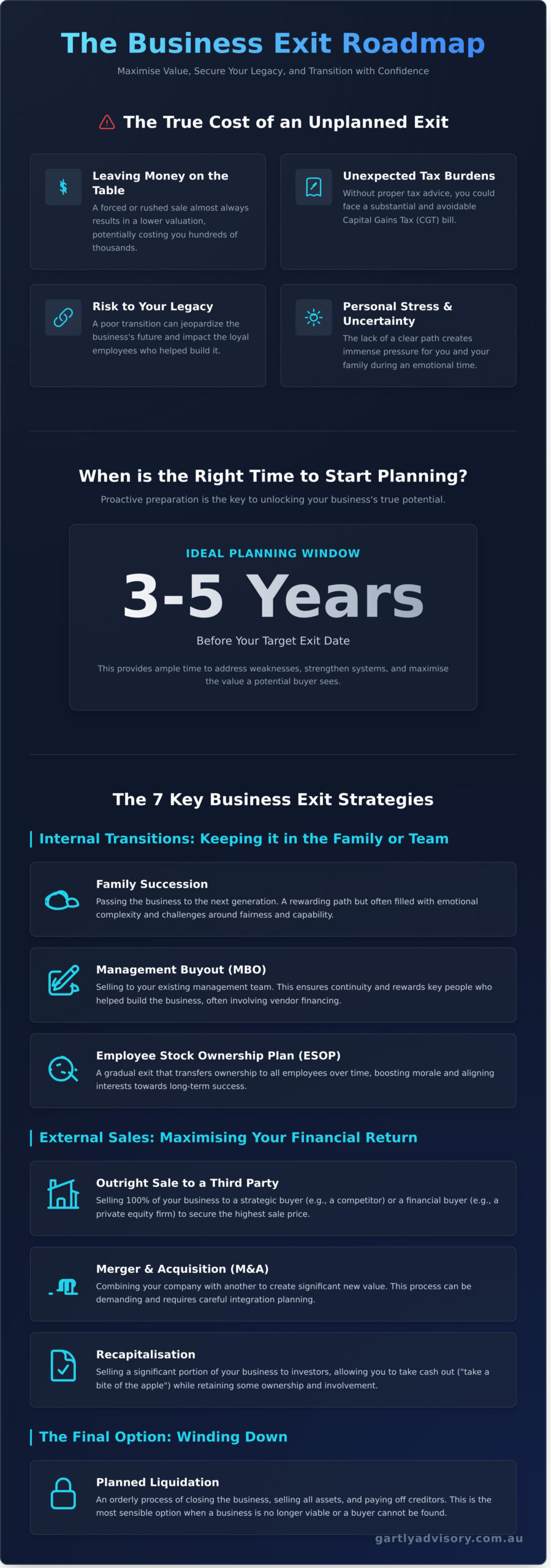
The True Cost of Not Having an Exit Plan
Failing to plan can have significant and often irreversible consequences. As your trusted partner, we want to provide the guidance to help you avoid these common pitfalls:
- Leaving money on the table: A forced or rushed sale almost always results in a lower valuation, potentially costing you hundreds of thousands of dollars.
- Unexpected tax burdens: Without proper advice, you could face a substantial and potentially avoidable Capital Gains Tax (CGT) bill here in Australia.
- Risk to your legacy: A poorly managed transition can jeopardise the future of the business, impacting the loyal employees who helped you build it.
- Personal stress and uncertainty: The lack of a clear path creates immense pressure for you and your family during an already emotional time.
When is the Right Time to Start Planning?
The simple answer is: as early as possible. Proactive preparation is the key to unlocking your business’s true potential and ensuring you are ready to seize opportunities when they arise. Ideally, your exit strategy should be a living document that evolves with your business.
We recommend starting the formal Business Exit Planning process at least 3-5 years before your target exit date. This provides ample time to address weaknesses, strengthen systems, and maximise the value a potential buyer sees. Key triggers like approaching retirement, market shifts, or personal health matters often prompt action, but the most successful exits are those integrated into your business strategy from day one.
The 7 Key Business Exit Strategies: Which Path is Right for You?
When the time comes to step away from your business, there are several well-trodden paths available to Australian SME owners. The right choice is deeply personal, depending on your financial goals, desired legacy, and the nature of your business. A core part of effective business exit planning is understanding these pathways, as each carries unique tax, legal, and operational implications. Navigating this complexity requires careful consideration and professional guidance to ensure you achieve the best possible outcome.
Internal Transitions: Keeping it in the Family or Team
For many owners, preserving the company’s culture and legacy is paramount. An internal transition offers a way to pass the torch to trusted hands.
- Family Succession: Passing the business to the next generation can be incredibly rewarding but is often fraught with emotional complexity and challenges around fairness and capability.
- Management Buyout (MBO): Selling to your existing management team ensures continuity and rewards the people who helped build the business. This often involves vendor financing.
- Employee Stock Ownership Plan (ESOP): A more gradual exit that transfers ownership to employees over time, boosting morale and aligning everyone’s interests towards long-term success.
External Sales: Maximising Your Financial Return
If your primary goal is to secure the highest possible sale price, an external sale is typically the most direct route. These transactions are complex and require expert negotiation.
- Outright Sale to a Third Party: This involves selling 100% of your business to a strategic buyer (like a competitor) or a financial buyer (like a private equity firm).
- Merger & Acquisition (M&A): Combining your company with another can create significant new value, though the integration process can be demanding.
- Recapitalisation: Selling a significant portion of your business to investors allows you to take cash out while retaining some ownership and involvement.
Winding Down: The Final Option
While not the preferred outcome for most, sometimes the most logical step is to close the business in an orderly fashion. A planned liquidation is a structured process of selling all assets, paying off creditors, and distributing any remaining funds to shareholders. This becomes the most sensible option when the business is no longer viable, a suitable buyer cannot be found, or the owner’s health necessitates a swift exit.
Choosing the right path is one of the most significant decisions you will make on your business journey. It’s a decision that deserves experienced, supportive advice. Unsure which path suits you? Let’s discuss your options.
The 5-Year Exit Planning Timeline: A Step-by-Step Roadmap
A successful business sale is rarely a last-minute decision; it’s the result of careful, proactive preparation. Viewing your exit as a multi-year journey allows you to systematically increase your company’s value, address weaknesses, and align the final outcome with your personal goals. This structured approach to Business Exit Planning transforms a potentially overwhelming event into a manageable process.
Think of it as a roadmap. By breaking the journey into distinct phases, you can focus on the right priorities at the right time, ensuring you are in the strongest possible position when you decide to sell. Having a trusted advisor by your side throughout this timeline provides the guidance and support needed to navigate each step with confidence.
Years 3-5: Building the Foundation
This initial phase is about introspection and organisation. It’s where you get your house in order and set a clear direction for the future. The goal is to create a solid, transparent, and attractive foundation for a potential buyer to build upon. Key actions include:
- Define Your Goals: Clarify your personal financial needs and lifestyle aspirations post-sale. How much do you need to secure your future?
- Establish a Baseline: Obtain a professional business valuation to understand your company’s current worth and identify areas for improvement.
- Address Weaknesses: Systematically identify and mitigate operational risks, from customer concentration to outdated systems.
- Clean Financials: Ensure your financial records are pristine, accurate, and easy for a third party to understand.
Years 1-2: Preparing for Market
With a strong foundation in place, the focus now shifts to actively enhancing business value and preparing for scrutiny. This is about making your business as attractive as possible to a potential acquirer. Your priorities should be:
- Boost Profitability: Implement strategies to grow revenue, improve margins, and increase recurring income streams.
- Reduce Owner Dependency: Develop a strong management team capable of running the business without your daily involvement.
- Structure for Tax Efficiency: Work with your accountant to ensure you can access valuable concessions, such as the Small Business CGT Concessions in Australia.
- Prepare for Due Diligence: Begin compiling key documents, contracts, and financial reports in a secure data room.
The Final Year: Execution
This is the transactional phase where your years of preparation pay off. With a valuable, well-structured business, you can confidently go to market. This final leg involves:
- Engage Professionals: Select an experienced business broker or M&A advisor to manage the sale process and find qualified buyers.
- Finalise Documentation: Prepare the Confidential Information Memorandum (CIM) to present your business professionally.
- Negotiate and Close: Navigate offers, rigorous due diligence, and the final sale and purchase agreement.
- Plan Your Next Chapter: Solidify your post-exit financial plan and consider what you want to do with your newfound freedom.
Maximising Your Business Valuation: Key Drivers of Sale Price
When a potential buyer assesses your business, they are not just buying your past profits; they are investing in its future potential and calculating the associated risks. A higher valuation is achieved by demonstrating strong future cash flows and minimising those risks. This is why a proactive approach, ideally over a three-to-five-year timeframe, is a cornerstone of effective Business Exit Planning. It provides the necessary time to systematically enhance the fundamental drivers of your business’s value.
As your trusted advisory partner, we provide guidance that goes beyond the numbers. We help you focus on the tangible actions that make your business more robust, scalable, and ultimately, more attractive to a future owner.
Financial Health and Predictability
A buyer’s first point of due diligence is your financials. Clean, transparent, and accurate records build immediate trust and confidence. We support our clients in focusing on:
- Impeccable Record-Keeping: Ensuring financial statements, BAS, and tax returns are accurate and always up-to-date.
- Consistent Profitability: Demonstrating a stable or growing trend in profits and, most importantly, positive cash flow.
- Recurring Revenue: Securing long-term customer contracts or subscription models to guarantee future income streams.
- Margin Optimisation: Actively managing cost of goods sold and minimising non-essential overheads to improve net profit.
Reducing Owner Dependency
A business that can thrive without your daily involvement is significantly more valuable. It proves the enterprise has a life of its own and is not just a job you created. Key steps include:
- Systemising Operations: Documenting all key processes and procedures in Standard Operating Procedures (SOPs) so the business is a ‘turnkey’ operation.
- Building a Strong Management Team: Empowering a capable and autonomous team that can handle day-to-day decisions and strategic implementation.
- Customer Diversification: Ensuring no single client accounts for a disproportionate amount of your revenue, reducing concentration risk.
Protecting and Enhancing Assets
Your business’s value is also tied to its tangible and intangible assets. Protecting these assets is non-negotiable in any value-building strategy.
- Intellectual Property: Securing trademarks, patents, and proprietary systems that create a competitive advantage.
- Key Contracts: Ensuring critical employee, customer, and supplier agreements are formalised, current, and transferable.
- Modern Infrastructure: Investing in up-to-date technology and equipment that demonstrates scalability and efficiency.
Building a valuable, saleable business is a deliberate journey. As a core part of our Business Exit Planning support, we help you identify and strengthen these value drivers. To create a strategic plan for maximising your business’s potential, contact us for a complimentary consultation.
Assembling Your A-Team: The Experts You Need for a Smooth Exit
Successfully navigating the sale of your business is a team sport, not a solo endeavour. One of the most common and costly mistakes owners make is trying to manage every complex detail themselves. Assembling a team of trusted professionals early in your Business Exit Planning process ensures every angle is covered, protecting your interests and maximising the final value you receive.
The Core Advisory Team
These professionals form the strategic foundation for your exit. They work with you long before the business goes to market to ensure you are properly prepared.
- Chartered Accountant/Business Advisor: Provides a realistic business valuation, structures the sale for optimal tax outcomes, and prepares your financials for the rigours of due diligence.
- Commercial Lawyer: Essential for drafting and reviewing all legal documents, including the sale agreement, and navigating the complexities of legal due diligence to protect your interests.
- Financial Planner: Focuses on your post-sale life, helping you invest the proceeds wisely to fund your retirement and achieve your personal financial goals.
The Transaction Team
Once you are ready to sell, these experts manage the process of finding a buyer and closing the deal. The right choice depends on the size and complexity of your business.
- Business Broker: For most small-to-medium enterprises, a broker confidentially markets your business, vets potential buyers, and facilitates negotiations to find the right fit.
- M&A Advisor: Typically engaged for larger or more complex transactions, they provide high-level strategic advice on mergers, acquisitions, and sophisticated deal structures.
Why Your Accountant is Your Most Valuable Partner
While every team member is crucial, your accountant or specialised business advisor often acts as the central ‘quarterback’. They understand your business numbers inside and out, providing the objective, data-driven advice needed to steer the entire process. They are uniquely positioned to structure the deal to be as tax-efficient as possible, ensuring you keep more of your hard-earned money. Throughout what can be an emotional journey, their steady guidance provides the clarity and support you need to make the best decisions for your future. Let Gartly Advisory be the trusted partner on your exit journey.
Secure Your Legacy: Your Next Chapter Starts Here
Your business is the culmination of your vision and hard work. As we’ve explored, securing its future value and your own personal legacy isn’t left to chance-it’s achieved through careful preparation. The most critical takeaways are to begin the process years in advance, to strategically choose the exit path that aligns with your goals, and to proactively build value within your operations. This foresight is the very essence of successful Business Exit Planning.
Navigating the complexities of a sale or succession requires a steady, experienced hand. For over 25 years, Gartly Advisory has been a trusted partner for Melbourne’s business owners, providing guidance that goes beyond the numbers. Our team of Certified Chartered Accountants and accredited Business Valuebuilder Advisors specialises in not only maximising your company’s sale price but also in navigating critical Australian regulations like the Small Business CGT Concessions to ensure you retain as much of your hard-earned wealth as possible.
The rewarding exit you deserve is achievable with the right support. Let us be your trusted partner in planning your successful exit. Schedule a consultation today.
Frequently Asked Questions About Business Exit Planning
How much does it cost to create a business exit plan?
The cost to create a business exit plan in Australia varies based on your business’s complexity. A foundational plan may start from A$3,000 to A$7,000, while a comprehensive strategy for a larger enterprise can exceed A$15,000. It’s best to view this as a crucial investment, not an expense. Proper business exit planning guided by an experienced advisor ensures you maximise your sale price, often delivering a return far greater than the initial outlay, making it a valuable step in your journey.
What are the most common mistakes business owners make when selling?
A common mistake is a lack of preparation, including disorganised financial records and unclear operational processes, which can deter buyers. Many owners also set unrealistic valuation expectations without professional guidance. Another critical error is neglecting the business during the sale process, causing performance to dip and reducing its final value. A proactive approach with a trusted partner helps you sidestep these pitfalls and ensures you achieve the best possible outcome for your hard work.
How long does the process of selling a business typically take in Australia?
In Australia, the process of selling a business typically takes between 6 and 12 months from the decision to sell to the final settlement. This timeline can vary significantly depending on the industry, business size, and market conditions. The process involves several key stages: preparing the business for sale, marketing to potential buyers, conducting due diligence, and finalising legal contracts. Patience and thorough preparation are essential for a successful and timely transaction, which we can provide guidance on.
What are the main tax implications I need to be aware of, like Capital Gains Tax?
The primary tax implication when selling your business in Australia is Capital Gains Tax (CGT) on the profit you make. However, the Australian tax system offers several Small Business CGT Concessions that can significantly reduce, or even eliminate, this tax liability. These concessions have strict eligibility criteria. It is crucial to seek professional tax advice well in advance to structure the sale correctly and ensure you can legitimately access all available concessions to protect your final proceeds.
Can I still sell my business if it’s not currently profitable?
Yes, it is possible to sell a business that isn’t currently profitable. Buyers may see value beyond recent profit figures, such as a strong customer base, valuable intellectual property, unique technology, or significant physical assets. A strategic buyer might also see an opportunity for a turnaround under new management. The key is to identify and clearly articulate these alternative sources of value. We can support you in building a compelling case that highlights your business’s future potential.
How do I keep the sale confidential from my employees and competitors?
Confidentiality is paramount during a business sale. This is managed through a structured process led by your advisor. All prospective buyers are required to sign a legally binding Non-Disclosure Agreement (NDA) before receiving any sensitive information. We help you vet potential buyers carefully to ensure they are genuine and qualified. This controlled approach ensures that your employees, customers, and competitors remain unaware of the sale until you are ready to make a strategic announcement at the appropriate time.