
Your Complete Guide to Starting & Growing a Manufacturing Business in Australia
The dream of creating a tangible product is powerful, but the reality of launching a successful manufacturing business in Australia can feel overwhelming. If you’re grappling with questions about financial viability, finding it difficult to navigate complex regulations, or feeling the pressure of managing cash flow and pricing your products for profit, you are not alone. These are the foundational challenges that can make or break a new venture, turning ambition into anxiety.
This guide is designed to be your trusted partner on that journey, providing the clarity and support you need. Here, we move beyond the numbers to give you a clear roadmap for success. Discover the essential steps for getting started, proven financial strategies for managing costs and maximising profitability, and expert advice to ensure your operation is both compliant and scalable. Let’s build the confidence you need to take control and grow your dream into a thriving Australian enterprise.
What is a Manufacturing Business? Core Concepts for Success
At its core, a manufacturing business is an enterprise that transforms raw materials, components, or parts into finished goods for sale. The process can involve machinery, human labour, or even biological and chemical processing. To truly understand what is manufacturing? is to see it as the act of creation. Unlike a retail business that simply sells products made by others, or a service business that offers intangible expertise, a manufacturer is the creator of a tangible product. This fundamental difference shapes every aspect of the operation, from sourcing to sales.
To see a simple manufacturing process in action, consider this example:
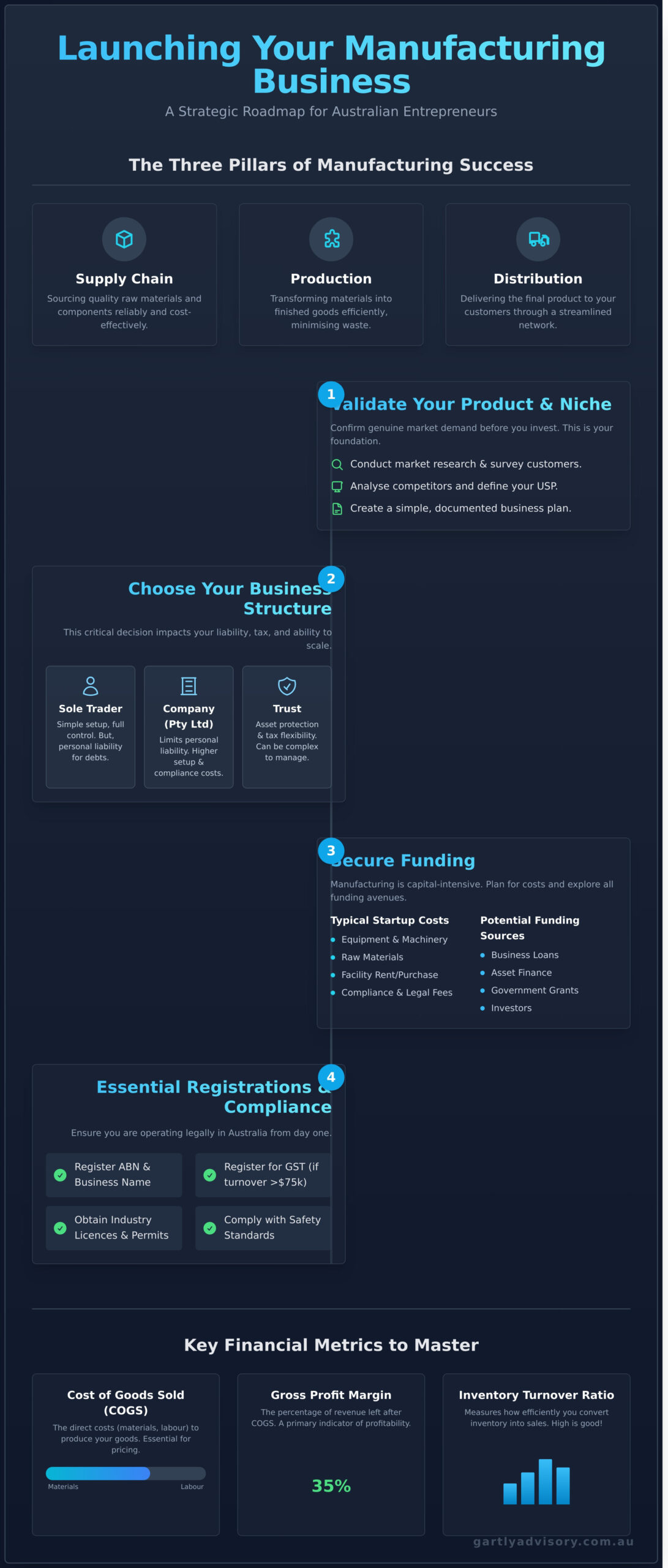
Success in this sector hinges on mastering three interconnected pillars: a reliable supply chain to source quality materials, an efficient production process to create the goods, and a streamlined distribution network to deliver them to customers. Getting these right from the start is fundamental to building a sustainable and profitable enterprise.
The Modern Manufacturing Model
Today’s manufacturing isn’t just about large-scale factory lines. Many successful Australian businesses thrive by adopting lean manufacturing principles to eliminate waste and improve efficiency. They often operate on either a made-to-order model (e.g., custom furniture) or a made-to-stock model (e.g., mass-produced food items). We’ve also seen a significant rise in niche and artisanal manufacturing, from local craft breweries to bespoke fashion labels, creating unique value in the market.
Key Financial Metrics Every Manufacturer Must Track
From day one, understanding your financial position is non-negotiable. As your trusted partner, we provide guidance on the critical metrics every manufacturer must track to ensure profitability and growth:
- Cost of Goods Sold (COGS): The direct costs of materials and labour tied to producing your goods. This is essential for accurate pricing and profit analysis.
- Gross Profit Margin: The percentage of revenue left after subtracting COGS. It’s the first and most important indicator of your core business’s profitability.
- Inventory Turnover Ratio: This shows how efficiently you are converting inventory into sales, ensuring your capital isn’t tied up in unsold stock.
Common Types of Manufacturing in Australia
The Australian manufacturing landscape is diverse and full of opportunity. Some of the most common sectors where entrepreneurs are finding success include:
- Food and beverage production
- Textiles, clothing, and footwear (TCF)
- Furniture, cabinetry, and other wood products
- Chemicals, metal fabrication, and specialised machinery
The Startup Phase: Turning Your Idea into a Viable Business
An innovative product idea is the spark, but transforming that spark into a successful manufacturing business requires a solid foundation built on careful planning. Before a single item comes off the production line, it is crucial to establish the financial, legal, and strategic frameworks that will support long-term growth. This phase is about moving from concept to a concrete, viable enterprise, ensuring you are set up for stability and success from day one.
Validating Your Product and Finding a Niche
First, you must confirm that a genuine market exists for your product. Conduct research by surveying potential customers, analysing online trends, and studying your competitors to define your unique selling proposition (USP). What makes your product better, faster, or more cost-effective? Documenting these findings in a simple business plan is essential. A well-structured plan is a core part of any comprehensive guide to starting a manufacturing business and serves as your strategic roadmap for making informed decisions.
Choosing the Right Business Structure
Selecting the correct legal structure in Australia is a critical decision with lasting implications for your liability, tax obligations, and ability to scale. The most common options include:
- Sole Trader: Simple to set up with full control, but you are personally liable for all business debts.
- Company (Pty Ltd): A separate legal entity that limits your personal liability, but involves higher setup and compliance costs.
- Trust: Offers asset protection and tax flexibility, but can be complex to administer.
Seeking professional advice here can save you significant headaches and financial distress in the future.
Securing Funding for Your Manufacturing Venture
Manufacturing is capital-intensive. You will need a clear understanding of your startup costs, which typically include equipment, raw materials, facility rent or purchase, and compliance fees. Funding can be sourced through various channels, such as traditional business loans, asset finance specifically for machinery, or government grants for innovation. Lenders and investors will require a robust financial forecast demonstrating your business’s profitability and cash flow. This is where expert guidance can be invaluable.
Essential Australian Registrations and Compliance
Operating legally in Australia requires several key registrations. Your initial checklist should include:
- ABN and Business Name: Register for an Australian Business Number (ABN) and secure your business name.
- GST Registration: You must register for Goods and Services Tax (GST) if your annual turnover is expected to be A$75,000 or more.
- Licences and Permits: Research and obtain any industry-specific licences, environmental permits, and council approvals relevant to your operations.
- Safety Standards: Comply with all Work Health and Safety (WHS) regulations to ensure a safe workplace.
Managing Operations and Finances for Sustainable Profit
Once your production line is operational, your focus must shift to diligent financial stewardship. A successful manufacturing business isn’t just about making excellent products; it’s about making them profitably. Managing the unique financial cycles of manufacturing-from purchasing raw materials to collecting customer payments-is fundamental for long-term stability and growth.
Mastering Cash Flow: The Lifeblood of Manufacturing
The most significant challenge is often managing the gap between paying suppliers for materials and getting paid by customers. Proactive cash flow management is essential. We provide guidance to clients on negotiating longer payment terms (e.g., 60 days) with suppliers while securing shorter terms or deposits from customers. Accurate cash flow forecasting helps you anticipate shortfalls and ensures you always have the capital to operate.
Costing and Pricing Your Products Accurately
To ensure profitability, you must understand the true cost of every unit you produce. This isn’t just materials and labour; it’s a combination of:
- Direct Costs: Raw materials and direct labour for assembly.
- Overheads: A portion of factory rent, utilities, and machinery depreciation.
A common mistake is pricing based only on direct costs, which erodes margins. Your final price must cover all costs and include a healthy profit margin to fuel your business’s future.
Smart Inventory Management
Inventory is a balancing act. Holding too much stock ties up valuable working capital and incurs storage costs, while holding too little risks losing sales due to stock-outs. Implementing a simple tracking system is vital. Modern accounting software like Xero offers excellent inventory management tools to help you find the right balance, optimise stock levels, and improve cash flow.
Navigating Tax Obligations and Incentives
Staying compliant with Australian tax law is non-negotiable. Key obligations include managing GST, PAYG withholding for your staff, and paying company tax. Beyond compliance, however, lie significant opportunities. The R&D Tax Incentive, for example, can provide valuable cash flow benefits if you are developing new or improved products or processes. Understanding these complexities is key to maximising your financial position. Let us help you navigate complex tax obligations.
Scaling Your Manufacturing Business: Strategies for Growth
Once your operations are stable and generating consistent revenue, the next exciting phase is growth. Transitioning from a steady operation to a growing enterprise requires a strategic shift in focus from day-to-day survival to long-term value creation. This means making calculated investments, building resilience, and proactively expanding your reach. Success at this stage is about building a robust framework that can support increased demand and complexity.
Investing in People and Technology
Growth is rarely a solo endeavour. Hiring your first employees is a significant milestone that comes with crucial obligations in Australia, including superannuation, WorkCover insurance, and adherence to Fair Work standards. Alongside people, technology is a powerful lever for productivity. Investing in automation, such as CNC machinery or inventory management software, can dramatically increase output and reduce errors. Planning for this capital expenditure is essential for any growing manufacturing business, and requires careful financial forecasting.
Building a Resilient Supply Chain
Your ability to produce is only as strong as your supply chain. Relying on a single supplier, especially an overseas one, exposes your business to significant risks like shipping delays or sudden price hikes. It’s vital to build resilience by diversifying your sources. Consider the trade-offs:
- Local Suppliers: Often provide faster turnaround and higher quality control, but may come at a premium cost.
- Overseas Suppliers: Can offer lower unit costs but introduce risks related to logistics, tariffs, and communication barriers.
Building strong, long-term relationships with a few key suppliers can lead to better payment terms and greater reliability when you need it most.
Expanding Your Market Reach
To grow, you need more customers. This involves exploring new sales channels beyond your initial market, such as wholesaling to retailers, selling direct-to-consumer (DTC) via an e-commerce website, or even exporting. A simple, targeted marketing strategy is crucial to attract these new buyers. Most importantly, use your financial data to guide your efforts. By analysing your sales and profit margins, you can identify which products and customer segments are most profitable, allowing you to focus your resources where they will have the greatest impact. Seeking professional guidance can provide the clarity needed to turn your financial data into a strategic roadmap for your manufacturing business.
Why a Specialist Advisor is Your Most Valuable Asset
Starting and scaling a manufacturing business is a complex undertaking. You are managing not just production, but intricate supply chains, significant capital investments, compliance, and fluctuating cash flow. While it’s tempting to handle everything yourself to control costs, viewing professional advice as an expense is a common mistake. A specialist advisor is a direct investment in your long-term success, providing the strategic guidance needed to navigate challenges and build a resilient enterprise.
Strategic Guidance Beyond Basic Compliance
A great advisor moves you beyond historical bookkeeping and into forward-looking financial strategy. They help you develop accurate forecasts, create robust pricing models that protect your margins, and analyse performance against key industry benchmarks. More than just a compliance expert, they act as a trusted sounding board for critical decisions, offering objective insights when you’re considering major equipment purchases or expansion plans. This is advice that goes far beyond the numbers on a tax return.
Identifying Opportunities and Mitigating Risks
The right partner proactively protects your business and enhances its value. In Australia, this means identifying valuable opportunities like the R&D Tax Incentive, which can provide a significant cash boost for innovative processes. They will also ensure your business structure is optimised from day one for both asset protection and tax minimisation. This foresight extends to planning for the future, whether it’s securing finance for growth or preparing the business for a profitable sale down the track.
Your Partner on the Journey to Success
A Chartered Accountant with experience in the manufacturing sector understands the entire business lifecycle, from startup to maturity. They provide the financial clarity and confidence you need to lead effectively. By translating complex financial data into actionable insights, they empower you to make the right decisions at the right time. If you’re ready to build a strong foundation for your venture, it’s time to partner with an expert who understands manufacturing.
Your Partner in Manufacturing Success
Embarking on the journey to build a successful manufacturing business in Australia is an ambitious and rewarding endeavour. As this guide has shown, success is built on a foundation of clear strategy, meticulous financial management, and a proactive approach to growth. From turning your initial idea into a viable operation to scaling for long-term profitability, each step requires careful planning and expert execution.
Navigating these stages doesn’t have to be a solitary effort. Having a trusted advisor is your most valuable asset. At Gartly Advisory Pty Ltd, we are more than just Chartered Accountants and registered Tax Agents; we are your strategic partners. With over 35 years of experience, we provide the proactive support and guidance needed to help you overcome challenges and seize opportunities.
Let us be your trusted partner on your journey towards success. We invite you to take the next step with confidence. Schedule a complimentary consultation to discuss your manufacturing business goals. Together, we can build a thriving Australian manufacturing legacy.
Frequently Asked Questions About Starting a Manufacturing Business
How much capital do I need to start a small manufacturing business?
The required capital varies significantly based on your scale and industry. A small, niche operation might start with A$50,000 to A$100,000, covering initial equipment leases, materials, and compliance. However, a business requiring more sophisticated machinery could need upwards of A$250,000. A detailed financial forecast is essential to secure funding and ensure you have adequate working capital. We can provide guidance to help you build a realistic and comprehensive budget for your venture.
What are the most profitable types of manufacturing businesses in Australia?
In Australia, high-profitability is often found in niche and specialised sectors. Food and beverage manufacturing, particularly artisanal or health-focused products, remains strong. Other promising areas include advanced manufacturing of medical devices, specialised construction materials, and custom machinery parts. Success typically comes from targeting a specific market gap with a high-quality, innovative product rather than competing on volume alone. Thorough market research is the key to identifying these opportunities.
What is the biggest challenge for new manufacturing businesses?
The most significant challenge is often managing cash flow and navigating supply chain complexities. New ventures face high initial outlays for equipment and materials before generating consistent revenue. Unreliable supplier deliveries or sudden price increases can halt production and strain finances. Proactive financial management and building strong supplier relationships are critical to overcoming these hurdles and ensuring the long-term stability of your new manufacturing business.
Do I need specialised accounting software for my manufacturing business?
Yes, we strongly advise using accounting software with manufacturing-specific features. Standard software often can’t properly track inventory across its different stages-raw materials, work-in-progress, and finished goods. You need a system that can accurately calculate the cost of goods sold (COGS), manage bills of materials, and handle job costing. This provides the detailed financial insight necessary to price products correctly and manage profitability effectively.
How can I make my manufacturing business more environmentally sustainable?
Sustainability can be a key competitive advantage. Start by conducting an energy audit to identify savings, implementing lean manufacturing principles to minimise waste, and sourcing recycled or sustainable raw materials. Installing solar panels can also significantly reduce long-term energy costs. Exploring these options not only reduces your environmental impact but can also improve efficiency, lower operational expenses, and appeal to a growing market of eco-conscious consumers.
When should I hire my first employee?
The right time to hire is when your workload consistently prevents you from focusing on strategic growth activities like sales, marketing, and innovation. If you are spending too much time on production or administrative tasks that could be delegated, it’s a clear sign. Hiring your first employee is a major financial commitment, so it’s crucial to ensure you have stable revenue and a clear role defined before you begin the recruitment process.