
Estate Planning for Business Owners: A Complete Guide to Protecting Your Legacy
As a business owner, the line between your personal life and the company you’ve poured everything into is often blurred. Your assets are intertwined, and the thought of what happens to your staff, customers, and family if you’re no longer at the helm can be a source of constant worry. The complexity of Australian succession laws and the potential for family disputes can make the entire process feel overwhelming, but it doesn’t have to be. Getting clear, professional estate planning advice for business owners is the most crucial step toward gaining peace of mind.
This guide is designed to be your trusted partner on this important journey. We will walk you through the essential steps and strategies to protect your legacy, providing practical guidance to create a robust plan. You will learn how to structure your affairs to ensure your business can continue operating smoothly, provide lasting financial security for your family, minimise the tax burden on your beneficiaries, and create a clear path for succession or sale.
Key Takeaways
- Your business is a unique and complex asset that requires more than a standard will to protect its value and ensure smooth continuity for your family.
- A robust plan integrates key legal documents, like a carefully structured will and buy-sell agreements, to create a clear succession pathway.
- Proactive estate planning advice for business owners is essential for navigating Australian tax laws, such as Capital Gains Tax (CGT), to maximise the inheritance your family receives.
- The legal structure of your business-whether you operate as a sole trader, company, or through a trust-fundamentally dictates the strategies available for transferring ownership.
- Creating a successful estate plan is a collaborative effort; assembling the right team of professional advisors is the first step to securing your legacy.
Why Estate Planning is More Than Just a Will for Business Owners
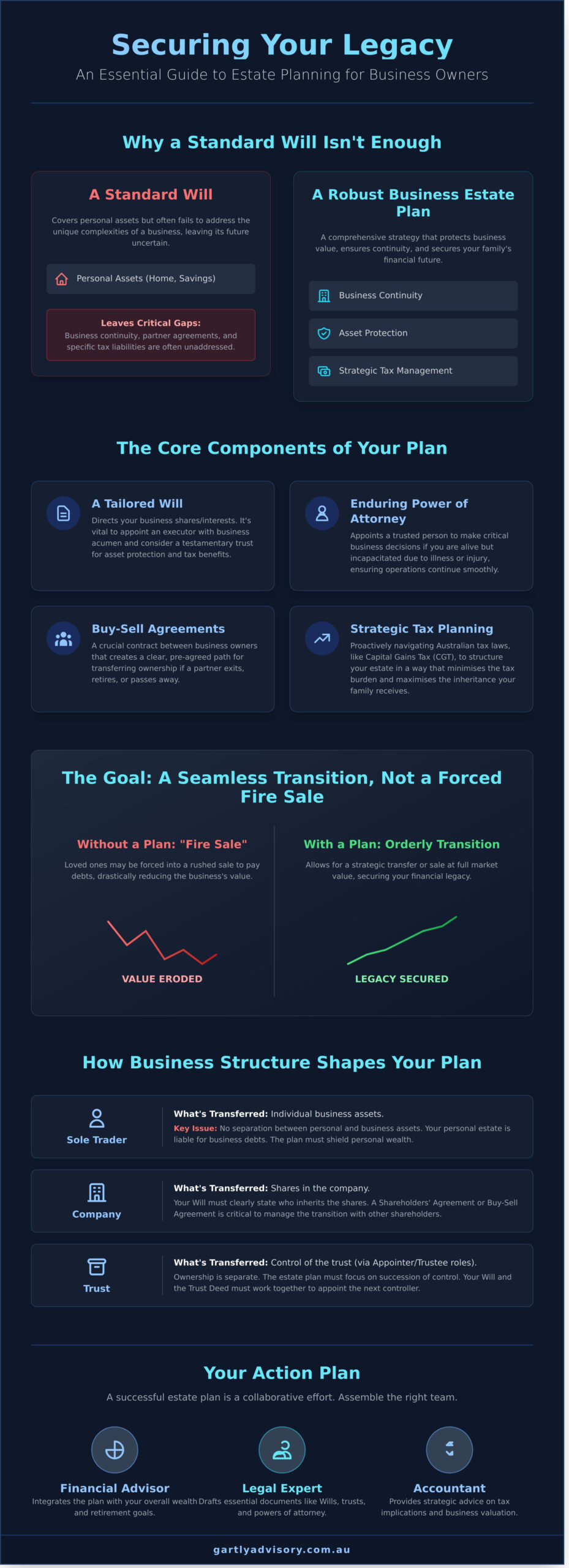
For many Australian entrepreneurs, your business isn’t just a job-it’s your life’s work, your most significant asset, and the primary source of financial security for your family. While a standard will might cover your personal assets, it often falls dangerously short of addressing the complexities of a business. This is where strategic estate planning becomes essential. It moves beyond basic inheritance to create a comprehensive roadmap that protects the value you’ve built. To fully grasp its scope, it’s helpful to understand What is Estate Planning? at its core: a process of anticipating and arranging for the management and disposal of a person’s estate during their life and after their death, while minimising tax and other complications.
To better understand this concept, watch this helpful video:
Failing to plan can disrupt operations, erode value almost overnight, and leave your family, partners, and employees in a state of uncertainty. Effective estate planning advice for business owners is not just about asset distribution; it’s a critical tool for business continuity, asset protection, and strategic tax management that secures your legacy.
The Critical Link Between Business Continuity and Your Estate Plan
Imagine what would happen if you were suddenly unable to run your business. A well-structured estate plan provides clear answers to urgent questions, creating a roadmap for survival during a difficult transition. It defines:
- Decision-Making Authority: Who has the legal power to sign contracts, approve payments, and lead the team?
- Operational Access: How can your successor access critical business bank accounts, software systems, and intellectual property?
- Stakeholder Confidence: A clear plan reassures key clients, suppliers, and staff that the business remains stable and reliable.
Separating Personal Assets from Business Liabilities
Your business structure-whether you operate as a sole trader, partnership, or company-directly impacts your personal liability. Without the right protections, your family home and personal savings could be at risk to settle business debts. We provide guidance on using legal structures like trusts to create a strong barrier, ensuring your personal wealth is shielded from business-related financial challenges.
The Goal: A Seamless Transition, Not a Forced Fire Sale
Without a succession plan, your loved ones may be forced to sell the business quickly to pay debts or finalise the estate. This rushed “fire sale” scenario almost always results in a significantly lower sale price, destroying much of the value you worked so hard to create. Proper planning allows for an orderly transition to new ownership or a strategic sale at full market value, securing the financial legacy you intend for your family.
The Core Components of Your Business Estate Plan
A robust business estate plan is not a single document, but a carefully constructed suite of legal instruments designed to work together. While your personal Will is a crucial starting point, it cannot protect your business on its own. The most effective estate planning advice for business owners involves integrating several key components to ensure a seamless transition, protect your assets, and provide certainty for your family and partners. Let us provide guidance on how each piece of this puzzle protects your legacy.
Your Personal Will: Directing Your Shares and Assets
Your Will is the foundational document that dictates who inherits your ownership interest or shares in the business. It is vital to appoint an executor with the commercial acumen to manage complex business matters during the administration of your estate. For added asset protection and potential tax benefits for your beneficiaries, your Will can also establish a testamentary trust to hold your business interests, shielding them from potential claims and providing long-term financial structure.
Enduring Power of Attorney: Who Acts When You Can’t?
What happens if you are alive but unable to make decisions due to illness or injury? An Enduring Power of Attorney is a critical safeguard. This document appoints a trusted person (your attorney) to manage your financial and business affairs on your behalf. It is essential to clearly define the scope of their decision-making power. This is distinct from an Enduring Power of Guardianship, which covers personal and medical decisions, ensuring all aspects of your life are managed by someone you trust.
Business Succession Agreement (Buy-Sell Agreement)
Often considered a ‘pre-nup’ for business partners, a Buy-Sell Agreement is a legally binding contract that provides a clear roadmap for the future. It removes uncertainty by pre-determining what happens if a partner exits due to death, disability, or retirement. Key elements include:
- Triggering Events: Defines the specific circumstances under which the agreement is activated.
- Valuation Method: An agreed-upon formula to calculate the business value, ensuring a fair price and avoiding costly disputes.
- Funding Mechanism: Often funded by life and Total and Permanent Disability (TPD) insurance policies, providing the remaining owners with the capital to buy out the departing owner’s share without financial strain.
This single document provides certainty for all owners, their families, and the ongoing stability of the business you have worked so hard to build.
Navigating Key Tax Implications for Your Business Estate
Without proactive planning, your passing can trigger significant and often unexpected tax events that can diminish the value of the legacy you leave behind. Understanding these potential liabilities is a cornerstone of effective estate planning advice for business owners, allowing you to legally minimise the tax burden and maximise what your heirs receive. Here in Australia, there are three key areas that demand your attention.
Capital Gains Tax (CGT) on Business Assets
While death itself doesn’t automatically trigger a Capital Gains Tax (CGT) event, the liability passes with the asset. CGT may become payable when your beneficiaries later sell those assets. Fortunately, special rollover provisions can defer this tax obligation until the asset is sold. For entrepreneurs, the small business CGT concessions are particularly powerful, potentially reducing or even eliminating the tax payable on business assets, including shares in a company or units in a trust. Strategic use of these concessions is vital for preserving your business’s value.
Managing Your Self-Managed Super Fund (SMSF)
It’s a common misconception that your superannuation is covered by your Will. In reality, your SMSF assets are governed by the fund’s trust deed. To ensure your super benefits are distributed according to your wishes, a valid Binding Death Benefit Nomination (BDBN) is essential. This legally directs the trustee on how to pay out your balance. Equally important is planning for who will take control as trustee. Remember, death benefits paid to a ‘tax dependant’ (like a spouse) are generally tax-free, while payments to non-dependants can be heavily taxed.
Using Testamentary Trusts for Tax-Effective Distributions
A Testamentary Trust is a sophisticated trust created by your Will that activates upon your death. Instead of beneficiaries receiving a direct lump sum, assets are held in the trust and managed by a trustee. This structure offers powerful advantages for asset protection and tax planning.
- Asset Protection: It helps safeguard a beneficiary’s inheritance from creditors or claims arising from relationship breakdowns.
- Tax-Effective Distributions: It allows income from the estate’s assets to be distributed flexibly among beneficiaries. Crucially, income paid to minor children is taxed at adult marginal rates, providing significant tax savings for your family.
Navigating these complexities requires tailored and proactive estate planning advice for business owners. As your trusted partner, we provide the guidance to structure your affairs tax-effectively, ensuring your legacy is protected for generations to come.
How Your Business Structure Shapes Your Estate Plan
Your business structure is the legal foundation upon which your operations are built, and it plays an equally critical role in your estate plan. How you own your business-whether as a sole trader, in a partnership, or through a company or trust-directly dictates how it can be passed on. Each structure has unique rules for ownership transfer, and failing to align your legal documents can create significant complications for your beneficiaries. Getting tailored estate planning advice for business owners is crucial to ensure a smooth transition that protects the value you’ve worked so hard to build.
Understanding these differences is the first step towards creating a plan that is both legally sound and aligned with your personal wishes. Let’s explore the key considerations for common Australian business structures.
Sole Trader: The Business Is You
As a sole trader in Australia, there is no legal distinction between you and your business. Your business assets, from equipment to bank accounts, are your personal assets. This means your Will is the primary document that must specify how these assets are to be managed, sold, or distributed. Without a clear plan, your business legally ceases to exist upon your death, potentially leaving your family to untangle a complex situation and lose significant value.
Partnership: The Importance of an Agreement
In a partnership, the death of a partner can automatically trigger the dissolution of the business under Australian law, unless a comprehensive partnership agreement states otherwise. A robust agreement is vital; it should outline a clear buyout process, detailing how the remaining partners can purchase the deceased partner’s share. This is a fundamental component of a Business Succession Agreement, providing certainty and stability for all parties during a difficult time.
Company: Transferring Your Shares
If you operate as a proprietary limited (Pty Ltd) company, your ownership is held in the form of shares. These shares are personal assets that form part of your estate. Your Will directs who will inherit these shares, but it’s essential that your intentions are also reflected in a Shareholders’ Agreement. This agreement can manage the transfer of shares to prevent disputes and ensure the business continues to operate smoothly under new ownership.
Trusts: Passing on Control, Not Just Assets
Assets held within a trust (like a family or discretionary trust) are not legally owned by you, so they do not form part of your personal estate and cannot be gifted through your Will. The critical element here is control, which is typically held by the ‘Appointor’. Your estate plan must carefully address the succession of the Appointor role, usually through a clause in your Will or the Trust Deed itself, to ensure control passes to your chosen successor.
Navigating these complexities requires specialist guidance. As your trusted partner, we provide clear estate planning advice for business owners to secure your legacy. Contact us for a complimentary appointment to discuss your unique situation.
Your Action Plan: Assembling Your Team and Getting Started
Effective estate planning is a team sport, not a solo activity. Building a comprehensive plan requires a proactive approach to ensure no detail is missed and your legacy is protected. The journey from intention to a legally sound plan can feel complex, but it begins with a few clear, manageable steps. This action plan provides a trusted pathway to begin the process and secure the future you have worked so hard to build.
Step 1: Define Your Objectives and Value Your Business
The first step is gaining clarity on your vision. Do you want the business to continue with family or key employees, be sold to a third party, or wound down? Your answer shapes every decision that follows. Simultaneously, obtaining a realistic and up-to-date business valuation is critical. This figure is not just a number; it forms the foundation for fair distributions among beneficiaries and provides the data needed to structure effective buy-sell agreements.
Step 2: Assemble Your Professional Advisory Team
You don’t have to navigate this journey alone. The right team provides comprehensive estate planning advice for business owners by covering all legal, financial, and tax implications. Your core team should include:
- Your Accountant/Business Advisor: To provide guidance on business valuation, tax-effective structures, and succession strategies.
- Your Solicitor: To draft legally binding documents, including your Will, Powers of Attorney, and any necessary trust or shareholder agreements.
- Your Financial Planner: To align your personal wealth goals with the business transition, managing insurance policies (like key person insurance) and investment strategies.
As your trusted partner, we can help you coordinate this process from the very beginning. Start the conversation with a trusted business advisor.
Step 3: Communicate With Your Family and Successors
One of the most common sources of conflict in estate transitions is a lack of communication. Discussing your plans openly with family members and designated successors can prevent future misunderstandings and manage expectations. It is also vital to confirm that your chosen successors are both willing and able to take the reins. These conversations, while sometimes difficult, are essential for ensuring a smooth and successful transition that honours your intentions.
Taking these first steps today is the most powerful thing you can do to protect your business, support your family, and secure your legacy. By seeking professional estate planning advice for business owners, you transform uncertainty into a clear, actionable strategy.
Secure Your Legacy: Your Next Steps in Business Estate Planning
As we’ve explored, protecting the business you’ve built requires more than a standard will. A truly effective estate plan is a dynamic strategy, one that carefully considers your business structure, navigates complex Australian tax laws, and ensures a seamless transition for your company and your family. It’s the ultimate safeguard for your life’s work, providing clarity and security when it matters most.
The path forward involves seeking professional estate planning advice for business owners who understand these unique challenges. At Gartly Advisory, we pride ourselves on being a trusted partner for Melbourne’s small and medium businesses. We go beyond the numbers to provide the strategic support you need to make confident decisions about your future.
With over 35 years of experience, our Chartered Accountants specialise in tax and succession planning. Let us help you put a robust plan in place. Schedule a consultation to secure your business legacy with our expert guidance. Taking this proactive step today is the best investment you can make in your peace of mind and the future of your legacy.
Frequently Asked Questions About Estate Planning for Business Owners
How often should I review my business estate plan?
Your estate plan is not a “set and forget” document. We recommend a thorough review every 3-5 years, or whenever a significant life or business event occurs. This includes marriage, new partners, or major shifts in business value. Regular updates are a cornerstone of effective estate planning advice for business owners, ensuring your plan remains aligned with your current goals and protects both your family and your business legacy.
What happens if I have business partners and no buy-sell agreement?
Without a buy-sell agreement, your share of the business could pass to your heirs, who may have no interest or skill in running it. This can lead to serious disputes between your family and remaining partners, potentially forcing a sale at a disadvantageous price. It creates uncertainty and instability, threatening the business’s continuity and the value of the asset you built. Proactive planning is essential to avoid this difficult scenario.
Can I use my estate plan to reduce taxes for my family?
Absolutely. A well-structured estate plan can significantly minimise tax burdens for your beneficiaries in Australia. Strategies like using testamentary trusts can help protect assets and stream income in a tax-effective way for your family. Proper planning can also manage potential Capital Gains Tax (CGT) liabilities that may arise from the transfer of business assets. Seeking professional guidance ensures you leverage all available tax-minimisation strategies.
What is the difference between an executor and a trustee?
An executor is responsible for administering your deceased estate according to your Will. Their duties include collecting assets, paying debts, and distributing the remaining assets to beneficiaries. This role typically ends once the estate is finalised. A trustee’s role often begins where the executor’s ends, managing any ongoing trusts established by your Will—sometimes for many years—for beneficiaries such as young children or vulnerable family members. An executor may also be responsible for making final arrangements, and services like Funera can provide invaluable guidance during this difficult time.
How do I ensure my business has enough cash flow to survive my death?
A key strategy is to secure key person insurance. This policy provides a lump sum payment to the business upon your death, covering potential revenue loss and the cost of finding a replacement. Another vital component is a clear succession plan that empowers a capable person to step in immediately. This combination of funding and leadership provides the stability needed to navigate the transition period and maintain business operations.
What are the most common mistakes business owners make in estate planning?
One of the biggest errors is failing to have a plan at all. Others include not funding a buy-sell agreement, creating a plan that conflicts with company documents, and forgetting to update it after major life events. A common oversight is neglecting to account for tax implications. Getting sound estate planning advice for business owners is crucial to avoid these pitfalls and ensure your legacy is protected as you intended.