
What Does a Business Advisor Do? A Guide for Australian Business Owners
As an Australian business owner, you wear many hats. But when you’re caught up in daily operations, it’s easy to feel like your growth has stalled and strategic planning has taken a backseat. You might have a great accountant for your tax compliance, but find yourself wondering who can provide the forward-looking guidance needed to break through to the next level. This is where the role of a strategic partner becomes crucial, leading many to ask: what does a business advisor do differently?
A great advisor moves beyond simple compliance. They become a trusted partner on your journey, offering the objective insights and proactive strategies essential for navigating challenges and seizing opportunities. This guide is designed to provide clarity. We will explore the key responsibilities of an advisor, demonstrate how their support delivers a tangible return on investment, and give you the confidence to find the right expert to help you achieve your company’s true potential.
Key Takeaways
- A business advisor acts as a strategic partner, offering high-level, objective guidance that goes beyond day-to-day accounting to focus on your long-term vision.
- Learn the crucial differences between an advisor, an accountant, and a business coach to ensure you engage the right expert for your specific challenges and goals.
- Understanding what a business advisor does covers practical support in areas like strategic planning, cash flow management, and profitability analysis to drive sustainable growth.
- Recognise the common warning signs-from stagnant growth to feeling overwhelmed-that indicate it’s time to seek professional support for your business journey.
The Core Role of a Business Advisor: Beyond the Numbers
Many Australian business owners are experts in their trade but find themselves bogged down by the complexities of running the business itself. This is where a business advisor becomes an invaluable asset. But what does a business advisor do, exactly? Far more than just a number-cruncher, a true business advisor acts as a strategic partner, offering high-level, objective guidance to help you navigate challenges and seize opportunities. Their primary focus is forward-looking: planning for sustainable growth, solving complex problems, and helping you work on your business, not just in it.
To understand this dynamic relationship better, the video below offers a clear overview:
This approach is fundamentally different from purely transactional services. While an accountant ensures your tax compliance and a bookkeeper manages daily finances, a business advisor partners with you to shape the future. They are invested in your long-term success, providing the strategic support needed to turn your vision into a reality.
An Objective Sounding Board
As a business owner, you are deeply involved in the day-to-day operations, which can make it difficult to see the bigger picture. An advisor provides a crucial external perspective. They act as a confidential sounding board, helping you identify blind spots you might otherwise miss and offering unbiased feedback on your ideas, strategies, and most sensitive business challenges. This creates a safe space to explore possibilities without internal politics or emotional bias.
A Strategic and Accountable Partner
Vision without a plan is just a dream. A key part of an advisor’s role is to collaborate with you to set clear, achievable long-term goals. They help transform your ambitions into a tangible strategic roadmap with defined milestones. More importantly, they provide accountability. By regularly checking in on progress and challenging you to stay on track, an advisor ensures that your strategic plans are consistently executed, driving real, measurable growth for your business.
This level of specialised guidance is crucial in any field, not just business. For instance, in the world of sport fishing, anglers seeking a specific trophy catch often rely on expert charters. The guides at South Louisiana Redfishing provide that deep, localized expertise to help their clients succeed. In the same way, a business advisor offers the strategic knowledge to help you navigate your industry and achieve your goals.
Ultimately, while the term Business consultant can encompass a wide range of expertise, a dedicated advisor focuses on building a long-term, trusted partnership. They are the co-pilot on your journey, providing the guidance and support needed to navigate with confidence and build lasting value.
Business Advisor vs. Accountant vs. Coach: Understanding the Key Differences
In the complex world of business, it’s easy to feel overwhelmed by the different types of professional support available. Many business owners use the terms ‘accountant’, ‘coach’, and ‘advisor’ interchangeably, but they each play a distinct and crucial role in your journey. Understanding these differences ensures you get the right guidance when you need it most.
While their functions can sometimes overlap, their primary focus is unique. Let’s break down how they support your business in different ways.
The Role of an Accountant
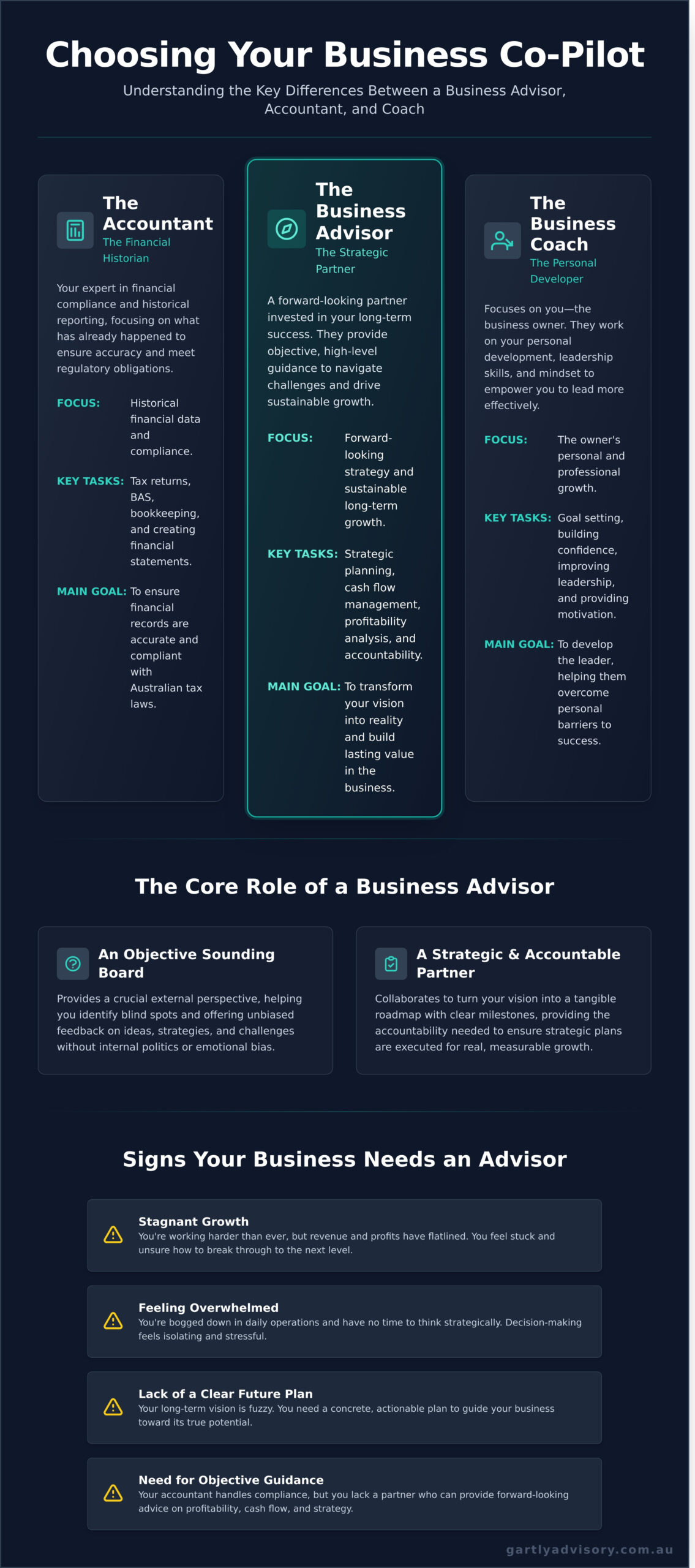
An accountant is your expert in financial compliance and historical reporting. Their primary role is to ensure your business meets its regulatory obligations with precision and accuracy. They are backward-looking, focused on what has already happened financially.
- Focus: Historical financial data and compliance.
- Key Tasks: Preparing and lodging tax returns, managing Business Activity Statements (BAS), bookkeeping, and creating financial statements.
- Main Goal: To ensure your financial records are accurate and you remain compliant with Australian tax laws.
The Role of a Business Coach
A business coach focuses on you, the business owner. Their work centres on your personal development, leadership skills, and mindset. They act as a source of motivation and accountability, helping you overcome personal barriers that may be holding the business back.
- Focus: The business owner’s personal and professional growth.
- Key Tasks: Goal setting, building confidence, improving leadership skills, and providing accountability.
- Main Goal: To develop the leader, empowering them to drive the business forward more effectively.
The Role of a Business Advisor
So, what does a business advisor do that sets them apart? A business advisor concentrates on the health, strategy, and future growth of the business entity itself. They are forward-looking, using your financial data not just for compliance, but as a tool to map out a successful future.
- Focus: Overall business strategy, operational efficiency, and sustainable growth.
- Key Tasks: Analysing financial and operational data for insights, strategic planning, improving systems, and identifying new opportunities. A skilled advisor synthesises this data with broader industry knowledge and resources, like those found on business.gov.au, to provide actionable guidance.
- Main Goal: To partner with you to build a more profitable, valuable, and resilient business.
While you need an accountant for compliance from day one, you may seek a coach when facing leadership challenges and an advisor when planning to scale. Importantly, some highly experienced professionals, such as Chartered Accountants, evolve to fulfil both accounting and advisory roles. They provide the compliance you need while offering the strategic, forward-thinking guidance that truly drives growth-offering support that goes far beyond the numbers.
What Does a Business Advisor Actually Do? Key Responsibilities
Moving beyond theory, the real value of a business advisor lies in their practical, hands-on support. So, what does a business advisor do on a day-to-day basis? They act as a strategic partner, rolling up their sleeves to work on the core functions of your business. Their responsibilities aren’t confined to a single area; instead, they provide comprehensive guidance across strategy, finance, and operations to ensure every part of your business is optimised for sustainable growth.
Strategic Planning and Growth
A skilled advisor provides the objective perspective needed to see the bigger picture. They facilitate crucial conversations and provide the structure to turn ambitious goals into an actionable roadmap. This proactive guidance ensures your business isn’t just reacting to the market but is actively shaping its future.
- Facilitating strategic planning sessions with your leadership team to define a clear vision and long-term goals.
- Conducting a comprehensive SWOT (Strengths, Weaknesses, Opportunities, Threats) analysis to identify competitive advantages and potential risks.
- Assisting with market research and competitor analysis to carve out a strong market position.
- Developing robust business plans for expansion, securing funding, or launching new products.
Financial Management and Analysis
This is where an advisor truly goes beyond the numbers. They don’t just review your financial history; they interpret it to provide forward-looking insights that drive profitability. Their expertise transforms complex financial data into clear, strategic actions that protect and grow your bottom line.
- Analysing profit and loss statements, balance sheets, and cash flow reports to uncover hidden opportunities.
- Improving cash flow management through accurate forecasting and strategic budgeting.
- Reviewing your pricing models and profit margins to maximise profitability without sacrificing market share.
- Providing guidance and support when seeking business loans or investment from Australian lenders and investors.
Operational Efficiency and Systems
A successful business runs on effective systems. An advisor acts as an efficiency expert, examining your internal processes to identify bottlenecks that drain time and resources. They help you build a well-oiled machine, ensuring your team and technology are aligned to support your growth objectives.
- Reviewing key business processes to streamline workflows and eliminate costly inefficiencies.
- Advising on the selection and implementation of new technology or software to boost productivity.
- Helping establish Key Performance Indicators (KPIs) to accurately measure progress towards your goals.
- Offering guidance on optimising your team structure, roles, and responsibilities for better performance.
Signs Your Business Needs an Advisor: When to Seek Expert Guidance
Every business owner reaches a point where their own expertise, time, or perspective is no longer enough to drive the next phase of growth. Recognising this moment is not a sign of failure; it’s a mark of a strategic leader ready to invest in their success. If you’re wondering whether it’s the right time to seek professional support, review these common scenarios. They are strong indicators that a business advisor can provide the guidance you need.
You’re Experiencing Stagnant or Declining Growth
Growth is never a straight line, but a prolonged plateau or a downward trend is a critical warning sign. Your business might need an advisor if you’re facing challenges like:
- Flatlined Sales: Your revenue has stalled despite your team’s best marketing and sales efforts. An advisor can help identify underlying issues in your strategy, pricing, or market positioning.
- Shrinking Profit Margins: Costs are rising, or pricing pressures are increasing, but you’re unsure how to respond without sacrificing quality or customer loyalty.
- Losing Market Share: New or existing competitors are capturing your customers, and your unique value proposition seems to be losing its impact.
You’re Feeling Overwhelmed or ‘Stuck’
Are you so caught up in the day-to-day running of the business that you have no time to think about the future? This is a common trap for passionate owners. Feeling isolated without a trusted expert to confide in can make decision-making stressful and uncertain. Understanding what does a business advisor do in this context is crucial; they act as your strategic partner, freeing you from operational overload to focus on high-level direction and reignite your vision.
You’re Preparing for a Major Business Transition
Navigating significant change requires careful planning and foresight. These pivotal moments are where an advisor’s experience becomes invaluable. Seek guidance if you are:
- Planning to expand into new Australian markets or launch a new product line.
- Engaging with international markets, where understanding the culture is key. For entrepreneurs looking towards Japan, for example, it can be beneficial to discover Nunawading Japanese School as part of a broader market-entry strategy.
- Preparing your business for sale and want to maximise its value.
- Developing a clear exit strategy or succession plan for the future.
If these challenges sound familiar, let’s talk. A trusted partner can help you navigate these complex situations with confidence and clarity.
Choosing the Right Business Advisor in Melbourne
Engaging a business advisor is a significant step towards securing your company’s future. Now that you understand the value they bring, the next challenge is finding the right partner in Melbourne’s competitive landscape. The ideal advisor is more than a consultant; they are a trusted ally on your journey. To make an informed decision, consider these crucial factors.
Look for Qualifications and Experience
Verifiable expertise is non-negotiable. Look for professional credentials, such as a Chartered Accountant (CA) designation, which signals a high standard of technical knowledge and ethical conduct. Ask about their direct experience with businesses of your size and in your industry. A proven track record is your best indicator of future success, so don’t hesitate to request client testimonials or case studies that demonstrate their ability to deliver tangible results.
Evaluate Their Approach and Process
A proactive advisor offers more than just ad-hoc meetings; they provide a structured framework for growth. Their process reveals a lot about what does a business advisor do beyond surface-level tasks. In your initial meeting, they should listen more than they talk, focusing intently on understanding your specific goals, operational challenges, and long-term vision. This client-centric approach ensures their guidance is tailored, relevant, and genuinely supportive of your unique business needs.
Assess the Personal Chemistry
This is a long-term professional relationship, so a strong personal fit is essential. You need an advisor you can trust implicitly-someone who is both supportive of your vision and confident enough to challenge your assumptions when necessary. Are they approachable and easy to communicate with? Do they inspire confidence? Take full advantage of initial complimentary consultations to gauge this chemistry. It’s an opportunity we proudly offer at Gartly Advisory to ensure we are the right trusted partner for your journey towards success.
Your Partner in Success: Take the Next Step
Navigating the complexities of business ownership is a journey you don’t have to take alone. A great business advisor acts as your strategic partner, offering the forward-looking guidance and accountability needed to turn your vision into reality. Understanding what does a business advisor do is the first crucial step towards proactively shaping your company’s future and moving beyond survival to genuine growth.
At Gartly Advisory, we are the trusted partner Melbourne SMEs have turned to for over 35 years. As Chartered Accountants, we deliver strategic advice that goes ‘beyond the numbers’, a commitment reflected in our 70+ 5-Star Google Reviews from local business owners. If you’re ready for proactive support from a team that is genuinely invested in your success, we invite you to connect with us.
Book a complimentary consultation to discuss your business journey. Your goals are within reach, and we’re here to help you achieve them.
Frequently Asked Questions About Business Advisors
What is the difference between a business advisor and a consultant?
While the terms are often used interchangeably, a key difference lies in the relationship’s scope. A consultant is typically engaged for a specific, project-based task with a defined endpoint, like implementing new software. An advisor, however, acts as a long-term, trusted partner on your business journey. They provide ongoing strategic guidance across various challenges and opportunities, focusing on your holistic growth and helping you navigate the complex world of business matters.
How much does a business advisor cost in Australia?
The cost of a business advisor in Australia varies based on their experience and the engagement’s scope. Hourly rates can range from A$150 to over A$500. Many advisors also offer fixed-fee packages or monthly retainers for ongoing support, which can provide better value and budget certainty. It is best to view this cost as a strategic investment in your business’s stability and future growth, one designed to deliver a strong return.
Is my small business too small to benefit from a business advisor?
Absolutely not. No business is too small for strategic guidance. In fact, engaging an advisor early can set your business on a solid foundation for sustainable growth and help you avoid common pitfalls. A skilled advisor can provide crucial support to startups and small businesses in areas like cash flow management, business planning, and identifying opportunities. The key is finding a partner who understands the unique challenges faced by businesses of your size.
What qualifications should I look for in a business advisor?
Look for a combination of formal qualifications and proven, real-world experience. Professional credentials like being a Chartered Accountant (CA) or holding specific certifications establish a strong technical foundation. However, it is just as important to find someone with relevant industry experience, positive client testimonials, and a proactive approach. An advisor who goes “beyond the numbers” to understand your vision will provide the most valuable support on your journey.
How often should I meet with my business advisor?
The ideal frequency of meetings depends entirely on your business’s current needs and goals. Many businesses find that a monthly or quarterly meeting provides the right rhythm for strategic planning, accountability, and reviewing progress. During periods of significant change or rapid growth, you might opt for more frequent check-ins. A good advisor will work with you to establish a schedule that offers consistent support without being overwhelming.
What can I expect from my first meeting with a business advisor?
Your first meeting is a discovery session focused on understanding your vision and challenges. Expect the advisor to ask many questions about your operations, finances, goals, and pain points. This helps them clarify exactly what a business advisor does in your specific context. It is also your opportunity to assess if they are the right fit for you. The goal is to establish a foundation of trust and determine how they can best support you as a partner.