
Registering for GST in Australia: A Strategic Guide for Small Businesses (2026)
What if registering for GST wasn’t just another box to tick on your compliance checklist, but a powerful tool for improving your cash flow? It’s a question many business owners don’t stop to ask. For most, the thought of the Goods and Services Tax brings on a wave of anxiety. You worry about complex calculations, potential ATO penalties, and whether adding 10% to your prices will scare away loyal customers. The rules can feel overwhelming, and the fear of getting it wrong is very real.
This is where we can provide support. This comprehensive registering for GST Australia guide is designed to demystify the entire process for 2026. We will give you the clarity and confidence to not only meet your obligations but also to turn this tax requirement into a strategic advantage for your business. We’ll walk you through a simple roadmap, from understanding the critical A$75,000 threshold and choosing the right accounting method to claiming every credit you’re entitled to.
Key Takeaways
- Understand whether your business has reached the mandatory $75,000 GST turnover threshold and what immediate actions are required for compliance in 2026.
- Discover the strategic benefits of voluntary registration, including how you can claim back GST paid on business expenses through Input Tax Credits.
- Follow our practical registering for GST australia guide to navigate the application process seamlessly, from verifying your ABN to gathering the correct documentation.
- Prepare for your ongoing obligations by learning the essentials of managing your Business Activity Statement (BAS) and simplifying your record-keeping for stress-free compliance.
What is GST and Why is Registration a Milestone for Your Business?
Embarking on the journey of running a business in Australia involves several key financial steps, and understanding the Goods and Services Tax (GST) is one of the most crucial. At its core, GST is a broad-based tax of 10% levied on most goods, services, and other items sold or consumed in the country. Before you can even consider this step, your business must have an Australian Business Number (ABN), which is the foundational identifier for all your dealings with the Australian Taxation Office (ATO). This registering for GST Australia guide is designed to provide clarity and support as you navigate this important transition.
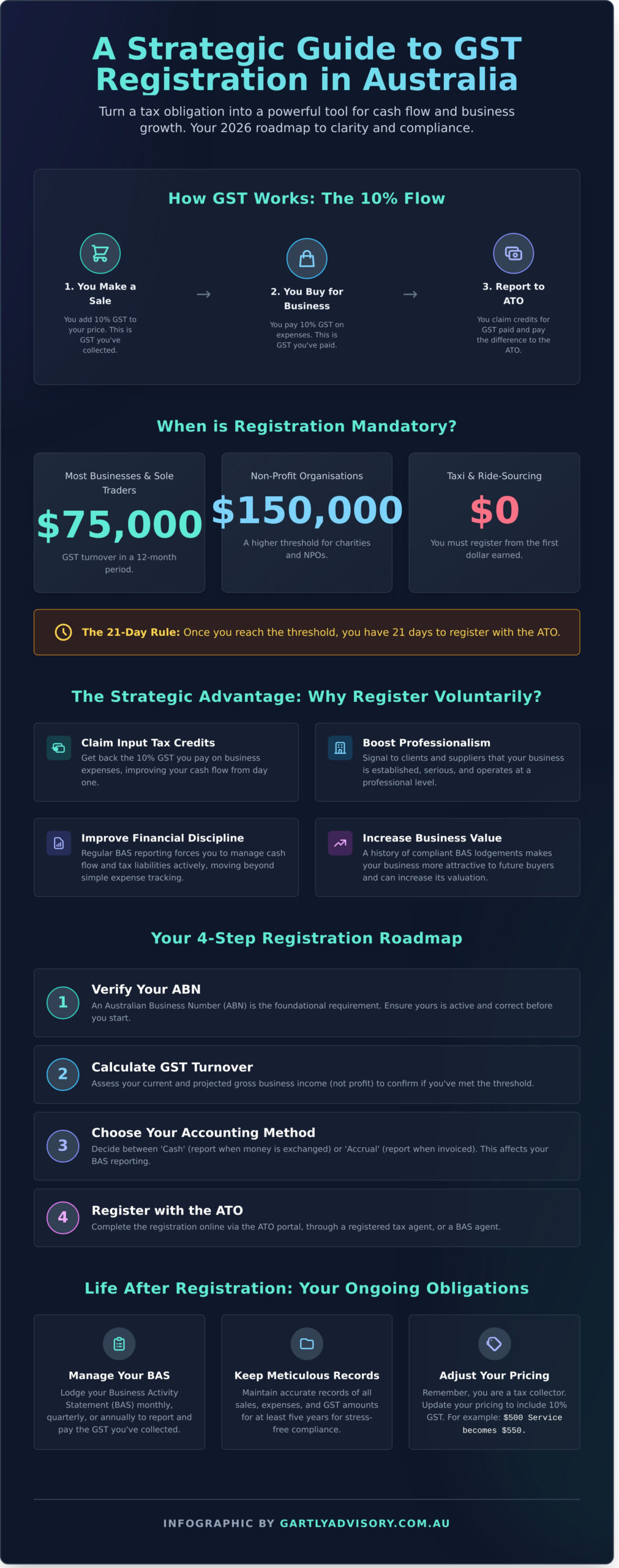
Think of the 10% GST not as a cost to your business, but as a tax you collect on behalf of the government. When you make a sale, you add 10% GST to the price. When you purchase goods or services for your business, you pay 10% GST. The key is that you can claim a credit for the GST you’ve paid on your business expenses. At the end of each reporting period, you pay the ATO the difference between the GST you’ve collected and the GST you’ve paid. Registering becomes mandatory once your business has a GST turnover of $75,000 AUD or more in a 12-month period. Reaching this threshold isn’t just a compliance requirement; it’s a clear signal to clients, suppliers, and financial institutions that your enterprise is established, growing, and operating at a professional level.
The “Beyond the Numbers” Perspective on GST
At Gartly Advisory, we believe in providing advice that goes beyond the numbers. Registering for GST is a perfect example. It fundamentally shifts your business mindset and operational discipline. It moves you from simply tracking income and expenses to actively managing cash flow, tax liabilities, and financial reporting through regular Business Activity Statements (BAS). This transition marks the psychological leap from a hobby or side-hustle to a serious, professional venture. Furthermore, maintaining a clean and compliant GST record from the outset builds immense long-term value. For any entrepreneur planning a future exit, a business with a 5-year history of on-time, accurate BAS lodgements is significantly more attractive and carries a higher valuation than one with a disorganised financial past.
GST and Your Pricing Strategy
Understanding your role as a “tax collector” is vital for your pricing strategy. You are not paying the tax; your customer is. Your responsibility is to collect it and remit it to the ATO. This requires a careful adjustment to your pricing model. For example, a service you previously offered for $500 will now need to be invoiced at $550 ($500 + $50 GST). For a deeper understanding of its structure, you can explore this Overview of Goods and Services Tax in Australia, which details its history and application. Communicating this change is especially important for your loyal customers. For our clients with a Melbourne customer base, we often advise a direct and transparent approach. A simple email explaining that your business growth now legally requires you to register for GST is usually met with understanding. It reinforces your success and professionalism, turning a compliance step into a positive business announcement.
The GST Thresholds: When is Registration Mandatory?
One of the most common questions we hear from growing businesses is, “When do I actually need to register for GST?” It’s a critical question, because getting the timing wrong can lead to serious financial headaches. The Australian Taxation Office (ATO) has established clear turnover thresholds to determine when registration becomes compulsory. For most businesses, this isn’t a choice; it’s a legal requirement once you reach a certain size.
Understanding these thresholds is a vital first step in any comprehensive registering for GST australia guide. The primary figures to keep in mind are:
- $75,000 per year for most businesses and sole traders. If your gross business income (your GST turnover) is $75,000 or more, you must register.
- $150,000 per year for non-profit organisations. Charities and other NPOs are given a higher threshold before registration is mandatory.
- $0 for taxi or ride-sourcing services. If you drive for services like Uber, Ola, or DiDi, or operate a taxi, the rules are different. You must register for and charge GST from the very first dollar you earn. There is no threshold.
Once you realise your business will meet or exceed the relevant threshold, the ATO gives you 21 days to register. This “21-day rule” means you must be proactive. Waiting until after you’ve crossed the line is too late and can lead to penalties.
Calculating Your GST Turnover
A frequent point of confusion is the difference between turnover and profit. Your GST turnover is your total business income (gross sales) for a financial year, not the profit you keep after expenses. For example, if you sell a product for $220 that cost you $150 to acquire, your turnover from that sale is $220, not the $70 profit. The ATO looks at your total sales figures when assessing your need to register. It’s also crucial to know what to exclude from this calculation, such as GST-free sales (e.g., basic food items), the sale of private assets, or certain financial supplies. The ATO assesses your turnover based on both your current figures from the last 12 months and your projected turnover for the next 12 months, so you must plan ahead.
The Risks of Late Registration
Failing to register for GST on time isn’t something the ATO takes lightly. The consequences can be significant and put unnecessary strain on your business’s cash flow. If you register late, the ATO will likely backdate your registration to when you were first required to be registered. This creates a difficult “backdating trap”: you’ll owe the ATO 1/11th of the income you earned from that date, even if you never charged your customers GST. This means the tax comes directly out of your pocket. On top of this, you may face Failure to Lodge (FTL) penalties and be charged interest on the outstanding GST amount. This is where proactive financial guidance becomes invaluable. Having a trusted accounting partner to monitor your turnover monthly ensures you’re always prepared and never caught by surprise, protecting your business from these avoidable costs.
Strategic Decision: Should You Register Voluntarily?
While the Australian Taxation Office (ATO) mandates GST registration for businesses with an annual turnover of A$75,000 or more, a significant number of savvy entrepreneurs choose to register long before hitting that threshold. This isn’t about rushing into compliance; it’s a calculated strategic move. For many Melbourne startups and small businesses, the benefits of early registration can provide a crucial financial and professional advantage right from day one.
The decision hinges on understanding one powerful mechanism: Input Tax Credits (ITCs). Simply put, when you’re registered for GST, you can claim back the 10% GST you pay on most of your business-related purchases and expenses. Think of it as a refund from the ATO on everything from your new A$3,300 laptop (a A$300 credit) to your monthly accounting software subscription. This strategic decision is a core part of any comprehensive registering for GST australia guide, as it directly impacts your business’s cash flow and perceived legitimacy in the market.
Beyond the financial upside, there’s a strong element of brand perception. When you’re dealing business-to-business (B2B), your clients are almost always GST-registered themselves. An invoice that doesn’t include GST can inadvertently signal that you’re a very small or new operation. Presenting a tax invoice with an ABN and a GST component projects professionalism and stability, assuring larger clients that you’re an established entity. The trade-off, of course, is the administrative task of lodging a regular Business Activity Statement (BAS). Yet for many, the financial returns and enhanced credibility far outweigh the quarterly reporting requirements.
Who Benefits Most from Voluntary Registration?
Certain business models are perfectly positioned to gain from registering for GST before it’s compulsory. If your business fits one of these profiles, proactive registration should be a serious consideration:
- High-Capital Startups: Tech, manufacturing, or construction businesses often face significant upfront costs. A software development company might spend A$66,000 on servers and equipment before earning its first dollar. Registering for GST allows them to immediately claim back A$6,000 in ITCs, a vital injection of cash.
- B2B Service Providers: Consultants, agencies, and freelancers who primarily serve other GST-registered businesses. Your clients can claim back the GST you charge them, so it doesn’t affect their purchasing decision. Your ability to claim ITCs on your own expenses becomes a pure benefit.
- Exporters: Businesses that sell goods or services overseas operate under ‘GST-free’ export rules. This is the best of both worlds. You don’t have to charge GST on your international sales, but you can still claim full ITCs on your local Australian expenses, such as rent, materials, and utilities.
Choosing Your Accounting Method: Cash vs. Accruals
Once you decide to register, you must choose how you’ll account for GST. This choice directly affects your cash flow. The ATO’s official information on Registering for GST provides the technical details, but the practical difference is simple:
- Cash Basis: You account for GST in the period you actually receive payment from a client or pay a supplier. If you invoice a client in March but don’t get paid until April, the GST is reported in your June quarter BAS. This method is excellent for small business cash flow management as it aligns your tax obligations with the actual money in your bank.
- Accruals Basis: You account for GST in the period you issue an invoice or receive a bill, regardless of when money changes hands. Using the same example, the GST on the March invoice would be due in your March quarter BAS, even if your client pays you 60 days later. This can create a temporary cash shortfall but is often standard for larger businesses with more complex financial systems.
Your choice here is critical. As your trusted partners, we can provide the guidance to help you select the method that best supports your business’s financial health and operational reality.
How to Register for GST: A Step-by-Step Practical Guide
Once you’ve determined that you need to register for GST, the next phase involves a methodical process to ensure your business is correctly set up with the Australian Taxation Office (ATO). While it seems straightforward, each step has implications for your future compliance and cash flow. This practical registering for GST australia guide breaks down the core actions required, helping you move forward with confidence.
Before you begin, it’s crucial to have your foundational business details in order. The process is built on four key pillars:
- Step 1: Verify Your ABN Details. Your Australian Business Number (ABN) is the cornerstone of your business identity. Before registering for GST, log into the Australian Business Register (ABR) and confirm that all your details, including your business name, address, and listed associates, are 100% current. Any discrepancies can cause delays or compliance issues down the track.
- Step 2: Gather Your Information. The ATO requires specific information to process your registration. Have these details ready: your Tax File Number (TFN), your legal business structure (sole trader, company, trust), and a realistic projection of your GST turnover for the next 12 months.
- Step 3: Choose Your Reporting Frequency. You must decide how often you’ll report and pay GST. For businesses with a GST turnover of less than A$20 million, the default is quarterly. You can elect to report monthly, which is often beneficial for businesses expecting regular GST refunds. Businesses with a turnover below A$75,000 who register voluntarily may be eligible to report annually.
- Step 4: Select Your Registration Method. You have three primary pathways to complete your registration: doing it yourself online, calling the ATO, or engaging a professional.
Registering via ATO Online Services for Business
For those comfortable with digital systems, the ATO’s online portal is the fastest method. You’ll need a myGovID set up and linked to your ABN via the Relationship Authorisation Manager (RAM). Once logged in, navigate to “Tax Registrations,” select GST, and enter your chosen start date. A common error is entering the current date by default, which might not be the most strategic choice for your business operations or for claiming initial setup costs.
Why Using a Registered Tax Agent is the Safest Path
Engaging a professional transforms registration from a simple task into a strategic decision. A Chartered Accountant can advise on the optimal start date, potentially backdating it up to four years to claim GST credits on major initial purchases. They also ensure your business is assigned the correct industry code (ANZSIC), as an incorrect code is a known trigger for ATO scrutiny. This proactive guidance provides invaluable peace of mind, ensuring your setup is correct from day one. Let our experienced Chartered Accountants provide the support you need for a flawless GST setup. Contact us today to ensure your business starts on the right foot.
Life After Registration: Managing BAS and Compliance with Ease
Congratulations, you’ve successfully registered for GST. This is a significant milestone for your business, but it’s also the beginning of a new set of responsibilities. Your focus now shifts from registration to ongoing management, ensuring you meet your obligations to the Australian Taxation Office (ATO) accurately and on time. This isn’t just about compliance; it’s about building a robust financial system that supports your growth.
The cornerstone of your GST obligations is the Business Activity Statement (BAS). This is the form you’ll use to report and pay your GST to the ATO. Most businesses lodge their BAS quarterly, though some may be on monthly or annual cycles depending on their turnover. Staying on top of your BAS cycle is crucial for managing cash flow and avoiding penalties. Modern tools and professional support can transform this task from a stressful chore into a valuable business insight.
Record Keeping Essentials
Meticulous record-keeping is non-negotiable. To claim GST credits on your business purchases, you must hold a valid tax invoice. According to the ATO, for any purchase over A$82.50 (including GST), a valid tax invoice must show:
- The words “Tax Invoice”
- The seller’s identity and ABN
- The date the invoice was issued
- A brief description of the items sold
- The GST amount (or a statement that the total price includes GST)
- Your business name or ABN (for sales of A$1,000 or more)
The ATO requires you to keep these records for five years, and digital copies are perfectly acceptable. Using cloud accounting software like Xero not only automates the collection of these invoices via bank feeds but also stores them securely, making an ATO audit a far less daunting prospect. It’s also vital to separate your private and business expenses, ideally with a dedicated business bank account. This prevents confusion and ensures you only claim GST on legitimate business purchases.
The Value of a Strategic Partnership
While this registering for GST australia guide provides the foundational knowledge, true financial control comes from a proactive partnership. At Gartly Advisory, we believe in going “beyond the numbers.” Lodging your BAS is a compliance task, but analysing the data within it is a strategic opportunity. We don’t just file your statement; we review it with you to uncover trends and insights.
This regular review process turns your BAS into a powerful tool for business planning. By analysing the GST you’ve collected versus the credits you’ve claimed, we can help you develop more accurate cash flow forecasts. Are your sales growing? Are your expenses increasing disproportionately? These are the questions that move you from simple compliance to proactive business management, allowing you to make informed decisions that drive real growth.
Let us be your trusted partner on your journey. We provide the support and guidance needed to manage your GST obligations with confidence and turn compliance into a competitive advantage. If you’re ready to move beyond the paperwork and unlock the strategic value in your numbers, contact Gartly Advisory for a complimentary consultation at our Ormond office today.
Take Control of Your GST Strategy Today
Understanding your GST obligations is a critical milestone for any growing Australian business. Whether you’re approaching the A$75,000 threshold or considering the strategic benefits of voluntary registration, the path you choose has a real impact on your cash flow and credibility. This registering for GST australia guide has given you the foundational knowledge to act with confidence, turning a compliance task into a strategic opportunity.
You don’t have to navigate the details alone. At Gartly Advisory Pty Ltd, we offer more than just compliance; we provide a strategic partnership. With over 35 years of Chartered Accounting experience right here in Melbourne and the trust of local businesses proven by 70+ 5-Star Google Reviews, our “Beyond the Numbers” advisory is designed for growth. Talk to the Melbourne experts at Gartly Advisory Pty Ltd and let us help you with your GST journey.
Let’s build a stronger financial future for your business, together.
Frequently Asked Questions About Registering for GST
Do I need a separate ABN to register for GST?
No, you don’t need a separate Australian Business Number (ABN) for GST. Your GST registration is directly linked to your existing ABN. When you register for GST, the Australian Taxation Office (ATO) simply adds this tax obligation to your ABN profile. This integrated approach helps streamline your business compliance, allowing you to manage all tax matters, like income tax and GST, under one single ABN for simpler reporting and management.
Can I claim GST back on items I bought before I registered?
Yes, you can generally claim GST credits on business-related purchases made before your GST registration date. The ATO allows you to claim credits for assets you still hold, like equipment, and for other business expenses acquired up to 48 months prior. To make a claim on your first Business Activity Statement (BAS), it’s essential that you have retained the original tax invoices for these purchases as proof for the ATO.
What happens if my turnover drops back below A$75,000?
If your business turnover falls below the A$75,000 threshold, you have the option to cancel your GST registration. You aren’t obligated to cancel, and many businesses choose to remain registered to continue claiming GST credits. Should you decide to cancel, you must inform the ATO within 21 days. Be aware that you might need to repay some GST credits for business assets you still hold at the time of cancellation.
How often do I have to lodge a BAS once I am registered?
Your required frequency for lodging a Business Activity Statement (BAS) is determined by your annual GST turnover. The majority of small businesses with a turnover below A$20 million are required to lodge their BAS quarterly. If your turnover is A$20 million or more, you must lodge monthly. The ATO will officially notify you of your specific reporting cycle when your GST registration is confirmed, ensuring you are clear on your obligations from the start.
Is GST registration different for a Trust or a Company?
No, the practical process of registering for GST is the same for all business structures, including a Trust, a Company, or a sole trader. The A$75,000 registration threshold applies equally to the business entity itself. The main difference is legal; for a company, the GST liability belongs to the company, whereas for a trust, the trustee is responsible. The steps for applying and lodging a BAS remain consistent across these structures.
What are GST-free sales and how do they affect my registration?
GST-free sales are specific goods and services where GST is not charged, such as basic food items, some medical services, and certain exports. These sales are still included in your total “GST turnover” calculation. For instance, if your business has A$80,000 in GST-free sales, you are still required to register for GST. Understanding this is a vital part of any complete registering for GST australia guide, as it allows you to claim GST credits on your business expenses.
Can I change from Cash to Accruals accounting later on?
Yes, it is possible to change your GST accounting method from a cash basis to an accruals basis. Businesses with an annual turnover under A$10 million can choose either method. If you wish to switch, you must notify the ATO of the change, which usually takes effect at the beginning of a new tax period or financial year. It’s important to seek advice on this, as switching to accruals means you account for GST when an invoice is issued, not paid.
What is the penalty for not registering for GST?
Failing to register for GST when you are required to carries significant consequences from the ATO. You will be liable for GST on all sales made from the date you should have been registered, which amounts to 1/11th of your total sales income. Additionally, the ATO can impose a Failure to Lodge (FTL) penalty for each BAS that was due, plus a General Interest Charge (GIC) on the outstanding GST amounts. Proactive registration is the most secure financial strategy.