
Financial Forecasting for Startups in Melbourne: Your 2026 Guide to Growth and Runway
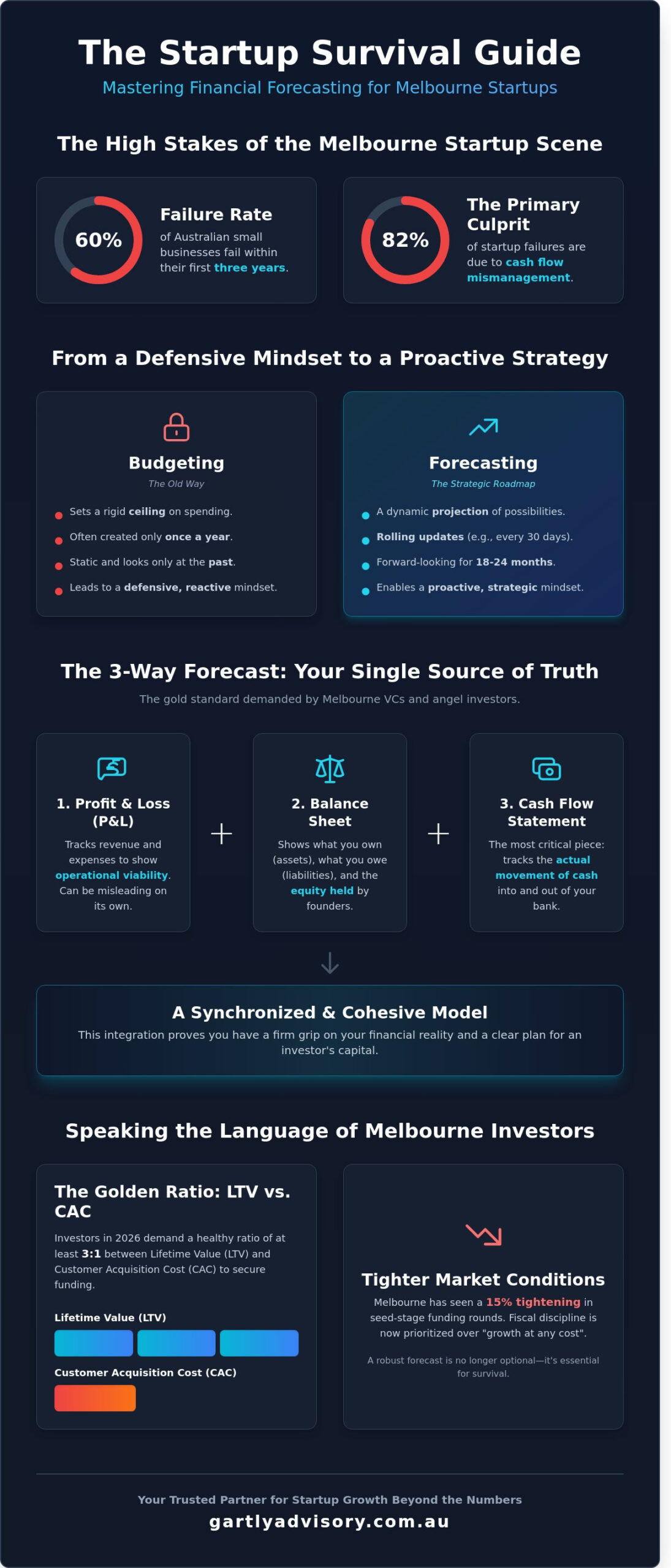
According to data from the Australian Bureau of Statistics, 60% of small businesses fail within their first three years, and for Melbourne startups, the primary culprit is almost always a mismanaged cash runway. You likely know the feeling of staring at a complex spreadsheet at 11:00 PM, wondering if your current burn rate will actually sustain your 2026 growth plans. It’s stressful to face investor pressure for realistic projections when you’re still trying to decode the difference between a simple budget and a full 3-way forecast. You need a plan that works.
We’ve spent over 25 years helping founders move beyond the numbers to find clarity and confidence. This guide will show you how to master financial forecasting for startups melbourne so you can secure your next A$500,000 seed round with total authority. We’ll break down the mechanics of 3-way forecasting, calculate your exact runway, and build a proactive strategy to help you thrive in the competitive local ecosystem.
Key Takeaways
- Learn how to transform static accounting data into a strategic roadmap that guides your startup’s future growth and operational decisions.
- Master the mechanics of a 3-way forecast to speak the language of Melbourne’s VC community and build the confidence required to secure investment.
- Discover how to stress-test your business model with scenario planning, allowing you to proactively manage your cash flow through best and worst-case outcomes.
- Maximise your runway by effectively integrating the Australian R&D Tax Incentive and local Victorian grants into your financial forecasting for startups melbourne.
- Understand the value of partnering with a seasoned Chartered Accountant who provides guidance “beyond the numbers” to help you navigate the 2026 market.
What is Financial Forecasting for Startups and Why Does it Matter in 2026?
Financial forecasting isn’t a static spreadsheet gathering dust in a digital folder. It’s your startup’s strategic roadmap. While historical accounting tells you where your money went, What is Financial Forecasting actually does is project where your business is headed based on current data and future assumptions. In the 2026 Melbourne market, this distinction is vital for survival. Founders often mistake their tax returns for a growth strategy, but accounting only looks at the past. Forecasting looks at the next 18 to 24 months of your runway to ensure you don’t run out of oxygen before reaching your next milestone.
The Melbourne startup ecosystem has matured significantly. In 2026, we’ve seen a 15% tightening in seed-stage funding rounds compared to two years ago. Investors in tech hubs like Cremorne and Richmond now prioritize fiscal discipline over the “growth at any cost” metrics that defined the previous decade. Flying blind is the primary reason 82% of startups fail due to cash flow mismanagement. Without a clear view of your future cash position, you’re making guesses rather than informed decisions. Implementing professional financial forecasting for startups melbourne ensures you aren’t part of that failure statistic.
At Gartly Advisory, we see forecasting as a tool for confidence. When you understand your numbers, you can lead with authority. You stop reacting to bank balance fluctuations and start planning for expansion. It’s about moving beyond the numbers to understand the story they tell about your future. We act as your trusted partner on this journey, providing the calm competence needed to navigate a complex economic environment.
The Difference Between Budgeting and Forecasting
A budget is essentially a ceiling. It sets a strict limit on what you can spend over a fixed period, often created once a year. Forecasting is a projection of possibilities. It adapts as your startup scales or market conditions shift. In 2026, startups need rolling forecasts that update every 30 days. This allows you to pivot quickly when a marketing campaign overperforms or a supplier raises prices by 10%. Our team at Gartly Advisory helps founders move from a defensive mindset to a proactive one. We don’t just ask how much you can spend; we help you determine how to invest your A$100,000 capital injection for the highest possible return.
Why Melbourne Investors Demand a 3-Way Forecast
A Profit and Loss (P&L) statement can be incredibly misleading. It might show your startup is “profitable” on paper while your bank account is actually empty. This happens because the P&L doesn’t track the timing of cash entering and leaving your business. Melbourne VCs and angel investors now expect a 3-way forecast as a standard requirement for any serious pitch. This model connects your P&L, Balance Sheet, and Cash Flow statement into one cohesive, synchronized unit.
- Profit and Loss: Tracks your revenue and expenses to show operational viability.
- Balance Sheet: Shows what you own, what you owe, and the equity held by founders.
- Cash Flow: Tracks the actual movement of A$ into and out of your accounts.
3-way forecasting is the mathematical integration of your projected profit, asset position, and actual cash flow into a single, synchronized model. This level of detail is essential for financial forecasting for startups melbourne when seeking Series A funding or managing a complex burn rate. It proves to investors that you have a firm grip on your financial reality and a clear plan for their capital.
The 3 Pillars of a Robust Startup Financial Model
Building a successful venture in Melbourne’s competitive tech hubs, from Cremorne to Carlton, requires more than a visionary pitch deck. You need a 3-way forecast. This integrated approach connects your profit and loss, cash flow, and balance sheet to provide a single source of truth. It’s the gold standard for financial forecasting for startups melbourne, transforming raw data into a strategic roadmap. For the local VC community, these numbers represent your “language of business.” If you can’t articulate your unit economics, like a Customer Acquisition Cost (CAC) compared to a Lifetime Value (LTV) of at least 3:1, you’ll struggle to secure a Series A in 2026.
Modern founders rely on cloud accounting tools like Xero to keep these pillars standing. Xero automates up to 80% of manual data entry, ensuring your forecast reflects real-time bank feeds rather than outdated guesses. This accuracy allows us to act as your trusted partner on your journey, helping you spot trends before they become crises.
Pillar 1: The Profit and Loss (P&L) Projection
Your P&L projection is your primary tool for measuring operational efficiency. In 2026, the “growth at all costs” mentality has faded. Current data shows that 72% of Melbourne investors now prioritize a clear “path to profitability” over pure user acquisition. Your P&L must project revenue based on realistic 90-day sales cycles and proven conversion rates. You need to account for Cost of Goods Sold (COGS) and Operating Expenses (OPEX) with precision. If your scaling plan involves doubling your headcount, your P&L should reflect the associated payroll tax and superannuation increases immediately.
Pillar 2: The Cash Flow Forecast (The Runway)
Cash flow is the heartbeat of your startup. While the P&L shows if you’re profitable on paper, the cash flow forecast tells you if you can pay your rent in Docklands next Tuesday. You must track your “Burn Rate,” which is the total amount of cash you’re spending each month. By dividing your current bank balance by this monthly burn, you find your “Runway.” A safe runway in the 2026 market is typically 12 to 18 months. Managing debtor collection is vital; a 30-day delay in a major payment can be the difference between growth and insolvency. Many local startups bolster their cash position by accessing R&D Tax Incentives, which can provide a significant AUD refund for eligible activities, effectively extending your runway without diluting equity.
Pillar 3: The Projected Balance Sheet
The balance sheet is often overlooked by early-stage founders, yet it’s critical for your future valuation. It tracks your assets, such as proprietary IP and equipment, against your liabilities, including founder loans or convertible notes. A healthy balance sheet demonstrates financial maturity. It shows how you’re managing debt and equity to fund your operations. When you prepare for a capital raise, sophisticated investors will scrutinize your debt structure to ensure the company isn’t over-leveraged. Keeping this pillar clean ensures your startup remains “investment-ready” at all times. Our team focuses on providing advice beyond the numbers to ensure your financial forecasting for startups melbourne captures the full value of your hard work and intellectual property.
Scenario Modelling: Planning for ‘What If’ in the Melbourne Market
Scenario modelling acts as a high intensity stress test for your business model. It allows you to see how your runway reacts when variables shift unexpectedly. Many founders in Cremorne or the CBD argue that their ventures move too quickly for static plans. We see it differently. The faster your business moves, the more you need a framework to guide your reactions. Effective financial forecasting for startups melbourne isn’t about predicting the future with 100% accuracy; it’s about building a map for every possible detour.
A Robust Startup Financial Model should always include three core views. Your ‘Most Likely’ scenario is your operational North Star. Your ‘Best Case’ prepares you for the logistical strain of success. Your ‘Worst Case’ ensures you have a survival plan before the cash gets tight. Using these data points helps you identify your ‘Pivot Point’. This is the specific metric that tells you it’s time to change direction rather than doubling down on a failing strategy.
Common Startup Scenarios to Model
We recommend every Melbourne founder prepares for these three specific situations to maintain a healthy cash position:
- Scenario A: Funding delay. What happens if your A$1.5 million Series A round takes 180 days longer than expected? You need to know exactly which expenses to cut to extend your runway without killing your core product.
- Scenario B: Rapid growth. If a marketing campaign goes viral, can you afford to hire 5 new developers at A$140,000 each next month? Modelling this helps you understand the immediate impact on your bank balance before you sign the employment contracts.
- Scenario C: Market downturn. If the local economy cools and you face a 20% drop in recurring revenue, how long can you sustain your current burn rate? Having this plan ready saves weeks of panicked decision-making during a crisis.
Using Data to Make Hard Decisions
Identifying ‘Red Flags’ early is the difference between a controlled pivot and a total collapse. We look for indicators like a 15% increase in churn or a 10% rise in customer acquisition costs over two consecutive months. These aren’t just numbers; they’re early warning signals that your current strategy needs adjustment. By setting these thresholds in advance, you remove the emotional bias that often leads founders to stay the course for too long.
Our team at Gartly Advisory brings over 35 years of experience to help you interpret these complex scenarios. We don’t just hand over a spreadsheet; we act as a proactive partner to help you see the story behind the data. We’ve seen how a clear ‘Plan B’ significantly reduces founder stress by replacing uncertainty with a documented strategy. Through professional financial forecasting for startups melbourne, we provide the calm competence you need to lead your team through any market condition. Having a pre-defined response to adversity provides you with the mental clarity to focus on growth instead of fear.
Maintaining that mental clarity often means stepping away from the numbers to recharge. Many successful founders find that pursuing a new skill or hobby is essential for long-term resilience and creativity. For those in Melbourne looking for a rewarding challenge outside of their venture, you can explore Adult Japanese Group Classes.
Local Melbourne Context: R&D Tax Incentives and Grants
Melbourne’s startup ecosystem is built on a foundation of innovation and government support. For founders, understanding how to leverage non-dilutive funding is a critical component of financial forecasting for startups melbourne. These funds allow you to extend your runway without giving up equity, but they require a proactive approach to compliance and cash flow management. We’ve seen many founders overlook these opportunities, missing out on thousands in capital that could have accelerated their growth.
Maximising the R&D Tax Incentive
The Australian R&D Tax Incentive (RDTI) remains the most significant support mechanism for Melbourne software and biotech firms. For the 2026 financial year, eligible companies with an aggregated turnover of less than A$20 million can access a 43.5% refundable tax offset. This means for every A$100,000 you spend on eligible experimental activities, the ATO could refund you A$43,500 in cash. To qualify, your work must involve systematic, experimental activities where the outcome cannot be known in advance. This often includes developing new algorithms or conducting clinical trials in Carlton’s world-class medical precinct.
Factoring this refund into your forecast is essential, but timing is everything. Most startups receive this cash between August and November after the financial year ends. If your burn rate is A$30,000 per month, a A$120,000 R&D refund adds four full months of life to your business. However, don’t fall into the trap of “R&D lending” without a solid plan. While some lenders provide early access to these funds, interest rates often sit between 12% and 16%. We recommend only using this debt if your forecast shows a clear gap that cannot be filled by other means. Our team provides the guidance needed to ensure your claims are robust and your forecast accounts for the net benefit after fees.
Navigating the Melbourne Startup Ecosystem
Melbourne is home to distinct innovation hubs that offer more than just desk space. Cremorne has established itself as the “Silicon Yarra” for tech, while the South East Melbourne corridor supports advanced manufacturing. LaunchVic, the state’s startup agency, has invested over A$100 million into the ecosystem since 2016, offering grants like the Alice Anderson Fund for women-led startups. Being “investor-ready” in Melbourne often requires a stronger focus on capital efficiency compared to the high-burn culture of Silicon Valley. Local investors expect you to show how you’ve utilised Victorian government grants to de-risk your technology before seeking private capital.
Compliance is the bedrock of this journey. The ATO and AusIndustry are increasingly vigilant regarding R&D claims and grant acquittals. Keeping meticulous records of your technical experiments and related expenses is not optional; it’s a survival skill. You can learn more about these requirements in our Starting a Business in Australia: A Compliance Checklist. By treating these grants as a core part of your financial forecasting for startups melbourne, you position your business as a stable, low-risk investment for future partners. Let us help you navigate these complex matters with the calm competence your vision deserves.
Ready to build a forecast that captures every available incentive? Talk to us and let us help you secure your startup’s future.
Why Gartly Advisory is Your Trusted Partner for Startup Growth
Most accounting firms focus solely on tax compliance and historical data. They tell you what happened last year, but they rarely help you figure out what will happen next month. At Gartly Advisory, we operate differently. Geoff Gartly brings over 35 years of experience to the Melbourne business community, acting as a Chartered Accountant who looks beyond the numbers to the human ambition driving your venture. We’ve spent 25 years building a reputation for trust and reliability, backed by 70+ five-star Google reviews from local founders who value our grounded, practical advice.
We believe that effective financial forecasting for startups melbourne requires a blend of technical precision and strategic foresight. You don’t just need a spreadsheet that balances; you need a roadmap that accounts for market volatility and growth opportunities. Our “Business Advisory” approach means we sit on your side of the table. We analyze your burn rate, customer acquisition costs, and unit economics to ensure your model is sustainable. We don’t just hand over a file; we provide a strategy that helps you make difficult decisions with confidence.
Your success is our journey. We’ve designed our firm to be a supportive partner that stays proactive rather than reactive. By integrating our deep knowledge of the Australian tax system with our certifications as Business Valuebuilder Advisors, we help you build an asset that is ready for scale or exit. We’re here to solve problems before they become crises, ensuring your focus stays on your product and your customers.
Our Proactive Approach to Your Runway
Many early stage companies in Victoria find themselves in a difficult position. They’re too large to manage finances on a DIY basis, yet they aren’t ready to commit A$200,000 or more to a full time CFO. Gartly Advisory fills this gap by acting as your Virtual CFO. This service provides high level financial oversight at a fraction of the cost of a permanent hire. We don’t just check in at tax time. We schedule regular strategy calls to review your financial forecasting for startups melbourne, adjusting your projections based on real time performance data.
This proactive stance saves businesses from making fatal errors. In 2023, our interest in a client’s specific technical developments allowed us to identify an overlooked R&D tax incentive opportunity. By acting quickly, we helped them secure a A$48,500 refund that extended their runway by an additional five months. This capital injection arrived at a critical moment, allowing them to complete a product pivot that ultimately secured their Series A funding. We look for these hidden opportunities in every client relationship, ensuring no stone is left unturned in your quest for growth.
Get Started with a Complimentary Consultation
Taking the first step toward financial clarity shouldn’t be a stressful experience. We invite you to visit our office in Ormond for a coffee and a chat about your vision. If you’re working remotely or based elsewhere in Melbourne, we’re equally happy to connect via Zoom. These initial meetings are entirely low-pressure. Our goal is to listen to your challenges, understand your goals, and see if our expertise aligns with your needs.
We pride ourselves on being approachable and professional. You won’t find any confusing corporate jargon here; just honest, experienced advice from a team that genuinely wants to see you succeed. Whether you’re struggling to understand your cash flow or preparing for a major investment round, we’re ready to help you navigate the complexities of the startup world. Book your complimentary startup strategy session with Gartly Advisory today and let’s start building your future together.
Secure Your Startup’s Future Beyond 2026
Navigating the Melbourne startup ecosystem requires more than just a basic spreadsheet. You need a robust model that accounts for A$100,000+ R&D tax offsets and shifting market variables. Effective financial forecasting for startups melbourne means you aren’t just guessing your runway; you’re actively extending it through three-way modeling and proactive scenario planning. These pillars ensure you stay agile when market conditions shift.
At Gartly Advisory, we bring 35+ years of Melbourne business experience to your boardroom. As Chartered Accountants and proactive advisors, we’ve helped hundreds of founders move beyond basic compliance to achieve strategic growth. Our 70+ 5-Star Google Reviews reflect our commitment to being a safe pair of hands for your business. We don’t just look at the past; we provide the guidance you need to seize future opportunities and grow your dreams.
Let us be your trusted partner on your journey, book a consultation today. Your vision deserves a solid financial foundation to thrive in the years ahead.
Frequently Asked Questions
What is the difference between a cash flow forecast and a P&L forecast?
A P&L forecast tracks your accounting profit and loss based on when you earn revenue, while a cash flow forecast tracks when cash actually hits your bank account. In Australia, the gap between a sale and receiving payment often spans 30 to 60 days. This timing difference is vital because you can’t pay staff with accrued revenue. We help you bridge this gap so you stay liquid while growing.
How often should a Melbourne startup update its financial forecast?
You should update your financial forecasting for startups melbourne at least once every month to reflect real world performance. Data from 2024 shows that startups reviewing their models monthly are 30% more likely to secure follow-on funding. Regular updates allow you to spot trends early and adjust your strategy before a minor cash dip becomes a major crisis.
Does my startup need a 3-way forecast to get VC funding in Australia?
Most Australian venture capital firms require a comprehensive 3-way forecast before they’ll release a term sheet. This model connects your Profit and Loss, Balance Sheet, and Cash Flow Statement into one cohesive system. It proves to investors that you understand how a change in your sales pipeline impacts your A$ bank balance and your company’s overall valuation.
Can I use Xero for my startup’s financial forecasting?
Xero is an excellent foundation for your data, but it typically requires integrated tools like Fathom or Spotlight Reporting for sophisticated forecasting. While Xero handles your daily bookkeeping, these specialized apps provide the 12 to 24 month projections investors demand. We often set up these integrations to ensure your data flows seamlessly from your invoices to your future growth plans.
How do I calculate my startup’s runway?
To calculate your runway, divide your total cash reserves by your monthly net burn rate. If your Melbourne startup has A$300,000 in the bank and your monthly expenses exceed your income by A$25,000, you have exactly 12 months of runway. It’s a simple calculation that provides the clarity you need to decide when to start your next capital raise.
What are the most common financial mistakes Melbourne startups make?
The most frequent mistake is failing to set aside funds for statutory obligations like the 11.5% Superannuation Guarantee or GST. Many founders also overestimate their conversion rates by 20% or more. These errors lead to a cash crunch that can stall a promising product launch or force an emergency, high-dilution funding round.
How does the R&D Tax Incentive affect my financial model?
The R&D Tax Incentive acts as a significant cash injection, offering a 43.5% refundable tax offset for eligible spending. If you spend A$100,000 on eligible software development, you could receive A$43,500 back from the ATO. We recommend modeling this as a specific cash inflow, usually occurring in the second quarter of the financial year, to accurately project your extended runway.
What is a ‘reasonable’ burn rate for a pre-seed startup?
For a pre-seed startup in Melbourne with a core team of 3 people, a reasonable burn rate usually sits between A$18,000 and A$25,000 per month. This budget covers modest founder salaries, cloud hosting costs, and basic marketing. Keeping your burn low at this stage gives you the flexibility to pivot your product without the immediate pressure of running out of capital.