

Business Exit Strategy Advisor: Maximising Your Melbourne Business Value
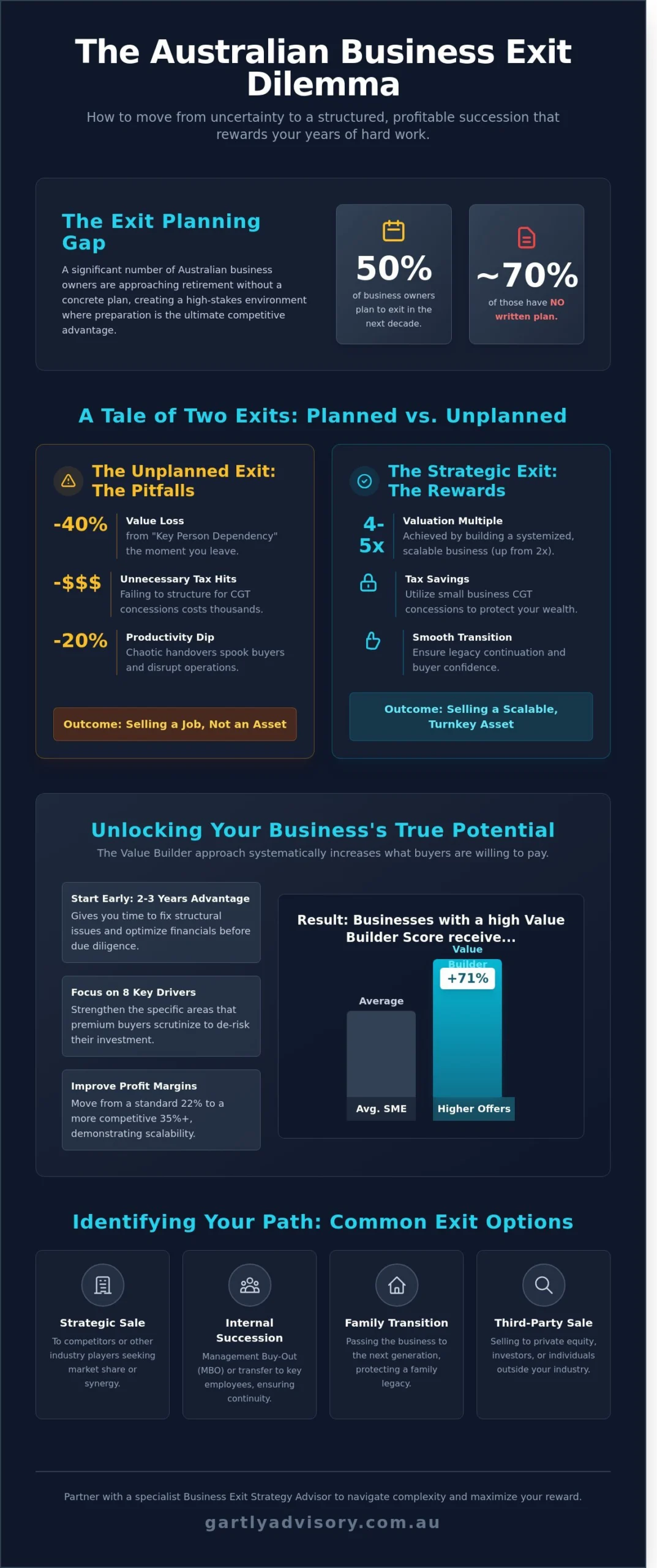
Did you know that while 50% of Australian business owners plan to retire or move on within the next decade, nearly 70% of them haven’t written down a single step of their transition plan? It’s completely natural to feel a sense of “valuation vertigo” or worry that your Melbourne business might stumble the moment you step away from the helm. You’ve spent years, perhaps decades, building this legacy. The thought of losing a significant chunk of that value to Capital Gains Tax (CGT) is enough to keep any founder awake at night.
This is where a specialist business exit strategy advisor makes the difference. We understand that you want more than just a transaction; you want a “clean” break and a maximum financial return. You’ll discover how to prepare your business for a high-value sale, use specific tax concessions to protect your wealth, and ensure your legacy continues. We’ll show you exactly how to move from uncertainty to a structured, profitable succession that rewards your years of hard work.
Key Takeaways
- Learn why starting your exit roadmap two to three years early gives you a massive competitive advantage in the local Melbourne market.
- Discover the “Value Builder” approach to identify and strengthen the specific drivers that make your business irresistible to premium buyers.
- Find out how to navigate complex ATO regulations and CGT requirements so you can keep more of your hard-earned sale profit.
- Understand the benefits of partnering with a professional business exit strategy advisor to manage the emotional and financial complexities of your transition.
- Compare the most effective exit options in Australia, from strategic sales to competitors to internal successions, to find your perfect path forward.
What is a Business Exit Strategy (And Why Start Now?)
Most Melbourne business owners only think about leaving their company when they feel burnt out or ready to retire. By then, they’ve often lost their best leverage. A business exit strategy isn’t just a “for sale” sign; it’s a comprehensive roadmap that outlines how you’ll transfer ownership while maximizing the value you’ve built over decades. In the current Australian market, where roughly 50% of small business owners are aged 50 or older, the competition for high-quality buyers is increasing. Starting your preparation 2 or 3 years before you intend to leave gives you a massive advantage. It allows you to fix structural issues and optimize your financial position before the due diligence process begins.
To better understand why professional guidance is vital during this transition, watch this helpful video:
A major hurdle for many founders is the transition from “selling a job” to “selling a scalable asset.” If the business depends entirely on your personal relationships or technical skills to function, a buyer isn’t purchasing a company; they’re purchasing your daily schedule. This significantly lowers your valuation. When you work with a business exit strategy advisor, the focus shifts to building systems and a management team that can thrive without you. This shift increases buyer confidence and can move your valuation multiple from a modest 2x profit up to 4x or 5x, depending on your industry. Having a clear strategy reduces the immense stress of the unknown, ensuring you stay in control of the narrative rather than reacting to market whims.
The “Beyond the Numbers” Philosophy
Financial statements are the foundation of a deal, but they don’t tell the whole story. At Gartly Advisory, we know that leaving a business you built from scratch is an emotional milestone, not just a line item. Geoff Gartly uses his 35 years of experience to act as a supportive partner who understands the late nights and personal sacrifices you’ve made. We don’t just check for tax compliance; we help you navigate the identity shift that comes with an exit. We ensure your legacy is protected while you transition into your next chapter with financial certainty.
The Risks of an Unplanned Exit
Exiting without a plan often leads to “value leakage.” One of the biggest risks is key person dependency, where the business value drops by 40% the moment you walk out the door. You also face unnecessary tax hits. For example, failing to structure your exit to meet the Australian Taxation Office (ATO) small business CGT concessions can cost you hundreds of thousands of dollars in avoidable tax. Without a roadmap, the handover process often causes internal disruption, leading to a 15% to 20% dip in productivity that can spook buyers and cause deals to collapse at the eleventh hour.
Maximising Business Value: The “Value Builder” Approach
Building a business that’s ready for sale is a different task than running one for daily cash flow. Many Melbourne business owners find they’ve built a “job” rather than an asset. If the owner is the primary driver of sales or operations, the business carries high risk for a buyer. A professional business exit strategy advisor uses the Value Builder system to move you away from this “Hub and Spoke” model. This methodology focuses on eight specific drivers that institutional buyers and private equity firms use to judge worth. Statistics from 2023 indicate that businesses with a high Value Builder score receive offers 71% higher than the average SME. This process involves preparing your exit strategy by systematically de-risking your operations.
In the Melbourne market, buyers look for scalability. We focus on improving your gross profit margins from a standard 22% to a more competitive 35% or higher. This demonstrates that your business has the “legs” to grow without a linear increase in costs. When you reduce dependency on yourself, you create a turnkey solution. This shift is what transforms a stressful exit into a rewarding one. We love the opportunity to support our clients through this transition, acting as a safe pair of hands while you prepare for your next chapter.
Cleaning Up Your Financial House
Due diligence is where many deals fall apart. If your records are messy, a buyer will either walk away or slash their offer by 25% to account for the “unknown” risk. We insist on using cloud-based systems like Xero to provide real-time, accurate data. It’s vital to strip away personal expenses that might be buried in the accounts. Whether it’s a A$65,000 family vehicle lease or personal travel, these must be identified as “add-backs” to show your true adjusted net profit. Organising your contracts, commercial leases, and IP documentation now prevents 11th-hour panics. Having expert guidance on your side ensures your financial narrative is transparent and compelling.
Creating Recurring Revenue Streams
Predictability is the holy grail of business valuation. Buyers pay a significant premium for businesses that have “automatic” income. A company relying on one-off sales might trade at a 2.5x multiple of earnings; however, one with a subscription or contract-based model can often command 4.5x or 5x. We look for ways to shift your service or product into a recurring model. For example, we recently helped a Melbourne service firm transition 40% of their ad-hoc clients into annual maintenance contracts. This simple shift uncovered hidden value and added over A$250,000 to their final valuation. This proactive approach ensures you aren’t just selling a list of past customers, but a guaranteed future income stream for the new owner.
The Tax Minefield: Navigating CGT and Structural Clean-ups
Think of the Australian Taxation Office (ATO) as the silent partner you never asked for, yet they’ll be standing right there on settlement day. Many business owners we speak with have a common fear: losing 30% to 50% of their hard-earned profit to Capital Gains Tax (CGT). It’s a valid concern if you haven’t prepared. However, a skilled business exit strategy advisor looks at tax as a hurdle to clear, not a wall that stops you. By planning your exit two to five years in advance, you can often reduce that tax bill significantly, sometimes even to zero through legal concessions.
Your business structure dictates how much cash stays in your pocket. Selling a business held in a discretionary trust offers different tax flow-through benefits compared to a company structure. Companies are great for capped tax rates during growth, but they don’t access the 50% CGT discount available to individuals and trusts. If your current setup is outdated, changing it six months before a sale is often too late due to anti-avoidance rules. You need time to implement “clean-up” strategies. For instance, removing lifestyle assets like the family boat or excess cash from the balance sheet makes the business more attractive to buyers and ensures you meet specific tax thresholds.
Small Business CGT Concessions Explained
The ATO provides four powerful concessions that can shield your windfall. The 15-year exemption is the “holy grail,” potentially making the entire capital gain tax-free if you’ve owned the asset for 15 years and are retiring. Then there’s the 50% active asset reduction, the retirement exemption (up to a A$500,000 lifetime limit), and the rollover relief. To qualify for these, your business must be a “CGT small business entity” with an annual turnover of less than A$2 million or have a maximum net asset value not exceeding A$6 million. Understanding these rules is a core part of maximising Small Business CGT Concessions for our clients.
The Importance of a Structural Audit
A structural audit is about more than just tax; it’s about presentation. A buyer wants a “clean” entity. If your accounts are cluttered with inter-company loans or personal expenses, it creates “deal friction” that can devalue your business by 10% or more. We often see structures that worked perfectly in 2012 but are now a liability for a 2025 sale. Cleaning up the balance sheet involves identifying “lazy assets” and ensuring your financial records align with the Australian Government guide to exiting a business protocols. A proactive business exit strategy advisor will identify these red flags early, ensuring the structure supports your goals rather than hindering them. This preparation ensures you don’t leave six figures on the table simply because your paperwork wasn’t ready for scrutiny.
Identifying Your Path: Common Exit Strategy Options in Australia
Choosing the right exit route isn’t just a financial decision; it’s a deeply personal one that defines your next chapter. You’ve spent years, perhaps decades, building your enterprise. Now you need to decide if you want a clean break, a lasting legacy, or a transition that rewards your team. A business exit strategy advisor helps you weigh these options against current Australian market conditions to ensure your hard work translates into financial security.
If your primary goal is achieving the highest possible price, a strategic sale to a competitor or a larger entity is often the most effective path. These buyers aren’t just looking at your bottom line. They’re buying your market share, your established customer lists, or your unique intellectual property. In the 2023 Australian M&A market, strategic buyers often paid premiums of 20% to 35% over standard valuations because they could integrate the business into their existing operations to create immediate scale.
Family succession remains a popular choice, as family businesses make up approximately 70% of all Australian firms. However, it’s a path filled with emotional and financial complexity. You must balance your need for retirement capital with the successor’s ability to manage the business. Data from Family Business Australia indicates that while many owners intend to pass the reins down, only 30% of these businesses successfully transition to the second generation. Success requires a structured plan that addresses both leadership training and the equitable distribution of assets.
Management Buyouts (MBO) offer a middle ground. This route allows you to exit gracefully while rewarding the loyal staff who helped you grow. Since the internal team already understands the company culture and operational quirks, the transition risk is lower. Financing an MBO in Australia often involves a mix of bank debt and “vendor finance,” where you receive a portion of the sale price over time from the business’s future profits.
Selling to a Third Party vs. Internal Succession
Selling to an outsider usually results in a higher upfront cash payment, but it often comes with strings attached. You’ll likely face an “earn-out” period, which in the current Australian market typically lasts between 12 and 36 months. During this time, about 25% of your sale price might be held back, contingent on the business meeting specific profit targets. If you’re exiting a franchise, your advisor will focus heavily on “Franchise Accounting” to ensure all records meet the franchisor’s strict audit standards before the transfer is approved.
The Liquidation or “Wind-down” Option
Sometimes, a sale or succession isn’t the most viable path, especially if the business’s value is tied almost entirely to your personal brand. During the 2022-23 financial year, the Australian Bureau of Statistics recorded a business exit rate of 10.6%. Winding down with dignity means managing your final tax obligations and employee entitlements, such as long service leave and redundancy pay, under the Fair Work Act. Proactive planning ensures you protect your personal assets and exit the market without leaving a trail of debt or legal complications.
Ready to discover which exit path will secure your financial future? Talk to our experienced business exit strategy advisors at Gartly Advisory for a confidential consultation.
Partnering with a Business Exit Strategy Advisor in Melbourne
Melbourne’s business environment is unique. Victorian owners face specific challenges, from local payroll tax thresholds currently sitting at A$700,000 to the nuances of the state’s commercial property market. You need a business exit strategy advisor who isn’t just reading from a global script. They need to understand the local Victorian landscape and the specific tax pressures that apply to businesses in our city.
At Gartly Advisory, we bring 35 years of experience to the table. This isn’t just about spreadsheets; it’s what we call going “beyond the numbers.” We’ve spent 25 years building a reputation as a safe pair of hands in the Melbourne and greater Victorian community. We’ve helped clients through the 1990s recession, the GFC, and the recent shifts in the 2024 economic climate. This depth of experience means we don’t just react to problems. We anticipate them before they impact your sale price.
We act as your “safe pair of hands” during what is often the most stressful period of your professional life. Selling a business involves high stakes and complex emotions. Our role is to maintain the calm. We manage the heavy lifting of due diligence and financial scrutiny so you can focus on keeping the business profitable until the final signature. With over 70 five-star Google reviews, our track record shows that we prioritize the person, not just the transaction.
The Role of Your Chartered Accountant as a Lead Advisor
Your accountant is often the only professional who has seen your business grow from its early stages. This historical perspective makes us the natural choice to lead your exit team. While brokers focus on the sale and lawyers on the contract, we ensure the entire process aligns with your long-term financial health. We coordinate these moving parts to prevent costly tax surprises that can strip 20% or 30% off your net proceeds. If you’re looking for proactive Business Advisory Melbourne services, having a lead advisor who understands your “why” is vital. We act as the central hub, ensuring your legal and brokerage teams are working toward the same goal without losing sight of the tax-effective outcome.
Taking the First Step Toward Your Future
The transition out of your business is about more than just a bank transfer. It’s about what happens next. We integrate your exit with Self-Managed Super Fund (SMSF) strategies and estate planning to ensure your wealth is protected for the next generation. We often find that business owners haven’t considered the A$500,000 lifetime CGT cap or how the small business concessions can be maximized. Our business exit strategy advisor services ensure these opportunities aren’t missed.
We offer a complimentary initial appointment as a low-pressure starting point. It’s a chance for us to hear your story and for you to see if we’re the right fit for your journey. We’ve helped over 500 clients navigate complex financial matters, and we’d love to do the same for you. Talk to us and let us help you plan your journey towards success by securing your legacy today.
- Expertise: 35 years of professional accounting and advisory experience.
- Local Knowledge: Deep understanding of the Victorian business climate and tax system.
- Holistic Care: Integration with SMSF and estate planning for life after the sale.
- Proven Results: 70+ five-star reviews from business owners just like you.
Secure Your Legacy and Maximise Your Sale Price
You’ve spent years building your Melbourne business. Now it’s time to ensure you capture every cent of its worth. Most owners wait too long to plan, but starting your exit strategy 2 or 3 years ahead of time significantly boosts your final payout. By focusing on the 8 key drivers of the Value Builder system, you’ll create a more attractive asset for potential buyers while cleaning up complex tax structures that might otherwise trigger heavy Capital Gains Tax liabilities.
Navigating this process alone is stressful. Engaging an experienced business exit strategy advisor provides the clarity you need to move forward with confidence. Geoff Gartly offers 35 years of local Melbourne expertise and holds dual certifications as a Chartered Accountant and Business Valuebuilder Advisor. With 70+ 5-star Google reviews, he’s earned a reputation for helping owners look beyond the numbers to secure their financial future.
Book a complimentary consultation with Geoff Gartly to discuss your exit strategy and take the first step toward a rewarding transition. It’s your journey, and we’re here to be your trusted partner every step of the way.
Frequently Asked Questions
When is the best time to hire a business exit strategy advisor?
You should engage a business exit strategy advisor at least 24 to 36 months before you intend to step away from your company. This three year lead time is the “goldilocks zone” for business owners because it provides enough room to identify operational inefficiencies and fix them before a buyer ever looks at your books. If you try to sell in a hurry, you’ll likely face a “fire sale” price that doesn’t reflect your years of hard work. We find that owners who start early can often increase their final sale price by 20% or even 40% simply by documenting processes and reducing the business’s reliance on them personally.
Waiting until you’re burnt out or reaching retirement age is a common mistake that leads to leaving money on the table. By starting the conversation now, we can implement the Value Builder System to track your progress across eight key drivers of company value. This proactive approach ensures that when the time comes to sign the contract, you’re doing so from a position of strength and clarity. We’ve seen 2023 and 2024 market data suggesting that prepared businesses sell 35% faster than those that rush to market without a formal strategy. It’s about being a trusted partner on your journey towards success, ensuring every year of your hard work is accounted for in the final valuation.
How much does it cost to develop a business exit plan in Melbourne?
A comprehensive business exit plan in the Melbourne market typically costs between A$5,000 and A$25,000 depending on the complexity of your corporate structure and the depth of the financial audit required. For a small family owned business in suburbs like Hawthorn or Malvern, a foundational plan might sit at the lower end of that scale, focusing on valuation and basic tax structuring. Mid sized enterprises with turnover between A$5 million and A$20 million should expect to invest more, as the planning involves detailed risk assessments, management buy out feasibility studies, and complex Capital Gains Tax modelling.
Think of this cost not as a sunk expense, but as an investment in your final payout. If an A$10,000 advisory fee helps you secure an extra A$200,000 during negotiations, the return on investment is clear. We provide transparent, fixed fee quotes after an initial consultation so there aren’t any surprises down the track. In our 25 years of experience, we’ve noticed that Melbourne business owners who invest in professional planning early on avoid the costly legal disputes and tax penalties that often plague unplanned exits. We’re here to provide a safe pair of hands to navigate these financial waters, making sure your transition is as profitable as possible.
Can I use my current accountant as my exit strategy advisor?
You can certainly involve your current accountant in the process, but you’ll likely need a specialist business exit strategy advisor to handle the strategic value building aspects of the transition. Most traditional accountants are excellent at compliance, tax returns, and look back reporting, but exit planning requires a “look forward” approach that focuses on buyer psychology and market multiples. While your tax agent knows your history, they might not have the specific “Business Valuebuilder” certification required to boost your company’s attractiveness to an external purchaser.
We often work as a collaborative partner alongside existing accountants to bridge this gap. We bring the strategic “beyond the numbers” advice that transforms a stable business into a highly sellable asset. Your current accountant will be vital for providing historical data and managing the A$6 million net asset test calculations, but our role is to drive the strategy that maximizes the final cheque. It’s a team effort where we provide the specialized guidance needed for this once in a lifetime transaction. By combining your accountant’s intimate knowledge of your books with our proactive exit expertise, you get the best of both worlds without risking your legacy.
What are the main CGT concessions for small businesses in Australia?
The four primary Capital Gains Tax (CGT) concessions available to Australian small businesses are the 15 year exemption, the 50% active asset reduction, the retirement exemption, and the rollover relief. If you’ve owned your business for at least 15 years and you’re over 55 and retiring, the 15 year exemption could allow you to pay zero tax on the entire sale price. This is a massive benefit that can save you hundreds of thousands of dollars, provided you meet the strict Australian Taxation Office criteria regarding turnover or net asset value.
The retirement exemption is another powerful tool, allowing you to move up to A$500,000 of capital gains into a complying superannuation fund tax free over your lifetime. To qualify for these, your business must generally have an annual turnover of less than A$2 million or your total net assets must not exceed A$6 million. We’ve spent decades helping clients navigate these 2007 era tax laws to ensure they don’t pay a cent more than necessary. Because these rules are incredibly technical, we provide the steady guidance needed to structure your sale in a way that satisfies the ATO while protecting your hard earned wealth. We don’t just look at the tax you owe; we look at the wealth you keep.
How do I value my business before an exit?
You value your business by applying a market multiple to your EBITDA (Earnings Before Interest, Taxes, Depreciation, and Amortization) or your Seller’s Discretionary Earnings (SDE). For most small to medium enterprises in Australia, these multiples typically range from 2.5x to 4.5x, though high growth tech firms or businesses with recurring revenue models can see much higher figures. We start by “normalizing” your financial statements, which means adding back one off expenses like that personal car lease or the non commercial rent you might be paying yourself.
Once we have a clean profit figure, we look at the “Value Builder” score to determine where your business sits on the multiple scale. If your business can run without you for three months, your multiple goes up; if you’re the main salesperson, it goes down. We also consider the “Asset Approach” for businesses with significant machinery or property, and the “Discounted Cash Flow” method for companies with predictable future earnings. Getting a professional valuation early gives you a realistic benchmark so you don’t enter negotiations with an inflated or deflated expectation. We’ve found that having a grounded, data backed valuation is the best way to build trust with potential buyers and close the deal faster.
What happens if I want to retire but my children don’t want the business?
If your children aren’t interested in taking over the family legacy, you should shift your focus toward a Management Buy-Out (MBO) or an external trade sale to a competitor. This is a common scenario in Australia, where only about 30% of family businesses successfully transition to the second generation. If the kids have different career paths, it’s better to know now so we can start grooming your senior management team to take the reins. An MBO allows you to sell the business to the people who already know how to run it, often involving a gradual equity transfer over several years.
Alternatively, we can prepare the business for a trade sale, which often results in the highest possible price because a competitor can gain “synergies” from buying your customer list or location. We help you navigate the emotional complexity of this shift, ensuring you don’t feel like you’re “giving up” on the family dream. Instead, we’re securing your retirement and ensuring the business survives under new, passionate leadership. We’ve guided many Melbourne families through this exact transition, acting as a supportive partner to ensure the financial outcome is secured even when the original succession plan changes. It’s about finding the right home for your life’s work while protecting your financial freedom.
How long does the business exit process typically take?
The entire business exit process usually takes between 12 and 24 months from the moment you decide to sell to the day the funds hit your bank account. This timeline is broken down into several distinct phases, starting with a 6 to 9 month period of “value enhancement” where we fix any red flags in your operations or financials. After the business is “sale ready,” the marketing and buyer search phase typically takes another 3 to 6 months depending on your industry and the current economic climate in Australia.
Once you’ve found a qualified buyer and signed a Letter of Intent, you’ll enter the due diligence phase, which usually lasts 60 to 90 days. This is where the buyer’s accountants and lawyers comb through every detail of your business history. Finally, the legal settlement and handover period can take another month. If you try to compress this timeline into 3 months, you’ll likely face significant stress and a lower valuation because you won’t have time to create a competitive bidding environment. We help manage this rhythm, keeping the momentum high while ensuring no details are missed. Our proactive approach means we prepare the “data room” in advance, which can shave weeks off the due diligence period and reduce the risk of the deal falling through at the last minute.
Do I need a business broker as well as an exit advisor?
Yes, you often need both because they play very different roles in your journey; the advisor prepares the business for sale while the broker manages the actual transaction and finds the buyer. You can think of us as the architects who ensure the house is structurally sound and beautiful, while the broker is the real estate agent who lists it and brings the crowds through. We focus on the “internal” work like tax structuring, profit maximization, and systemization. The broker focuses on the “external” work like writing the information memorandum and managing the bidding war.
While this separation of roles is common, some integrated firms handle both aspects. For instance, in the US market, firms like Bravo Kilo Advisors operate as both M&A advisors and business brokers, offering a comprehensive service from preparation through to final sale.
Having an advisor in your corner during the broker’s negotiation phase is vital because we can spot when a deal structure isn’t in your best interest, especially regarding earn outs or deferred payments. We’ve seen cases where a high “headline price” was actually a poor deal once the tax implications and payout terms were analyzed. We partner with some of Melbourne’s most reputable brokers to ensure our clients have a seamless experience. By having a complete team of experts, you ensure that the “safe pair of hands” philosophy extends from the very first planning session all the way to the final handshake. We’re here to support you through the entire lifecycle, ensuring you have the guidance and trust needed to exit on your own terms.