
What Happens in an ATO Tax Audit? A Guide for Melbourne Business Owners
Last Tuesday morning, a business owner in South Yarra opened their email to find a formal notification from the Australian Taxation Office that wasn’t a routine update. It was the start of a full compliance review. If you’ve received a similar notice, you’re likely feeling the heavy weight of potential penalties and the stress of losing precious time away from your operations. We understand that for the 435,000 small businesses across Victoria, the sheer uncertainty of what happens in an ATO tax audit is often the most taxing part of the experience.
We agree that sitting across from government officials feels incredibly daunting when you’re trying to protect what you’ve built. With 35 years of experience as Chartered Accountants, we’ve learned that clarity is the best cure for that anxiety. This guide provides the exact step-by-step process of an audit so you can navigate the coming weeks without the usual stress. We’ll walk you through the standard timeline, explain your legal rights, and show you how to minimize any financial impact on your business.
Key Takeaways
- Learn to distinguish between a routine data review and a full investigation to ensure you respond with calm, professional confidence.
- Discover exactly what happens in an ATO tax audit and how the 2026 timeline affects your Melbourne business from the moment you receive a notification letter.
- Understand how modern data-matching technology spots discrepancies and why proactive record-keeping is your most powerful tool for financial stability.
- Explore the benefits of voluntary disclosure to reduce penalties and learn how a Chartered Accountant acts as a supportive buffer between you and the ATO.
- Gain practical strategies to manage the inquiry without the stress, allowing you to stay focused on your journey toward business success.
Understanding the ATO Audit: Is it a Review or a Full Investigation?
Receiving a notification from the Australian Taxation Office (ATO) often triggers an immediate sense of dread. It’s a common reaction for business owners in Melbourne and across Australia, but it’s vital to remember that a letter doesn’t mean you’ve done something wrong. The ATO isn’t necessarily accusing you of tax evasion; they’re often just verifying that the numbers align with their benchmarks. An audit notification isn’t a guilty verdict. It’s a request for transparency.
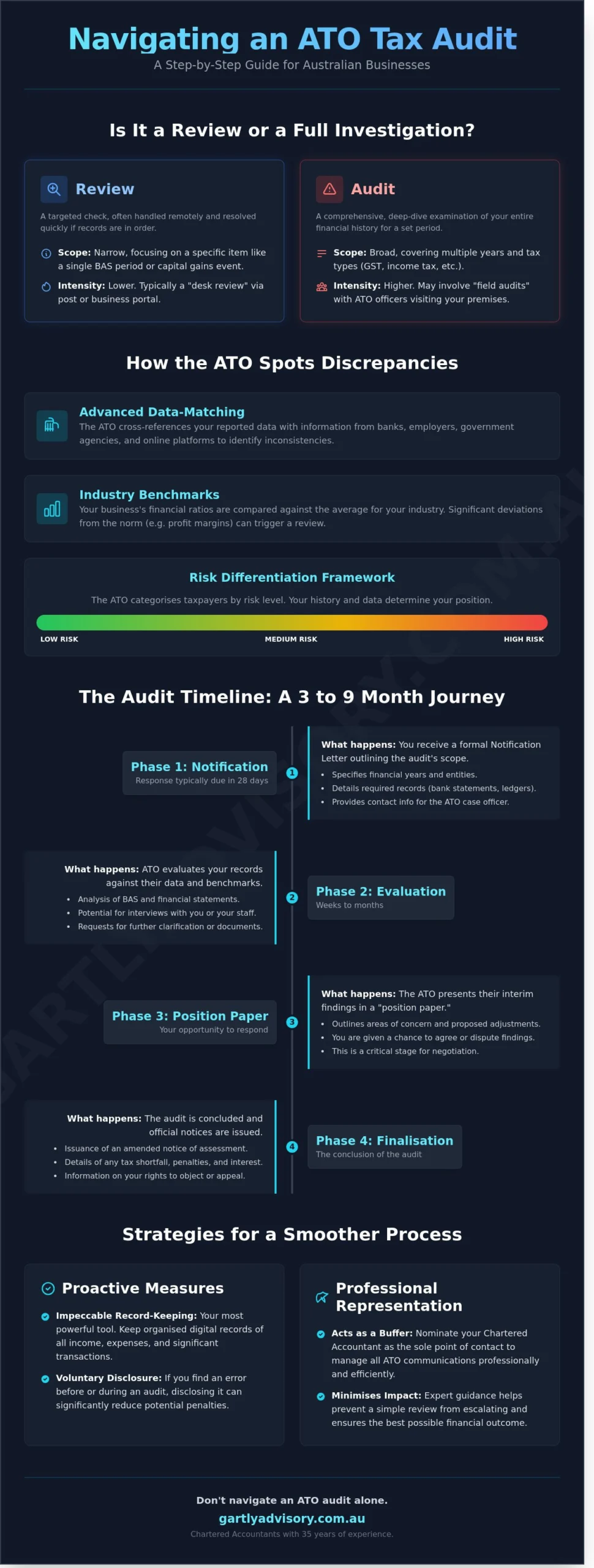
The first step is identifying the scope of the inquiry. A “Review” is typically a narrow look at a specific area, like a single BAS period or a specific capital gains event. An “Audit” is a more intensive process where the ATO examines your entire financial history for a set period. Understanding what happens in an ATO tax audit starts with knowing which path you’re on. In 2023, the ATO increased its focus on “shadow economy” activities, meaning they’re looking closer at cash-heavy businesses than they did three years ago. Whether it’s a quick check or a deep dive, staying calm and gathering your records is the best way to move forward.
The Purpose of ATO Compliance Activities
The ATO’s primary goal is to maintain a level playing field. If one business skips its superannuation obligations, it gains an unfair advantage over the 90% of Australian small businesses that do the right thing. These activities ensure everyone contributes their fair share to fund public services. They also use these checks to spot systemic issues in specific sectors. For instance, the ATO has monitored the franchising and property development industries closely, conducting over 1,200 targeted reviews in the last two fiscal years to ensure GST and payroll tax compliance.
Common Types of ATO Inquiries
Most interactions begin as a desk review. This is where an officer asks for specific receipts or bank statements via post or the business portal. It’s often handled remotely and resolved quickly if your records are in order. A field audit is more involved. This involves ATO officers visiting your business premises in Melbourne to view your systems, check stock, and interview staff.
The ATO uses the “Risk Differentiation Framework” to decide who to contact. This system ranks taxpayers from “Low Risk” to “High Risk” based on their history and industry data. If your profit margins look significantly different from the 85% of businesses in your specific niche, you’ll likely move up that framework. It’s not a random process; it’s a data-driven approach to ensure every dollar is accounted for. If you’re contacted, seeking professional advice from a Chartered Accountant immediately can prevent a simple review from spiralling. We’ve spent 25 years acting as a safe pair of hands for our clients, ensuring they have a trusted partner to navigate what happens in an ATO tax audit with confidence.
The ATO Audit Timeline: What Happens from First Contact to Finalisation?
Knowing exactly what happens in an ATO tax audit helps remove the fear of the unknown. In 2026, the ATO’s approach is data-driven and methodical. While a simple review might wrap up in weeks, a full audit for a small business typically lasts between three and nine months. Managing your expectations about this timeframe is vital. You should expect some disruption to your daily routine, but a structured approach keeps your business running while we handle the heavy lifting for you.
Phase 1: Notification and Information Gathering
The process begins with a formal Notification Letter. This document is a roadmap for the inquiry. It specifies which financial years are under review and whether the focus is on GST, income tax, or employer obligations. You generally get 28 days to compile the requested information. The letter usually identifies:
- The specific tax years and entities under review.
- The scope of the audit, such as Capital Gains Tax or Superannuation Guarantee.
- A detailed list of required records, including bank statements or ledger exports.
- The contact details of the assigned ATO case officer.
Establishing your tax agent as the sole contact point ensures the ATO gets exactly what they need without you having to manage constant phone calls. This protects your time and keeps the communication professional and focused.
Phase 2: The Evaluation and Interview Process
Next, the ATO evaluates your Business Activity Statements (BAS) against their internal benchmarks and third-party data. They look for discrepancies that don’t align with industry norms or reported income. An interview is often scheduled to clarify these points. This meeting is a critical part of what happens in an ATO tax audit as it shapes the officer’s initial opinion. It’s a formal discussion where they’ll ask about your business processes and record-keeping habits. Having your accountant present is a non-negotiable safety step. We provide the calm, professional support needed to ensure your answers are accurate and contextually correct.
Phase 3: Draft Findings and Finalisation
The ATO won’t just send a bill out of the blue. They first issue a Position Paper. This document details their findings and any A$ adjustments they intend to make to your tax liability. You have a formal opportunity to respond, provide more evidence, or challenge their interpretation of tax law. Once both sides have been heard, the ATO issues a final notice of assessment. If you find yourself facing an inquiry, our team offers the professional advice required to reach a fair resolution and move forward with confidence.
Modern Scrutiny: How the ATO Uses Data Matching to Spot Discrepancies
The ATO’s digital brain is more connected than ever in 2026. Their data-matching systems now pull information from over 30 third-party sources, including state land titles, luxury car registries, and private health insurance providers. This creates a transparent map of your financial life. If you’ve wondered what happens in an ATO tax audit, it usually begins with an automated prompt from this system. Hiding income has become nearly impossible because the digital footprint of a transaction is permanent. Whether it’s a cryptocurrency trade on a local exchange or a large cash deposit flagged by AUSTRAC, the ATO sees the movement of money before you even lodge your return.
The Role of Single Touch Payroll (STP) and TPAR
Real-time reporting via STP Phase 2 means the ATO receives your payroll data the moment you click “pay”. This level of visibility makes it easy for them to spot inconsistencies between your Business Activity Statements (BAS) and your annual reports. If your reported wages don’t align with your superannuation obligations, the system triggers an alert. Similarly, the Taxable Payments Reporting System (TPAR) tracks payments made to contractors in specific sectors like building, cleaning, and IT services. By June 2025, the ATO had refined this system to cross-reference contractor income against their individual tax returns with 98% accuracy. Discrepancies here are immediate red flags that often lead to more questions.
Lifestyle and Asset Benchmarking
Benchmarking allows the tax office to compare your business against others in your specific industry. They look at over 100 different business types to see if your labor costs or turnover ratios are outside the norm. If your business reports a modest profit while you’re simultaneously registering a new A$120,000 caravan or a boat, the ATO’s lifestyle algorithms will notice. They’re looking for unexplained wealth; this simply means your reported income doesn’t seem to support your standard of living. This doesn’t mean you’ve done anything wrong. There might be a perfectly valid reason, like an inheritance or a family loan.
Our role as your advisory partner is to help you document these sources of funds so you can satisfy the ATO’s curiosity with confidence. Understanding what happens in an ATO tax audit involves knowing that the ATO is looking for a logical story behind your numbers. We help you tell that story accurately, ensuring your records reflect the reality of your business journey. We’ve seen how a proactive approach to record-keeping can turn a stressful inquiry into a simple clarification. By keeping your data clean and your documentation ready, you stay in control of the process.
Practical Steps: How to Prepare Your Records and Manage the Inquiry
Taking a proactive stance can change the entire trajectory of an ATO review. One of the most effective tools at your disposal is “Voluntary Disclosure.” If you identify an error in your reporting before the audit formally commences, you can often secure an 80% reduction in administrative penalties. It’s about showing the ATO you’re committed to compliance rather than waiting for them to find a discrepancy. This transparency builds immediate rapport and trust with the auditor from day one.
Organization is your best defense. Whether you use Xero, MYOB, or a physical filing system, your records need to be easily accessible. Digitize everything you can. Data from 2023 shows that businesses using digital record-keeping systems resolved audits 35% faster than those relying on paper. If you’ve lost records from 2021 or earlier, don’t panic. We can often reconstruct your position using bank statements, supplier invoices, or third-party data. The key is demonstrating you’ve taken “reasonable care” to maintain your obligations under Australian tax law.
Never speak to the ATO alone. It’s not about hiding information; it’s about ensuring the context of your business operations is communicated accurately. Auditors follow a specific line of questioning that can lead to unintended admissions if you aren’t familiar with the nuances of the Tax Acts. We act as your buffer, managing all correspondence and ensuring the inquiry stays within its original scope. This protection is vital to understanding what happens in an ATO tax audit without feeling overwhelmed by the technicalities of the process.
The Audit Readiness Checklist
- Lodgement Status: Confirm all GST, IAS, and Payroll Tax lodgements are up to date. Late lodgements are a red flag that suggests poor internal controls to an investigator.
- Logbooks: Check that your motor vehicle logbooks are current and valid. These must be updated every five years or if your business use changes by 10% or more.
- Structure Documents: Ensure trust deeds are signed, dated, and stamped. Company registers must reflect current shareholdings as reported in your last annual return.
Managing the Human Element of an Audit
Auditors are professionals doing a job. Maintaining a professional, polite, and cooperative relationship helps the process move toward a resolution much faster. If they request a field visit to your premises, set clear boundaries. Provide a dedicated meeting room away from your general staff to minimize distractions and keep your team focused on daily operations. We provide advice beyond the numbers to help you manage the emotional stress of these visits, acting as your safe pair of hands throughout the entire inquiry.
Navigating the Audit with a Trusted Partner: Why Professional Representation Matters
Facing the Australian Taxation Office (ATO) on your own feels like a lopsided battle. When you understand what happens in an ATO tax audit, you realize the process is as much about communication as it is about numbers. Our team at Gartly Advisory acts as a professional buffer. We step between you and the tax office, managing all correspondence so you can keep running your business without the constant weight of ATO queries on your mind. You won’t have to worry about misinterpreting a request or providing more information than is legally required.
Our Chartered Accountants speak the ATO’s language fluently. We translate complex technical jargon into clear, actionable advice that makes sense for your specific situation. If the audit uncovers an honest mistake, we don’t just accept the first penalty notice issued. We leverage our decades of experience to negotiate sustainable payment plans or seek penalty remissions. In many cases, demonstrating that you took “reasonable care” can reduce administrative penalties from 25% of the tax shortfall down to zero. We move you past the survival phase and into a state of future-proof compliance.
- Direct Representation: We handle the phone calls and meetings, ensuring your rights are protected.
- Technical Accuracy: We ensure the ATO’s interpretation of tax law aligns with current Australian legislation.
- Penalty Mitigation: We argue for the reduction of interest and penalties based on your compliance history.
The Gartly Approach: Support Beyond Compliance
With 35 years of experience, we provide a safe pair of hands for business owners. We use the audit process as a diagnostic tool to clean up messy business structures, such as poorly managed family trusts or outdated company setups, that might be attracting unwanted attention. A proactive partnership means we fix the cracks in your record-keeping now. This prevents future audits from ever starting, as your data becomes consistently clean in the eyes of ATO data-matching algorithms. We’ve seen how a well-structured business can turn an audit from a crisis into a catalyst for better financial health.
Next Steps: Securing Your Business in Melbourne
Securing your business in Melbourne starts with a conversation. We offer a complimentary appointment to review your current concerns and lower your stress levels immediately. Beyond just tax, we help you build a “Valuebuilder” business. This framework ensures your company is robust, profitable, and able to withstand any level of regulatory scrutiny. We focus on the long-term health of your enterprise, ensuring you’re ready for growth rather than just reacting to problems. Talk to Gartly Advisory today for expert audit support and gain the peace of mind you deserve.
Secure Your Business Future Beyond the Audit
Navigating an inquiry from the tax office doesn’t have to be a solo journey. You’ve seen how the ATO uses sophisticated data matching to flag discrepancies and why the timeline can stretch from a few weeks to several months. Understanding exactly what happens in an ATO tax audit is the first step toward protecting your livelihood and ensuring your Melbourne business remains compliant.
Preparation is your strongest asset. When you maintain clear records and seek professional guidance early, you transform a stressful investigation into a manageable process. We’ve spent 35 years helping local business owners navigate these complex waters with calm competence. Our team of Chartered Accountants and Business Valuebuilder Advisors provides the advice beyond the numbers you need to settle disputes and find opportunities for growth even during a review.
Don’t let tax uncertainty stall your progress. With over 70 5-Star Google Reviews, we’ve proven our commitment to being a safe pair of hands for Melbourne’s entrepreneurial community. Book a consultation with our Melbourne Chartered Accountants today and let’s ensure your business is positioned for long-term success. We’re ready to be your trusted partner on this journey.
Frequently Asked Questions
How long does an ATO audit usually take for a small business?
An ATO audit for a small business typically takes between three and nine months to reach a final resolution. While a simple record review might conclude within 90 days, more complex investigations involving trusts or international transactions often extend beyond 12 months. The duration depends heavily on the quality of your record-keeping and how quickly you provide requested documents to the case officer. At Gartly Advisory, we’ve seen that businesses with digital records and clear audit trails often shave eight weeks off the standard processing time.
We understand that a long-running investigation creates uncertainty for your operations. Our team works proactively to manage the timeline by ensuring all responses are technically accurate and delivered before the ATO’s specified deadlines. By acting as your trusted partner on your journey towards success, we aim to minimise disruption to your daily workflow. We leverage our 35 years of experience to keep the process moving efficiently, ensuring you aren’t left in limbo while the tax office reviews your historical data. Our goal is to provide the calm competence needed to navigate these months of scrutiny.
If your business is selected, the first 30 days are usually spent in the “scoping” phase where the ATO defines exactly what they’re looking at. Following this, you’ll enter the information-gathering stage which can last several months. It’s during this middle period where delays often happen if the data isn’t presented in a way the ATO understands. We bridge that gap by translating your business activities into the professional accounting language the tax office expects. This proactive approach helps prevent the audit from dragging on unnecessarily into a second year.
Can I be audited by the ATO even if I haven’t done anything wrong?
Yes, you can certainly be selected for an audit even if your tax affairs are perfectly in order and you’ve made no errors. The ATO uses sophisticated data-matching technology and random sampling techniques to maintain the integrity of the tax system. In a typical financial year, approximately 5% of audits are initiated through random compliance programs designed to establish industry benchmarks. This means that simply being “average” or “compliant” doesn’t make you invisible to the tax office’s selection algorithms.
It’s important to remember that being audited isn’t an accusation of wrongdoing; it’s a verification process. We’ve helped many clients navigate these “no-fault” reviews where the outcome resulted in zero changes to their tax position. Our role is to provide the supportive guidance you need to feel confident during this process. We believe in looking beyond the numbers to show the ATO the reality of your business operations. Having a safe pair of hands to manage the correspondence ensures that a routine check doesn’t escalate due to simple misunderstandings or poorly phrased answers.
The ATO’s current focus includes benchmarking small businesses against their peers in the same industry. If your profit margins or expense ratios sit outside the expected range for your sector, you might trigger a review. For example, if most cafes have a labour cost of 30% but yours is 45%, the ATO might want to understand why. This doesn’t mean you’ve done anything wrong, but it does mean you’ll need to explain your specific business circumstances. We’re here to help you tell that story clearly and professionally, backed by 25 years of trust in the accounting industry.
What are the most common triggers for an ATO tax audit in 2026?
In 2026, the most common triggers revolve around the Sharing Economy Reporting Regime (SERR) and discrepancies in lifestyle asset reporting. The ATO now receives over 15,000 data points from digital platforms like Uber, Airbnb, and various freelance marketplaces. If the income reported on your tax return doesn’t match the data provided by these platforms, an automated flag is generated. Additionally, the tax office is closely monitoring “lifestyle assets” such as luxury vehicles registered for over A$100,000 or marine vessels that don’t seem to match the taxpayer’s reported taxable income levels.
Another major trigger involves the misuse of “Division 7A” regarding private company loans. The ATO has increased its surveillance of business owners using company funds for personal expenses without proper loan agreements or interest payments. We’ve seen a 20% increase in queries related to these internal financial arrangements over the last two years. Understanding what happens in an ATO tax audit often starts with identifying these red flags before the tax office does. Our proactive approach involves conducting internal reviews for our clients to catch these discrepancies early.
Work-related expenses also remain a high-priority area, specifically for those claiming over the A$300 threshold without receipts or using the “shortcut method” incorrectly. The ATO’s algorithms are now sensitive enough to spot claims that are statistically unlikely for your specific occupation code. If you’re a retail manager claiming A$5,000 in “other” expenses, you’ll likely receive a letter. We help our clients navigate these complexities by providing advice beyond the numbers, ensuring every claim is substantiated and defensible under current Australian tax law. This level of preparation is why our clients feel secure even in a high-scrutiny environment.
What happens if the ATO finds a mistake in my tax return during an audit?
If the ATO identifies an error, you’ll be required to pay the tax shortfall plus the General Interest Charge (GIC), which is currently set at 11.38% per annum. Depending on the nature of the mistake, administrative penalties may also apply, ranging from 25% for a “lack of reasonable care” to 75% for “intentional disregard” of the law. The final outcome is documented in a “Notice of Amended Assessment,” which outlines exactly how much you owe and the reasons for the adjustments. This can be a stressful moment for any business owner, but it’s where our experienced team provides the most value.
We work hard to mitigate these penalties by demonstrating your “good faith” and showing that you took reasonable steps to be compliant. If we can prove the error wasn’t intentional, we can often negotiate a significant reduction in the penalty percentage. In many cases, making a voluntary disclosure before the audit reaches a formal conclusion can reduce penalties by up to 80%. We’re your partners in this process, helping you solve problems and find the best path forward when things don’t go as planned. Our 35 years of experience means we know how to present your case in the best possible light.
It’s also possible that the mistake was a simple technical error or a misunderstanding of a complex tax rule. When what happens in an ATO tax audit leads to a dispute, we don’t just accept the ATO’s first calculation. We review their findings with a critical eye to ensure they haven’t misinterpreted your specific business context. If the ATO’s view is too rigid, we use our deep understanding of the tax system to argue for a fairer outcome. Our goal is to ensure you only pay what’s legally required, protecting your business’s financial health and your peace of mind.
Can I appeal an ATO audit decision if I disagree with the findings?
You have a legal right to appeal an ATO decision, starting with an internal objection which must be lodged within 60 days of receiving your assessment. This objection is reviewed by a separate department within the ATO that wasn’t involved in your original audit. Statistics show that approximately 35% of objections result in a partial or full variation of the original decision. If the internal objection is unsuccessful, you can then take your case to the Administrative Appeals Tribunal (AAT) or the Federal Court of Australia for an independent ruling.
Navigating an appeal requires a strategic and methodical approach. We don’t just repeat the same arguments; we look for new evidence or legal precedents that support your position. We’ve earned a reputation for giving advice beyond the numbers, and this is especially true during the appeals process. Our team acts as your advocate, ensuring your voice is heard and your business’s unique circumstances are fully understood. We provide the stability and reliability needed when you’re facing off against a large government body like the tax office.
Appealing a decision involves a significant amount of paperwork and technical legal argument. It’s not something you should do alone. We’ve spent decades building trust with our clients by standing by them during these difficult disputes. We’ll give you a realistic assessment of your chances of success so you don’t waste time or money on a hopeless case. However, if the ATO has made a genuine error in their interpretation of the law, we’ll be the proactive partners you need to fight for a fair result. Your success is our priority, and we’re committed to supporting you every step of the way.
How much does it cost to have an accountant represent me in an audit?
The cost of professional representation in an ATO audit typically ranges from A$2,000 for a minor review to over A$15,000 for a full-scale business audit. Most Chartered Accountants in Australia charge hourly rates between A$300 and A$550 depending on their level of expertise and the complexity of the matter. While these costs might seem high, the value of having an expert manage the communication often far outweighs the fees by preventing excessive penalties and interest charges. We always provide a clear estimate of costs upfront so there are no surprises during the process.
Many of our clients choose to take out Tax Audit Insurance, which can cover these professional fees up to a limit of A$10,000 or A$20,000. This insurance provides a safety net, allowing you to access our high-level advice without worrying about the mounting hourly costs. We love the opportunity to support our clients in a way that protects their cash flow. By acting as your trusted partner, we ensure that you have the best possible defence without the financial strain that an audit can otherwise cause. It’s about proactive protection for your business’s future.
When you hire us, you aren’t just paying for time; you’re paying for 35 years of experience and a deep understanding of the tax system. We know which documents the ATO will ask for before they even ask for them. This preparation saves time and reduces the overall cost of the audit. We also handle all the phone calls and meetings, which frees you up to keep running your business. Our approach is designed to be collaborative and supportive, ensuring you feel like you’re in a safe pair of hands throughout the entire journey.
What is the difference between a tax review and a tax audit?
A tax review is a preliminary inquiry where the ATO looks at a specific part of your tax return, whereas an audit is a comprehensive investigation into your entire financial history. Reviews are usually less formal and might only require you to provide receipts for a single claim, like a large GST refund or a specific capital gain. Audits are much broader and involve a deep dive into your bank statements, business diaries, and internal accounting systems. Think of a review as a spot check and an audit as a full forensic examination.
During a review, the ATO is often just looking for a simple explanation for an anomaly their system has flagged. If you provide a clear, substantiated answer, the matter usually ends there. However, if the review uncovers inconsistencies, it can quickly escalate into a full audit. This is why it’s vital to have professional guidance even at the review stage. We treat every interaction with the ATO with the same level of seriousness, ensuring that a simple review doesn’t turn into something more complex. Our proactive approach is designed to solve problems before they grow.
In an audit, the ATO officer will likely visit your premises or request an extensive list of digital files. They’ll look at your “lifestyle” to see if your spending matches your reported income. We understand that this level of scrutiny can feel intimidating. That’s why we position ourselves as your partner, handling the heavy lifting and the technical jargon. We provide the calm competence needed to navigate the “complex world of business matters”. Whether it’s a review or an audit, we’re here to provide the guidance and support you need to reach a successful conclusion.
Does the ATO audit everyone who has a Self-Managed Super Fund (SMSF)?
The ATO does not audit every SMSF directly, but every single fund is legally required to undergo an independent audit by a registered SMSF auditor every year. This annual audit is a mandatory part of your compliance obligations and must be completed before you lodge your annual return. The ATO themselves only directly audit about 2% of the 600,000+ SMSFs currently operating in Australia. They usually focus their attention on funds that have been flagged for “regulatory contraventions” by their independent auditor or funds that have unusual investment patterns.
If your independent auditor finds an issue, they’re required to lodge an Auditor Contravention Report (ACR) with the ATO. This is the most common way an SMSF ends up in the tax office’s crosshairs. We specialise in SMSF advisory and help our clients stay compliant with the complex “Sole Purpose Test” and investment rules. We believe in being proactive, helping you identify potential issues long before the annual audit takes place. Our goal is to grow your dreams by ensuring your retirement savings are protected and your fund remains in the ATO’s good books.
The penalties for SMSF non-compliance can be severe, including the fund being declared “non-complying,” which results in a 45% tax rate on all assets. This is why having an experienced Chartered Accountant as your partner is so important. We’ve spent 25 years building trust with SMSF trustees, providing advice beyond the numbers to ensure their funds stay on the right side of the law. Let us be your trusted partner on your journey towards a secure retirement. We provide the stable, reliable guidance you need to manage your SMSF with total confidence.