
Division 293 Tax Explained Simply: A 2026 Guide for High Income Earners
Last October, a client we’ll call David opened his mail to find an unexpected A$4,850 tax bill from the ATO, nearly four months after he thought his annual obligations were finished. Like David, you might find that hitting a certain salary milestone triggers a surprise notice that feels more like a penalty than a reward for your hard work. Having division 293 tax explained simply is the first step to ensuring you aren’t blindsided by these additional costs during the 2026 financial year.
It’s understandable to feel frustrated when complex superannuation laws seem to shift just as you reach your financial goals. We believe you should be able to celebrate your success without fearing the next letter from the tax office. Our team at Gartly Advisory has spent 35 years helping Australians gain clarity over their finances so they can focus on growth rather than paperwork.
This guide breaks down exactly how the 15% surcharge works and how the ATO calculates your income for surcharge purposes. You’ll learn whether to pay the bill from your own pocket or your super fund; we’ll provide the specific numbers you need to plan your cash flow effectively for the year ahead.
Key Takeaways
- Understand why the ATO applies an additional 15% tax on super contributions and how it aims to balance the tax benefits for high-income earners.
- Get division 293 tax explained simply as we break down the A$250,000 threshold and what specifically counts toward your “income for surcharge purposes.”
- Evaluate the pros and cons of your payment options, including whether to pay the bill out of pocket or use your superannuation funds to settle the debt.
- Learn why this tax is generally unavoidable for high earners and how business owners can proactively manage income spikes to minimize future surprises.
- Discover how partnering with a specialist for “advice beyond the numbers” helps you predict your tax liabilities and stay in control of your financial journey.
What is Division 293 Tax and Why Did You Get a Notice?
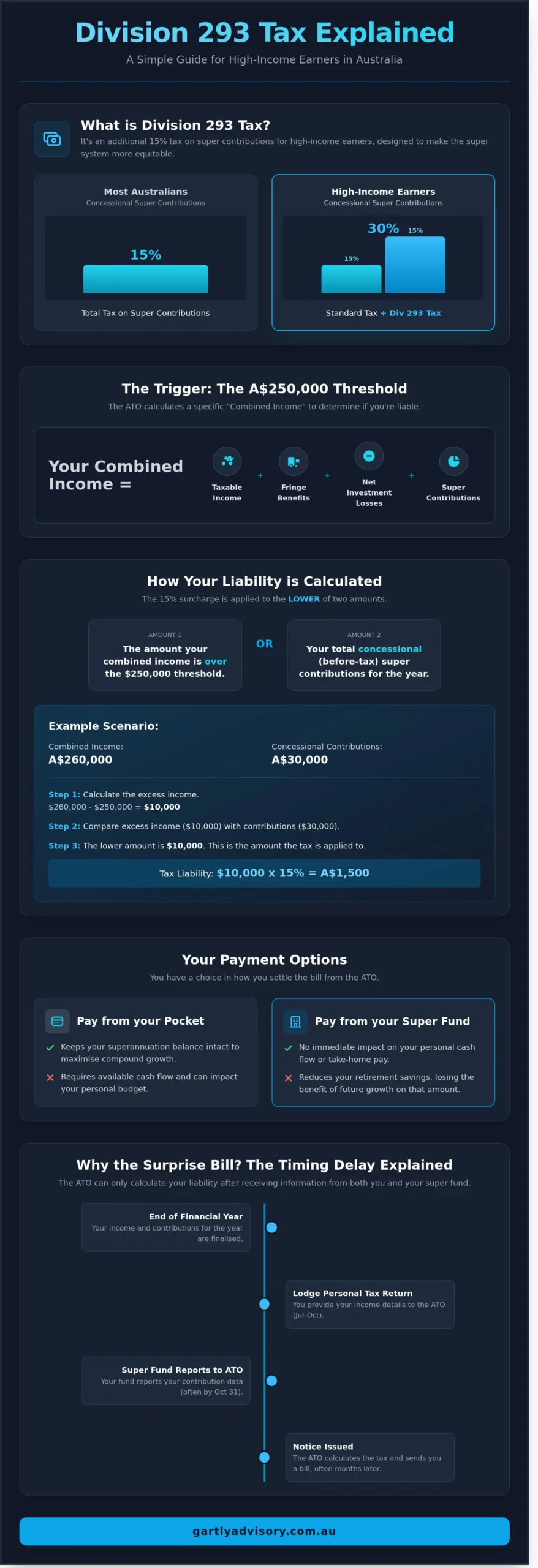
Receiving an unexpected letter from the Australian Taxation Office (ATO) can be unsettling, especially when it involves a tax you haven’t encountered before. If you’ve found a Division 293 notice in your inbox, you aren’t alone. To have division 293 tax explained simply, you should view it as a “top-up” tax designed to ensure the superannuation system remains fair for everyone. While most Australians pay a flat 15% tax on their super contributions, the government applies an additional 15% for high income earners, bringing the total tax rate on those contributions to 30%.
This notice often feels like a surprise because of the ATO’s reporting cycles. They can’t calculate your liability until they have two distinct pieces of information: your personal tax return and the annual report from your super fund. Since many funds don’t finalize their reporting until late in the calendar year, you might receive a bill for the previous financial year months after you thought your tax affairs were settled. It’s vital to distinguish this from your personal income tax. This is a specific charge on the concessional contributions made into your super account, not an extra tax on your take-home pay.
The ‘Social Equity’ Behind the Tax
The Australian tax system uses a progressive model to level the playing field. When a high earner in the 45% tax bracket only pays 15% on super contributions, they receive a massive 30% tax break. The government views this as an overly generous concession that favors the wealthy. Division 293 acts as a tool for tax equity in the super system by halving that concession for those earning above the threshold. We see this as a way the system balances retirement incentives with fair contribution levels.
Common Signs You Might Be Liable
The primary trigger is a combined income and concessional super contributions exceeding A$250,000. You don’t need a massive base salary to hit this mark. One-off spikes often cause the liability, such as a significant performance bonus or a capital gain from selling a long-held investment property. Business owners are often caught off guard when they have a bumper profit year or sell a business asset. If your total income plus super hits that A$250,000 ceiling, the ATO will be in touch.
The $250,000 Threshold: How the ATO Calculates Your Income
The Australian Taxation Office (ATO) uses a specific formula to decide if you need to pay this extra levy. It isn’t as simple as looking at your base salary on a payslip. To provide division 293 tax explained simply, we have to look at what the ATO calls your “combined income.” This figure is the sum of your income for surcharge purposes plus your low tax contributions. If this total exceeds $250,000, the surcharge applies to either the excess amount or the super contributions, whichever is lower. We see many clients who are surprised by a bill because they didn’t realize how their investments or salary sacrifice arrangements interacted with this threshold.
What’s Included in the Calculation?
Your income for surcharge purposes includes several components that often surprise high earners. It starts with your taxable income but adds back items that usually reduce your tax bill. The main components are:
- Taxable income (your salary minus standard deductions).
- Reportable fringe benefits (like a company car or health insurance).
- Total net investment losses, such as those from negatively geared property or shares.
- Reportable superannuation contributions.
Salary sacrificing into super is a common strategy to lower taxable income; however, for Division 293 purposes, these contributions are added back in. Your total income for this calculation is almost always higher than your net take-home pay. The ATO looks at your total financial capacity before applying the surcharge. This proactive approach by the tax office ensures that the tax reaches those with high economic income, regardless of how they’ve structured their investments to minimize taxable income.
The ‘Marginal’ Nature of the Tax
One common worry is that crossing the threshold by a small amount will trigger a massive bill on your entire income. That’s not how the system is designed. You only pay the additional 15% on the portion of your super contributions that sits above the $250,000 mark. The tax is calculated on the lesser of two amounts: your concessional contributions or the amount that exceeds the $250,000 threshold.
Consider a professional earning a combined income of $260,000. In this scenario, they’ve only crossed the line by $10,000. Even if they made $30,000 in super contributions, they only pay the extra 15% on the $10,000 excess. Their liability would be $1,500. The tax is effectively capped at your total concessional contributions. If you only put $20,000 into super, you’ll never pay more than 15% of that $20,000, regardless of how far over the income threshold you climb. Understanding these nuances is why many successful individuals choose to talk to us and let us help manage their tax strategy as a trusted partner.
The ATO receives data from both your tax return and your super fund to make these calculations. This usually happens automatically. You don’t need to calculate the division 293 tax explained simply yourself, but knowing the components helps you plan for the cash flow impact. Most notices arrive several months after you lodge your tax return, so keeping a buffer for this specific liability is a sound financial move for anyone earning near the $250,000 mark.
Paying the Bill: Out of Pocket vs. Using Your Super
Receiving a Division 293 notice from the ATO can feel like an unexpected hurdle. You aren’t alone in this; approximately 180,000 Australians received these assessments in the 2022-23 financial year. Once that notice arrives in your myGov inbox, you have a choice to make about where the money comes from. You can either pay it using your personal savings or ask your super fund to cover the cost. Having a clear strategy helps you maintain your long-term wealth while staying compliant. This division 293 tax explained simply guide focuses on helping you choose the path that fits your current cash flow and future retirement goals.
Option 1: Paying with Personal Cash
Many of our clients choose to pay the bill from their bank account to keep their retirement savings intact. This strategy is popular because it allows more capital to stay within the low-tax environment of superannuation. When you leave the money in your fund, you benefit from the power of compounding over the next decade. However, this does mean a direct hit to your current cash flow. If you decide to go this route, you can settle the debt through BPAY or the ATO portal on myGov. Most assessments are due 21 days after the notice is issued. Acting quickly prevents any unnecessary stress or late fees.
Option 2: The Release Authority Explained
If you’d rather not dip into your take-home pay, you can use a release authority. This is a formal request for your super fund to pay the ATO on your behalf. You have a 60-day window from the date of your assessment to make this election via myGov. It’s a straightforward process, but timing is vital. If you miss the payment deadline while waiting for the release process, the ATO might apply the General Interest Charge. This rate currently sits at 11.38% per annum as of the December 2024 quarter.
For those managing a Self-Managed Super Fund (SMSF), the process involves more steps. You must ensure the fund has enough liquidity to make the payment. You also need to ensure the correct reporting is completed to reflect the withdrawal. We often see people get confused by these timelines. Understanding division 293 tax explained simply means knowing that even if you choose the release authority, the debt is technically yours until the fund pays it. We recommend talking to us early so we can help you weigh up which option protects your financial future best.
Can You Avoid or Minimise Division 293 Tax?
The hard truth is that Division 293 tax is generally unavoidable if your income and super contributions combined exceed the A$250,000 threshold. It isn’t a levy you can simply opt out of or ignore. If you meet the criteria, the ATO will find you. However, understanding how division 293 tax explained simply works allows you to manage the timing of your income to prevent unnecessary spikes. Most high earners view this as a 15% surcharge on their retirement savings. While it feels like a penalty, the total tax on your super contributions is still 30%, which is lower than the top marginal rate of 45% plus the Medicare Levy.
Business owners often have more flexibility than employees. If you control a company or trust, you might be able to manage the flow of dividends or trust distributions. By keeping your “income for surcharge purposes” below the A$250,000 mark in a specific financial year, you can stay clear of the extra bill. This requires proactive planning. You don’t want to realize a large capital gain and receive a massive bonus in the same June 30 period if it can be avoided.
This level of foresight is a key part of wealth management for high-income earners. To understand the broader strategies that specialists use to optimize financial outcomes, it’s beneficial to explore Advanced Tax Planning and its principles.
Income Smoothing and Timing
Timing is everything when managing your tax profile. If you’re planning to sell a capital asset, like an investment property or shares, the resulting capital gain counts toward your Division 293 threshold. If that sale happens in the same year you receive a performance bonus, you’ll likely trigger the tax. We often suggest looking at the 12-month horizon. Spreading income across two financial years can keep you under the limit. You should also be careful about “doubling up” on concessional contributions. If you use the “carry-forward” rule to tip A$50,000 into super in one year, you’re almost certain to hit the Division 293 ceiling. Always consult an advisor before making large voluntary contributions to ensure you understand the tax impact.
The Role of Spouse Splitting and Other Strategies
A common misconception is that spouse splitting reduces your Division 293 liability. It doesn’t. While spouse splitting is a brilliant way to balance your total super balances and stay under the A$1.9 million transfer balance cap, Division 293 is based on your individual income. The ATO looks at your taxable income plus your reportable fringe benefits and your own concessional contributions. It doesn’t matter if you move those funds to a partner later; the tax is triggered the moment the contribution hits your account. You should focus on long-term wealth creation rather than just the 15% hit. Even with the tax, super remains one of the most effective wealth-building tools in Australia. To see how these rules apply to your specific situation, you can book a strategy session with our team today.
Making non-concessional (after-tax) contributions is another way to grow your super without increasing your Division 293 exposure. Because these contributions are made from money you’ve already paid income tax on, they don’t count toward the A$250,000 threshold calculation. It’s a clean way to build your nest egg. We’ve helped over 500 clients navigate these thresholds by looking beyond the numbers to their total family wealth strategy.
Beyond the Numbers: How Gartly Advisory Supports You
Earning a high income is a significant achievement, but it often brings a layer of tax complexity that feels overwhelming. You’ve worked hard to reach this level of success. Now, you need a safe pair of hands to ensure your wealth is managed effectively. At Gartly Advisory, we believe that division 293 tax explained simply isn’t just about the calculation; it’s about how that tax fits into your total financial picture. A specialist accountant does more than just fill out forms. We act as your strategic partner, identifying opportunities to optimize your position while ensuring you stay fully compliant with ATO regulations.
We take a proactive approach that looks ahead. Instead of waiting for a surprise assessment from the ATO months after you’ve filed your return, we work to predict your liability before the bill arrives. This foresight allows Melbourne business owners to manage cash flow with confidence. We’ve earned a reputation for providing advice beyond the numbers, focusing on the human side of your business and personal goals. Whether you’re navigating a business sale or managing a high-salary professional career, we help you understand the “why” behind the tax, not just the “how much.”
Proactive Planning for the 2026 Financial Year
Our team conducts thorough mid-year reviews to assess your current income and superannuation contributions. By June 30, 2026, you’ll have a clear understanding of your projected Division 293 obligations. We also handle the heavy lifting with Release Authority paperwork, saving you hours of administrative stress. By integrating this tax management into your broader wealth strategy, we ensure your super remains a powerful tool for your future. We look at the 15 percent additional tax as a manageable variable, not a roadblock to your retirement goals.
Your Trusted Partner in Ormond
With over 25 years of trust built within the Melbourne community, and Geoff Gartly’s 35 years of professional experience, we understand the specific needs of high-income earners. We invite you to a complimentary chat to discuss your current tax position and how we can simplify your obligations. Our goal is to replace your tax-time stress with a sense of stability and reliability. Don’t let tax complexity overshadow your success. Talk to Gartly Advisory about your Division 293 strategy today and experience the peace of mind that comes with expert guidance.
Take Charge of Your 2026 Tax Strategy Today
Receiving an unexpected ATO notice can feel daunting, but you’ve now seen division 293 tax explained simply. Remember that the A$250,000 threshold includes both your taxable income and your reportable super contributions. Whether you choose to pay out of pocket or release funds from your super, the decision should align with your broader retirement goals. It’s about more than just a single bill; it’s about your total financial health.
Gartly Advisory has spent over 35 years acting as a trusted partner for high-income earners and SMSF trustees. Our team of Chartered Accountants uses this deep experience to provide advice that goes beyond the numbers. We’re proud of our 70+ 5-star Google reviews, which reflect our commitment to proactive and supportive service. We’ll help you navigate these complex Australian tax regulations with confidence and clarity.
Book a consultation with our specialist tax team to ensure your strategy is optimized for the years ahead. We’re here to support you every step of the way.
Frequently Asked Questions
Is Division 293 tax a one-off payment or every year?
Division 293 tax is an annual obligation that applies every year your combined income and concessional superannuation contributions exceed the A$250,000 threshold. It isn’t a one-time penalty or a single adjustment; rather, it’s a recurring feature of the Australian tax system for high earners. If your income fluctuates, you might find yourself paying it in a year where you receive a large bonus or sell an asset, and then not paying it the following year if your income drops below the limit. For example, a professional earning A$245,000 who receives a A$10,000 performance bonus will trigger the tax for that specific financial year. We often see clients who are surprised when the notice arrives a second or third time because they didn’t realize it was tied to their ongoing annual earnings.
At Gartly Advisory, we help you build this recurring cost into your yearly cash flow management strategy so it doesn’t disrupt your lifestyle or investment plans. Since the threshold hasn’t moved since July 1, 2017, more Australians are finding themselves paying this tax every year as their salaries naturally grow with inflation. We believe in being a safe pair of hands for your financial future, which means tracking these triggers proactively. Our team uses our 35 years of experience to ensure you’re prepared for these bills well before they arrive in your inbox. We want to be your trusted partner on your journey towards success by providing this kind of consistent, reliable guidance year after year.
Can I challenge a Division 293 assessment if I think it’s wrong?
You can definitely challenge a Division 293 assessment by lodging a formal objection with the ATO within 60 days of receiving your notice. Mistakes often occur because of incorrect data reporting by superannuation funds or errors in your personal tax return that inflate your adjusted taxable income. For instance, if your super fund accidentally lists a A$30,000 non-concessional contribution as a concessional one, the ATO’s automated systems will generate an inflated tax bill. We’ve helped many clients navigate these disputes by meticulously reviewing their “Income for Division 293 purposes” against their actual payslips and annual super statements. You shouldn’t just accept the notice as final if the numbers don’t align with your records. It’s about ensuring you only pay what’s legally required and nothing more.
Our proactive approach at Gartly Advisory means we act as your partner to rectify these data errors through the formal objection process. We understand the tax system deeply and know exactly which levers to pull to get a correction processed. If the ATO makes a mistake, we provide the evidence needed to resolve the issue quickly so you can focus on your professional goals. Dealing with the ATO can be intimidating, but our 25 years of trust in the industry allows us to handle these administrative hurdles with calm competence. We take the complexity out of the process, providing advice beyond the numbers to protect your wealth. If you suspect your assessment is incorrect, talk to us and let us help you find the right solution.
What happens if I have an SMSF and receive a Div 293 notice?
If you have a Self-Managed Super Fund (SMSF) and receive a notice, you have the choice to pay the tax personally or have your fund pay the amount on your behalf. The notice is always sent to you as an individual because it’s your personal tax liability, but you can use a “release authority” to instruct your SMSF to settle the bill. Once you lodge this authority through the ATO’s online services, your SMSF must pay the amount from its bank account to the ATO within 10 business days. This requires your fund to have enough liquid cash available to cover the payment. If your SMSF assets are primarily tied up in illiquid investments like commercial property or unlisted shares, you may need to plan ahead to ensure cash is available for this annual obligation.
We work closely with SMSF trustees to ensure there’s always a sufficient cash buffer for these types of tax liabilities. It’s a key part of our supportive and proactive fund management service. Dealing with the ATO’s digital systems for SMSFs can be complicated, but we’re here to guide you through every step of the release authority process. We want to ensure your SMSF remains a powerful tool for your retirement rather than a source of administrative stress. Our role is to provide the guidance you need to manage your fund efficiently while staying compliant with all regulations. By partnering with us, you can navigate the complex world of business matters and superannuation with total confidence and peace of mind.
Does Division 293 apply to redundancy payments?
Redundancy payments can trigger a Division 293 liability because the taxable portion of the payout is included in your income calculation for the year. While a portion of a “genuine redundancy” is tax-free based on your years of service, any amount exceeding that limit is considered a taxable component. For the 2024-25 financial year, the base tax-free limit is A$12,524 plus A$6,264 for each completed year of service. If you receive a large redundancy payout of A$150,000 after a decade of service, a significant part of that payment will be added to your regular salary and super contributions. This often pushes high earners well over the A$250,000 threshold, leading to a surprise tax bill at a time when they might be transitioning between roles.
We recommend setting aside a specific portion of any redundancy payout to cover this potential tax hit later in the year. Our experience shows that planning for this “double hit” is vital for maintaining financial stability during a career transition. At Gartly Advisory, we help clients model these scenarios so they know exactly what to expect from the ATO months in advance. We provide advice beyond the numbers to help you see the full picture of your financial situation during a redundancy. It’s not just about the immediate payout; it’s about the tax obligations that follow you into the next financial year. Let us be your trusted partner during these transitions to ensure you’re making the most of your payout while staying fully compliant.
Is the $250,000 threshold likely to change in 2026?
There is currently no legislated plan to change the A$250,000 threshold for the 2025-26 financial year or beyond. The government hasn’t adjusted this figure since they lowered it from A$300,000 on July 1, 2017. Because this threshold isn’t indexed to inflation, more Australians are being pulled into this tax bracket every year as their wages rise. This phenomenon is known as bracket creep, and it effectively increases the tax burden on senior professionals and business owners without the government needing to pass new laws. Given the current economic climate and the focus on budget repair, it’s unlikely we’ll see this threshold increased in the near future. We advise our clients to assume the A$250,000 floor will remain firm for their long-term retirement planning.
Our team stays on top of every Federal Budget and legislative shift to ensure our advice is always current and reliable. If a change is proposed by the Treasury, we’ll be the first to let you know how it impacts your strategy. We take a proactive approach to tax planning, looking beyond the immediate horizon to see what’s coming next for our clients. Trusting in a steady threshold allows for more predictable wealth building, even if it means accounting for the extra 15% tax. We’re here to provide the stability and guidance you need to navigate these macro-economic factors. Our goal is to simplify the complex world of tax so you can stay focused on growing your dreams and achieving your financial milestones.
How do I know if the ATO has already sent my notice?
You can check if the ATO has issued your notice by logging into your myGov account or checking the ATO online services portal directly. The ATO typically issues these notices after they’ve processed both your individual tax return and the annual member contribution statement from your superannuation fund. This means notices usually arrive between October and May, which is several months after the end of the financial year. If your myGov account is linked to the ATO, you’ll generally receive an email or SMS notification when a new document is available in your digital inbox. It’s important to check these channels regularly because the ATO is increasingly moving away from sending physical paper notices through the mail.
If you’re a client of Gartly Advisory, we can also monitor your tax portal for you to ensure no notices are missed. Missing a payment deadline can lead to interest charges, so staying proactive is essential for good tax management. We’ve earned the reputation of giving advice beyond the numbers by helping our clients stay on top of these administrative details. We’re here to help you navigate these digital systems and ensure your compliance is always up to date. If you’re unsure whether a notice has been issued or if you’ve lost track of your digital logins, talk to us and let us help you get the information you need. Our supportive team is always ready to provide the guidance you need to stay in control of your tax affairs.
Can I pay Division 293 tax in instalments?
The ATO generally requires Division 293 tax to be paid in full by the due date, but you can apply for a formal payment plan if you’re unable to settle the bill at once. The due date is usually 21 days after the notice is issued. If you’re paying the tax personally and need more time, you can set up an instalment arrangement through the ATO’s online services or by calling them. However, you should be