
How to Get an ABN for My New Business: A Step-by-Step Guide for 2026
What if that 11-digit number you’re chasing is more than just a registration requirement? It’s actually the foundation of your professional identity. You likely feel that starting a business should be about chasing your dreams, not drowning in ATO paperwork. We agree that the fear of government fines or picking the wrong structure, like choosing between a Sole Trader or a Company setup, can feel overwhelming. You aren’t alone in wondering how to get an ABN for my new business or when you actually hit that A$75,000 GST threshold.
As your trusted partner on this journey, we want to make this process seamless. You’re about to learn exactly how to register for your Australian Business Number and set yourself up for long-term success. This guide provides a clear, step-by-step walkthrough of the application. We will also cover how to verify your business structure and what your next moves should be for total tax compliance. Let’s get your venture started on the right foot.
Key Takeaways
- Understand the vital role of the 11-digit Australian Business Number (ABN) and why it is a legal requirement for your business to identify itself to the ATO.
- Learn why choosing the right business structure is a critical first step that shapes your future tax flexibility and provides essential asset protection.
- Follow our clear, practical guide on how to get an ABN for my new business by safely accessing the Australian Business Register with your TFN and identity documents.
- Navigate the post-registration phase with confidence by using our checklist to determine if your turnover requires mandatory GST registration.
- Discover how partnering with a proactive Chartered Accountant offers “advice beyond the numbers” to help your new venture achieve long-term success.
What is an ABN and why does your new business need one?
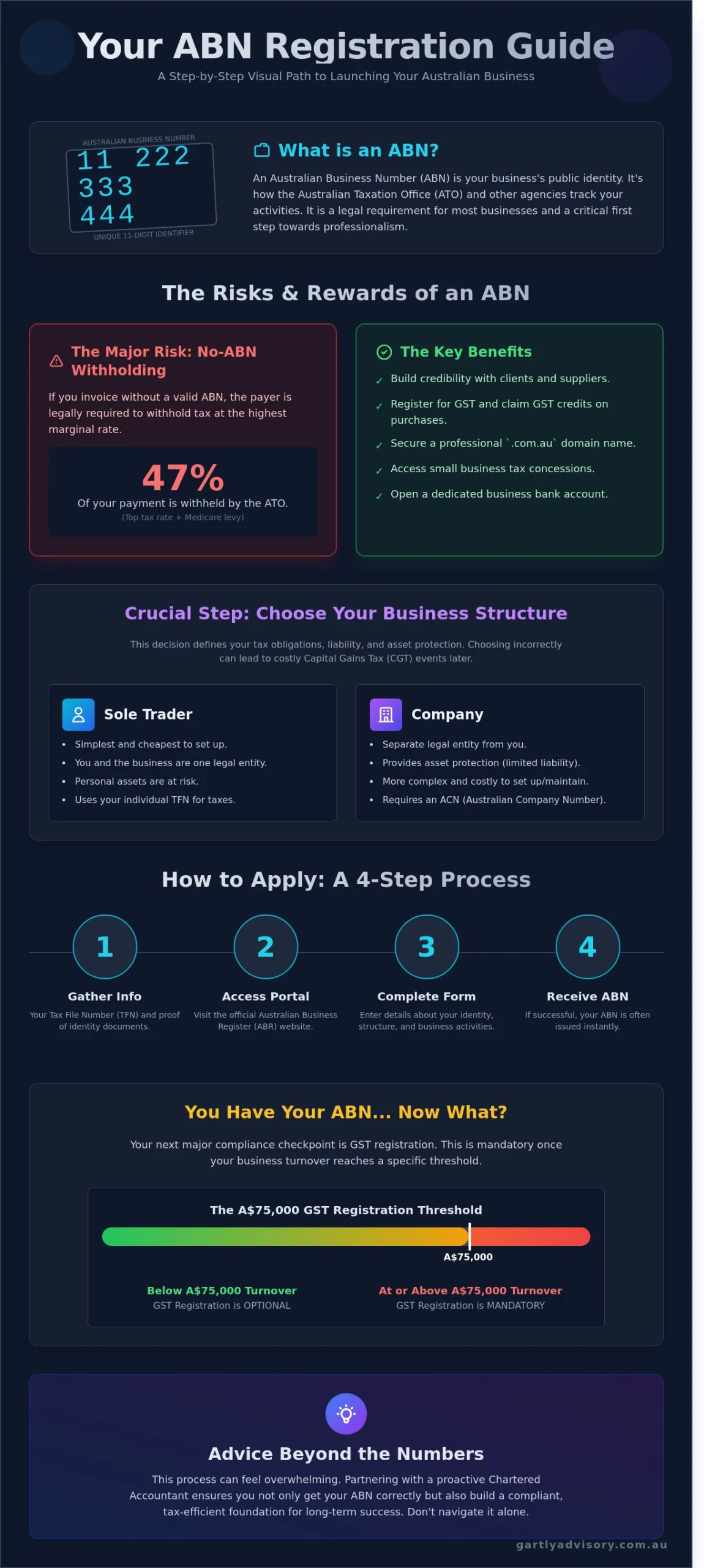
Your Australian Business Number (ABN) is a unique 11-digit identifier that acts as the public face of your enterprise. It’s the primary way the Australian Taxation Office (ATO) and other government agencies track your business activities. While it doesn’t replace your Tax File Number (TFN), it’s a critical tool for interacting with the Australian business community. If you’re researching how to get an ABN for my new business, you’re taking the first step toward establishing a professional identity that is recognized across the country.
The legal requirement to hold an ABN becomes undeniable when you start invoicing. Under Australian tax law, if you provide a service or product without quoting a valid ABN, the paying entity is legally obligated to withhold 47% of that payment. This is the top marginal tax rate plus the Medicare levy. This withholding can severely impact your cash flow during those delicate first months of operation. Beyond tax, the ABN is your gateway to the Australian business ecosystem. You’ll need it to register for Goods and Services Tax (GST), claim fuel tax credits, or even secure a “.com.au” domain name for your website.
It’s vital to distinguish between the different identification numbers you’ll encounter. An ABN is for all business types, including sole traders and partnerships. In contrast, an Australian Company Number (ACN) is a 9-digit number issued by ASIC specifically for registered companies. Your TFN remains your private identifier for income tax purposes. At Gartly Advisory, we’ve spent 35 years helping clients navigate these distinctions to ensure they’re registered correctly from day one.
Are you actually entitled to an ABN?
You aren’t automatically entitled to an ABN just because you’ve started a project. To qualify, you must be “carrying on an enterprise” in Australia. This means your activity is organized, continuous, and clearly intended to result in a profit. The ATO distinguishes between a hobby and a business based on the scale and intent of your work. For example, a freelancer taking on regular monthly contracts or an online store owner who has invested A$2,000 in inventory is clearly running a business. However, someone selling occasional handmade crafts at a local market to cover the cost of materials may still be considered a hobbyist. If you’re unsure where you stand, seeking professional guidance can prevent future compliance issues with the ATO.
The benefits of being a registered business
Registering your business provides more than just a tax number; it offers a foundation for growth and trust. Once you have an ABN, you can apply for a unique business name through the Australian Securities and Investments Commission (ASIC). This prevents others from trading under your chosen brand. Furthermore, having an active ABN on your quotes and invoices builds immediate credibility with high-value clients and landlords. Beyond the numbers, being a registered entity allows you to:
- Claim GST credits for the tax included in your business purchases if your turnover exceeds the A$75,000 threshold.
- Access small business tax concessions that can reduce your overall tax liability.
- Open a dedicated business bank account to keep your personal and professional finances separate.
- Establish formal trade accounts with suppliers who often require an ABN to verify your commercial status.
Taking the time to understand how to get an ABN for my new business ensures you start your journey with a safe pair of hands. It positions you as a serious player in the market, ready to seize opportunities as they arise.
Choosing your business structure: The crucial step before you apply
Before you jump into the application portal, you’ve got to make a big decision. Your business structure isn’t just a box you tick; it defines your legal identity, how much tax you’ll pay, and whether your personal assets are safe. Choosing the right path is the most important part of learning how to get an ABN for my new business because the Australian Business Register (ABR) asks for this detail on the very first page. If you provide the wrong information, you’ll likely have to cancel the application and start over, which delays your ability to invoice clients.
At Gartly Advisory, we’ve spent 35 years helping Melbourne business owners avoid the “accidental” sole trader trap. It’s often tempting to pick the easiest option to save time, but a mistake here is expensive. If you start as a sole trader and decide to move to a company structure two years later, you could trigger a Capital Gains Tax (CGT) event. Unless you qualify for specific small business restructure rollovers under the Income Tax Assessment Act 1997, the ATO might treat that change as a sale of your business to a new entity. This can lead to a surprise tax bill and additional stamp duty costs. We prefer to get your foundation right from day one.
Sole Trader vs. Company: Which is right for you?
Being a sole trader is the simplest way to start. It’s low cost and gives you full control. However, you’re personally liable for every debt the business incurs. If things go wrong, your personal assets like your car or home could be at risk. A Proprietary Limited (Pty Ltd) company acts as a separate legal person. This offers a shield for your personal assets and allows you to access the 25% corporate tax rate for base rate entities in the 2023-24 financial year. This is often much more efficient than paying up to 45% on individual tax scales. While ASIC registration costs approximately A$576, the long term protection and growth potential are often worth the investment.
When to consider a Trust or Partnership
If you’re looking for tax flexibility and asset protection, a Family Trust (Discretionary Trust) might be the answer. These structures allow you to distribute profit to family members in lower tax brackets, which can significantly reduce your household’s total tax. Partnerships are effective for collaborative startups with two or more founders who want to share costs and expertise. It’s vital to remember that both trusts and partnerships require their own unique ABN; they aren’t just extensions of your personal tax file number. If you’re feeling unsure about these complexities, talk to us and let us help you find the structure that supports your specific journey towards success.
How to apply for an ABN: A step-by-step registration guide
Our team at Gartly Advisory has spent over 25 years helping entrepreneurs launch their dreams, and we know that the registration phase is where many feel most overwhelmed. Applying for an ABN doesn’t have to be a stressful experience if you follow the right path. You should only use the official Australian Business Register website at abr.gov.au. Avoid third-party sites that often charge between A$50 and A$150 for a service the government provides for free. Understanding how to get an ABN for my new business starts with having your Tax File Number (TFN) ready. If you’re a sole trader, your personal TFN is enough. For other structures, you’ll need the TFNs of all partners or directors involved to verify their identities instantly.
Information you’ll need to have ready
To keep the process moving without interruptions, gather the dates of birth and residential addresses of all business associates beforehand. You’ll also need to provide a clear description of your primary activity to find your ANZSIC code. For example, a local cafe uses code 4511, while a consultant might use 6962. Even a specialised local venture needs a unique code; as a great example of a community-focused business, you can discover Flinn Taekwondo Academy. We also suggest calculating your expected annual turnover. If you anticipate earning over A$75,000 in your first 12 months, you’re legally required to register for GST during this application. Having these figures ready prevents the “technical jargon” from becoming a roadblock.
Navigating the ABR online form
The form first asks you to select your entity type. This is a critical decision, as a Sole Trader structure is handled differently than a Company or a Trust. Next, you must declare you’re “carrying on an enterprise.” This means you’ve already taken active steps like buying equipment, leasing a commercial space, or creating a formal business plan. Accuracy is vital. One wrong tick-box can trigger a manual review by the ATO, which often delays your registration by up to 28 days. Once you’ve entered your business location and associate details, review the summary page twice before you hit the submit button.
Common application red flags to avoid
The ATO’s system cross-references your application with existing tax records in real-time. If your legal name on the application doesn’t match the name on your TFN record exactly, the system will flag the entry for manual intervention. Another frequent error is selecting “Company” before you’ve received your Australian Company Number (ACN) from ASIC. Remember, an ABN isn’t for everyone. If your activity is a hobby with no genuine intention of making a profit, the ATO may reject the application. We’ve seen many applicants get stuck because they couldn’t clearly define their commercial intent. If you’re still wondering how to get an ABN for my new business without these hiccups, seeking professional guidance ensures you start your journey on solid ground.
You have your ABN-now what? The post-registration checklist
Receiving your successful registration email is a milestone for any entrepreneur. Once you’ve successfully navigated how to get an ABN for my new business, you hold the key to the Australian tax system. However, this 11-digit number is just the foundation. You have 28 days to notify the Australian Business Register (ABR) of any changes to your circumstances. Keeping these details updated ensures you receive critical correspondence from the ATO and stay compliant with federal regulations.
Your next priority is securing your brand. Many new owners mistakenly believe an ABN protects their business name. It doesn’t. Unless you’re trading under your exact personal name, you must register your business name with ASIC. This usually costs around A$42 for one year or A$99 for three years. Doing this immediately prevents others from legally operating under your chosen brand identity while you’re trying to build market presence.
Separating your finances is the final piece of the immediate post-registration puzzle. Open a dedicated business bank account before you process your first invoice. Mixing personal and business transactions is a leading cause of accounting errors. A clean separation makes it easier to track deductible expenses and provides a clear audit trail if the ATO ever requests a review of your records.
Understanding GST and other tax registrations
Tax compliance isn’t a one-size-fits-all process. If your business reaches an annual turnover of A$75,000, GST registration becomes mandatory. You’ve got 21 days to register once you realise you’ll hit that threshold. For non-profit organisations, the limit is higher at A$150,000. Even if you’re below these figures, you might choose to register voluntarily to claim GST credits on your setup costs and equipment purchases.
- PAYG Withholding: You must register for this if you plan to pay employees or contractors under specific voluntary agreements.
- Fringe Benefits Tax (FBT): This applies if you provide “perks” to staff, such as a company car or private health insurance, that exceed A$2,000 in total taxable value within the FBT year (1 April to 31 March).
- Luxury Car Tax: If you’re importing or selling vehicles with a value above the ATO threshold (currently A$76,950 for fuel-efficient vehicles in the 2023-24 financial year), this registration is essential.
Setting up your cloud accounting (Xero) and record-keeping
Paper receipts in a shoebox won’t cut it in a digital-first regulatory environment. The ATO expects businesses to maintain records for five years. Using a cloud-based system like Xero allows you to automate this process. When you link your ABN to your accounting software, you can generate professional invoices and automate your Business Activity Statement (BAS) lodgements with a few clicks. It’s about moving beyond the numbers to gain a real-time view of your cash flow.
Setting your ledger up correctly from day one prevents expensive cleanup costs during tax season. You can follow our Xero Accounting Guide to ensure your chart of accounts is tailored to your specific industry needs. This proactive approach ensures you’re always ready for growth rather than just reacting to deadlines.
Ready to ensure your new venture is built on a solid financial foundation? Contact Gartly Advisory today for expert guidance on your business journey.
Why partnering with a Chartered Accountant makes the difference
Applying for an ABN is often the very first official act you’ll perform as an entrepreneur. While the government’s online portals are designed for accessibility, they don’t provide the strategic oversight required to protect your assets or optimize your tax position. Understanding how to get an ABN for my new business is only half the battle; the other half is ensuring that the registration fits within a structure that can scale. At Gartly Advisory, we provide advice beyond the numbers. We don’t just process forms. We look at your long-term goals to ensure your business foundation is solid from day one.
Falling into the DIY trap is a common mistake for Australian startups. It’s easy to accidentally register as a sole trader when a family trust or a proprietary limited company would have saved you thousands in tax or protected your personal home from business creditors. Messy audits or missed tax concessions often haunt business owners who rushed the setup process without professional guidance. Geoff Gartly brings 35 years of experience to the table, helping you avoid these expensive pitfalls. We act as your proactive partner, identifying opportunities for growth that you might not see while you’re focused on daily operations.
- Structural Integrity: We help you choose between a Company, Trust, Partnership, or Sole Trader structure based on your specific risk profile.
- Tax Compliance: Our team ensures you’re registered for the right obligations, including GST, PAYG withholding, and FBT, so there are no surprises at EOFY.
- Growth Mapping: We provide a clear roadmap for your business journey, from the first dollar of revenue to a multi-million dollar exit.
Gartly Advisory’s small business setup services
We love supporting local entrepreneurs in Ormond and across Melbourne. That’s why we offer a complimentary appointment for new business owners to discuss their vision. During this session, we handle the heavy lifting of ASIC and ATO registrations so you don’t have to worry about technical jargon or the risk of incorrect filings. We focus on strategic planning to ensure your business structure remains flexible as your revenue grows. Whether you’re a local consultant or a growing tech startup, we ensure your setup is professional, compliant, and ready for success. If you’re wondering how to get an ABN for my new business without the stress, our team is here to guide you through every step.
Your next steps toward business success
Starting a business is an exciting milestone, but it’s also a significant responsibility. Remember that professional advice is a strategic investment in your future, not just an administrative cost. By getting your structure right today, you’re saving yourself from the stress and expense of restructuring down the track. We’ve spent 25 years building trust with Melbourne business owners, and we’re ready to help you too. Take the first step with confidence and let us handle the complexities of the Australian tax system for you.
Ready to build your dream on a firm foundation? Book a consultation with Geoff and the team today and get the expert support your new venture deserves.
Launch Your Australian Business with Confidence
Starting your venture in 2026 requires more than just a great idea; it demands a solid legal foundation. You now understand that choosing the right structure, whether it’s a sole trader setup or a proprietary limited company, directly impacts your tax obligations and personal liability. While learning how to get an ABN for my new business is a vital first step, the real work begins with your post-registration checklist. Navigating GST requirements and TFN applications can be complex without a proactive growth strategy in place.
With over 35 years of experience in small business advisory, Gartly Advisory provides guidance that goes beyond the numbers. We’ve helped hundreds of Melbourne entrepreneurs turn their dreams into reality, earning 70+ 5-star Google reviews from local business owners. As Chartered Accountants, we don’t just file paperwork; we partner with you to ensure your business structure scales as your revenue grows. We’re here to help you navigate the tax system and seize every opportunity as you build your legacy.
Talk to us and let us help you set up your new business correctly. We look forward to being your trusted partner on this exciting journey towards success.
Frequently Asked Questions
Is it free to get an ABN in Australia?
It’s completely free to get an Australian Business Number (ABN) when you apply directly through the official Australian Business Register (ABR) website. The government doesn’t charge any application fees for this service, so you won’t need to reach for your credit card if you’re handling the process yourself. We often see new business owners get confused by third-party websites that look official but charge service fees ranging from A$50 to A$150 to lodge the application on your behalf. While these agents provide a service, you can save that money for your initial business expenses by going straight to the source. You should remember that while the ABN itself costs A$0, you might still face other startup costs. For example, if you want to trade under a name other than your own personal name, you’ll need to register a business name with ASIC. This currently costs A$39 for one year or A$92 for a three-year registration period. Our team is here to help you navigate these initial setup costs so you can keep your capital for growing your dreams.
We believe in providing advice beyond the numbers, and that starts with making sure you don’t pay for things that are legally free. If you’re unsure about which website is the official one, always look for the .gov.au suffix in the URL. This ensures you’re dealing directly with the Australian government and not a private company. Staying vigilant during these early stages of your business journey helps you build a foundation of financial savvy. If you ever feel overwhelmed by the paperwork, remember that a trusted partner can guide you through the registration process without the stress of hidden fees. We love supporting our clients as they take these first steps, ensuring they have the right tax structures in place from day one. By choosing the free path for your ABN, you’re making a smart, cost-effective decision for your new venture’s future.
How long does it take for an ABN to be approved?
Most ABN applications are approved instantly, and you’ll receive your 11-digit number as soon as you finish the online form. This immediate turnaround happens in about 90 percent of cases where the applicant provides all the necessary identity information and clear business details. If your application is successful, you can start using your number straight away to set up bank accounts or issue invoices. However, if the system can’t verify your identity or if your business activities require further investigation, it can take up to 28 days for the Australian Taxation Office (ATO) to process your request. This delay often happens if there are discrepancies in your tax file number records or if you’ve had an ABN cancelled in the past. We recommend having your TFN and proof of identity ready before you start learning how to get an ABN for my new business to ensure the process remains as smooth as possible.
If your application goes into manual review, don’t panic. The ATO will usually contact you within 14 days if they need more information to progress your case. They might ask for evidence that you’re actually carrying on an enterprise or intended to start one soon. During this waiting period, it’s a good idea to keep a record of your application reference number. This number is your lifeline for checking the status of your application if the 28-day window is approaching. We understand that waiting can be frustrating when you’re eager to launch, but this time can be used to refine your business plan or consult with a business adviser. Our firm has 25 years of trust in helping clients navigate these bureaucratic hurdles. We can help you understand why a delay might have occurred and what steps you can take to resolve it quickly so you can get back to what you do best.
Can I have more than one ABN for different businesses?
You generally only have one ABN for each legal entity, which means if you’re a sole trader, you’ll use the same ABN for every business activity you run. For instance, if you’re a freelance graphic designer on weekdays and a gardener on weekends, both of these ventures fall under your personal legal identity. You don’t need a second ABN for the gardening work; you simply add the new business name to your existing ABN registration. This keeps your tax obligations streamlined and reduces the amount of paperwork you need to track. If you decide to start a completely separate legal entity, like a proprietary limited company or a family trust, that new entity will require its own unique ABN. A company is viewed as a separate “person” in the eyes of the law, so it must have its own registration, tax file number, and Australian Company Number (ACN).
Managing multiple business lines under one ABN is common and perfectly legal in Australia. You can register multiple business names with ASIC and link them all to your single ABN through the ABR portal. This approach is often the most efficient way for small business owners to test different markets without the complexity of multiple tax returns. However, as your business grows, you might find that the risks or tax benefits of a different structure become more attractive. This is where professional guidance becomes invaluable. We can help you determine if your current sole trader ABN is still the best fit or if it’s time to move toward a more complex structure like a company. Our proactive approach ensures you’re always using the most effective setup for your specific goals. We’re here to be your partner on this journey, helping you understand when one ABN is enough and when it’s time to expand your legal horizons.
What happens if I don’t have an ABN but I’m trading?
If you’re trading without an ABN, other businesses that pay you are legally required to withhold 47 percent of the total payment amount. This is the top marginal tax rate plus the Medicare levy, and it’s designed to ensure that tax is captured even when a supplier isn’t registered. For a small invoice of A$1,000, you’d only receive A$530 in your bank account, which can create a massive cash flow problem for a new business. The payer then sends that withheld A$470 to the ATO as part of their regular reporting. While you can eventually claim this money back as a credit when you lodge your annual income tax return, you’ll be waiting months to access your own hard-earned cash. This rule applies to any payment over A$75, excluding GST, unless an exception applies.
Beyond the financial hit, not having an ABN can make your business look unprofessional to potential clients and partners. Most established Australian companies won’t even work with suppliers who can’t provide a valid ABN because it creates extra administrative work for their accounts department. They have to fill out specific forms and handle the withholding process, which is a hassle they’d rather avoid. You might also find it impossible to open a dedicated business bank account or apply for commercial credit without a valid registration. If you’re serious about your venture, getting your ABN is a non-negotiable step in establishing your credibility. We’ve seen how much easier life is for our clients when they have their registrations sorted from the start. Let us help you avoid these 47 percent withholding traps by ensuring your business is fully compliant before you send your first invoice. It’s about protecting your revenue and building a reputation for reliability in the marketplace.
Do I need an ABN if I’m only working as a sole trader?
You need an ABN as a sole trader if you’re carrying on an enterprise with a reasonable expectation of profit. While there’s no law saying every person must have one, you’ll find it nearly impossible to operate effectively in the Australian business landscape without it. If your activities are more than just a hobby, the ATO expects you to have an ABN to track your business income and expenses. This is especially true if you plan to register for GST, which is mandatory once your annual turnover reaches A$75,000. Even if you’re below that threshold, having an ABN allows you to claim back business expenses and ensures you’re treated as a legitimate commercial entity by the government. When you’re looking into how to get an ABN for my new business, you’ll see that the application process for sole traders is straightforward and fast.
Deciding whether your activity is a hobby or a business can sometimes be a grey area. The ATO looks at factors like whether you intend to make a profit, the repetition of your activities, and whether you run things in a business-like manner. If you’re selling handmade crafts once a year at a local market for A$200, you probably don’t need an ABN. But if you’re actively seeking clients and invoicing for your time, you’ve crossed the line into being a sole trader. We understand the tax system can feel complex, and we’re here to help you make that distinction clearly. Our team can review your specific situation and provide the reassurance you need to move forward confidently. Being a sole trader is an exciting way to grow your dreams, and having the right foundation is key to your success. We love the opportunity to support our clients through these early transitions, acting as a safe pair of hands as you navigate your new responsibilities.
How do I look up an existing ABN to check if it’s active?
You can check the status of any ABN by using the free ABN Lookup tool at abr.business.gov.au. This public website is the official source of ABN information and allows you to search by the 11-digit number, the business name, or the legal entity name. When you perform a search, the system will show you if the ABN is “Active” or “Cancelled,” along with the date the status was last updated. It also provides details about GST registration and whether the entity is a deductible gift recipient. This is an essential step for any business owner before they pay a new supplier. If you pay someone with a cancelled ABN, you could be held liable for not withholding tax, which is a risk you don’t want to take with your business capital.
Verifying an ABN is a simple habit that can save you from significant financial headaches down the track. We recommend checking the status of your major suppliers at least once a year, as businesses can sometimes lose their registration without notifying their clients. The ABN Lookup also has a mobile app and an extension for some accounting software, making it even easier to stay compliant on the go. If you find that your own ABN isn’t showing up correctly, it might be because your details are out of date or the ATO has flagged your account for inactivity. In these cases, it’s vital to act quickly to restore your active status. Our proactive approach involves helping you maintain these records so you never face a disruption in your trading. We believe that staying on top of these small details is part of giving advice beyond the numbers. By keeping your registrations current, you ensure that your journey towards success remains uninterrupted by administrative errors.
Do I need to renew my ABN every year?
Your ABN doesn’t have an expiry date, so you don’t need to renew it every year or pay any ongoing maintenance fees to the ABR. Once it’s issued, it remains active indefinitely as long as you continue to carry on your business activities. This is different from a registered business name, which must be renewed with ASIC every one or three years for a fee of A$39 or A$92. While the ABN itself is permanent, you do have a legal obligation to update your details on the register within 28 days of any changes. This includes changes to your business address, contact details, or the nature of your business activities. If the ATO notices that you haven’t reported any income or lodged any tax returns for a long period, they may contact you to see if you’re still in business or cancel the ABN if they believe you’ve stopped trading.
Keeping your information accurate is a small but vital part of your business compliance. If your contact details are wrong, you might miss important notices from the government regarding your tax obligations or new grants that could benefit your industry. We often help our clients perform an annual “health check” on their registrations to ensure everything is up to date. This proactive step prevents the sudden shock of finding out your ABN has been cancelled right when you’re trying to sign a major contract. If your ABN is cancelled and you need it again, you’ll have to go through a reapplication process, which can take time you might not have. Our firm’s 35 years of experience has shown us that a little bit of maintenance goes a long way in avoiding future stress. We’re here to be your trusted partner, ensuring your business remains in good standing with all the relevant authorities so you can focus on growth and seizing new opportunities.
Can I apply for an ABN before I start my business?
You can apply for an ABN before you officially launch, provided you have taken significant steps toward starting your venture and have a firm intention to trade. The ATO doesn’t expect you to have your first customer on day one, but they do want to see that you’re “carrying on an enterprise.” This means you might be in the process of leasing a shopfront, buying equipment, or setting up a professional website. Having an ABN early is often necessary because many wholesalers and service providers will ask for it before they’ll even give you a quote or open a commercial account. You’ll also need it if you want to claim back the GST on your initial setup costs, which can be a huge help for your starting budget. If you’ve spent A$5,000 on equipment, being able to claim back that A$454 in GST makes a real difference to your cash flow.
When you apply early, be prepared to describe the activities you’ve already undertaken to get the business off the ground. The application will ask for your expected start date, and it’s fine if that date is a few weeks or even months in the future. However, if you apply for an ABN and then do nothing for a year, the ATO might view the registration as inactive and cancel it. We encourage our clients to reach out for a consultation during this pre-launch phase. It’s the perfect time to discuss your tax structure and ensure you’re setting yourself up for long-term success. We love supporting new entrepreneurs as they transition from the planning stage to the reality of running a business. Let us be your partner on this journey, providing the guidance and support you need to turn your vision into a thriving enterprise. Starting with the right advice ensures you don’t just get an ABN, but you build a business that’s designed to last.