Rental Property Depreciation Schedule: What It Is & How It Works
If you own an investment property in Melbourne and haven’t claimed depreciation, you’re leaving money on the table every single tax return. A rental property depreciation schedule is the document that unlocks these deductions, yet plenty of property investors either don’t have one or are using an outdated version that misses thousands of dollars in claims. Wear and tear on your property counts as a legitimate tax deduction, even though you never physically spend that money.
This guide explains exactly what a depreciation schedule covers, how a quantity surveyor calculates the figures, and what separates the capital works deductions from plant and equipment items. You’ll see how the numbers flow through to your tax return and why the schedule needs updating when you renovate or the property changes hands.
At Gartly Advisory, we work with property investors across Melbourne who want their depreciation claims handled correctly alongside their broader tax strategy, not as an afterthought. Below, we break down how the schedule works, what it costs to get one prepared, and how to make sure you’re claiming every dollar you’re entitled to.
Why a depreciation schedule matters for your investment property
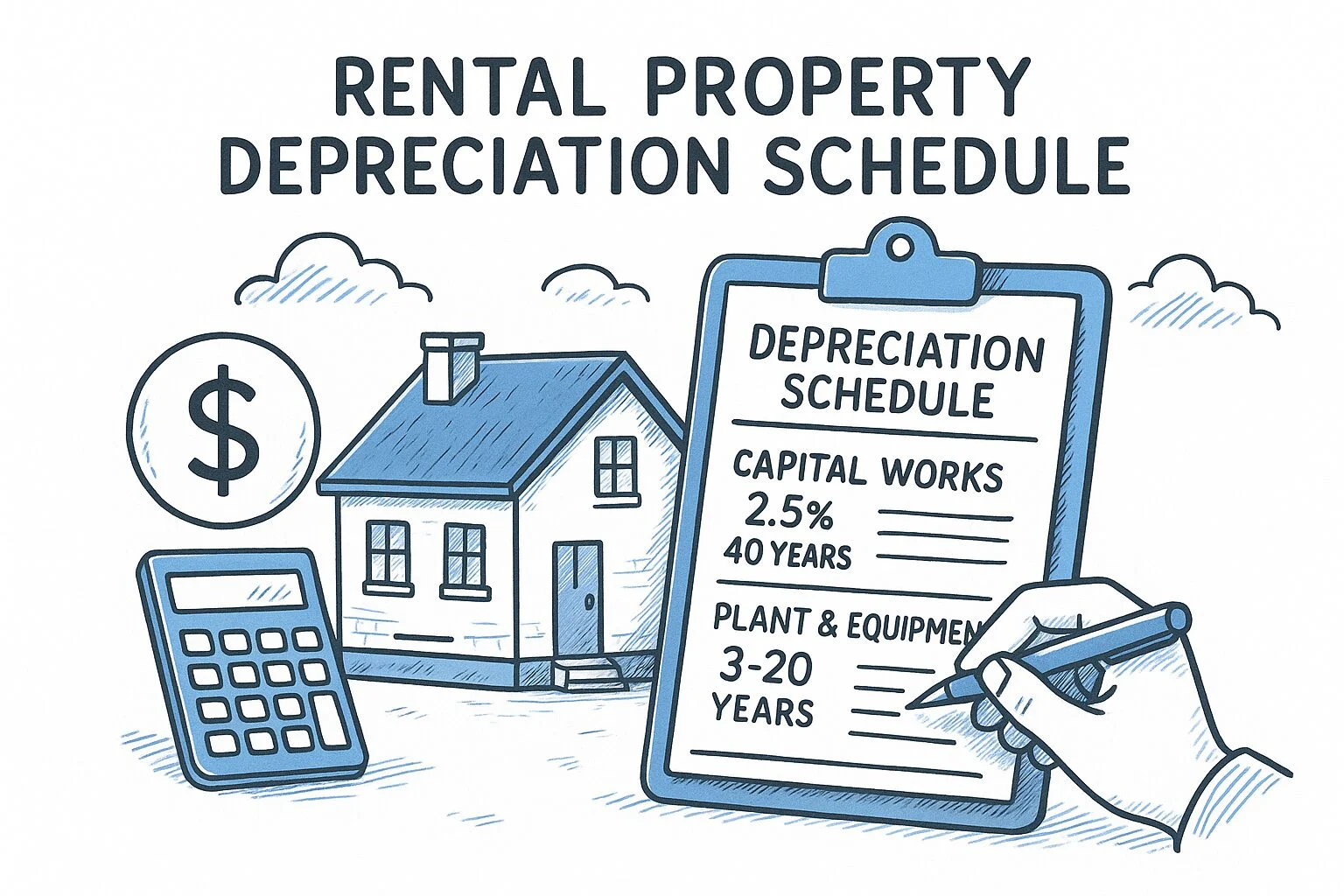
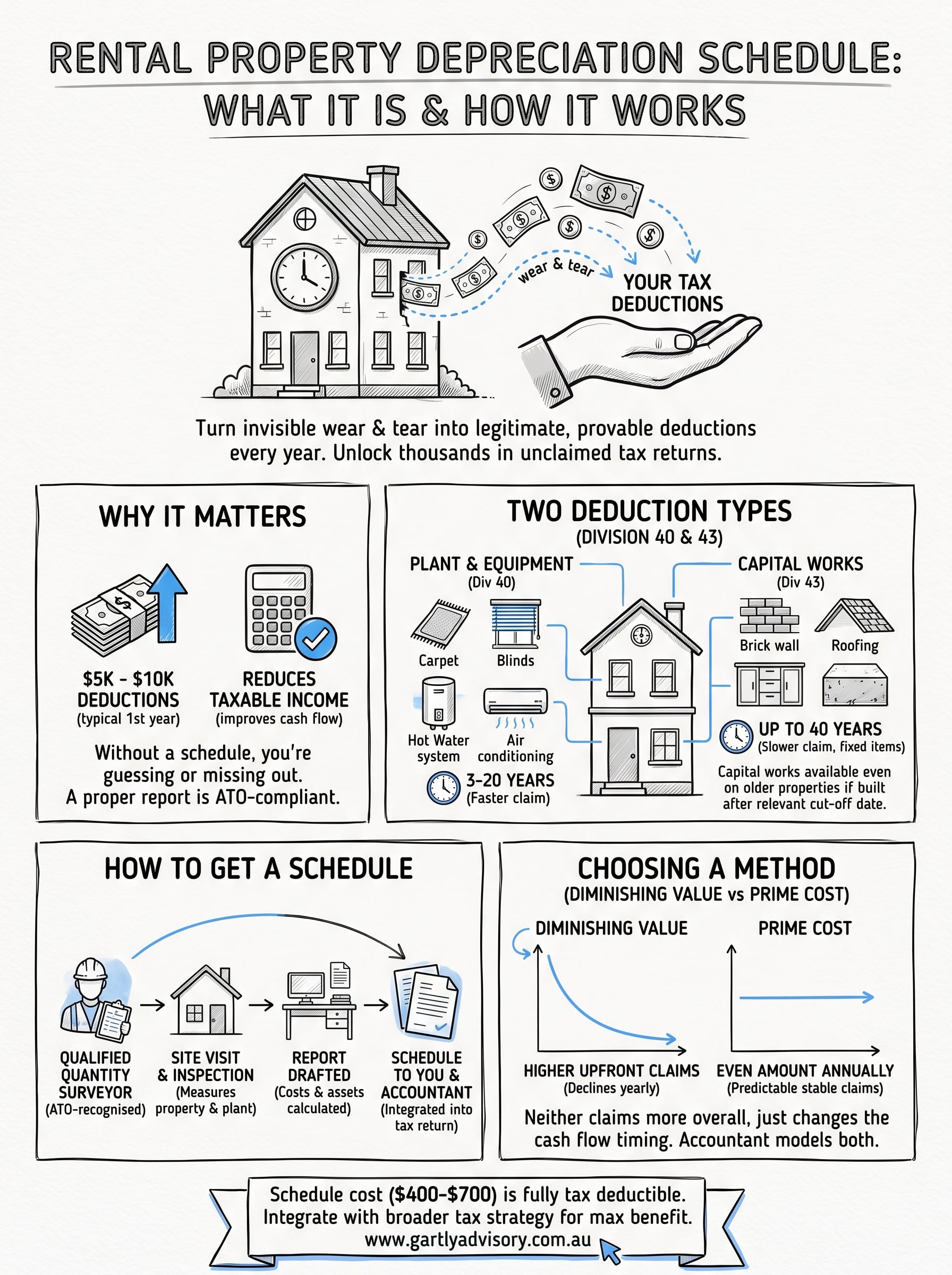
Depreciation deductions fall into two categories, and a proper schedule captures both. Capital works deductions cover the building’s structure, brickwork, roofing, and fixed items like kitchen cabinetry, typically claimed at 2.5% per year over 40 years. Plant and equipment items, meaning carpets, blinds, hot water systems, and air conditioning units, depreciate faster because they wear out sooner than the building itself.
| Deduction type | Examples | Claim period |
|---|---|---|
| Capital works (Division 43) | Structure, brickwork, built-in cabinetry | Up to 40 years |
| Plant and equipment (Division 40) | Carpets, blinds, appliances, hot water systems | 3 to 20 years depending on item |
Without a schedule, most investors either skip these claims entirely or guess at rough figures their accountant can’t substantiate if the ATO asks questions. Guessing at figures invites an audit risk that a properly prepared report eliminates, because every value ties back to a quantity surveyor’s assessment rather than an estimate pulled from memory.
A depreciation schedule turns invisible wear and tear into a legitimate, provable deduction every year you own the property.
Numbers matter here. A typical established three-bedroom investment property can generate $5,000 to $10,000 in deductions in the first full financial year alone, tapering in later years as plant and equipment items age. Over a decade, that adds up to a meaningful reduction in taxable income, often the difference between a property that’s cash-flow negative and one that breaks even.
Older properties still qualify too, contrary to a common myth among investors. Legislative changes in 2017 restricted plant and equipment claims on previously used residential assets bought after that date, but capital works deductions remain available regardless of when the building was constructed, provided it was built after the relevant cut-off date, generally 1985 for residential property. That’s still a substantial claim worth capturing properly, and it’s one reason a rental property depreciation schedule pays for itself many times over across the life of the investment.
How to get a rental property depreciation schedule
Getting a schedule started is simpler than most investors expect, and it doesn’t require you to do any of the technical work yourself. You engage a qualified quantity surveyor, the only professional the ATO recognises as competent to estimate construction costs for depreciation purposes, and they handle the rest from inspection through to the final report.
The typical process
Most quantity surveyors follow a similar sequence, whether you’re dealing with a house in Ormond or an apartment in Sydney. Here’s what to expect:
- Book an inspection: the surveyor arranges a convenient time, often within a week or two of contact
- Site visit: they photograph and measure the property, noting building materials, fixtures, and plant items
- Desktop research: construction costs, purchase contracts, and any renovation invoices get cross-checked against their findings
- Report drafted: a detailed schedule is compiled, usually within 7 to 14 business days
- Delivery to you and your accountant: most firms send the completed report directly to both parties
Choose a quantity surveyor who’s a registered tax agent or works alongside one, so the figures hold up if the ATO ever asks questions.
Working with your accountant
Once the report lands, your accountant applies the figures to each year’s tax return, adjusting for any disposals or additions along the way. At Gartly Advisory, we coordinate directly with quantity surveyors on behalf of Melbourne clients, so the schedule integrates with your broader tax planning rather than sitting as a standalone document nobody revisits.
Diminishing value vs prime cost: choosing a method
Every rental property depreciation schedule offers a choice between two calculation methods, and picking the wrong one can cost you thousands over the life of your investment. The diminishing value method front-loads deductions, applying a higher percentage to the remaining value of each asset every year, so claims start large and shrink over time. The prime cost method spreads deductions evenly, applying a fixed percentage to the original cost each year, giving you the same claim amount annually until the asset’s effective life runs out.
Comparing the two methods
Quantity surveyors typically run both calculations and present them side by side, letting you and your accountant decide which suits your circumstances.
| Feature | Diminishing value | Prime cost |
|---|---|---|
| Deduction pattern | Higher upfront, declines yearly | Even amount each year |
| Best suited to | Investors wanting maximum early cash flow | Investors wanting predictable, stable claims |
| Total deductions over asset life | Same total, different timing | Same total, different timing |
Neither method claims more overall, they simply change when you receive the cash flow benefit.
Which one fits your situation
Most Melbourne investors we work with choose diminishing value, since maximising early deductions helps offset the higher holding costs that come with a new mortgage. If you’re planning to hold the property for decades and prefer predictable figures for budgeting, prime cost might suit you better. Your accountant can model both scenarios against your actual income before you lock in a choice.
What influences the cost and savings of your schedule
Several factors determine what you’ll pay for a rental property depreciation schedule and how much it returns in deductions. Property age, size, location, and the complexity of any renovations all feed into the quantity surveyor’s fee, while the same variables also shape the size of your annual claim. Fees for a standard residential schedule in Melbourne typically sit between $400 and $700, a one-off cost that’s fully tax deductible in the year you pay it.
Factors that drive the fee
Quantity surveyors price jobs based on the effort involved in inspecting and documenting the property. Expect the fee to move depending on:
- Property type: apartments with shared plant items often cost less than standalone houses with pools or extensive outdoor structures
- Distance from the surveyor’s base: regional Victorian properties can attract a travel surcharge
- Age and renovation history: older properties with multiple renovations require more research to substantiate historical costs
- Access requirements: tenanted properties needing coordinated access can add scheduling time
Factors that drive your savings
The deductions themselves scale with construction cost, fixtures included, and how recently the property was built or renovated.
A newer property with quality fittings will almost always outdeduct an older one with basic finishes, regardless of purchase price.
Understanding both sides helps you judge value rather than just comparing quotes. A cheaper schedule that misses claimable items costs you far more than the fee saved, year after year.
Putting your depreciation schedule to work
A rental property depreciation schedule only earns its cost once the figures actually reach your tax return each year. Getting the report done is step one, but the real value comes from an accountant who applies it correctly, tracks disposals when you replace items, and updates the schedule after renovations. Skipping that follow-through means you’re back to guessing, which defeats the purpose of paying for a proper report in the first place.
Before your next tax return, check whether your current schedule still reflects the property accurately, and if you’ve never had one prepared, get it sorted before deductions slip past another financial year. Gartly Advisory works with Melbourne property investors to coordinate quantity surveyor reports and fold the resulting deductions into a broader tax strategy, not a one-off task. If you want a hand getting your depreciation claims right, get in touch with Gartly Advisory and we’ll walk you through it.