
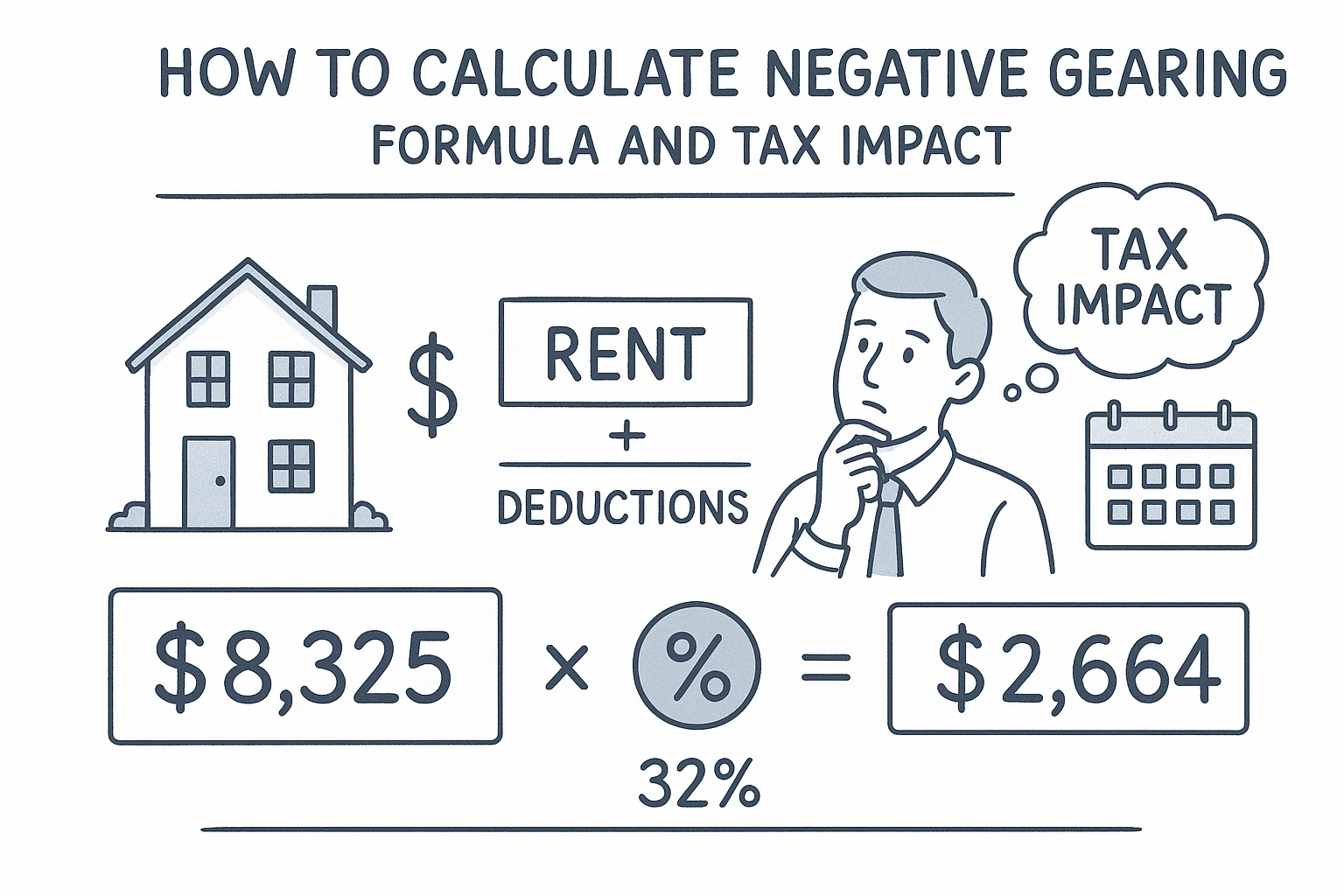
How to Calculate Negative Gearing: Formula and Tax Impact
You bought an investment property, the rent doesn’t cover the costs, and you want to know what that loss is actually worth at tax time. Many owners guess, or wait for their accountant to tell them in July. Working it out yourself beforehand is far better, because it shows whether the property can really carry its weight.
Here is the short answer. To calculate negative gearing, add up your rental income, subtract all deductible expenses (including loan interest, rates, insurance, agent fees and depreciation), and if the result is a loss, multiply that loss by your marginal tax rate. That figure is the tax you save. Note that you still lose money overall, because the refund only recovers part of the loss.
Below, we walk through the formula step by step with a worked Australian example, show which expenses count and which don’t, and explain how your tax bracket changes the outcome. You can then use the calculator to estimate your own tax impact. At Gartly Advisory, we run these numbers for Melbourne property investors every week, so the examples reflect real situations.
What negative gearing means for your tax
The idea in plain terms
A property is negatively geared when its deductible costs are higher than the rent it earns. The shortfall is a net rental loss, and the ATO lets you offset that loss against your other income, such as your salary or business profit. That lowers your taxable income, so you pay less tax.
Negative gearing is a tax outcome, not an investment strategy. You still fund the shortfall from your own pocket every month, and the tax saving recovers only part of it. If the numbers go the other way and rent beats expenses, the property is positively geared and the profit is added to your taxable income.
Negative gearing never turns a loss into a gain. It only reduces what the loss costs you.
The gain you are really chasing is capital growth over time. The tax saving just makes the holding costs easier to carry while you wait.
Why your marginal tax rate sets the saving
Your saving depends on the rate you pay on your last dollar of income, called your marginal rate. A higher earner saves more from the same loss than a lower earner does. Add the 2% Medicare levy, because a lower taxable income reduces that too.
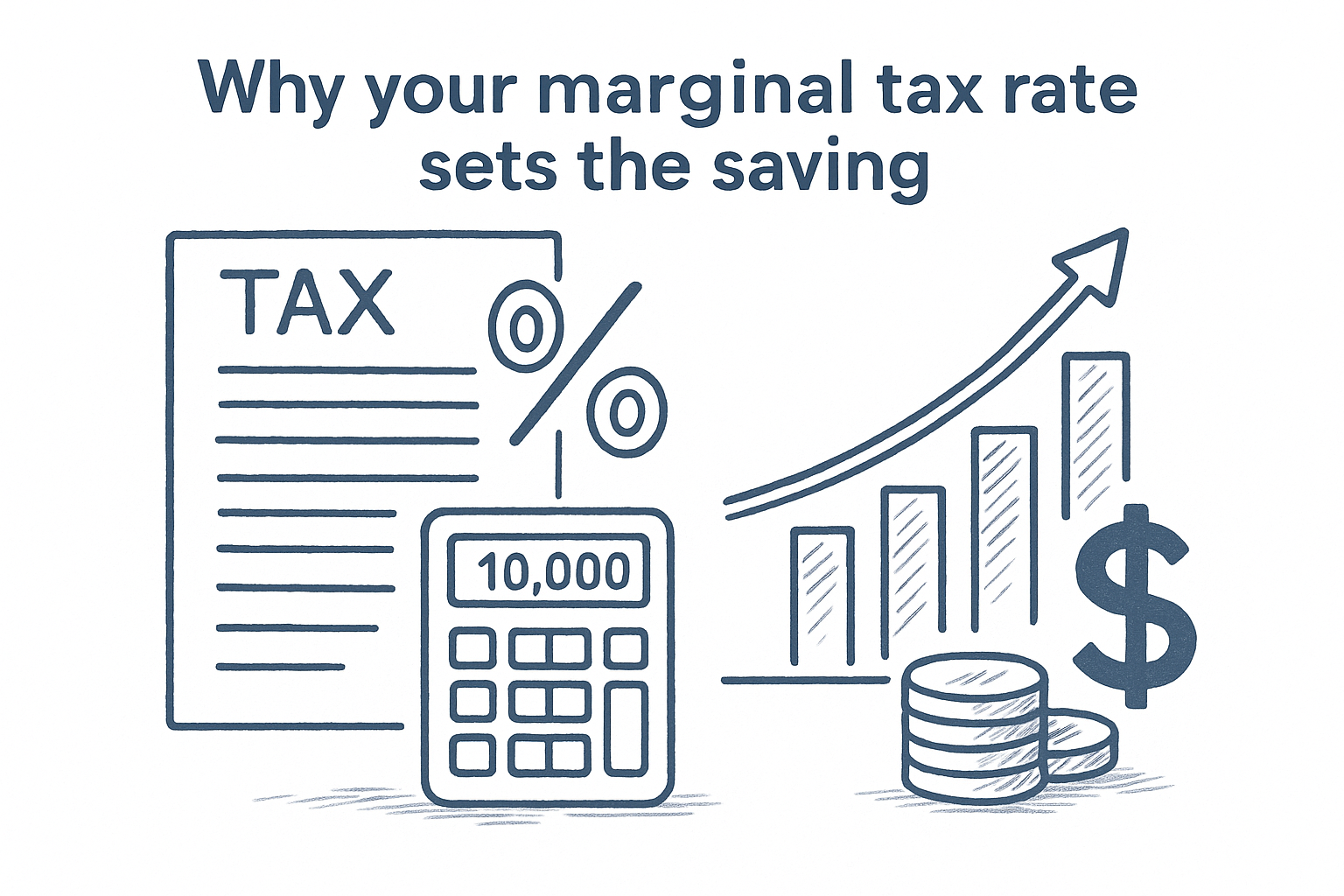
The table below shows the saving on a $10,000 rental loss, using resident rates for 2026-27. Check the ATO’s current resident tax rates before you rely on them.
| Taxable income | Marginal rate | With Medicare levy | Tax saved on a $10,000 loss |
|---|---|---|---|
| $18,201 to $45,000 | 15% | 17% | $1,700 |
| $45,001 to $135,000 | 30% | 32% | $3,200 |
| $135,001 to $190,000 | 37% | 39% | $3,900 |
| Over $190,000 | 45% | 47% | $4,700 |
So someone on $110,000 with a $10,000 loss gets $3,200 back and still carries $6,800 of real cost. That gap is why you should know how to calculate negative gearing before you buy, not after. The next three steps give you the full calculation: rent in, expenses out, then the loss multiplied by your rate.
Step 1. Add up your annual rental income
What counts as rental income
The first figure you need when working out how to calculate negative gearing is gross rent for the financial year, 1 July to 30 June. Count what you actually received, not what the lease says you should have received. Weekly rent is only part of it. The ATO also treats these as assessable:
- Rent received, including rent paid in advance
- Any part of the bond you keep for unpaid rent or damage
- Insurance payouts for lost rent
- Short-term letting income, such as Airbnb bookings
- Fees tenants pay you, such as lease break fees
Count the rent you received in the year, not the rent you expected.
Where to find the figures
Your property manager’s end-of-year statement shows total rent collected, usually by late July. Use the gross figure, not your bank deposits, because agents take their fees out before paying you. If you self-manage, add up every deposit for the year.
Two adjustments catch people out. If you owned or rented the property for only part of the year, count only that period. If you co-own it, report your ownership share, such as 50%, not the full rent.
For example, a Melbourne unit let at $550 a week with two weeks vacant brings in 50 weeks of rent. That is $27,500 of rental income, and it is the first number you carry into Step 2.
Step 2. Total your deductible expenses and depreciation
Expenses you can claim
Start with every cost of holding the property. The ATO lets you deduct costs in the year you incur them, provided they relate to earning rental income. Here are typical claims for our $27,500 unit:
- Loan interest: $22,000
- Strata fees: $2,800
- Council rates and water: $2,400
- Agent fees (7%): $1,925
- Landlord insurance: $1,200
- Repairs and maintenance: $1,500
Those add up to $31,825. Interest is usually the biggest line, so take the figure from your lender’s annual statement, not from your repayments.
Loan interest is deductible, but principal repayments are not.
Some costs never belong on this list. Stamp duty and purchase costs go into your capital gains tax cost base. A capital improvement, such as an extension, is claimed over many years. Repairs that fix wear and tear are deductible now, but upgrades are not.
Depreciation, the deduction that costs you nothing
Depreciation is a non-cash deduction, so it lowers your taxable income without any money leaving your account. Under the capital works rules, you can claim 2.5% a year of the construction cost for residential buildings built after 15 September 1987. Fixtures such as carpets and ovens fall under plant and equipment, but if you bought a second-hand residential property after 9 May 2017, you can only claim new items you add yourself.
A quantity surveyor’s depreciation schedule usually costs a few hundred dollars, and that fee is deductible too. Say ours shows $4,000 for the year. Total expenses become $35,825, and that is the second number you carry into Step 3.
Step 3. Work out your loss and tax saving
The formula
Now combine the figures from Steps 1 and 2. Subtract expenses from income first, then apply your rate to the net rental loss. A positive result is rental profit, which is added to your taxable income instead.
Net rental result = rental income - total deductible expenses
Tax saving = net rental loss x (marginal rate + 2% Medicare levy)
Applying it to our unit
Rent of $27,500 less expenses and depreciation of $35,825 leaves a net rental loss of $8,325. Say you earn $110,000. Your marginal rate is 30% plus the 2% Medicare levy, so the tax saving is $2,664.
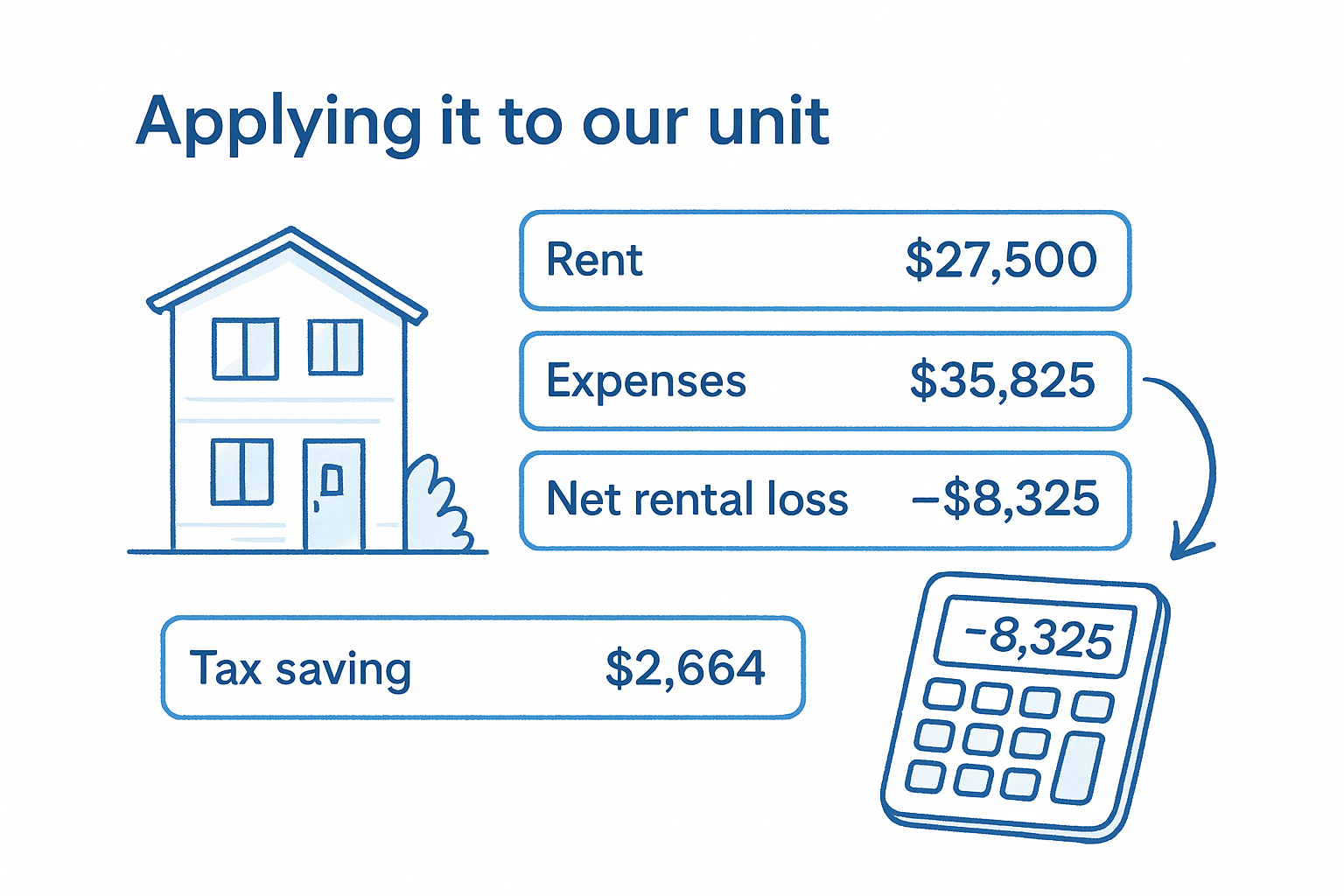
| Item | Amount |
|---|---|
| Rental income | $27,500 |
| Expenses and depreciation | $35,825 |
| Net rental loss | $8,325 |
| Tax saving at 32% | $2,664 |
Multiply the loss, not the expenses, by your marginal rate.
Watch for bracket boundaries. A large loss can drag part of your income into a lower bracket, so the saving shrinks. If your taxable income sits near a threshold, compare your tax with and without the loss and apply each rate only to the slice it covers.
Worked example and what to check next
The full picture for our unit
Tax saving is only half the story, because your budget runs on cash. Our unit collects $27,500 and spends $31,825 in cash, a shortfall of $4,325. Subtract the $2,664 tax saving and you pay $1,661 a year, about $32 a week. Depreciation does the heavy lifting, since it creates a deduction without any money leaving your account.
Judge a property by its after-tax cash cost, not by the size of its tax deduction.
Use this as your calculator, swapping in your own figures:
Net loss    = rental income - cash expenses - depreciation
Tax saving  = net loss x (marginal rate + 0.02)
Cash cost   = (cash expenses - rental income) - tax saving
Checks before you rely on the number
Before you trust any result from this method of how to calculate negative gearing, test it against four points:
- Loan purpose: only interest on money borrowed for the rental is deductible. A redraw used for a holiday is not.
- Records: keep statements, invoices and your depreciation schedule for five years.
- Tax bracket: rerun the sums with your actual taxable income, not a rounded guess.
- PAYG variation: you can ask the ATO to vary your withholding, so the saving reaches your pay during the year instead of arriving as a refund.
Finally, ask whether the capital growth can outrun the loss. Our unit costs $1,661 a year after tax, so modest growth covers it. A property with a $15,000 cash shortfall needs far more, and rising interest rates can quickly widen that gap.
Putting the numbers to work
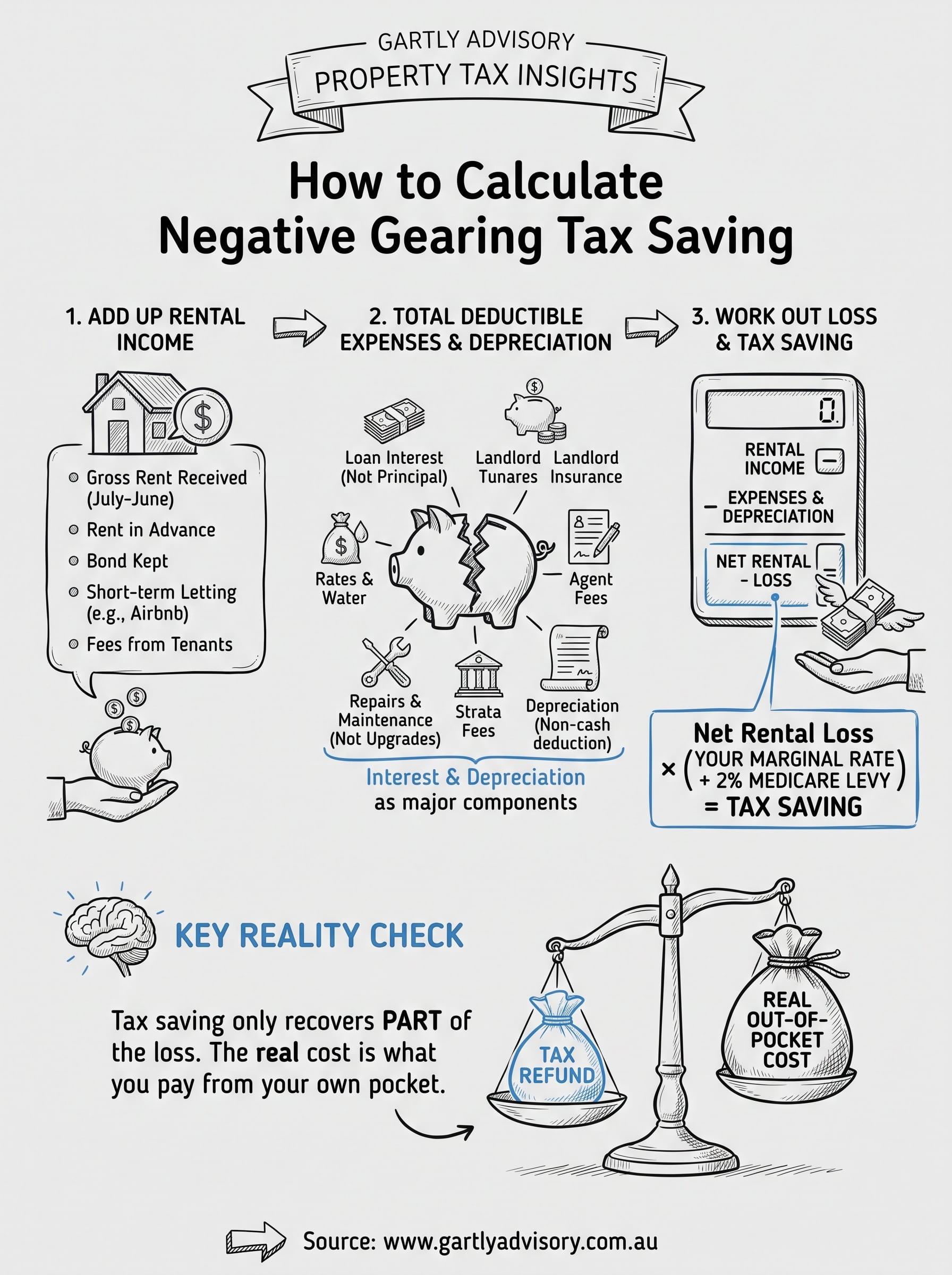
Knowing how to calculate negative gearing comes down to three moves. Add up the rent you received, subtract every deductible expense including depreciation, then multiply any loss by your marginal rate plus the Medicare levy. Our Melbourne unit lost $8,325 on paper, saved $2,664 in tax and cost $1,661 a year in cash.
Remember that the tax saving only recovers part of the loss. The real test is whether capital growth and rent rises can outpace what you pay out of pocket, and whether your budget can survive higher interest rates.
Your own figures will differ, and bracket boundaries, co-ownership and loan purpose can all change the result. If you want a second pair of eyes before you buy or lodge, talk to the Gartly Advisory property accountants and we will run the calculation with you and flag what you can and can’t claim.