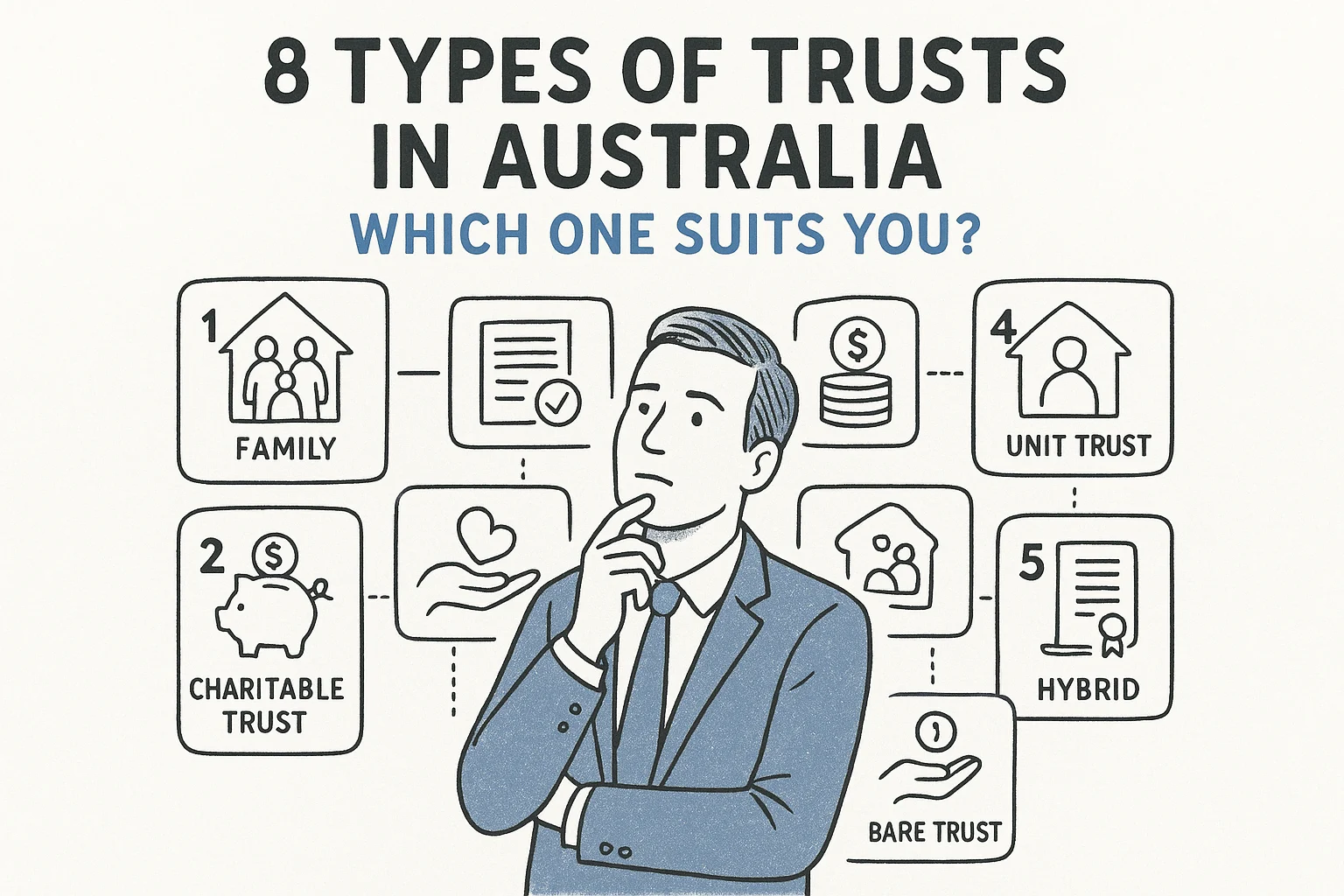
8 Types of Trusts in Australia: Which One Suits You?
Setting up a trust sounds simple until you actually try to choose one. Ask five different people about the types of trusts in Australia and you will get five different answers, each convinced their structure is the right one. That confusion costs business owners real money, either through the wrong setup from day one or years of paying for a structure that no longer fits their circumstances.
This article walks through the eight trust structures we see most often in our Melbourne practice, from discretionary family trusts to unit trusts and testamentary trusts. You will learn what each one actually does, who tends to use it, and the practical trade offs between asset protection, tax flexibility, and control that most guides skip over.
We have set up and managed trust structures for hundreds of clients across trades, property, and franchise businesses, so this is not theory. By the end, you will have a clearer picture of which structure matches your business goals and be ready for a proper conversation with your accountant about making it work.
1. Discretionary trusts (family trusts)
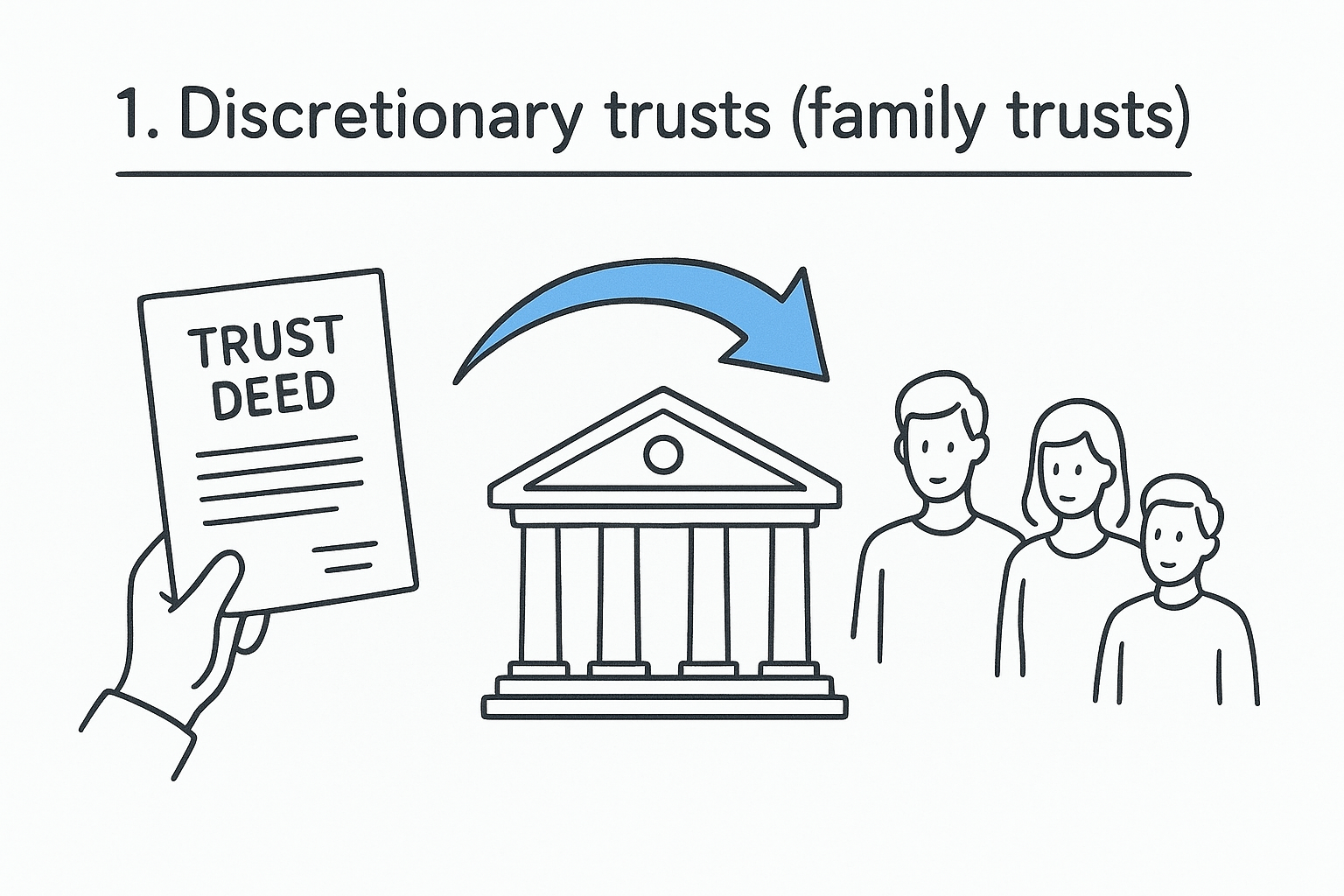
Discretionary trusts, often called family trusts, are the workhorse of small business structuring in Australia. A trustee holds assets or runs a business on behalf of a group of beneficiaries, usually family members, but nobody has a fixed entitlement to income or capital until the trustee actually decides to distribute it. That discretion is the whole point, and it is why this structure sits at the top of most types of trusts in Australia discussions, as our plain English guide to family trusts explains in more detail.
How it works
The person who sets up the trust (the settlor) signs a trust deed, then hands control to a trustee, who can be an individual or a company, and the steps involved in establishing a family trust follow a fairly set order. Each year, the trustee decides who among the named beneficiaries gets income or capital, and how much. Nobody has an automatic right to anything, which gives the trustee real flexibility to respond to changing family or business circumstances.
Who it suits
We recommend this structure most often for family-owned trading businesses, property investors holding assets outside super, and business owners who want to split income across a spouse, adult children, or a corporate beneficiary. It works particularly well when family members sit on different marginal tax rates.
Key benefits
The standout advantage is tax planning flexibility. Distributing income to beneficiaries on lower tax brackets each year is one of the legal strategies for cutting the family’s overall tax bill, and assets held in trust generally sit outside a beneficiary’s personal estate if they get sued or divorced.
A discretionary trust gives you control without ownership, which is exactly what protects the assets inside it.
Potential drawbacks
Trust losses cannot be distributed to beneficiaries the way profits can, so a loss-making year offers no immediate tax relief. The annual trustee resolutions also need to be documented properly before 30 June or the tax office can tax the trust income at the top marginal rate. Banks sometimes view discretionary trusts less favourably for lending purposes too, since no single beneficiary has a guaranteed stake, which can complicate finance applications for larger asset purchases or business expansion.
2. Fixed trusts
Fixed trusts flip the discretionary model on its head. Instead of a trustee deciding who gets what, each beneficiary holds a fixed entitlement to a set percentage of income and capital, spelled out in the trust deed from day one. That certainty makes fixed trusts a different animal entirely from the family trust structure above, where the difference between a family trust and a discretionary trust is really just a difference in name, even though all of them sit under the same broad umbrella of types of trusts in Australia.
How it works
Beneficiaries are allocated a specific proportion of the trust’s income and capital, often expressed as units or a percentage share, and the trustee has no discretion to redirect that entitlement elsewhere. Whatever the trust earns flows through to beneficiaries in those fixed proportions, year after year.
Who it suits
We see fixed trusts used mainly where beneficiaries need certainty for government or lending purposes, such as land tax concessions in some states, or where an unrelated group of investors wants a clear, unchangeable stake in a jointly held asset.
Key benefits
Fixed entitlements can unlock land tax thresholds and certain government concessions that discretionary trusts miss out on, and lenders generally view the guaranteed stake more favourably.
Certainty is the whole appeal of a fixed trust, but it comes at the cost of the flexibility you get elsewhere.
Potential drawbacks
Death, divorce, or a falling out among beneficiaries can force a costly restructure, and there is far less scope to shift income towards lower tax brackets each year.
3. Unit trusts
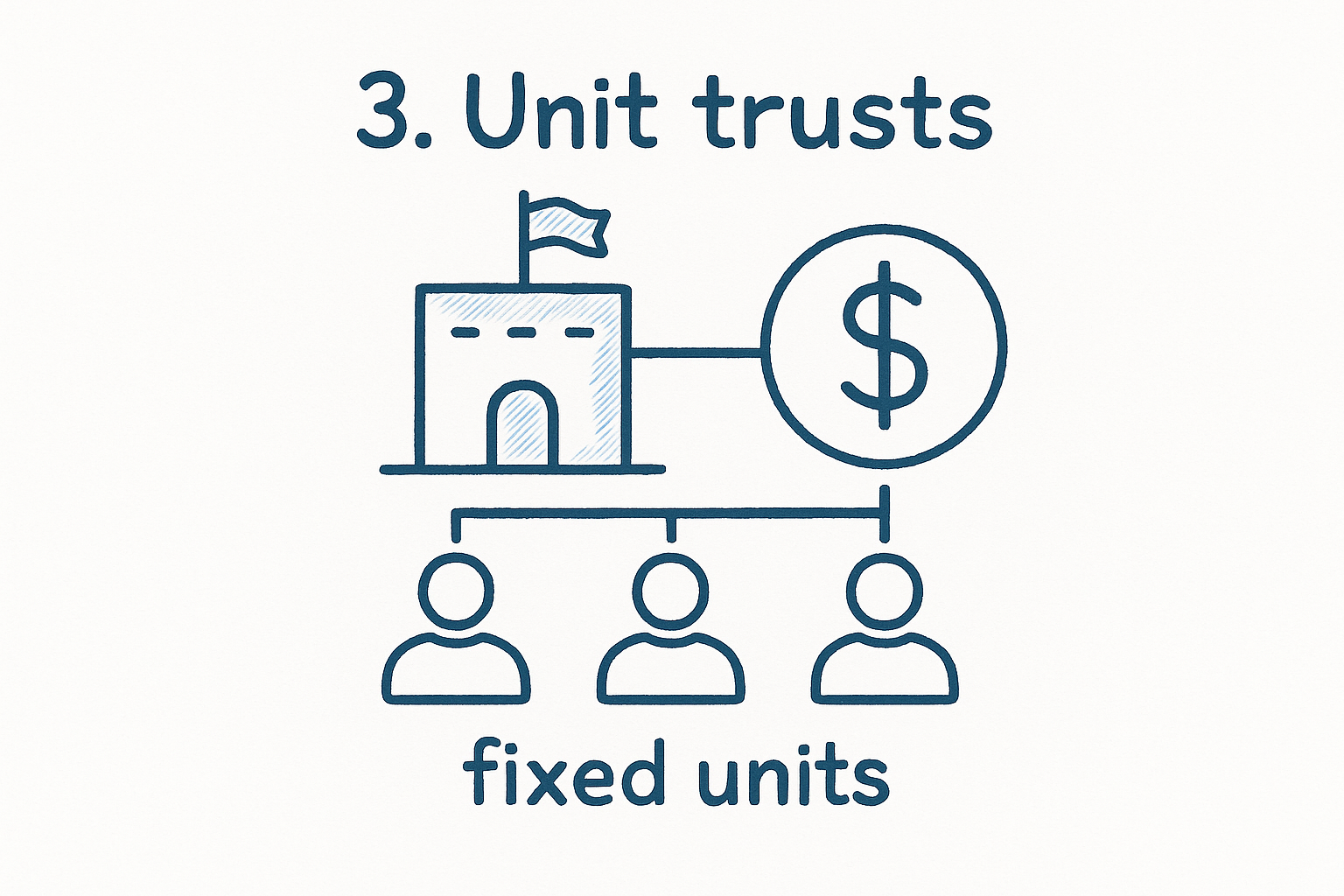
Unit trusts work like a company wearing a trust structure. The trust’s capital is divided into fixed units, similar to shares, and each unitholder owns a proportional slice of the trust’s income and assets based on how many units they hold. Unlike a discretionary trust, there is no guessing who benefits each year, and unlike a straight fixed trust, units can usually be bought, sold, or redeemed, which gives the structure a bit more commercial flexibility.
How it works
Investors buy units at an agreed value, and the trustee manages the underlying assets or business on their behalf. Income and capital gains flow through to unitholders in direct proportion to their unit holding, with no discretion involved.
Who it suits
We use unit trusts most often for joint ventures between unrelated parties, such as two families going into a property development together, or where investors want a tradeable stake in a shared business without the complexity of a company structure.
Key benefits
Each party’s ownership is transparent and can be transferred without unwinding the whole arrangement, which suits situations where investors expect to enter or exit over time.
Unit trusts suit partnerships between separate parties who each want a clear, tradeable share, not one family’s discretionary control.
Potential drawbacks
Capital gains and losses attach to unitholders regardless of their personal tax position, and unit trusts generally lack the income-splitting flexibility that makes discretionary trusts so popular for family businesses, a key difference worth comparing side by side before you commit.
4. Hybrid trusts
Hybrid trusts blend the fixed and discretionary models into one deed, giving unitholders a guaranteed base entitlement while still leaving the trustee some discretion over surplus income. It is an attempt to grab the best of both worlds among the types of trusts in Australia, though the ATO has scrutinised these structures heavily in recent years, so they are far less common than they once were.
How it works
Unitholders hold fixed units entitling them to a set share of income or capital, but the trust deed also allows the trustee to distribute any additional income at their discretion, similar to a family trust. That dual mechanism is what separates a hybrid trust from a plain unit trust or a straightforward discretionary trust.
Who it suits
We rarely recommend hybrid trusts today, but they can occasionally suit business partners who want a guaranteed baseline return alongside some flexibility for discretionary distributions of surplus profit.
Key benefits
When structured well, a hybrid trust can combine borrowing advantages, since fixed unit interests may support loan arrangements, with some of the tax flexibility of a discretionary trust for leftover income.
A hybrid trust tries to serve two purposes at once, and that complexity is exactly why regulators watch it so closely.
Potential drawbacks
The ATO has removed or restricted several tax concessions previously available to hybrid trusts, particularly around interest deductibility, and the added structural complexity makes them more expensive to set up and maintain than either fixed or discretionary trusts alone.
5. Testamentary trusts
Testamentary trusts only spring into existence when someone dies, created through instructions written into a will rather than set up during a person’s lifetime. Among the types of trusts in Australia, this one belongs firmly in the estate planning toolkit rather than day-to-day business structuring, and it works alongside broader estate planning advice rather than replacing them.
How it works
Rather than assets passing straight to beneficiaries, the will directs some or all of the estate into a trust, managed by a nominated trustee for the benefit of children, a spouse, or other family members. The trust only activates on death, and the deceased’s will sets its terms in advance.
Who it suits
Parents with minor children, blended families wanting to protect inheritances from a future divorce, and anyone worried about a beneficiary’s spending habits or vulnerability to creditors tend to benefit most from this structure.
Key benefits
Income distributed to minor beneficiaries from a testamentary trust is taxed at adult tax rates rather than the punitive rates that normally apply to children’s unearned income, and the trust structure shields inherited assets from a beneficiary’s later relationship breakdown or business failure.
A testamentary trust protects an inheritance long after you’re no longer around to protect it yourself.
Potential drawbacks
Creating a testamentary trust through your will requires careful drafting, usually with a solicitor and accountant working together, and ongoing administration continues to cost money each year the trust remains active.
6. Charitable trusts
Charitable trusts exist to hold and distribute assets for a charitable purpose rather than for the benefit of named individuals. They sit apart from the other types of trusts in Australia covered so far because the beneficiary is a cause, not a person, and that distinction shapes every rule that follows, from registration to tax treatment.
How it works
A settlor transfers money or property into the trust, and a trustee manages those assets for purposes the law recognises as charitable, such as relieving poverty, advancing education, or supporting religion. To access tax concessions, the trust generally needs to register with the Australian Charities and Not-for-profits Commission and meet ongoing reporting obligations.
Who it suits
We see charitable trusts used by business owners wanting a structured, ongoing way to give back, families setting up a private ancillary fund, and philanthropists who want control over how donated funds get distributed over time rather than handing over a lump sum.
Key benefits
Registered charitable trusts can access income tax exemptions and allow donors to claim tax deductions for contributions, which makes structured giving considerably more tax-effective than ad hoc donations.
A charitable trust turns generosity into a repeatable, tax-effective system rather than a one-off gesture.
Potential drawbacks
Compliance obligations are strict and ongoing, assets must be applied strictly to charitable purposes with no scope for personal benefit, and winding one up or changing its purpose later usually requires regulatory approval.
7. Superannuation trusts
Superannuation trusts hold retirement savings on behalf of members, and every super fund in Australia, whether it is a massive industry fund or an SMSF run by its own members, operates as a trust under the law. Among the types of trusts in Australia, this one touches almost every working adult, even if most people never think of their super balance as sitting inside a trust structure.
How it works
Members contribute money, and one or more trustees invest and manage those contributions according to strict superannuation law, with the sole purpose of providing retirement benefits. In a self-managed super fund, the members themselves usually act as trustees, giving them direct control over investment decisions rather than leaving that choice to a fund manager.
Who it suits
Business owners wanting hands-on control over their retirement investments, including buying commercial property their own business leases, are the classic candidates for setting up and running an SMSF.
Key benefits
Concessional tax rates on contributions and earnings make superannuation trusts one of the most tax-effective structures available, and an SMSF adds the flexibility to invest directly in property, shares, or other assets you choose.
Superannuation trusts reward patience with some of the lowest tax rates in the entire system.
Potential drawbacks
Compliance is unforgiving, breaches of superannuation law carry serious penalties, and running an SMSF properly demands ongoing administration most business owners underestimate at the outset.
8. Bare trusts
Bare trusts are the simplest structure on this list. A trustee holds legal title to an asset, but the beneficiary has full and immediate rights to the capital and income, and can call for the asset to be transferred to them at any time. Because the trustee has no discretion whatsoever, this structure barely resembles the other types of trusts in Australia we’ve covered, yet it turns up constantly in property and lending arrangements.
How it works
Legal ownership sits with the trustee, but beneficial ownership, meaning all the rights and tax obligations, stays with the beneficiary. The trustee acts purely on instruction, with no power to withhold income or redirect entitlements.
Who it suits
We most often see bare trusts used for SMSF property purchases under limited recourse borrowing arrangements, where the rules for buying property inside an SMSF apply, and for holding assets on behalf of a minor or someone who cannot yet hold title directly.
Key benefits
Setup is quick and inexpensive compared with discretionary or unit trusts, and the arrangement satisfies lending requirements for SMSF borrowing without adding real complexity.
A bare trust holds the title, but the beneficiary holds everything that actually matters.
Potential drawbacks
Entitlements are fixed and immediate, so there’s no scope for income splitting or asset protection benefits, and all capital gains and tax liabilities pass straight through to the beneficiary regardless of their personal circumstances.
9. How to choose the right trust structure for you
Picking from the types of trusts in Australia listed above comes down to answering a handful of practical questions before you sign anything. Ask yourself what you actually need protected, who benefits, how much flexibility you want the trustee to have year on year, and whether a trust or a company suits the business better. Get these answers wrong and you end up paying for a restructure later, which costs far more than getting proper advice upfront.
Several factors decide which structure fits your situation, and it helps to weigh them side by side:
| Factor | Points toward |
|---|---|
| Family business with variable income | Discretionary trust |
| Unrelated investors, joint venture | Unit trust |
| Land tax or lending certainty needed | Fixed trust |
| Estate planning for minors or blended family | Testamentary trust |
| Retirement savings, direct property control | Superannuation trust (SMSF) |
| Simple asset holding, SMSF borrowing | Bare trust |
The right trust structure isn’t the most flexible one, it’s the one that matches your actual goals.
Considering your succession plans as a business owner matters just as much as your current tax position, since a structure that suits you today might not suit the business in ten years. Talking through your specific circumstances, including how you want assets protected and distributed, with someone who has set up hundreds of these structures beats guessing based on a generic checklist every time.
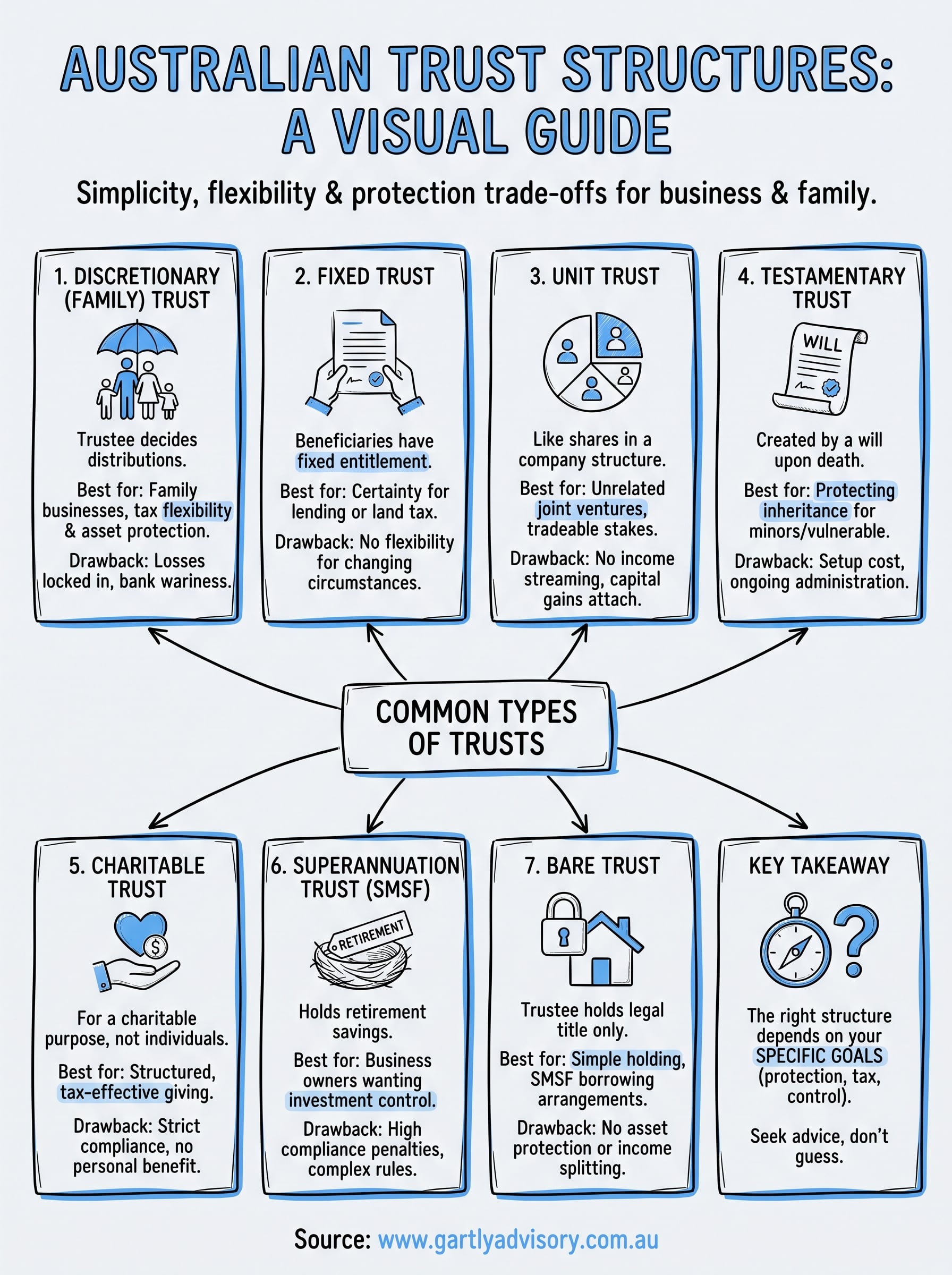
Making the right choice for your circumstances
Every structure covered here solves a different problem, and none of them is universally "best". A discretionary trust suits the family business splitting income across relatives, while a testamentary trust protects an inheritance for children long after you’re gone. Unit trusts serve unrelated partners, superannuation trusts build retirement wealth, and bare trusts quietly hold title in the background of an SMSF property deal. The trick isn’t memorising all eight, it’s matching your actual goals, whether that’s asset protection, tax planning, or a smooth succession, to the structure built for that purpose.
Getting this decision right from the start saves you thousands in restructuring costs down the track, and it’s rarely something you should settle through guesswork or a generic template. Your circumstances are specific, so the advice should be too. If you want that clarity, walk through the step-by-step process of setting up a trust in Australia, then book a conversation with our team at Gartly Advisory and we’ll help you land on the structure that actually fits.