
ATO Tax Return Audit Red Flags: A Small Business Guide to Staying Compliant
For many small business owners, the thought of a letter from the Australian Taxation Office can cause instant anxiety. You work hard to do the right thing, but the fear of a stressful audit often looms, turning tax time into a period of worry. It’s easy to question whether an honest mistake could be misinterpreted or if your deductions fall outside the norm. Understanding the most common ATO tax return audit red flags is the first step towards replacing that uncertainty with confidence and ensuring your business remains compliant.
In this guide, we provide the professional support you need to navigate the complex world of tax compliance. We will demystify what triggers the ATO’s attention, offer clear guidance on preparing a low-risk tax return, and provide actionable steps to ensure your records are in order. Our goal is to give you the peace of mind that comes from knowing your tax affairs are managed correctly, allowing you to focus on what you do best: growing your business.
Understanding ATO Audits: How and Why They Happen
The mere mention of a tax audit can cause anxiety for any small business owner. However, it’s important to understand that audits are a standard and necessary part of ensuring Australia’s tax system remains fair for everyone. They are not always a sign that you have done something wrong. Our goal in this guide is to demystify the process, providing you with the knowledge to feel prepared and confident in your compliance, and to help you recognise potential ato tax return audit red flags before they become an issue.
To help you grasp the key concepts, this video provides a helpful overview:
The Power of Data: How the ATO Selects Returns
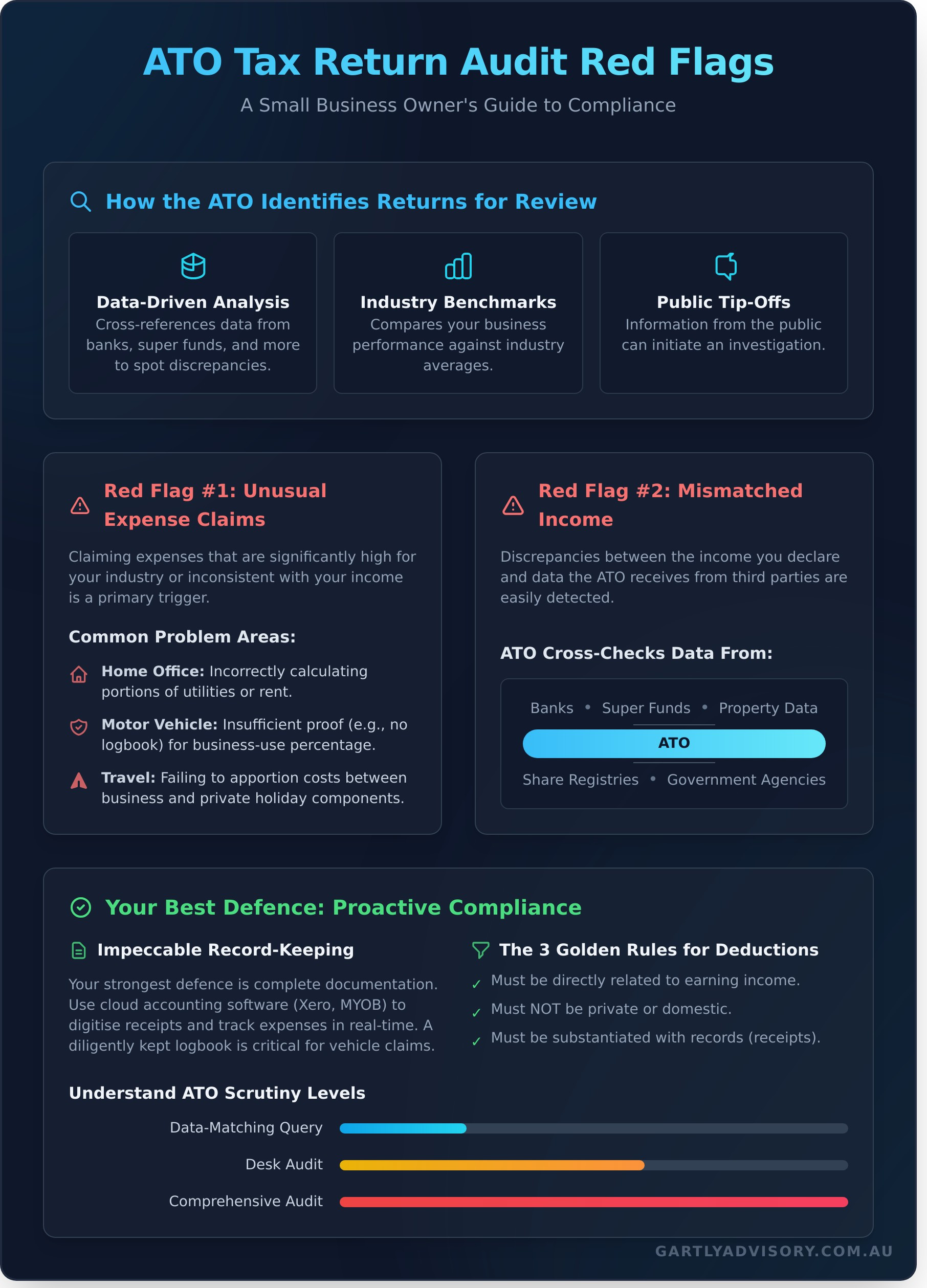
In the digital age, the Australian Taxation Office (ATO) no longer relies on random chance. It uses a highly sophisticated, data-driven approach to identify returns that may require a closer look. This system cross-references information from various sources to spot discrepancies, including data from banks, super funds, property transactions, and share registries. The ATO also uses industry benchmarks to compare your business’s performance against similar businesses. If your declared income or expenses are significantly different from the industry average, it can trigger a review. Finally, tip-offs from the public remain a valid source of information for initiating an investigation.
Not All Reviews Are Alike: Types of ATO Scrutiny
Receiving a letter from the ATO doesn’t automatically mean you are facing a full-blown, comprehensive audit. The level of scrutiny can vary significantly, and understanding the difference can help manage the process effectively. The main types include:
- Data-Matching Query: Often a simple letter asking for clarification on a specific discrepancy found through their data-matching programs, such as undeclared interest income.
- Desk Audit: A more focused review where an ATO officer examines specific claims or deductions in your return. They will typically request you provide supporting documents to verify your claims.
- Comprehensive Audit: The most intensive review, involving a full examination of your business’s financial affairs, often spanning multiple years. This is less common and usually reserved for more complex cases.
Red Flag #1: Unusually High or Inconsistent Expense Claims
Of all the potential ato tax return audit red flags, claiming expenses that are unusually high for your industry or inconsistent with your income is one of the most common triggers. The Australian Taxation Office (ATO) uses sophisticated data-matching systems to analyse your claims. It compares your figures against the ATO small business benchmarks for your industry, and any significant deviations can signal a need for closer inspection.
To ensure your claims are legitimate and defensible, always follow the three golden rules for deductions. The expense must:
- Be directly related to earning your assessable income.
- Not be private or domestic in nature.
- Be substantiated with a record (like a receipt or invoice).
Common Problem Areas for Small Businesses
Navigating deductions can be complex, and certain areas frequently cause issues for business owners. Be particularly diligent with:
- Home office expenses: Errors often occur when calculating the portion of utility bills or rent. Whether using the fixed rate or actual cost method, you must have a dedicated workspace and clear records.
- Motor vehicle expenses: The logbook method allows for higher claims but requires a detailed 12-week logbook to prove business-use percentage. The simpler cents per kilometre method is capped and may not reflect your actual costs.
- Travel expenses: If a business trip includes a personal holiday component, you must carefully apportion costs and only claim the business-related portion.
- Private expenses: Attempting to claim personal expenses, such as family meals, entertainment, or personal subscriptions, as business costs is a direct path to an audit.
Your Best Defence: Impeccable Record-Keeping
Your strongest defence against an ATO audit is clear, organised, and complete documentation. Receipts, invoices, and bank statements are not optional; they are your proof. Modern cloud accounting software like Xero or MYOB can be a powerful tool, helping you digitise receipts and track expenses in real-time, ensuring nothing is missed and everything is categorised correctly.
For motor vehicle claims, a diligently kept logbook is your most critical piece of evidence. Ultimately, robust record-keeping provides the substantiation needed to give you peace of mind and proves that every deduction is legitimate and directly tied to running your business.
Red Flag #2: Mismatched Income and Data Discrepancies
In today’s digital age, the Australian Taxation Office (ATO) has access to a vast amount of financial data from various third-party sources. One of the simplest and most common triggers for an audit is a discrepancy between the income you declare on your tax return and the data the ATO has on file for you. Their sophisticated systems are designed to automatically cross-check this information, making undeclared income one of the most easily identifiable ato tax return audit red flags.
Omitting income, whether by accident or intentionally, sends a clear signal to the ATO that your return may require closer inspection. As your trusted partner, we provide the guidance to ensure all your revenue streams are accurately reported, safeguarding your business from unnecessary scrutiny. It is crucial to remember that this includes not just your primary business revenue but all forms of income you receive.
Sources the ATO Cross-Checks
The ATO’s data-matching program is extensive. They receive regular reports from a wide range of institutions, expecting the information to align with what you’ve lodged. Key sources include:
- Banks and financial institutions: Reporting all interest earned on business and personal accounts.
- Share registries: Providing data on dividend income and the sale of shares.
- Government agencies: Sharing information on payments from sources like Centrelink or various business grants.
- Digital platforms: Including ride-sharing services, short-term accommodation websites (like Airbnb), and other gig economy platforms that report payments made to participants.
Capital Gains Tax (CGT) Events
Selling a significant business asset, such as property, shares, or specialised equipment, triggers a Capital Gains Tax (CGT) event. The ATO receives data on these disposals from sources like land title offices and financial markets and will expect to see the corresponding capital gain or loss declared in your tax return. Failing to report these events is a significant oversight. Meticulous record-keeping is essential to correctly calculate the asset’s cost base and determine the accurate capital gain, an area where professional advice can provide invaluable support and clarity.
Red Flag #3: Operating Outside Small Business Benchmarks
The Australian Taxation Office (ATO) collects and analyses data from millions of tax returns to establish ‘small business benchmarks’. These are financial ratios that reflect the average performance of businesses within specific industries. When your business’s figures fall significantly outside these benchmarks, it can be one of the more common ato tax return audit red flags. The ATO’s sophisticated data-matching systems may interpret a major deviation as a sign of unreported income or incorrectly claimed expenses.
However, it is crucial to understand that operating outside the benchmark is not automatically an admission of guilt. Many businesses have unique models or circumstances that lead to different results. The key is having a valid reason for the variance and the records to prove it.
Key Ratios the ATO Monitors
The ATO compares your performance against industry peers using several key ratios. Understanding what they look for provides valuable insight into both your financial health and your compliance risk. The main benchmarks include:
- Cost of sales to turnover: This shows the percentage of your sales revenue spent on the direct costs of the goods or services you sell. A very low ratio might suggest to the ATO that not all sales have been declared.
- Total expenses to turnover: This compares your complete business expenses to your total income. An unusually high ratio could indicate that you are over-claiming deductions.
- Labour to turnover: This measures your labour costs (including wages and superannuation) as a percentage of your turnover. A figure far from the benchmark could raise questions about cash wages or contractor arrangements.
What to Do If Your Business is an Outlier
If you suspect your business might be an outlier, the first step is to proactively check your performance against the benchmarks published on the ATO website. The most important next step is to understand why you are different. Perhaps your premium business model results in a higher cost of sales, or maybe you invested heavily in new staff this year, increasing your labour ratio.
Whatever the reason, maintaining clear and comprehensive records that justify your position is essential. This documentation will be your best defence if the ATO asks for an explanation. Navigating these benchmarks can be complex, and interpreting them correctly is vital for managing your risk. If you’re unsure how your business stacks up or why you might be an outlier, we can provide expert guidance. Let us help you analyse your performance against industry benchmarks.
Red Flag #4: Issues with GST, BAS, and Employee Obligations
The ATO’s view of your business compliance extends far beyond your annual income tax return. They build a comprehensive picture using all the information you lodge, including your Business Activity Statements (BAS) and payroll data. Inconsistencies between these reports are some of the most common ato tax return audit red flags, as they can suggest underlying errors or misreporting that may trigger a broader review of your affairs.
Maintaining accuracy and consistency across every lodgement is not just good practice-it’s essential for demonstrating your commitment to compliance and minimising the risk of an audit.
Common BAS and GST Errors
Your BAS lodgements are a regular touchpoint with the ATO, and errors here can quickly draw unwanted attention. The ATO’s sophisticated data-matching systems are designed to spot anomalies and discrepancies, such as:
- Incorrectly claiming GST credits: This includes claiming GST on purchases that are not creditable, such as private expenses, financial supplies, or items for which you don’t hold a valid tax invoice.
- Unusually large refund claims: A sudden, large GST refund that doesn’t align with your business’s typical trading patterns or industry benchmarks can signal a potential issue requiring investigation.
- Mismatched sales figures: A common and easily detectable error is when the total sales reported on your BAS for the financial year do not reconcile with the total income declared in your annual tax return.
Superannuation Guarantee (SG) Compliance
Of all your business obligations, failing to meet your Superannuation Guarantee (SG) commitments for your employees is one of the most serious. The ATO takes this responsibility very seriously. With the real-time data provided by Single Touch Payroll (STP), the tax office has complete visibility over whether you are paying the correct amount of super, and paying it on time. Non-compliance can lead to significant penalties, including the Superannuation Guarantee Charge (SGC), which is not tax-deductible and includes interest and administration fees.
Ensuring consistency across all your tax and employee obligations is fundamental to avoiding these ato tax return audit red flags. If you are feeling overwhelmed by these complexities, professional guidance can provide much-needed peace of mind. As your trusted partner in business, we can help ensure your lodgements are accurate and consistent. Talk to us at Gartly Advisory to get the support you need.
How to Minimise Your Audit Risk and Respond Confidently
Understanding the potential triggers for an ATO review is the first step, but the best strategy is always proactive prevention. By establishing good habits and seeking professional guidance, you can shift from a position of anxiety to one of confidence. Being prepared doesn’t just minimise your risk; it removes the fear associated with any potential contact from the Australian Taxation Office, allowing you to focus on what you do best-running your business.
Let us be your trusted partner in building a strong, compliant foundation for your success.
The Value of a Proactive Chartered Accountant
Partnering with an experienced Chartered Accountant is your most effective defence. We go beyond simple compliance; we act as your strategic advisor to ensure your financial affairs are structured for both compliance and efficiency. A proactive accountant provides invaluable support by:
- Identifying potential ato tax return audit red flags before your return is lodged, allowing for corrections and proper documentation.
- Offering expert guidance on structuring your business and transactions to align with tax laws and minimise scrutiny.
- Acting as your representative to communicate directly with the ATO, ensuring all correspondence is handled professionally and accurately.
What to Do If You Receive an ATO Letter
Receiving a letter from the ATO can be stressful, but it’s crucial not to panic. Often, the initial contact is simply a review or a request for more information to clarify something in your return. The most important thing is how you respond. Follow these simple steps:
- Do not ignore it. The ATO sets clear deadlines, and failing to respond can escalate the situation.
- Do not respond immediately. Before sending any information or speaking with the ATO, take a moment to prepare.
- Contact your accountant straight away. We can interpret the ATO’s request, help you gather the correct documentation, and formulate the most appropriate response on your behalf.
This ensures you provide exactly what is needed without inadvertently creating further questions. If you’ve been contacted by the ATO, schedule a consultation with us today. Let us provide the support you need to navigate the process with confidence.
Navigate Your Tax Obligations with Confidence and Clarity
Navigating the complexities of the Australian Taxation Office can feel daunting, but it doesn’t have to be. The key to staying compliant lies in proactive management and a clear understanding of your obligations. By maintaining meticulous records, ensuring consistency between your income and expenses, and operating within industry benchmarks, you can steer clear of the most common ato tax return audit red flags and protect your business.
You don’t have to manage this journey alone. True peace of mind comes from having an experienced partner by your side. At Gartly Advisory, we offer advice that goes beyond the numbers. With over 35 years of Chartered Accounting experience and the trust of our clients, reflected in our 70+ 5-Star Google Reviews, we provide the proactive support you need to thrive.
Partner with Gartly Advisory to ensure your tax affairs are compliant and optimised. Contact us for a complimentary consultation. Let us be your trusted partner, so you can focus on growing your business with complete confidence.
Frequently Asked Questions About ATO Audits
How far back can the ATO audit a tax return?
The Australian Taxation Office (ATO) generally has a standard period of review, which is two years for most individuals and small businesses. For businesses with more complex tax affairs, this extends to four years. It is crucial to understand that these time limits do not apply in cases of suspected fraud or tax evasion. In such situations, the ATO has the authority to go back an unlimited number of years, making diligent record-keeping absolutely essential for your protection.
Does using a tax agent reduce my chances of being audited?
While engaging a qualified tax agent doesn’t grant immunity from an audit, it significantly reduces the likelihood of errors that can trigger one. Professional agents ensure your claims are substantiated and align with ATO benchmarks, which helps avoid common mistakes. However, the ultimate responsibility for your tax return lies with you. Partnering with an experienced advisor provides peace of mind that your lodgements are accurate and compliant, which is the most effective way to minimise audit risk.
Are cash-based businesses more likely to be audited by the ATO?
Yes, businesses that deal heavily in cash are often subject to closer scrutiny from the ATO. This is due to the perceived higher risk of undeclared income. The ATO uses sophisticated data-matching and industry benchmarks to identify businesses whose reported income appears inconsistent with their sector. For any cash-based business, maintaining flawless records, using a modern point-of-sale system, and banking all takings are critical steps to demonstrate transparency and stay compliant.
What happens if the ATO finds a mistake in my tax return during an audit?
If the ATO discovers an error, they will issue an amended notice of assessment outlining the tax shortfall you need to pay. This amount will typically include interest charges on the unpaid tax. Depending on the nature of the mistake, penalties may also apply, ranging from 25% for a lack of reasonable care up to 75% for intentional disregard. Prompt and honest cooperation with the ATO during the process can often help in having the penalties reduced.
If I amend a previous tax return, will it automatically trigger an audit?
Amending a tax return does not automatically trigger a full-scale audit. In fact, the ATO encourages taxpayers to make voluntary disclosures to correct mistakes. Your amendment will be reviewed, and if it’s a simple, justifiable correction, it’s usually processed without further issue. However, frequent amendments or a change resulting in a large refund could increase scrutiny. It is always better to proactively correct an error yourself than to wait for the ATO to discover it.
Is it a red flag if my business makes a loss for several years in a row?
Reporting consecutive business losses can be one of the key ato tax return audit red flags. The ATO may review your activities to ensure you are running a genuine commercial enterprise and not simply offsetting other income with a hobby. To satisfy the non-commercial loss rules, you must demonstrate a clear business plan, a profit-making intention, and commercial viability. If your business is in a start-up phase, keeping detailed records that justify this initial loss period is essential.
Related Posts