
How to Improve Business Profitability: A Strategic Guide for Melbourne SMEs in 2026
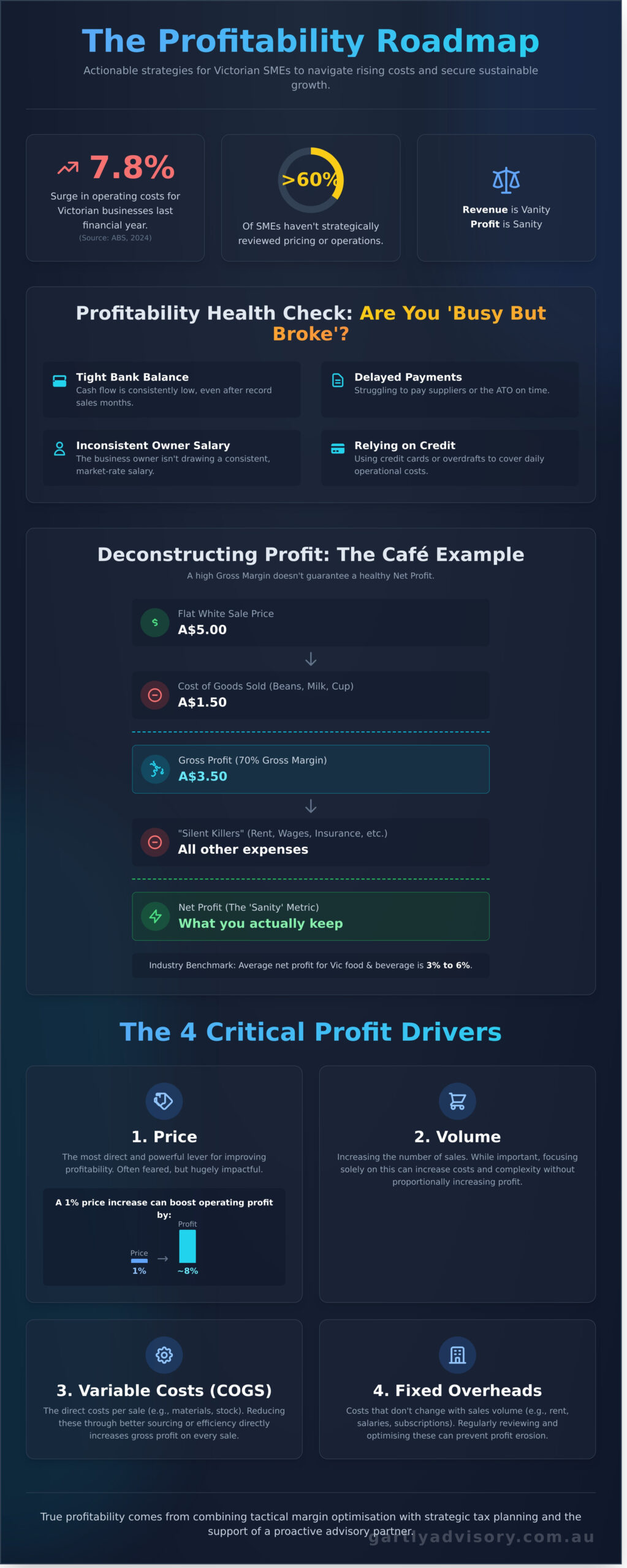
According to a 2024 report from the Australian Bureau of Statistics, operating costs for Victorian businesses surged by 7.8% over the last financial year. Despite this, over 60% of SMEs haven’t strategically reviewed their pricing or operational models to match, leaving potential profit on the table.
It’s a frustrating cycle. You’re working harder than ever, maybe even seeing more sales, but rising expenses and a hefty tax bill from the ATO seem to swallow every dollar of progress. For many Melbourne business owners, it feels less like running a company and more like being its most overworked employee. This guide is designed to change that. We’re going beyond simple cost-cutting to show you how to improve business profitability with actionable strategies that build resilience. You’ll discover how to truly understand your margins, optimise your tax position, and create sustainable cash flow to fund your goals, whether that’s expansion or simply a better lifestyle. We’ll walk you through a clear roadmap, covering everything from strategic pricing adjustments to maximising your business’s long-term value.
Key Takeaways
- Understand why high sales don’t always equal high profit in Melbourne’s current economic climate, and learn to focus on the ‘sanity’ metric that truly matters for business health.
- Discover how to strategically adjust your pricing and apply the 80/20 rule to your product or service mix to quickly and effectively boost your bottom line.
- Move beyond basic tax compliance to uncover smart strategies, like leveraging Small Business CGT concessions, that help you legally protect your profit and build long-term wealth.
- Learn a complete framework on how to improve business profitability by combining tactical margin optimisation with the support of a proactive advisory partner.
Why Your Sales Might Be Lying to You: Understanding Profitability in 2026
For many business owners, a rising sales figure feels like a major win. But revenue is a vanity metric; profit is sanity. A business can generate millions in sales and still be on the brink of collapse. This truth is more critical than ever for Melbourne businesses looking ahead to 2026. With persistent inflation impacting supply costs since the early 2020s and interest rates remaining a significant factor, the old model of simply selling more is no longer a reliable path to success. The key question isn’t just “how much did we sell?” but “how much did we keep?”
To begin exploring this vital distinction, this short video offers practical ways to protect your margins.
This is why the instinct to just ‘work harder’ often fails to solve a profit problem. Increasing sales volume without a clear understanding of your cost structure can actually accelerate losses. True, sustainable growth comes from working smarter, not longer. It requires a ‘beyond the numbers’ philosophy, where you look past the top-line sales figures to understand the intricate financial health of your operations. This is the first step in learning how to improve business profitability for the long term.
Gross Profit vs. Net Profit: Why Both Matter
Think of a popular café in Fitzroy. They sell a flat white for A$5.00. The cost of the coffee beans, milk, and cup (the Cost of Goods Sold or COGS) is A$1.50. Their gross profit per coffee is A$3.50, a healthy 70% gross margin. But this impressive number doesn’t pay the bills. Your net profit is what’s left after all other expenses are deducted. A high gross margin can quickly disappear, leading to a net loss, when you account for the ‘silent killers’ of net profit: exorbitant commercial rent, rising staff wages under the Hospitality Award, insurance, marketing subscriptions, and loan repayments.
The Profitability Health Check
Are you feeling ‘busy but broke’? It’s a common challenge for small businesses. Key warning signs include:
- Your bank balance is consistently tight, even after a record sales month.
- You’re delaying payments to the ATO or your suppliers.
- The business owner isn’t drawing a consistent, market-rate salary.
- You rely on credit cards or overdrafts to cover operational costs.
A crucial step is to benchmark your performance. For example, data from industry analysts in 2024 showed the average net profit margin for Victorian food and beverage services was between 3% and 6%. If your business is falling short, it’s a clear signal that your cost structure needs immediate attention. This is where modern tools become indispensable. Cloud accounting platforms like Xero provide a real-time dashboard of your financial health. Having instant access to your profit and loss statement is fundamental to making smart decisions. Understanding profitability analysis is not just a task for your accountant at tax time; it’s a vital, ongoing process for any serious business owner wanting to know how to improve business profitability and build a resilient enterprise.
The Four Critical Drivers to Improve Business Profitability
Understanding how to improve business profitability isn’t about finding a single silver bullet. It’s about methodically adjusting four critical drivers that control your financial outcomes. Think of them as the primary controls in your business’s cockpit: Price, Volume, Variable Costs, and Fixed Overheads. Each one has a distinct impact, and mastering them in concert is the key to sustainable financial health. Many business owners focus heavily on increasing sales volume, but often, the most significant gains are found elsewhere.
Mastering the Price Lever
Price is the most direct and powerful lever you can pull. A landmark study by global strategy firm Simon-Kucher & Partners found that a 1% increase in price, assuming volume remains stable, can boost operating profits by an average of 8%. That’s a disproportionately massive impact from a small adjustment. Yet, many Australian business owners fear raising prices, worried they’ll lose customers to cheaper competitors. This fear is often a symptom of not fully appreciating the value you provide. The solution lies in shifting from a cost-plus model (your cost + a markup) to a value-based model. Instead of asking “What does this cost me to deliver?”, ask “What is this solution worth to my client?”. If your service saves a client A$20,000 in operational inefficiencies, a A$4,000 price tag is not an expense; it’s an investment with a 5x return for them.
Volume and Efficiency: The Growth Trap
Chasing more sales can sometimes lead to less profit. This is the growth trap, where scaling up introduces diseconomies of scale. For example, a landscaping business might win a large commercial contract, but to service it, they have to hire expensive subcontractors and rent specialised equipment, completely eroding the project’s margin. Growth for its own sake is a liability. The key is to pursue profitable growth by focusing on your ‘ideal’ customer profile. The Pareto Principle is often at play here; a 2022 analysis from the Australian Small Business and Family Enterprise Ombudsman (ASBFEO) reinforced that for many service businesses, 80% of profits come from just 20% of clients. Identifying and targeting more of these high-value, low-maintenance clients is far more effective than casting a wide, inefficient net. This is where frameworks like The Value Builder System™ become invaluable. By assessing your business across eight key drivers, it helps determine if your operations are truly scalable. As certified ValueBuilder Advisors, we can provide guidance to ensure your growth is structured and profitable.
Managing Variable and Fixed Costs
While price and volume are about revenue, cost control is the other half of the profit equation. Variable Costs, or Cost of Goods Sold (COGS), are expenses that move in direct proportion to your sales, like raw materials or shipping. A consistent review of your supply chain can unlock significant savings. Approaching your top three suppliers to renegotiate a 5% discount in exchange for prompt payment or slightly larger order quantities can directly add thousands to your bottom line over a year.
Finally, you must actively manage your Fixed Overheads. These are the relentless, recurring expenses like rent, insurance, and software subscriptions that you pay regardless of sales. We call the unnecessary ones ‘zombie’ expenses because they quietly drain your cash flow month after month. A simple but effective strategy is to conduct a quarterly audit of all recurring payments. A 2023 report by Xero found that the average Australian small business was spending over A$600 per month on underutilised subscriptions. Trimming this fat is one of the fastest ways to boost your net profit.
Optimising Your Margins: A Tactical Approach for Australian SMEs
Boosting your top-line revenue is exciting, but true financial strength is built in the margins. For many Australian SMEs, profit isn’t lost in one single catastrophe; it’s eroded by a thousand small inefficiencies. Taking a proactive, analytical approach to your operational costs and product mix is one of the most powerful strategies for how to improve business profitability. It’s about working smarter, not just harder, to ensure every dollar of revenue is as effective as possible.
We find that many business owners are so focused on winning new customers that they overlook the goldmine of data within their existing operations. By dissecting where your profit truly comes from, you can make informed decisions that have a direct and lasting impact on your bottom line. Let’s explore the practical steps you can take to protect and expand your margins.
The 80/20 Profit Analysis
The Pareto Principle, or the 80/20 rule, is a concept we regularly use to provide clarity for our clients. It suggests that, in many cases, roughly 80% of your profits come from just 20% of your customers or products. Your mission is to identify that vital 20%. Start by running a sales report in your accounting software like Xero or MYOB, but don’t stop at revenue. Analyse the time, resources, and direct costs associated with your top clients. You’ll likely find some high-revenue clients are actually low-margin because they are incredibly high-maintenance. A client paying you $50,000 a year but consuming 70% of a key employee’s time is far less profitable than a $30,000 client who requires minimal oversight. Identifying and focusing your attention on these ‘star’ clients is a critical step.
This analysis gives you the confidence to make tough decisions. It might mean strategically increasing prices for those demanding, low-margin clients. If they leave, you’ve just freed up significant capacity to better serve your ‘A-grade’ clients or find new ones like them. A courageous business owner we advised in Perth did exactly this, parting ways with three of their biggest-revenue (but lowest-profit) clients. Within six months, their team’s stress levels dropped, service quality for their best clients improved, and their net profit margin increased by 4%.
Supplier and Operational Negotiations
Your expenses are the other side of the margin equation. In a high-inflation environment, where the Australian Bureau of Statistics reported a 3.6% annual CPI increase to the March 2024 quarter, your suppliers are likely increasing their prices. This is where a proactive partnership approach pays dividends. Don’t just accept a price hike. Instead, schedule a meeting and present your case with data. Show them your order volume over the last two years and discuss locking in a rate for 12 months in exchange for a guaranteed minimum spend. You could also negotiate better payment terms, moving from 30 to 60 days to improve your cash flow.
For smaller businesses, consider the power of collective bargaining. We’ve seen local business associations, like a group of five independent Sydney cafes, band together to negotiate a bulk discount on coffee beans and milk, achieving a 12% cost reduction that was impossible for them to get alone. This is a clear example of how to improve business profitability through collaboration.
Finally, look inward. For service-based businesses, wasted time is wasted profit. Use time-tracking software to conduct an audit of non-billable hours. You might discover your team is spending 10 hours a week on manual administrative tasks that could be automated for a few hundred dollars a month. Eliminating that ‘dead time’ adds directly to your profit margin without needing a single new client.
Tax-Smart Profitability: Keeping More of What You Earn
Generating revenue is only one side of the profit equation. The other, often overlooked, side is legally minimising the amount of that revenue you hand over to the Australian Taxation Office (ATO). A fundamental part of knowing how to improve business profitability is understanding that it’s not just about what you make, but what you keep. Viewing tax as a manageable variable, rather than a fixed cost, shifts your entire approach from reactive compliance to proactive profit protection.
Many business owners wait until April or May to think about tax, only to be met with a surprise bill that drains their cash reserves. A strategic approach involves planning year-round to ensure every decision is made with tax efficiency in mind. This foresight protects your profit pool and can unlock significant long-term wealth, especially when it comes to leveraging powerful mechanisms like the Small Business Capital Gains Tax (CGT) concessions upon exit.
Proactive Tax Planning Strategies
Reactive tax management is a recipe for missed opportunities and unnecessary costs. A proactive stance, guided by professional advice, turns your tax obligations into a strategic advantage. It starts with regular, structured reviews.
- Quarterly Chartered Accountant Reviews: Don’t wait for the end-of-year rush. Meeting with your advisor every quarter allows you to forecast your tax position, adjust strategies, and make informed decisions in real-time. A 2023 report by MYOB found that small businesses that regularly consult with an advisor are 25% more likely to achieve high growth. These meetings are the ideal time to identify potential deductions you might be missing.
- Uncovering Eligible Deductions: Are you claiming everything you’re entitled to? Beyond standard expenses, there are valuable government incentives. The R&D Tax Incentive, for instance, provides a tax offset of up to 43.5% for eligible companies with an aggregated turnover of less than A$20 million. It was our proactive approach that helped a manufacturing client secure a A$120,000 R&D grant they didn’t even know they qualified for.
- Managing GST and IAS Lodgements: Staying on top of your Business Activity Statements (BAS) and Instalment Activity Statements (IAS) is non-negotiable. The ATO’s Failure to Lodge (FTL) penalty for a small business can quickly escalate to A$1,375 per outstanding return. These penalties are a direct and completely avoidable drain on your profits.
Structuring for Profit and Protection
The legal structure of your business has a profound impact on your net take-home pay, asset protection, and final payout when you decide to sell. Choosing the right structure isn’t a one-time decision; it should be reviewed as your business evolves.
- The Power of a Family Trust: For many family-run businesses, a discretionary or family trust is a highly effective vehicle. It allows for income splitting, where profits can be distributed to family members on lower tax brackets. Distributing A$60,000 of profit to an adult beneficiary with no other income could save more than A$10,000 in tax compared to that same profit being taxed at the highest marginal rate of 47%.
- Connecting Profit to Your SMSF: Your business can be a powerful engine for building your retirement wealth. Making concessional contributions from the business into your Self-Managed Super Fund (SMSF) is a tax-effective strategy. These contributions are generally taxed at just 15% within the fund, a significant discount on company or personal income tax rates.
- Preparing for Your Exit: How your business is structured today will determine your tax bill when you sell. The Small Business CGT concessions are incredibly valuable, with the 15-year exemption potentially allowing you to pay zero capital gains tax. Planning for this outcome years in advance is a cornerstone of maximising your life’s work.
Navigating the complex world of tax structures and concessions requires specialist guidance. Let us be your trusted partner in building a tax-smart strategy that protects your hard-earned profits. Schedule a complimentary consultation with our Chartered Accountants to review your business structure today.
Beyond the Numbers: Partnering for Long-Term Success
You’ve analysed your pricing, streamlined your operations, and optimised your marketing. These are the essential mechanics of a profitable business. But sustainable, long-term growth isn’t just about tweaking the engine; it’s about having an expert co-pilot who can read the map, anticipate the terrain ahead, and help you navigate the entire journey. This is where many business owners miss a crucial opportunity. They see their accountant as a compliance necessity, a ‘tax person’ they speak to once a year. This is a reactive relationship focused on the past.
At Gartly Advisory Pty Ltd, we’ve spent over 35 years helping Melbourne businesses thrive by flipping this model on its head. We believe your financial advisor should be your most trusted strategic partner, providing proactive guidance that goes far beyond the numbers on a spreadsheet. It’s about shifting your mindset from a ‘Business Owner’, caught up in the day-to-day grind, to a ‘Business Investor’, focused on asset growth, risk management, and return on investment. An investor doesn’t just run the business; they build its value.
The Value of a Strategic Partner
An external perspective is one of the most powerful tools you can have. A 2023 MYOB report found that small businesses in Australia that seek external advice are 55% more likely to experience high growth. A strategic partner identifies the blind spots you can’t see from the inside. It’s the difference between simply ‘doing the books’ to meet ATO deadlines and actively using that financial data to grow the business. One is about reporting history; the other is about creating the future.
For example, we recently supported a local manufacturing client whose net profit margin had eroded from 14% to 9% over two years, despite steady revenue. By conducting a deep dive into their cost structures, we uncovered inefficiencies in their supply chain that were costing them over A$80,000 annually. By renegotiating two key supplier contracts and optimising inventory levels, we helped them restore their margin to 13.5% within six months.
Your Roadmap to a More Profitable 2026
True financial transformation begins with clear, deliberate steps. You don’t have to wait for the next financial year to start building a more resilient and profitable business. Here is a simple roadmap to begin your journey.
- Actions for This Week: Block out 90 minutes in your calendar. Pull up your Profit & Loss statement from the last quarter and identify your three largest non-essential expenses. Ask yourself one simple question for each: “What would happen if we cut this by 25%?”
- Goals for the Next 12 Months: Set one SMART (Specific, Measurable, Achievable, Relevant, Time-bound) profitability goal. Don’t just aim to “increase profit.” A better goal is: “Increase net profit margin from 10% to 12% by 30 June 2025, by reducing operating costs by 4% and increasing customer retention by 5%.”
These initial steps provide clarity, but a customised strategy is the definitive answer to how to improve business profitability for good. Let us be your trusted partner on that journey. We love the opportunity to provide the support and guidance you need to solve problems, seize opportunities, and grow your dreams. Contact Gartly Advisory Pty Ltd today to book your complimentary profit strategy session and start building your roadmap to a more successful future.
Your Path to Sustainable Profit Growth Starts Now
Navigating the Melbourne business landscape in 2026 means looking beyond surface-level sales figures. True financial health comes from understanding and acting on the core drivers of your bottom line, from optimising your margins to implementing tax-smart strategies. Knowing how to improve business profitability isn’t about guesswork; it’s about building a clear, actionable plan for the future. But you don’t have to create that plan alone.
Our team of Chartered Accountants and certified Business Valuebuilder Advisors brings over 35 years of dedicated experience to the table. We’ve earned the trust of the local community, reflected in over 70 5-star Google Reviews from Melbourne business owners. We’re here to provide guidance that goes beyond the numbers and become your trusted partner on the journey towards lasting success.
Ready to put these strategies into action? Book a complimentary consultation with our Melbourne advisory team today and let’s build a more profitable future for your business, together.
Frequently Asked Questions About Improving Business Profitability
What is a good profit margin for a small business in Australia?
A good net profit margin for a small business in Australia typically falls between 10% and 15%, but this figure varies significantly by industry. For example, retail or hospitality businesses might operate on tighter margins around 5% due to high overheads. In contrast, service-based businesses like consulting or creative agencies can often achieve 20% or more. It’s vital to benchmark your performance against your specific industry averages, using data from sources like the ATO or IBISWorld.
How often should I review my business’s financial performance?
You should review your business’s key financial reports, such as the Profit and Loss and Cash Flow Statement, at least once a month. This regular rhythm allows you to spot trends, manage your cash flow effectively, and make timely decisions before small issues become significant problems. We also guide our clients to perform deeper quarterly reviews for strategic adjustments and a comprehensive annual review for long-term tax planning and goal setting. This ensures you always have a clear view of your financial health.
Can I improve profit without increasing my sales volume?
Yes, you can absolutely improve profit without securing a single new sale by focusing on operational efficiency and cost reduction strategies. This is a fundamental aspect of how to improve business profitability. Start by analysing your Cost of Goods Sold (COGS); can you negotiate better rates with your suppliers or find more affordable alternatives? Then, review overheads like software subscriptions and utilities. Implementing process improvements or automation can also significantly reduce labour costs and wastage, directly boosting your bottom line.
What is the fastest way to reduce business overheads?
The fastest way to reduce business overheads is to conduct a detailed, line-by-line review of your most recent Profit and Loss statement to identify non-essential spending. Look for “quick wins” first. These often include unused software subscriptions, which can add up to hundreds of dollars per month, or renegotiating contracts for services like insurance and telecommunications. Scrutinising your largest variable expenses, such as reducing energy consumption or optimising freight costs, can provide immediate savings that directly increase profit.
How does my business structure affect my overall profitability?
Your business structure directly impacts your profitability, primarily through how your business income is taxed in Australia. A sole trader pays tax at their marginal personal income rate, which can be as high as 45%. In contrast, a company structure currently has a fixed tax rate of 25% for businesses with an aggregated turnover of less than A$50 million. For a profitable business, operating as a company can result in significant tax savings and better asset protection, leaving more after-tax profit for reinvestment.
Is it better to focus on cutting costs or increasing prices first?
It is generally better to focus on cutting unnecessary costs first, as this provides a fast, internal boost to your profit margin without affecting your customers. Cost reduction is entirely within your control and can yield immediate results. Once your operations are streamlined, you can then strategically review your pricing. Any price increase should be justified by the value you provide and benchmarked against your competitors. A combination of both strategies is ideal, but starting with cost control is the lower-risk option.
How can a Melbourne business advisor help me specifically?
A local Melbourne business advisor provides tailored guidance grounded in an intimate understanding of the Victorian economic landscape. We can help you navigate specific state-based grants, like those offered through Business Victoria, and connect you with a local network of trusted professionals. Our team understands the unique challenges and opportunities in the Melbourne market, from local council regulations to industry-specific trends. As your trusted partner, we offer proactive advice that goes beyond the numbers to help you seize these local advantages.
What are some common ATO red flags that can hurt my profit?
The most common Australian Taxation Office (ATO) red flags that can trigger a costly audit include large or unusual expense claims and failing to lodge activity statements on time. The ATO uses sophisticated data-matching to compare your business against industry benchmarks. Claiming a motor vehicle for 100% business use or having unusually low reported revenue for a cash-intensive business can attract scrutiny. An audit is not only stressful; any penalties and interest charges can severely damage your hard-earned profits.
Related Posts