
Tax Planning Strategies for SMEs in Australia: A 2026 Growth Guide
For many dedicated small and medium-sized business owners, the end of the financial year can feel less like a milestone and more like a minefield. The constant pressure of ATO compliance, the confusion over choosing the most tax-efficient structure, and the dread of an unexpected tax bill can overshadow your hard-earned success. If this sounds familiar, you’re not alone. Mastering effective tax planning strategies for SMEs in Australia is one of the most common challenges business leaders face, but it’s also one of the greatest opportunities for growth when approached with expert guidance.
This 2026 Growth Guide is designed to change your perspective on tax from a stressful obligation to a strategic tool. We’re going beyond the numbers to provide you with clear, actionable advice that can transform your business’s financial health. You will discover how proactive planning can significantly lower your tax liability, improve your cash flow management, and ultimately provide the peace of mind you need to focus on what you do best: growing your business. Let us be your trusted partner in navigating the path to a more profitable and secure financial future.
Key Takeaways
- Understand the crucial difference between reactive compliance and proactive, year-round approaches-a cornerstone of successful tax planning strategies for SMEs australia that protects your cash flow.
- Learn how to legally minimise your tax liability by leveraging key deductions like superannuation contributions and the R&D Tax Incentive for innovative projects.
- Choosing the right business structure is central to effective tax planning strategies for SMEs australia, directly impacting your long-term growth and asset protection.
- Discover a step-by-step timeline that pinpoints the ‘strategic window’ in your financial year to meet with an advisor and make impactful decisions before June 30.
What is Tax Planning for SMEs and Why Does it Matter in 2026?
For many business owners, the term ‘tax planning’ brings to mind the frantic, last-minute rush before the 30th of June. However, true tax planning is the complete opposite. It is the legal and proactive arrangement of your business and financial affairs throughout the year to minimise your tax liability. It’s a strategic, forward-thinking process that transforms tax from a compliance burden into a powerful tool for sustainable growth.
To better understand this concept, watch this helpful video from our industry colleagues:
As we look towards 2026, the economic climate for Australian SMEs continues to present challenges. Navigating persistent inflation, managing the impact of interest rates, and maintaining healthy cash flow are top priorities. In this environment, every dollar saved and every efficiency gained provides a vital competitive advantage. This is where receiving ‘advice beyond the numbers’ becomes essential. It’s about leveraging expert financial guidance to build resilience, seize opportunities, and ensure your business is not just surviving, but thriving.
The Core Benefits of a Proactive Approach
A structured, year-round approach to tax planning delivers tangible benefits that strengthen your business from the ground up. It allows you to move with confidence, knowing your financial house is in order.
- Improving Business Cash Flow: By legally minimising your tax payable, you retain more working capital. This crucial cash can be reinvested into new equipment, marketing campaigns, or hiring talent to drive your business forward.
- Avoiding ‘Tax Surprises’: Proactive planning provides a clear forecast of your tax obligations. This allows you to budget effectively and manage your ATO payments smoothly, eliminating the stress of unexpected bills.
- Building a Stable Financial Foundation: A history of sound tax management creates a healthier, more transparent financial profile. This is invaluable when seeking finance, attracting investors, or preparing for a future exit or succession.
Tax Planning vs. Tax Avoidance: Staying on the Right Side of the ATO
It is critically important to distinguish between legitimate tax planning and illegal tax avoidance. Effective planning involves using the concessions, deductions, and structures available within the Australian tax system to support your commercial goals. Tax avoidance, conversely, involves artificial or aggressive schemes that lack a genuine business purpose. The ATO’s key test is ‘commercial substance’-your decisions must be driven by legitimate business needs, not solely to reduce tax. As your trusted partner, we ensure all tax planning strategies for SMEs in Australia are robust, fully compliant, and designed to withstand ATO scrutiny, steering well clear of any ‘red flags’.
Proven Tax Reduction Strategies for Australian Small Businesses
Navigating the Australian tax landscape can feel like a complex challenge, but for the proactive small and medium-sized enterprise (SME), it presents a significant opportunity. Effective tax planning is not about finding loopholes; it’s about strategically and legally managing your financial affairs to minimise your tax liability, improve cash flow, and reinvest in your business’s growth. Understanding and implementing the right measures before the 30th of June can make a substantial difference to your bottom line. As your trusted partners, we believe in going beyond simple compliance to help you uncover these opportunities.
The most impactful tax planning strategies for SMEs australia are those that align with your commercial goals. They involve a combination of careful timing, leveraging available government incentives, and making smart decisions about your assets and liabilities. This section explores some of the most effective and proven strategies that we guide our clients through every year, transforming their tax obligations from a burden into a strategic component of their business journey.
Let’s delve into the practical steps you can take to reduce your taxable income and build a more resilient and profitable business.
Superannuation and Employee Benefits
One of the most powerful and often underutilised tools in an SME’s tax planning toolkit is superannuation. Beyond being a mandatory obligation, strategic super contributions can serve as a significant tax deduction for the business while simultaneously building wealth for you and your employees. However, the key to unlocking these benefits lies in understanding the rules and, most importantly, the timing.
To claim a tax deduction for superannuation contributions in the current financial year, the payment must be received and processed by the super fund’s bank account on or before the 30th of June. Simply making a transfer on the last day is not enough, as electronic clearing house (ECH) delays can mean the funds don’t arrive in time, pushing your deduction into the next financial year. We always advise our clients to make their final super payments by mid-June to ensure compliance and secure the deduction.
These deductible payments, known as concessional contributions, are capped annually. This cap includes both the employer’s Superannuation Guarantee (SG) contributions and any additional voluntary contributions. Exceeding this cap can lead to extra tax, so careful management is essential. As a point of reference for forward planning, the super guarantee rate is legislated to be 12% for the financial year ending in 2026. Maximising your concessional contributions up to the allowable limit is one of the most effective ways to reduce your business’s taxable income.
Beyond super, exploring Fringe Benefits Tax (FBT) exemptions can provide further value. The Australian tax system allows exemptions for certain work-related items provided to employees, meaning you can offer valuable benefits without incurring FBT. These can include:
- Portable Electronic Devices: Providing employees with items like laptops, tablets, and mobile phones that are primarily for work use can be an FBT-exempt benefit. The exemption is generally limited to one item per employee per FBT year for devices with substantially similar functions.
- Tools of Trade: Essential equipment required for an employee to perform their duties is typically exempt from FBT.
- Protective Clothing: Uniforms or specialised clothing required to protect an employee from injury or illness at work are also FBT-exempt.
Leveraging these exemptions allows you to better equip your team and offer attractive remuneration packages in a tax-effective manner, strengthening your position as an employer of choice.
Asset Depreciation and the Instant Asset Write-Off
Managing your business assets wisely is fundamental to sound financial management and presents a significant tax planning opportunity. Depreciation allows you to claim a deduction for the decline in value of an asset over its effective life. For small businesses, the Australian government often provides accelerated depreciation incentives, most notably the Instant Asset Write-Off (IAWO).
The IAWO is a powerful concession that allows eligible businesses to immediately claim a full deduction for the cost of qualifying assets in the year they are purchased and first used or installed ready for use. While the specific thresholds and eligibility criteria for schemes like the IAWO can change with government budgets, the principle remains a cornerstone of effective tax planning strategies for SMEs australia. For example, a measure allowing an immediate write-off for assets costing up to A$20,000 can provide a substantial, immediate reduction in your taxable income.
Imagine your design business needs to purchase new high-performance computers costing A$8,000 each. By purchasing two before June 30th for a total of A$16,000, you could potentially claim the full A$16,000 as a tax deduction in the current financial year, rather than depreciating it over several years. This applies to a wide range of new or second-hand assets, from office furniture and tools to vehicles and IT equipment. The rules around asset write-offs can be complex and are subject to change, so it’s always wise to consult with your advisor and refer to the official ATO Small Business Support pages for the most current information on thresholds and eligibility.
However, it is crucial to balance tax benefits with genuine business needs. A tax deduction should be the welcome consequence of a sound commercial decision, not the reason for it. Before making a significant purchase to leverage the IAWO, we guide our clients to ask critical questions:
- Is this asset essential for our operations? Will it improve efficiency, increase revenue, or reduce costs?
- Can our cash flow comfortably support this purchase? An immediate tax deduction is beneficial, but it doesn’t replace the cash required for the initial outlay.
- Is this the right time to invest? Consider the asset’s potential return on investment against other potential uses for the capital.
A strategic approach ensures that you are not only optimising your tax position but also making investments that will genuinely drive your business forward. This is the essence of advice that goes “beyond the numbers.”
Strategic Timing and Year-End Housekeeping
Some of the most practical tax reduction strategies involve disciplined financial management, particularly in the lead-up to the end of the financial year. By strategically timing your income and expenses, and diligently managing your accounts, you can have a direct impact on your taxable income for the year.
A core principle is to accelerate deductible expenses into the current financial year and, where possible, defer assessable income into the next. One way to achieve this is by utilising the ‘prepayment’ rule available to SMEs. This rule allows you to claim an immediate deduction for prepaid business expenses where the service period is 12 months or less and ends in the next financial year. Common examples include prepaying insurance premiums, business registration fees, professional subscriptions, or rent for July.
Furthermore, conducting a thorough review of your accounts before June 30th is critical. Two key areas to focus on are bad debts and obsolete stock.
- Writing Off Bad Debts: If you have invoices that you have pursued and now reasonably believe will never be paid, you can claim a tax deduction for the amount owed. To be eligible, the debt must have been previously included in your assessable income, and you must formally write it off in your accounting system before the financial year ends. Simply making a provision for a doubtful debt is not sufficient for a deduction.
- Valuing Obsolete Stock: At year-end, you must account for your trading stock. The tax rules allow you to value stock at either its original cost, its market selling value, or its replacement value. If you hold obsolete, damaged, or slow-moving stock, its market selling value may be significantly lower than what you paid for it. By formally writing this stock down to its true market value, you create a tax deduction equal to the difference, accurately reflecting its diminished worth.
Utilising the R&D Tax Incentive
For innovative SMEs, the Research and Development (R&D) Tax Incentive is one of the most generous and impactful programs offered by the Australian government. It is designed to encourage companies to engage in R&D activities by providing a tax offset for eligible expenditure. This is far more powerful than a standard deduction, as an offset directly reduces your tax payable dollar-for-dollar.
The incentive is targeted at R&D activities aimed at generating new knowledge, including creating new or improved products, processes, or services. To be eligible, the outcome of your activities cannot be known or determined in advance based on current knowledge, information, or experience. This could include developing a new software platform, experimenting with a new manufacturing technique, or creating a unique food product with specific properties.
For SMEs with an aggregated turnover of less than A$20 million, the R&D tax incentive provides a refundable tax offset. This means that if your company is in a tax loss position, you may be able to receive a cash refund from the ATO, providing a vital injection of non-dilutive funding to continue your innovation. Securing this incentive requires meticulous record-keeping and a well-prepared application. As proactive advisors, we take great pride in helping our clients identify eligible R&D activities and navigate the application process to unlock this valuable support for their growth and innovation.
Optimising Your Business Structure for Long-Term Efficiency
Choosing the right business structure is one of the most fundamental tax planning strategies for SMEs in Australia. It’s a decision that goes far beyond initial setup costs, directly influencing your tax obligations, asset protection, and long-term growth potential. The structure that served you well as a startup may become inefficient as your revenue and complexity grow.
Each structure carries distinct tax implications:
- Sole Trader/Partnership: Simple to set up, but profits are taxed at your personal marginal rates, and you are personally liable for business debts.
- Company: Offers a capped corporate tax rate (currently 25% for eligible base rate entities) and limited liability, separating your personal assets from the business. However, getting profits out can trigger further tax and requires careful management to comply with regulations like Division 7A, which governs loans and payments from a private company to shareholders.
- Trust: Provides significant flexibility in distributing income to beneficiaries, which can be highly effective for tax minimisation, especially in family-run businesses. It also offers a strong layer of asset protection.
As your business evolves, it’s crucial to reassess your structure. Key triggers for a review include significant increases in profit, bringing on partners or investors, or planning your exit strategy. Proactively managing your structure is a cornerstone of sound financial management. For those looking to deepen their understanding, resources like the SBDC Tax Planning Workshop offer valuable guidance on these foundational topics.
Small Business CGT Concessions: The ‘Holy Grail’ of Tax Planning
When you eventually sell your business, the structure you operate under will determine your eligibility for the highly valuable Small Business Capital Gains Tax (CGT) concessions. These concessions can drastically reduce, or even eliminate, the tax payable on the sale. The four key concessions are:
- 15-Year Exemption: No CGT is payable if you’ve owned an active asset for 15 years and are over 55 and retiring.
- 50% Active Asset Reduction: For eligible SMEs, this concession allows you to reduce the capital gain on an active business asset by 50% after any other capital losses have been applied.
- Retirement Exemption: You can apply a lifetime CGT exemption of up to A$500,000 on the sale of an active asset.
- Rollover: You can defer the capital gain by rolling it over into a replacement active asset.
Planning for access to these concessions from day one is a proactive strategy that can save you a fortune. We can help you structure your affairs to ensure you are in the best possible position when the time comes to sell.
Trusts and Income Distribution Strategies
For many family-run SMEs, a discretionary or ‘family’ trust is an exceptionally powerful tool. It allows the trustee to distribute income to various family members (beneficiaries) in a tax-effective manner, often streaming profits to those on lower marginal tax rates. This flexibility, combined with robust asset protection, makes it a popular choice. For more detail, you can explore our guide: What Is a Family Trust and How Can It Benefit Your Business?
However, the ATO is increasing its scrutiny on trust arrangements, particularly concerning Section 100A. This anti-avoidance rule targets situations where income is distributed on paper to a low-tax beneficiary, but the financial benefit is enjoyed by someone else. Ensuring your trust distributions are genuine and well-documented is now more critical than ever. As your trusted partner, we provide the guidance needed to navigate these complexities and ensure your structure remains compliant and effective.
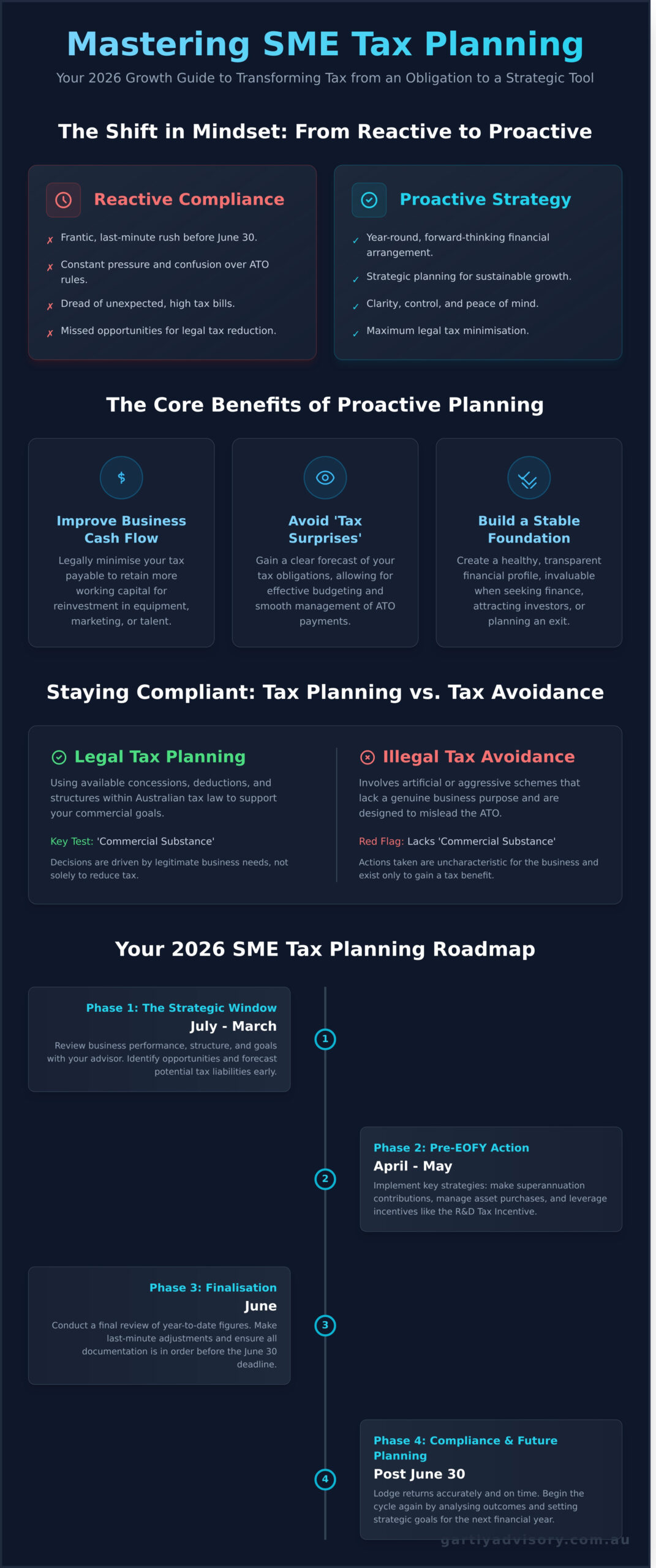
Your 2026 SME Tax Planning Roadmap: A Step-by-Step Timeline
Effective tax planning isn’t a last-minute scramble in June. It’s a year-round discipline that provides clarity, control, and confidence. By breaking down the financial year into manageable stages, you can move from a reactive position to a proactive one, ensuring you make the most of available opportunities. This timeline provides a clear, structured approach to the most effective tax planning strategies for SMEs in Australia.
Here is a step-by-step guide to keep your business on track throughout 2026:
- Quarterly Check-ins (July, Oct, Jan, Apr): Use your Business Activity Statement (BAS) and Instalment Activity Statement (IAS) lodgements as regular checkpoints. Review your profit and loss statements to track performance against your budget. These quarterly reviews allow you to adjust your strategy in real-time and avoid any end-of-year surprises.
- March/April – The ‘Strategic Window’: This is the most crucial period. Schedule a dedicated tax planning meeting with your advisor to review your year-to-date performance. Here, you can forecast your likely taxable income and identify key strategies to implement before 30 June.
- May – Action Month: With a clear plan, May is for execution. This is the time to bring forward any deductible expenses by pre-paying for services like rent or insurance. It’s also the final opportunity to make and process superannuation contributions to ensure they are received by the fund before the deadline.
- June – Finalisation and Compliance: In the final month, focus on compliance and last-minute details. Conduct your stocktake, finalise your motor vehicle logbooks, and make any planned asset purchases to take advantage of depreciation rules.
- Post-July – Review and Reset: Once the financial year is closed, meet with your advisor to analyse the year’s results. This review helps you understand what worked, finalise your tax position, and set clear financial goals for the 2027 financial year.
Record Keeping and the Role of Cloud Accounting
Proactive tax planning is powered by accurate, up-to-date data. Cloud accounting platforms like Xero provide a real-time view of your financial position, making quarterly reviews and strategic forecasting simple and precise. This digital approach is essential for maintaining compliance, particularly for ATO requirements like a motor vehicle logbook. For more details, see our guide on Keeping a Compliant ATO Logbook: Cents Per KM Explained.
Working with Your Tax Agent: What to Prepare
To get the most value from your tax planning sessions, preparation is key. Arrive with your year-to-date financial statements, details of any significant asset purchases or sales, and a list of your goals for the coming year. Don’t be afraid to ask direct questions like, “Are there any deductions we are overlooking?” or “How can we improve our tax efficiency next year?” A productive partnership with your advisor is central to successful tax planning strategies for SMEs in Australia. Need guidance on finding the right fit? Read our advice on Choosing the Best Small Business Accountant in Melbourne.
Navigating this timeline with a trusted partner ensures you never miss an opportunity. At Gartly Advisory, we provide the proactive guidance and support to help you achieve your financial goals. Contact us today to schedule your strategic planning session.
Beyond the Numbers: Partnering with Gartly Advisory for Success
Effective tax planning is more than just lodging a return on time; it’s an ongoing conversation about your business’s future. At Gartly Advisory, we believe our role is to be your trusted partner on the journey towards success. We move beyond simple compliance to provide strategic guidance that aligns with your long-term goals. This philosophy is built on a foundation of over 35 years of experience, which allows us to offer proactive, growth-oriented advice that anticipates challenges and seizes opportunities.
Navigating the complexities of Self-Managed Super Funds (SMSFs), franchising agreements, or intricate capital gains scenarios requires a safe pair of hands. Our seasoned expertise provides the stability and foresight needed to protect your assets and optimise your financial position. We are committed to transforming your approach from reactive tax management to a forward-thinking financial strategy, ensuring the tax planning strategies for SMEs Australia we implement are robust and tailored to your unique circumstances.
Why Melbourne SMEs Trust Gartly Advisory
Based in Ormond, our deep understanding of the Melbourne business landscape gives our clients a distinct advantage. We don’t just see numbers; we see the people and ambitions behind them. This proactive approach means we are constantly looking for hidden opportunities, such as identifying eligibility for R&D tax incentives that might otherwise be missed. Clients value our reassuring and supportive guidance, knowing they have an approachable expert ready to provide clarity and direction.
Take the Next Step Toward Financial Clarity
The most effective tax strategies are planned well in advance, not rushed in the lead-up to June 30. By acting now, you give your business the time and space to implement changes that can have a significant impact on your financial outcomes. We invite you to move beyond the numbers and begin a strategic partnership focused on sustainable growth and financial clarity. Let us help you build a more secure and prosperous future.
Contact Gartly Advisory to schedule your 2026 tax planning session and discover how our guidance can make a difference.
Secure Your 2026 Growth with a Trusted Partner
As we look towards 2026, it’s clear that proactive tax planning is no longer a luxury for Australian SMEs-it’s a fundamental pillar of success. By understanding the power of an optimised business structure and implementing a strategic roadmap, you can transform tax obligations into a powerful tool for growth. Mastering the right tax planning strategies for SMEs australia is the key to unlocking sustainable profitability and building a resilient financial future for your business.
You don’t have to navigate this complex landscape alone. At Gartly Advisory, we go beyond the numbers to become your trusted advisors. With 35+ years of experience, the backing of 70+ 5-Star Google Reviews, and our dual expertise as Chartered Accountants and Business Valuebuilder Advisors, we provide the proactive guidance your business deserves. Let us help you build the prosperous future you envision.
Book a consultation with our expert team today to secure your SME’s financial future.
Frequently Asked Questions About SME Tax Planning
When is the best time to start tax planning for my SME?
The most effective tax planning is a continuous, year-round process, not a last-minute scramble before 30 June. The ideal time to start is right now. By taking a proactive approach, we can work together throughout the financial year to make strategic decisions that legally minimise your tax obligations and support your business growth. This involves much more than just preparing your annual tax return; it’s about structuring your affairs correctly from the start, regularly reviewing your financial performance, and identifying opportunities for tax savings as they arise.
Waiting until the end of the financial year often means opportunities have already passed. Proactive planning allows you to make informed choices about asset purchases, superannuation contributions, and income distribution well in advance. As your trusted partner, we believe in looking ahead, helping you build a clear financial roadmap that aligns with your long-term goals. Let’s start the conversation today to ensure your business is in the strongest possible tax position for this year and beyond.
Can a Family Trust really help reduce my business tax in Australia?
Yes, for many small and medium-sized enterprises, a Family Trust (also known as a discretionary trust) can be a highly effective structure for tax minimisation and asset protection. The primary tax benefit comes from its ability to distribute income among family members, or ‘beneficiaries’. Instead of all business profits being taxed in the hands of one or two high-income earners, the trust can allocate profits to family members on lower marginal tax rates, such as a spouse with a lower income or adult children undertaking university studies.
For example, distributing A$40,000 of profit to a beneficiary with no other income could result in a significantly lower tax bill than if that same A$40,000 was retained by a business owner already in the top tax bracket. Beyond tax savings, a trust also provides valuable asset protection, separating your business assets from your personal liabilities. Setting up and managing a trust requires careful guidance to ensure full compliance, and we are here to provide the expert support you need to determine if this structure is right for your family and your business journey.
What are the most common tax deductions for small businesses in 2026?
Maximising your legitimate deductions is a cornerstone of effective tax planning strategies for SMEs in Australia. While specific deductions depend on your industry and operations, some of the most common claims for 2026 include immediate write-offs for asset purchases under the relevant threshold, which allows you to deduct the full cost of eligible assets in the year of purchase. Other key deductions include all day-to-day operating expenses like rent, utilities, insurance, and marketing costs.
Employee-related expenses are also fully deductible, covering salaries, wages, and superannuation contributions made on their behalf. Don’t forget motor vehicle expenses (using either the logbook method or cents per kilometre), travel costs for business purposes, and home office running expenses if applicable. Keeping meticulous records is essential for substantiating these claims. We can provide tailored guidance to ensure you are claiming every dollar you are entitled to, turning a compliance task into a strategic financial advantage.
How do the Small Business CGT concessions work if I sell my business?
The Small Business Capital Gains Tax (CGT) concessions are a powerful set of provisions that can significantly reduce, or even eliminate, the tax you pay when selling your business or an active business asset. Navigating these rules requires expert advice, as there are strict eligibility tests, including a maximum net asset value of A$6 million or an aggregated turnover of less than A$2 million. If you qualify, there are four main concessions that can be applied, sometimes in combination.
These are the 15-year exemption, which can make the entire capital gain tax-free if you’ve owned the asset for 15 years and are over 55 and retiring; the 50% active asset reduction, which halves the capital gain; the retirement exemption, allowing you to disregard up to A$500,000 of a capital gain; and the rollover concession, which lets you defer the capital gain by acquiring a replacement asset. Understanding how these concessions interact is complex, and our role is to guide you through the process to achieve the best possible outcome from the sale of your hard-earned business.
Is it worth upgrading to a Company structure for tax benefits?
Transitioning from a sole trader or partnership to a company structure can offer significant tax advantages, but it’s a strategic decision that must be weighed against the increased complexity and compliance costs. The primary tax benefit is the fixed corporate tax rate, which for a base rate entity is 25% (as of the current financial year). This is considerably lower than the highest individual marginal tax rate of 45% (plus Medicare levy). This structure is particularly beneficial for businesses that plan to retain profits within the company to fund future growth, as that profit is taxed at the lower corporate rate.
However, this structure also introduces challenges like Division 7A, which governs how owners can draw money from the company. Furthermore, losses are trapped within the company and cannot be used to offset your other personal income. As your advisors, we go ‘beyond the numbers’ to help you analyse your specific situation-your current profitability, growth plans, and personal financial needs-to determine if the tax benefits of a company structure truly outweigh the administrative responsibilities for your unique business journey.
What happens if I can’t pay my tax bill on time in 2026?
Receiving a tax bill you can’t immediately pay can be incredibly stressful, but the most important step is to not ignore it. The Australian Taxation Office (ATO) is far more receptive to taxpayers who communicate proactively and honestly about their situation. Ignoring the debt will only lead to escalating penalties and interest charges. The first thing you should do is contact a trusted advisor. We can help you understand your position and communicate with the ATO on your behalf to negotiate a manageable solution.
Typically, the best course of action is to arrange a payment plan. The ATO can offer arrangements that allow you to pay off your debt in regular instalments over an agreed period. Having a professional represent you in these negotiations demonstrates that you are taking the matter seriously and can often lead to a more favourable outcome. Our role is to provide calm, supportive guidance, helping you navigate this challenge and get your financial obligations back on track with minimal stress and disruption to your business.
How does the R&D Tax Incentive apply to non-tech SMEs?
It’s a common misconception that the Research & Development (R&D) Tax Incentive is only for tech companies or scientists in lab coats. In reality, this valuable government incentive is available to a wide range of industries, including manufacturing, agriculture, food production, and construction. The key is not the industry you’re in, but whether your business is conducting eligible ‘experimental activities’ to generate new knowledge or create new or improved products, processes, or services.
For example, a brewery experimenting with a new fermentation process to reduce waste, a construction firm developing a more durable and environmentally friendly building material, or a farm testing new irrigation techniques to improve crop yield could all potentially qualify. Our proactive approach means we look for these hidden opportunities for our clients. The incentive provides a refundable tax offset for eligible entities with a turnover under A$20 million, which can result in a significant cash injection for your business. We can help you assess your activities and navigate the application process.
What is Division 7A and why should my small business care about it?
If you operate your business through a private company, understanding Division 7A of the tax act is absolutely critical. In simple terms, Division 7A is an integrity rule designed to prevent company owners and their associates from taking money out of the company tax-free by calling it a ‘loan’ or a ‘payment’. Without these rules, a business owner could simply withdraw profits as a loan and never pay it back, effectively receiving a tax-free dividend. The ATO considers this a form of tax avoidance.
If a payment, loan, or forgiven debt from a private company to a shareholder (or their associate) is not structured correctly under Division 7A rules, the ATO can treat the entire amount as an unfranked dividend. This means it will be included in the shareholder’s personal tax return and taxed at their marginal tax rate, which can be as high as 47%. Proper management, often through a compliant Division 7A loan agreement with principal and interest repayments, is essential. This is a complex area where expert guidance is vital to avoid a very costly tax surprise.
Related Posts