
Your Guide to Running a Profitable Small Manufacturing Business in Australia (2026)
You have a passion for creating exceptional products, but the day-to-day financial realities of running a small manufacturing business in Australia can be overwhelming. Juggling unpredictable cash flow, wrestling with tight profit margins, and spending more time on spreadsheets than on the factory floor-it’s a familiar struggle. The constant pressure can make it feel impossible to get ahead, let alone find a clear path for sustainable growth.
But what if you could trade that uncertainty for confidence? This guide is designed to be your trusted partner on that journey. We’re moving beyond abstract ideas to give you the concrete financial framework and strategic advice you need to build a truly profitable operation. You’ll gain control over your business’s finances, understand the key numbers that drive success, and discover practical ways to improve cash flow and set a clear plan for the future. Let’s get started on building a more resilient and successful business for 2026 and beyond.
Key Takeaways
- Master the three essential financial metrics that provide a clear, real-time picture of your business’s health and profitability.
- Uncover five actionable strategies you can use today to directly address common cash flow gaps and boost your bottom line.
- Learn a strategic framework for scaling your small manufacturing business, ensuring you can grow confidently without risking financial stability.
- Understand how to transform key challenges like rising costs and supply chain disruptions into opportunities with the right strategic guidance.
The Reality of Running a Small Manufacturing Business in Australia
Turning a passion for making things into a business is an incredible achievement. Whether you’re a master craftsman, a food innovator, or a skilled tradesperson, the decision to scale up from a hobby or trade into a fully-fledged small manufacturing business is driven by a unique blend of creativity and ambition. You see the potential to create high-quality products and serve a market that values Australian-made goods. It’s an exciting journey, but one that quickly moves beyond the workshop and into the complex world of commerce.
For a little inspiration on the types of ventures taking this leap, this video offers a great overview of accessible production ideas:
The reality is that passion alone isn’t enough. The landscape for Manufacturing in Australia is competitive and presents unique hurdles. Unlike a service business, you’re managing physical inventory, complex production costs, and fluctuating supply chains. Most owners face four key challenges: persistent cash flow gaps, supply chain issues, rising costs, and a maze of compliance obligations. Overcoming these is the first step towards building a successful enterprise, and it all begins with financial clarity.
Common Cash Flow Traps for Manufacturers
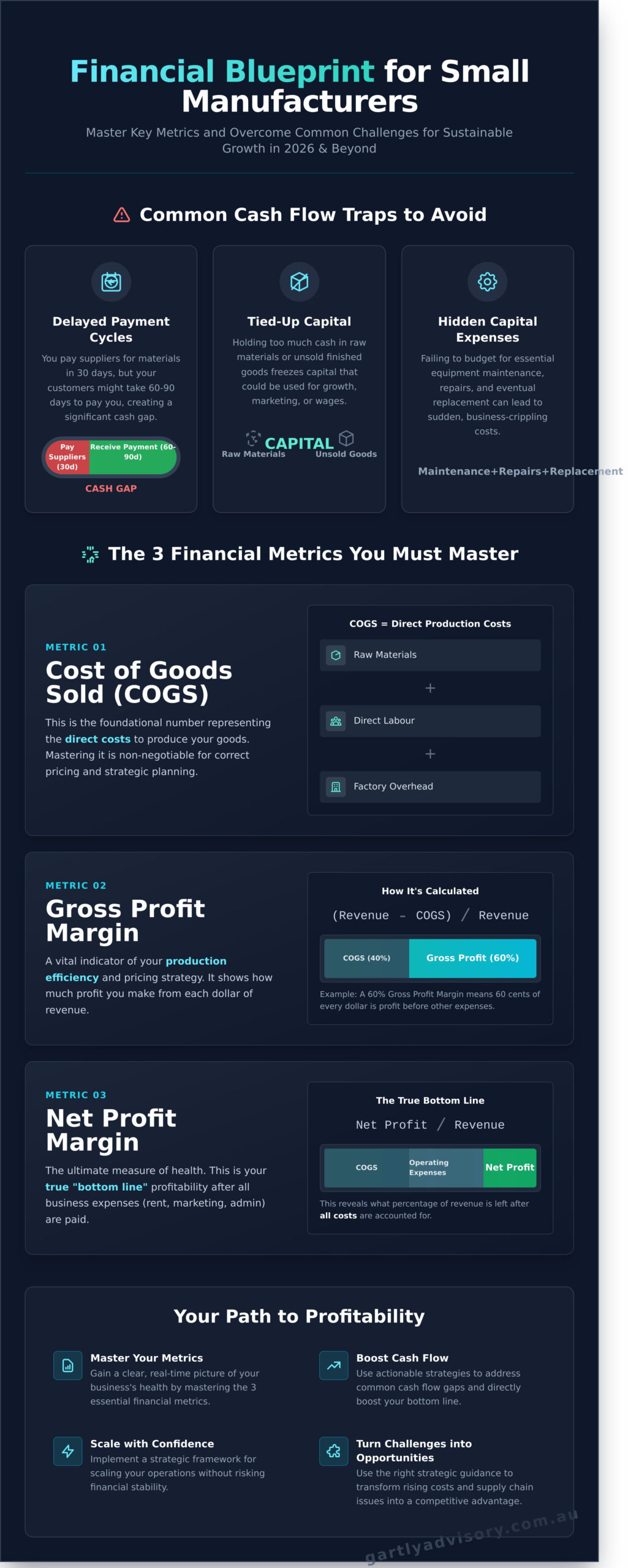
Profit on paper doesn’t always mean cash in the bank. For manufacturers, several common cash flow traps can stifle growth before it even begins:
- Payment Cycles: You often have to pay your suppliers for raw materials within 30 days, but your wholesale customers may not pay you for 60 or even 90 days, creating a significant cash gap.
- Inventory Costs: Tying up too much capital in raw materials or unsold finished goods is a common issue. This is cash that could be used for marketing, R&D, or paying wages.
- Hidden Capital Expenses: Failing to budget for essential equipment maintenance, repairs, and eventual replacement can lead to unexpected, business-crippling costs.
Navigating Australian Compliance and Red Tape
Meeting your regulatory duties is non-negotiable. For a manufacturer, this includes specific Work Health and Safety (WHS) standards, regular BAS lodgements with the ATO, and state-based payroll tax. Getting compliance wrong leads to hefty penalties, but it doesn’t have to be a daily fire to fight. With the right systems and guidance, these tasks become a predictable part of your operations, freeing you to focus on making great products.
These challenges might seem daunting, but they are manageable with proactive planning. The key isn’t just working harder in the workshop, but smarter on the business itself. By establishing a clear view of your finances from day one, you build a resilient foundation for sustainable growth.
The 3 Financial Metrics Every Manufacturer Must Master
To truly take control of your small manufacturing business, you must first learn to speak its language-the language of numbers. Think of key financial metrics as the dashboard on your car; they provide real-time feedback on performance, signal potential issues, and give you the critical information needed to navigate safely and efficiently. These figures tell the true story of your business’s health, moving beyond guesswork to provide a solid foundation for every strategic decision you make, from pricing and production to investment and growth.
As your trusted partner, we believe that mastering these numbers is the first step towards building a resilient and profitable operation. Let’s explore the three essential metrics that form the bedrock of financial control.
1. Cost of Goods Sold (COGS)
At its core, COGS represents the direct costs incurred in producing the goods you sell. It’s the foundational number that determines profitability on every single item that leaves your factory floor. Accurately calculating COGS is non-negotiable for correct pricing and strategic planning. Key components include:
- Raw Materials: The cost of all materials that go directly into your product.
- Direct Labour: The wages and superannuation for the staff physically making the product.
- Factory Overhead: A portion of costs like factory rent, utilities, and machinery depreciation.
2. Gross Profit Margin
Your Gross Profit Margin tells you how much profit you make from each dollar of revenue before accounting for administrative or selling expenses. It’s a vital indicator of your production efficiency and pricing strategy. The formula is straightforward:
(Total Revenue – COGS) / Total Revenue = Gross Profit Margin %
A healthy margin means your business is fundamentally viable. It’s also crucial to compare your margin to Australian industry benchmarks. Understanding how you stack up can reveal opportunities for improvement and is often a key consideration for lenders, investors, and even when applying for government support for manufacturing.
3. Inventory Turnover Ratio
This powerful metric measures how quickly you are selling your inventory and replacing it. A high turnover ratio is generally a sign of strong sales and efficient management. Conversely, a low ratio can indicate overstocking, poor sales, or obsolete products, all of which tie up your cash in unsold goods. Improving your inventory turnover directly impacts your cash flow, freeing up capital that can be reinvested into marketing, new equipment, or other growth initiatives for your small manufacturing business.
5 Practical Strategies to Boost Profitability & Cash Flow
Understanding the numbers is the first step; the next is taking decisive action. The strategies below are not complex theories but practical, proactive steps you can begin implementing today. For any small manufacturing business, consistent, incremental improvements in these areas can lead to significant long-term gains in both profitability and cash flow. Think of these as the control levers for the key financial metrics that determine your success.
Review Your Pricing Strategy
Many businesses fall into the ‘cost-plus’ pricing trap, simply adding a standard margin to their costs. We provide guidance to help our clients move towards value-based pricing, which focuses on the unique value your product delivers. For example, if your custom-fabricated component saves a client A$1,000 in installation time, your price should reflect that benefit, not just the cost of steel and labour. It’s crucial to regularly review your pricing against rising material and labour costs to protect your Gross Profit Margin. Consider introducing:
- Tiered Pricing: Offer standard, premium, and deluxe versions of a product at different price points. This strategy empowers customers to choose a higher-priced option and can significantly increase your average order value.
- Product Bundling: Combine a popular product with a slower-moving item or a related service (like installation or a maintenance plan) to improve sales across your entire range and create more value for the customer.
Optimise Your Inventory Management
Every item sitting on your warehouse shelves represents tied-up cash. Optimising your inventory is one of the fastest ways to improve your Cash Conversion Cycle and free up working capital. While a full ‘just-in-time’ (JIT) system may not be feasible for every operation, you can adopt its principles by ordering materials closer to your production schedule. We also support our clients in taking these proactive steps:
- Negotiating Supplier Terms: Proactively ask your key suppliers for better payment terms. Moving from 30-day to 60-day terms can give your business a crucial cash flow buffer, allowing you to sell your goods before the supplier invoice is due.
- Conducting Stock Audits: Regularly identify slow-moving or obsolete stock. A clearance sale might feel like a loss, but it converts dead stock back into valuable working capital that you can invest in growth.
Leverage Technology and Automation
Modern technology is a powerful ally for a growing small manufacturing business. Using cloud accounting software like Xero provides a real-time, accurate view of your financial health, empowering you to make smarter, data-driven decisions. It simplifies tracking your Cost of Goods Sold (COGS) on a per-job basis, ensuring every project you undertake is profitable. Furthermore, features like automated invoice reminders can significantly reduce your Days Sales Outstanding, directly improving your cash flow.
This technology provides the data you need to effectively manage the strategies above and be a truly proactive business owner. For a deeper dive into how this can transform your operations, see our comprehensive guide to Xero Accounting Software.
Implement Robust Cost Control Measures
Profitability isn’t just about increasing revenue; it’s equally about managing your expenses. Beyond material costs, regularly scrutinise your operational overheads. Look for opportunities to reduce waste in your production processes, negotiate better terms with service providers (e.g., utilities, insurance, cleaning), and explore energy-efficient equipment upgrades. Even small, consistent reductions across various cost centres can cumulatively lead to significant improvements in your bottom line. We at Gartly Advisory Pty Ltd often find hidden savings by conducting detailed operational expenditure reviews.
Strengthen Accounts Receivable Processes
Your cash flow is directly impacted by how quickly you collect payments. While automated reminders (as mentioned above) help, a holistic approach to accounts receivable is vital. Ensure your payment terms are clear and agreed upon upfront. Consider requesting deposits for larger projects or new clients. Implement a systematic follow-up process for overdue invoices, combining polite reminders with firm action when necessary. Proactive communication and efficient invoicing can dramatically reduce your Days Sales Outstanding (DSO), keeping cash flowing into your small manufacturing business.
Planning for Growth: Scaling Your Manufacturing Operations
Once your small manufacturing business moves beyond the initial survival phase, the focus must shift from day-to-day operations to long-term strategic thinking. This is an exciting milestone, but it often comes with a significant fear: growing too quickly and running out of cash. This is a valid concern, as unplanned expansion can strain resources and jeopardise the stability you’ve worked so hard to build. The key is not to avoid growth, but to manage it with a clear, proactive plan.
Careful planning allows you to scale your production, team, and market reach sustainably. It involves a critical assessment of your business structure, financial capacity, and operational readiness. Having a trusted strategic advisor to provide guidance during this phase can be the difference between seizing an opportunity and creating a crisis.
Structuring Your Business for Growth
The business structure that served you well at the start may not be suitable for a larger, more complex operation. In Australia, the main options each have distinct implications for liability, tax, and administrative overhead. A Sole Trader structure is simple but leaves your personal assets exposed. A proprietary limited (Pty Ltd) Company creates a separate legal entity, offering crucial asset protection. A Trust can provide flexibility and tax advantages but comes with more complex compliance. Choosing the right structure is fundamental for protecting your wealth and optimising your tax position as you grow. For a deeper dive, explore our Business Growth Strategy resources.
Financing Growth and Investment
Scaling up requires capital. Whether you need to purchase new equipment, lease a larger facility, or increase your inventory, securing the right funding is critical. Fortunately, several avenues are available:
- Asset Finance: An effective way to acquire new machinery or vehicles by leasing or using a hire-purchase agreement, preserving your working capital for other needs.
- Business Loans: Traditional term loans can provide the significant capital injection needed for major expansion projects, funded against the future profitability of the business.
- Government Grants: The Australian government offers various programs, like the R&D Tax Incentive or the Manufacturing Modernisation Fund, to support innovation and growth in the sector. These are often overlooked but can provide a non-debt funding boost.
To access any of these options, you will need robust financial forecasts. Lenders and grant bodies need to see a well-researched business case supported by detailed cash flow projections and a clear strategy. An experienced advisor is invaluable here, helping you prepare the crucial financial documents that demonstrate the viability of your growth plans and give funders the confidence to invest in your vision.
Scaling your small manufacturing business is a defining step on your journey. Let us be your trusted partner in this process, providing advice that goes beyond the numbers to ensure your growth is both ambitious and sustainable. Contact us to schedule a consultation.
Why a Trusted Advisor is Your Most Important Asset
Throughout this guide, we’ve explored the complex, interconnected parts of running a profitable small manufacturing business-from managing cash flow and optimising inventory to strategic pricing and scaling operations. Juggling these demands while ensuring compliance can feel overwhelming. This is where the right partnership transforms from a cost into your most valuable investment for growth and peace of mind.
At Gartly Advisory Pty Ltd, our philosophy is built on providing guidance that goes beyond the numbers. While accurate financials are the foundation, their true power lies in the story they tell about your business. We help you interpret that story, turning data into decisive action that drives profitability and builds a more resilient operation.
From Tax Compliance to Strategic Partner
Freeing up your time starts with handing over essential compliance tasks like BAS and tax returns. But our support doesn’t stop there. As your strategic partner, we dive deeper to address core manufacturing challenges. We provide clear, actionable advice on pricing strategies to protect your margins, cash flow forecasting to navigate seasonal demands, and growth planning to help you invest in the right equipment at the right time. With deep experience supporting businesses across Melbourne and Victoria, we understand the local landscape.
Your Next Step Towards a More Profitable Business
You don’t have to navigate the challenges of growing your manufacturing business alone. Having an experienced, proactive partner in your corner can make all the difference. We invite you to see how our supportive approach can bring clarity and confidence to your financial decisions. Let us be your trusted partner on your journey towards success.
Take the first step today. Schedule a complimentary consultation to discuss your business and discover how we can help you achieve your goals.
Your Partner in Manufacturing Success
Running a successful small manufacturing business in Australia is a challenging yet rewarding venture. As we’ve explored, your success hinges on mastering key financial metrics and implementing practical strategies to boost profitability and cash flow. But you don’t have to navigate this complex landscape alone; having the right guidance is the most critical asset for sustainable growth.
At Gartly Advisory, we bring over 35 years of experience as Chartered Accountants and Business Advisers, specialising in supporting Melbourne SMEs just like yours. Our 70+ 5-star Google reviews reflect our commitment to being more than just accountants; we are proactive partners dedicated to giving advice that goes beyond the numbers.
Ready to transform your vision into a thriving, profitable operation? Talk to us today and let us become your trusted partner on your journey to success. Your future in Australian manufacturing is bright, and we’re here to help you build it.
Frequently Asked Questions About a Profitable Small Manufacturing Business
What are the most common tax deductions for a small manufacturing business in Australia?
Navigating tax obligations is a critical part of running a profitable manufacturing business. In Australia, manufacturers can claim a wide range of deductions. The most significant is typically the Cost of Goods Sold (COGS), which includes all direct costs of production like raw materials, direct labour, and factory overheads. Beyond COGS, you can deduct general operating expenses such as factory rent, utilities, insurance, administrative staff wages, marketing costs, and professional fees. These deductions directly reduce your taxable income, so meticulous record-keeping is essential.
Furthermore, capital-intensive businesses like manufacturing have significant deductions related to assets. The depreciation of machinery, equipment, and vehicles is a key claim. Australian tax law often includes incentives like temporary full expensing or the instant asset write-off, allowing for immediate deductions on eligible assets. For innovative manufacturers, the Research and Development (R&D) tax incentive can provide a substantial offset or even a cash refund for eligible R&D activities. Understanding these complexities is vital, and expert guidance ensures you claim every entitlement and remain fully compliant.
How often should I review the pricing of my products?
Product pricing should never be a “set and forget” activity. In the dynamic manufacturing environment, costs can change rapidly, and failing to adjust your prices accordingly can severely erode your profit margins. We recommend a formal pricing review at least quarterly. However, you should be prepared to review prices more frequently if you experience significant shifts in key cost drivers, such as a sudden spike in raw material prices, increased shipping costs, or changes in labour rates. A proactive approach is always better than a reactive one.
A comprehensive review involves more than just adding a percentage to your costs. It’s an opportunity to analyse your competitors’ pricing, assess the value your products deliver to the market, and confirm your costings are accurate. This strategic exercise ensures your pricing not only covers all direct and indirect costs but also reflects your brand’s position and achieves your target profit margin. Regular, disciplined pricing reviews are a cornerstone of financial health and long-term profitability for any manufacturer.
Do I need special software to manage my manufacturing business finances?
While standard accounting software like Xero or MYOB is an excellent starting point for any business, manufacturers often find they quickly outgrow its capabilities. The unique complexities of production, such as tracking raw materials, managing work-in-progress, and calculating the true cost of a finished product, require more specialised tools. As your operations grow, managing these elements on spreadsheets becomes inefficient and prone to costly errors. This is where dedicated manufacturing software, often known as Manufacturing Resource Planning (MRP) or Enterprise Resource Planning (ERP) systems, becomes invaluable.
These systems integrate all aspects of your operation, from inventory and supply chain management to production scheduling and job costing. They provide a real-time, accurate view of your business, allowing you to create precise quotes, manage stock levels effectively, and understand the true profitability of each product line. Investing in the right software is not just an expense; it’s a strategic investment in efficiency, control, and the scalability of your business.
What’s the difference between gross profit and net profit?
Understanding the distinction between gross and net profit is fundamental to assessing the financial health of your manufacturing business. Gross profit is your total revenue minus the Cost of Goods Sold (COGS). For a manufacturer, COGS includes the direct costs tied to producing your goods: raw materials, direct labour wages, and the factory overheads required for production. Gross profit, and its corresponding margin, is a powerful indicator of your production efficiency and pricing strategy. It tells you how much money you make from your core production process before any other expenses are considered.
Net profit, on the other hand, provides the complete picture of your business’s profitability. It is calculated by taking your gross profit and subtracting all of your other operating, interest, and tax expenses. These are the costs not directly related to production, such as administrative salaries, rent for office space, marketing, insurance, and loan interest. Net profit is the true “bottom line” and shows what the business has earned after every single expense has been paid. Monitoring both metrics is crucial; a healthy gross profit with a low net profit, for example, signals that your operating expenses are too high.
When should I consider registering for GST as a small manufacturer?
In Australia, the rule for Goods and Services Tax (GST) is straightforward: it is compulsory to register for GST once your business has a GST turnover of A$75,000 or more per year. This turnover refers to your gross business income, not your net profit. You must register within 21 days of reaching, or expecting to reach, this threshold. Once registered, you are required to include GST in the price of your taxable sales and submit regular Business Activity Statements (BAS) to the Australian Taxation Office (ATO).
However, many manufacturers should consider registering for GST voluntarily even before hitting the A$75,000 threshold. The primary benefit of being registered is the ability to claim GST credits on your business-related purchases. For a manufacturer, these purchases can be substantial, including raw materials, machinery, equipment, factory rent, and professional services. Claiming these credits can significantly improve your cash flow. For any small manufacturing business, this decision involves weighing the benefit of claiming credits against the administrative requirement of lodging a BAS. Seeking professional advice can help you determine the optimal time to register based on your specific circumstances.
How can I improve cash flow when my clients have long payment terms?
Managing cash flow when clients operate on 30, 60, or even 90-day payment terms is one of the most common challenges for manufacturers. The key is to be proactive rather than waiting for cash reserves to run low. One effective strategy is invoice financing or factoring, where a third-party lender provides you with an advance on your outstanding invoices, giving you immediate access to cash while they collect the full payment from your client later. This can be a lifeline for bridging the gap between production costs and customer payment.
You can also implement procedural changes to encourage faster payments. Consider offering a small discount for early payment, such as a 2% reduction if an invoice is paid within 10 days. For large or custom orders, it is standard practice to request a significant upfront deposit to cover initial material costs, with progress payments made at key milestones. Finally, having a firm and consistent credit control process is essential. This includes clear communication of your payment terms from the outset and a systematic approach to following up on overdue accounts. Strong cash flow management is as important as a strong production line.
What business structure is best for a manufacturing business?
Choosing the right business structure is a foundational decision with long-term implications for liability, tax, and your ability to raise capital. While you can operate as a sole trader or partnership, the most common and often most suitable structure for a manufacturing business in Australia is a proprietary limited (Pty Ltd) company. The primary advantage of a company structure is limited liability. This means the business is a separate legal entity, and your personal assets are generally protected from business debts and legal claims-a crucial safeguard in a capital-intensive industry with significant operational risks.
A company structure also provides greater flexibility for growth. It allows you to bring in investors by issuing shares, makes it easier to secure financing, and can offer more sophisticated tax planning opportunities. While a company has more complex reporting and compliance obligations than a sole trader structure, the protection and scalability it offers are typically essential for a business that owns expensive equipment, employs staff, and deals with significant contracts. The “best” structure ultimately depends on your individual goals and circumstances, making it a critical area where professional guidance is invaluable.
Can a business advisor help me secure a loan for new equipment?
Absolutely. A business advisor or a Chartered Accountant can be an invaluable partner when you need to secure financing for new equipment. Their role extends far beyond simply reviewing paperwork; they act as a strategic advocate for your business. Lenders need to see a clear, compelling, and low-risk case for lending, and an advisor is an expert at building and presenting this case. They will work with you to prepare professional financial statements, detailed cash flow projections, and a robust business plan that clearly demonstrates your ability to service the loan.
Furthermore, an experienced advisor understands the lending landscape. They can help you identify the most appropriate type of financing for your needs, whether it’s a chattel mortgage, a finance lease, or another asset finance product. They often have established relationships with multiple lenders, which can help in finding competitive rates and favourable terms. By ensuring your application is professional, accurate, and strategically positioned, an advisor significantly increases your chances of approval. For a growing small manufacturing business, this support can be the crucial difference in securing the capital required to invest in productivity and expansion.
Related Posts