What is an IAS (Instalment Activity Statement)? An ATO Guide for Businesses
Navigating the world of business tax can feel like learning a new language, with a whole alphabet of acronyms from the Australian Taxation Office (ATO).
Terms like ‘BAS’ and the IAS may leave you feeling uncertain. Juggling cash flow for PAYG payments and avoiding costly penalties worry then you are not alone.
At Gartly Advisory, we aim to provide clear, straightforward guidance to help you manage your ATO obligations with confidence. This guide is designed to be your trusted partner in understanding the Instalment Activity Statement. We will walk you through exactly what it is, who needs to lodge one, the key due dates to remember, and how to complete the process correctly. By the end, you’ll have the clarity and peace of mind that comes from knowing your business is fully compliant.
What is an Instalment Activity Statement (IAS)?
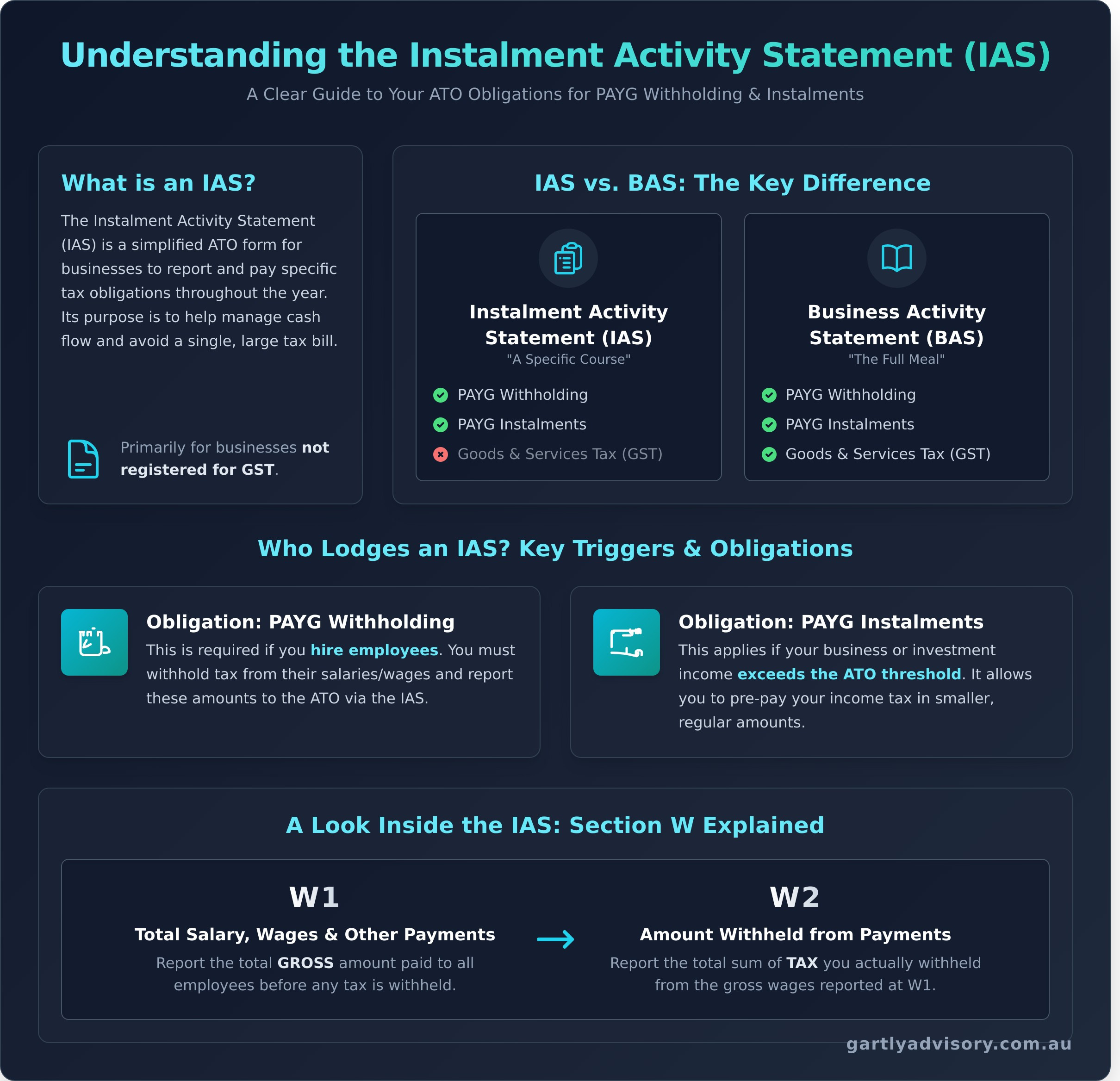
An Instalment Activity Statement, commonly known as an IAS, is an official form from the Australian Taxation Office (ATO) used by businesses to report and pay certain tax obligations. Think of it as a simplified tax reporting document. Its primary purpose is to help you stay on top of your tax commitments throughout the year, rather than facing a single large bill after your annual tax return.
For many business owners, managing tax can feel complex. This form is designed to streamline the process for specific obligations, making it a key part of maintaining good tax compliance in Australia.
IAS vs. BAS: What’s the Key Difference?
It’s easy to confuse the IAS with its more comprehensive cousin, the Business Activity Statement (BAS). The key difference lies in their scope. A BAS is used to report multiple tax types, including Goods and Services Tax (GST), PAYG withholding, and PAYG instalments. An IAS, however, is a simpler form typically for businesses that are not registered for GST but still need to report other taxes. To use an analogy, if a BAS is the full three-course meal of tax reporting, an ias is just a specific, essential course.
Why Does the ATO Send an IAS?
Receiving an IAS from the ATO means you have specific, ongoing tax obligations that need to be reported regularly. It isn’t sent randomly; it’s triggered by certain business activities. The ATO will typically start sending you an Instalment Activity Statement if your business:
**
- Hires employees: Once you register for Pay As You Go (PAYG) withholding to manage tax on your staff’s wages, you will need to report and pay these withheld amounts.
- Needs to pay income tax instalments: If you earn business or investment income above a certain threshold, the ATO may place you in the PAYG instalment system to pre-pay your income tax in smaller, regular amounts.
**
Essentially, the form is the ATO’s formal method for collecting these amounts from you on a monthly or quarterly basis, ensuring a smoother, more predictable tax process for your business.
Why you may need to lodge an Instalment Activity Statement?
Navigating your tax obligations can feel complex, but understanding who needs to lodge an Instalment Activity Statement (IAS) is quite straightforward. It’s important to note that not every business will receive or need to lodge an ias. Your requirement depends entirely on your specific tax registrations with the Australian Taxation Office (ATO).
Essentially, if your business is not registered for Goods and Services Tax (GST) but has other tax obligations, you will likely use an IAS. If you are registered for GST, these same obligations are typically reported on your broader Business Activity Statement (BAS). The key triggers for receiving an IAS are having PAYG Withholding or PAYG Instalment obligations. The government provides excellent guidance on how to lodge your activity statement, which covers the processes for both forms.
Businesses with PAYG Withholding Obligations
One of the most common reasons a business lodges an IAS is due to Pay As You Go (PAYG) withholding. This is the tax you are required to withhold from payments you make to employees. If you have employees, you must register for PAYG withholding. The IAS serves as the official document for reporting the total amount you have withheld during the period and paying it to the ATO, ensuring you remain compliant. This obligation can also extend to payments made to some contractors where a voluntary agreement is in place, or an ABN has not been quoted.
Businesses in the PAYG Instalments System
The second major trigger is being part of the PAYG instalments system. This system is designed to help you manage your income tax liability by making regular prepayments throughout the year, rather than facing a single large bill after lodging your annual tax return. The ATO will automatically place your business into this system once your business and investment income reaches a certain threshold. You will then receive an IAS to report and pay your instalment amount, helping you smooth out cash flow and stay on top of your tax.
Other Less Common Obligations
While less frequent for many small businesses, an IAS may also be used to report other tax liabilities. This can include obligations such as Fringe Benefits Tax (FBT) instalments, which are paid quarterly. However, for the vast majority of small and medium-sized enterprises, the requirement to lodge an Instalment Activity Statement will stem directly from being an employer with PAYG withholding duties or being part of the PAYG instalments system.
Understanding Your IAS Form: A Section-by-Section Breakdown
When you receive your Instalment Activity Statement, you’ll notice it’s already pre-filled with your business details, such as your ABN and contact information. The sections that appear on your specific form are tailored by the ATO to your business’s registered tax obligations. For example, if you don’t have employees, you won’t see the PAYG withholding section.
It is essential to only complete the sections relevant to your reporting period. To provide clarity and support, let’s walk through the most common fields a small business owner will encounter on their ias.
Section W: Pay as you go (PAYG) tax withheld
This is where you report the income tax you have withheld from salaries and wages paid to your employees. Maintaining accurate and up-to-date payroll records is fundamental to completing this section correctly. You will need to report two key figures:
-
W1 – Total salary, wages and other payments: This is the total gross amount paid to all your employees during the period, before any tax is taken out.
-
W2 – Amount withheld from payments at W1: This is the total sum of tax you actually withheld from the gross wages reported at W1.
Section T: Pay as you go (PAYG) income tax instalment
This section is for pre-paying your business or personal income tax in instalments throughout the year. The ATO gives you two primary options for this calculation:
-
Option 1 (Instalment Amount): The ATO provides a pre-calculated instalment amount for you at label T7. This is the simplest method and the one most small businesses use.
-
Option 2 (Instalment Rate): You calculate your payment by applying an ATO-provided percentage rate to your business’s income for that specific period.
While you can vary the instalment amount if your business’s financial situation has changed significantly, we recommend seeking professional guidance before doing so to avoid potential penalties.
The Payment or Refund Section
The final part of your IAS form calculates your total obligation. It adds up the amounts from the sections you’ve completed (such as W2 and your PAYG instalment) to determine the total amount you need to pay the ATO. If you lodge a paper form, a payment slip is attached for your convenience. When you lodge online or through a trusted partner like us, this calculation is done automatically, simplifying the process and reducing the chance of error.
IAS Lodgement and Payment Due Dates for 2025-2026
Meeting your Instalment Activity Statement (IAS) deadlines is a fundamental part of business compliance in Australia. The Australian Taxation Office (ATO) determines your reporting cycle-either quarterly or monthly-primarily based on the amount of PAYG tax you withhold annually. Understanding your specific obligations is crucial, as missing these deadlines can lead to penalties and interest charges, adding unnecessary financial pressure to your business.
To provide clear guidance, we’ve outlined the standard due dates for the 2025-2026 financial year. Staying on top of these dates ensures your business remains compliant and avoids any unwelcome attention from the ATO.
Quarterly IAS Lodgers
For most small businesses, lodging an ias on a quarterly basis is the standard. This cycle is typically assigned to businesses with an annual PAYG withholding of A$25,000 or less. It helps manage cash flow and administrative tasks efficiently. The key lodgement and payment dates are:
-
Quarter 1 (July, August, September): Due 28 October 2025
-
Quarter 2 (October, November, December): Due 28 February 2026
-
Quarter 3 (January, February, March): Due 28 April 2026
-
Quarter 4 (April, May, June): Due 28 July 2026
Monthly IAS Lodgers
Medium to large businesses that withhold more than A$25,000 in PAYG tax per year are generally required to lodge their IAS on a monthly basis. The due date for monthly lodgers is typically the 21st day of the month following the end of the reporting period. For example, your July statement is due by 21 August, and your August statement is due by 21 September.
It is worth noting that businesses who work with a registered tax or BAS agent may be eligible for extended deadlines, providing valuable flexibility. This is one of the many benefits of partnering with a professional advisor for your compliance needs.
Navigating ATO deadlines can be a complex and time-consuming task that distracts from your core business activities. If you feel overwhelmed or simply want the peace of mind that comes with expert management, we are here to provide support. Let us manage your ATO compliance for you.
How to Lodge and Pay Your IAS Correctly
Meeting your tax obligations is a fundamental part of running a business in Australia. The Australian Taxation Office (ATO) provides several modern, streamlined methods for lodging and paying your Instalment Activity Statement (IAS). It is crucial to lodge your ias on time, even if you cannot pay the full amount by the due date. Timely lodgement demonstrates good compliance and avoids late lodgement penalties, allowing you to arrange a payment plan if needed.
Lodging Online with the ATO
The most direct way to lodge is through the ATO’s digital channels. For companies, trusts, and partnerships, Online services for business is the secure portal to manage tax and super obligations. Sole traders can use their myGov account linked to the ATO. Once logged in, you can typically find your pre-filled IAS, review the figures, make any necessary adjustments, and lodge it instantly. Many modern accounting software platforms, like Xero or MYOB, also integrate directly with the ATO, allowing for seamless lodgement from within the software you use daily.
Lodging Through a Registered Tax Agent
Navigating tax compliance can be complex and time-consuming. Engaging a registered tax agent, like Gartly Advisory, ensures your IAS is prepared accurately and lodged correctly, helping you avoid common errors that can lead to penalties. As trusted partners, we manage this process on your behalf, providing peace of mind and often granting access to extended lodgement due dates. This frees up your valuable time, allowing you to focus on what you do best: running and growing your business. For expert guidance and support, talk to our team.
Making a Payment to the ATO
Once you have lodged, the final step is payment. The ATO offers several secure methods to settle your liability. Always find your unique 14-digit Payment Reference Number (PRN) on your IAS to ensure the funds are credited correctly to your account. Common payment options include:
-
BPAY: Use the Biller Code and PRN from your statement.
-
Credit or Debit Card: Available via the ATO’s online payment portal (a card payment fee may apply).
-
Bank Transfer: Transfer directly from your bank account using the provided details.
Beware of scams requesting payment through unusual methods like gift cards or wire transfers. Only use official ATO payment channels. If you are experiencing financial difficulty, contact the ATO or your tax agent to discuss setting up a payment plan.
Master Your Tax Obligations with a Trusted Partner
Navigating the Instalment Activity Statement is a fundamental part of managing your business’s tax obligations in Australia. By understanding what an IAS is, who needs to lodge one, and the critical due dates, you can ensure timely compliance and avoid unnecessary penalties from the ATO. Staying on top of your ias lodgements is key to maintaining healthy financial operations.
While this guide provides a solid foundation, we know that true peace of mind comes from having an expert in your corner. As Chartered Accountants with over 35 years of experience, we provide proactive advice that goes beyond simple compliance. The trust we’ve built is reflected in our 70+ 5-Star Google Reviews from Melbourne business owners who value our supportive, forward-thinking approach.
Let us handle the complexities so you can focus on growing your business. If you’re looking for a partner who offers guidance beyond the numbers, we’re here to help. Contact us for a complimentary consultation to discuss your business tax needs.
Frequently Asked Questions About the IAS
What is the difference between an Instalment Activity Statement (IAS) and a Business Activity Statement (BAS)?
An Instalment Activity Statement (IAS) is a simpler form used primarily to report and pay Pay As You Go (PAYG) withholding and instalments. In contrast, a Business Activity Statement (BAS) is a more comprehensive form for GST-registered businesses. A BAS is used to report multiple tax obligations, including GST, PAYG withholding, and PAYG instalments. Essentially, if your business is registered for GST, your PAYG obligations will be included on your BAS instead of a separate IAS.
What happens if I lodge my IAS late or can’t pay on time?
The Australian Taxation Office (ATO) can apply penalties for lodging your IAS late or failing to pay on time. These may include a Failure to Lodge (FTL) penalty and a General Interest Charge (GIC) on any unpaid amounts. If you are facing difficulties, it is crucial to be proactive. We strongly recommend contacting the ATO or a trusted advisor to discuss your situation. It is often possible to arrange a suitable payment plan to help you manage your obligations.
Do I need to lodge an IAS if I have nothing to report (a ‘nil’ statement)?
Yes, you must still lodge your IAS by the due date even if you have no amounts to report for the period. This is known as lodging a ‘nil’ statement. Filing on time informs the ATO of your current status and ensures you remain compliant with your tax obligations. Failing to lodge a nil statement can result in the ATO issuing an estimated assessment of what you owe and may lead to unnecessary penalties, so it is a vital step to take.
I am registered for GST. Do I need to lodge an IAS as well as a BAS?
Generally, if your business is registered for GST, you will not need to lodge a separate IAS. The ATO streamlines the process by consolidating your PAYG withholding and instalment obligations onto your Business Activity Statement (BAS). This means you only need to complete one form to manage your main tax reporting requirements. The BAS effectively replaces the need for an IAS for most entities registered for GST, simplifying your compliance workload.
Why did the ATO send me an IAS when I’m a sole trader?
As a sole trader, you may receive an IAS from the ATO once your business or investment income reaches a certain threshold. This automatically enters you into the PAYG instalment system. This system is designed to help you manage your income tax by paying it in regular instalments throughout the year, rather than facing one large bill after lodging your annual tax return. It is a proactive way the ATO helps you stay on top of your expected tax liability.
Can I change my PAYG instalment amount if my business income changes?
Yes, you can vary your PAYG instalment amount. If your business income has changed significantly-either increasing or decreasing-you can adjust the amount on your activity statement to better reflect your estimated tax for the year. This helps ensure your payments align with your actual earnings, preventing a large tax debt or overpayment. It is always wise to seek professional guidance to ensure your varied amount is calculated reasonably to avoid potential penalties.