
How Much Should I Pay for an Accountant in Australia? (2026 Guide)
Trying to find the right accountant can feel overwhelming. You’re faced with a confusing mix of quotes, different pricing models, and that nagging question: am I about to be overcharged for services I don’t even need? This uncertainty often leads Australian business owners and individuals to ask the same critical question: how much should I pay for an accountant? It’s a challenge to know what a fair price is, whether you’re a sole trader needing a simple tax return or a growing company requiring comprehensive financial guidance.
In this straightforward 2026 guide, we provide the clarity you need. We will break down the typical accounting fees in Australia, explore the key factors that influence the cost, and offer practical advice on finding a professional who provides real, measurable value. Our goal is to empower you to move beyond the price tag and find a trusted financial partner who will ensure you are compliant with the ATO, maximise your financial position, and support you on your journey to success.
Key Takeaways
- Australian accountant fees vary significantly, from a few hundred dollars for a straightforward individual tax return to several thousand annually for comprehensive business support.
- Understanding *how much should I pay for an accountant* requires looking beyond hourly rates to factors like your business complexity, the level of expertise required, and the scope of work.
- The cost of an accountant covers more than just tax returns; you are investing in crucial services like BAS lodgements, financial forecasting, and strategic business guidance to support your growth.
- Choosing the right professional involves more than comparing prices; focus on finding a trusted advisor whose expertise aligns with your specific financial goals to ensure you get the best long-term value.
Typical Accountant Fees in Australia: A Price Guide
Understanding what to budget for professional financial guidance is a critical first step. When asking, “how much should I pay for an accountant?”, the answer is that fees can range from a few hundred dollars for a simple tax return to several thousand for complex business compliance and advisory services. The final cost depends heavily on your specific needs, the complexity of your financial affairs, your business structure, and the level of experience your chosen accountant provides.
To help you navigate these costs, here is a helpful overview of typical pricing models and fee structures:
Indicative Price Ranges for Common Accounting Services
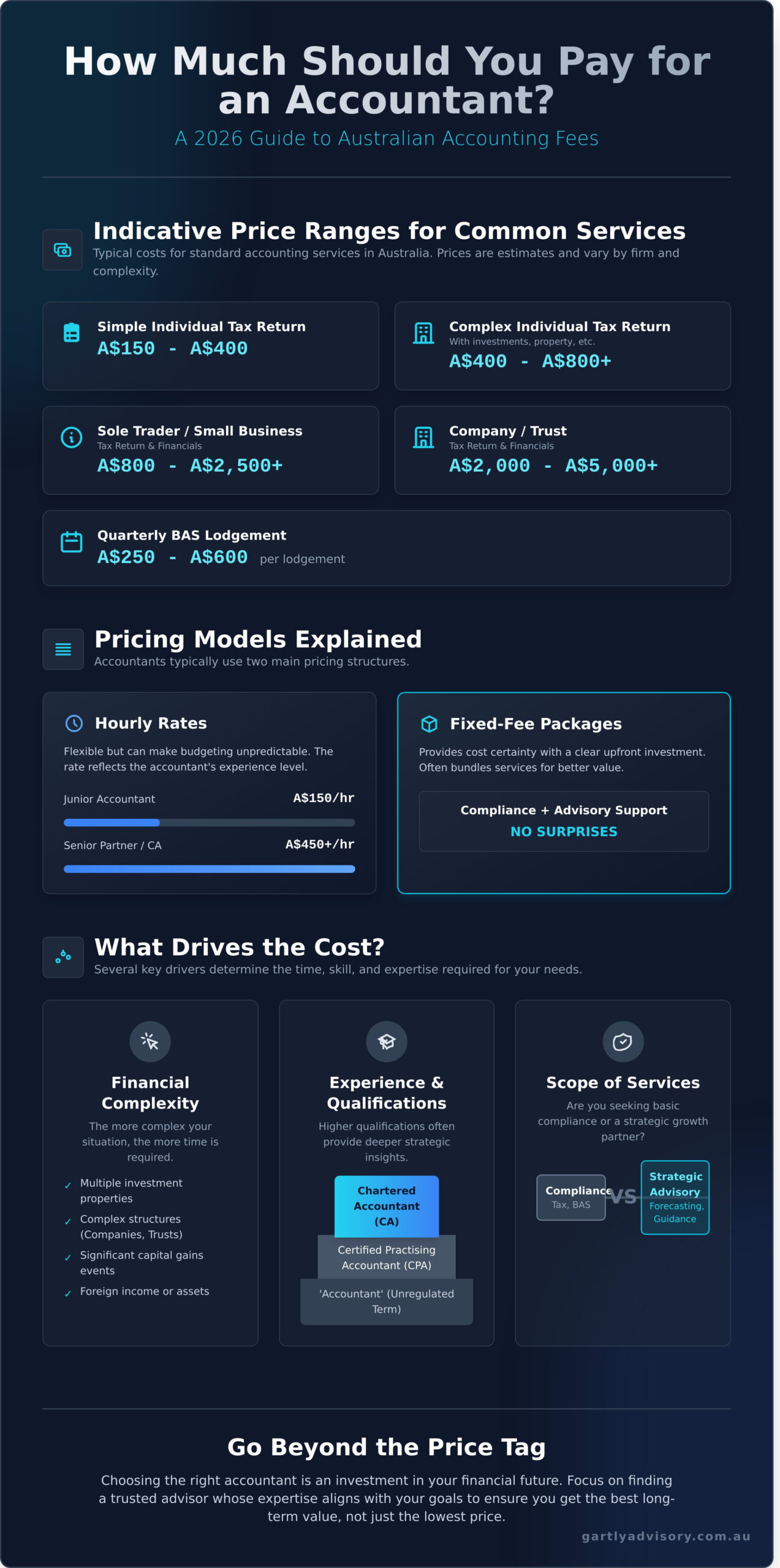
To provide a clear picture, we’ve compiled a guide to typical price ranges for standard accounting services across Australia. These figures are estimates and can vary based on factors like your location and the specific firm you engage.
- Simple Individual Tax Return: A$150 – A$400
- Complex Individual Tax Return (with investments, property, etc.): A$400 – A$800+
- Sole Trader/Small Business Tax Return & Financials: A$800 – A$2,500+
- Company/Trust Tax Return & Financials: A$2,000 – A$5,000+
- Quarterly BAS Lodgement: A$250 – A$600 per lodgement
Please note: These prices are indicative only. We always provide a tailored quote after understanding your unique situation, ensuring you receive the precise support you need without any surprises.
Hourly Rates vs. Fixed-Fee Packages
Accountants in Australia typically use two main pricing models. Hourly rates can range from A$150 for a junior accountant to over A$450 for a senior partner or a highly qualified Chartered Accountant, whose expertise provides significant strategic value. While this model is flexible, it can make budgeting unpredictable.
For this reason, many businesses and individuals prefer fixed-fee packages. This approach provides cost certainty, allowing you to know the exact investment upfront. These packages often bundle essential compliance tasks, like tax returns and BAS lodgements, with ongoing advisory support, making your accountant a true partner in your financial journey.
Key Factors That Influence How Much You’ll Pay an Accountant
Understanding the quote you receive from an accountant begins with recognising that not all financial situations are the same. The answer to how much should I pay for an accountant depends on several key drivers that determine the time, skill, and expertise required for your specific needs. Think of it not as a standard fee, but as a tailored investment in your financial health and peace of mind.
Here are the core factors that an accountant considers when preparing your quote.
Complexity of Your Financial Situation
The single biggest factor is the complexity of your financial affairs. An accountant will assess the time needed to accurately manage your situation. A straightforward individual tax return is relatively simple, but costs increase as more elements are introduced, such as:
- Multiple investment properties with rental income and expenses.
- Business structures involving companies, trusts, or partnerships.
- Significant capital gains events from selling shares or property.
- Foreign income or assets, which have unique reporting requirements.
The Accountant’s Experience and Qualifications
In Australia, anyone can call themselves an ‘accountant’, but not all have the same level of training. A Certified Practising Accountant (CPA) or a Chartered Accountant (CA) has completed rigorous postgraduate studies and is bound by a strict code of ethics. Chartered Accountants, in particular, often possess deep strategic and business advisory skills. Choosing the right professional is about more than just qualifications; it’s about finding the right partner for your goals. As the Small Business Development Corporation outlines in its guide on how to choose an accountant, understanding their specialisation is key. A highly experienced CA may charge more, but their proactive advice can uncover savings that far outweigh the cost.
Scope of Services: Compliance vs. Strategic Advisory
Are you seeking basic compliance or a strategic partner?
Compliance work is the foundation and includes necessary tasks like lodging tax returns and Business Activity Statements (BAS). This is the baseline cost.
Strategic advisory, on the other hand, is a premium service designed to build your wealth and grow your business. This includes cash flow forecasting, business structuring advice, and growth planning. Viewing this as an investment, not just a cost, is crucial for long-term success.
Your Level of Organisation
Finally, the state of your financial records directly impacts your bill. If you provide your accountant with a ‘shoebox’ of disorganised receipts and bank statements, they must spend significant time sorting, reconciling, and organising your data. This additional time is billed accordingly. Conversely, clients who use cloud accounting software like Xero or MYOB and provide clean, reconciled data will find their accounting fees are often lower, as the process is far more efficient.
Breaking Down the Services: What Are You Actually Paying For?
When asking “how much should I pay for an accountant?”, the answer depends entirely on the value you receive. The fee isn’t just for a one-off task; it’s an investment in financial clarity, compliance, and strategic growth. Understanding the specific deliverables helps you see beyond the price tag to the tangible outcomes for your business. The Australian government’s MoneySmart guide on how to choose an accountant also highlights the importance of matching services to your specific needs. Let’s break down the common services into three key areas.
Core Tax & Compliance Services
This is the foundational level of accounting, ensuring your business meets its legal and financial obligations. It’s about keeping you on the right side of the Australian Taxation Office (ATO) and providing complete peace of mind. Key deliverables include:
- Income Tax Returns: Accurate preparation and lodgement for all structures, including sole traders, companies, trusts, and partnerships.
- BAS & GST Management: Preparing and lodging your Business Activity Statements correctly and on time, managing your GST obligations seamlessly.
- ATO Compliance: Acting as your trusted representative with the ATO, managing deadlines, and ensuring all regulatory requirements are met without stress.
Business Accounting & Bookkeeping
This layer of service provides the clear, up-to-date financial data you need to run your business effectively day-to-day. It’s about transforming raw numbers into a clear picture of your business’s health.
- Cloud Accounting: Setting up and managing powerful software like Xero to streamline your financial processes and provide real-time data.
- Financial Reporting: Producing regular Profit & Loss statements and Balance Sheets so you always know your precise financial position.
- Payroll & Superannuation: Managing employee payments, PAYG withholding, and ensuring you meet your superannuation guarantee obligations flawlessly.
Strategic Business Advisory & Growth
This is where a true financial partner goes “beyond the numbers” to help you build a more profitable and resilient business. This proactive guidance is the key differentiator between a standard accountant and a strategic advisor, turning your financial data into a roadmap for the future.
- Cash Flow & Budgeting: Analysing your cash flow, identifying opportunities for improvement, and creating realistic budgets to drive profitability.
- Business Structuring: Providing expert advice on the right structure for robust asset protection and optimal tax efficiency.
- Growth Strategy: Helping you set meaningful KPIs, develop long-term strategic plans, and make informed decisions to grow your business sustainably.
Ultimately, a comprehensive understanding of these service tiers is the best way to determine how much you should pay for an accountant. While compliance is essential, a firm that provides proactive advisory, like Gartly Advisory, becomes a trusted partner on your journey towards success.
How to Choose the Right Accountant and Get the Best Value
Navigating the complex world of business finance means that the question of how much should I pay for an accountant is often top of mind. However, the most crucial factor isn’t the price, but the value you receive. The right financial professional is an investment in your future success, providing guidance and support that far outweighs their fees. Shifting your focus from cost to value is the first step in finding a true partner for your business journey.
Look Beyond the Price Tag
While it can be tempting to choose the cheapest option, this can be a costly mistake in the long run. A low-cost accountant may only provide basic compliance services, simply recording history. A great accountant, however, is proactive. They look ahead to identify opportunities for tax savings, business growth, and improved efficiency. Consider their communication style and responsiveness-will they be there to offer advice when you need it most?
Ask the Right Questions Before You Commit
Before engaging an accountant, it’s essential to do your due diligence. A brief interview can reveal whether they are the right fit for your specific needs. We recommend asking direct questions to ensure clarity and alignment from the start:
- What are your qualifications and memberships (e.g., Chartered Accountant – CA, Certified Practising Accountant – CPA)?
- How do you structure your fees? Are they fixed, hourly, or value-based? Are there any potential hidden costs?
- Who will be my primary point of contact at the firm, and what is their level of experience?
- What accounting software do you specialise in (e.g., Xero, MYOB, QuickBooks)?
Finding a Partner, Not Just a Number Cruncher
Ultimately, the goal is to find more than just a service provider; you need a trusted advisor who understands your industry, shares your vision, and is invested in your goals. A good accountant acts as a strategic sounding board, offering objective guidance on your business ideas and challenges. They provide the clarity and confidence needed to make informed decisions, transforming the question from “how much should I pay for an accountant” to “who is the right partner to help me grow?” Let’s discuss how a trusted partner can help your business. Schedule a complimentary consultation.
Beyond the Price Tag: Finding Your Trusted Financial Partner
Ultimately, the question of how much should I pay for an accountant in Australia is about value, not just cost. As we’ve detailed, fees are shaped by your specific needs, the complexity of your affairs, and the expertise of the professional. The wisest investment isn’t always the lowest price, but the partnership that delivers proactive guidance, ensures compliance, and helps you seize opportunities for growth.
For over 25 years, Gartly Advisory has provided this level of dedicated support to Melbourne’s small and medium-sized businesses. As Chartered Accountants with a reputation backed by more than 70 5-Star Google Reviews, we pride ourselves on giving advice that goes beyond the numbers. We are here to be your trusted partner on your journey to success.
Ready to gain financial clarity and grow your business with confidence? Let us be your trusted partner. Contact us for a complimentary appointment to discuss your needs.
Frequently Asked Questions About Accountant Fees
Are accounting fees tax-deductible in Australia?
Yes, in Australia, fees you pay to a registered tax agent for managing your tax affairs are generally tax-deductible. This includes the cost of preparing and lodging your tax return and any advice related to your tax obligations. It’s an investment that reduces your taxable income. However, fees for other services, such as general financial planning or setting up a business structure, may not be deductible in the same way. Always confirm with your trusted advisor.
How much does a simple individual tax return cost?
For a simple individual tax return in Australia, you can typically expect to pay between A$150 and A$400. If you’re asking how much should I pay for an accountant, the final cost depends on complexity. A return with just salary and basic deductions will be at the lower end of that range. If you have rental properties, capital gains from investments, or sole trader income, the fee will be higher to reflect the additional time and expertise required.
What’s the difference between a bookkeeper and an accountant?
A bookkeeper and an accountant provide different levels of financial support. A bookkeeper’s role is transactional-they record daily financial activities, manage payroll, and reconcile bank accounts to ensure your data is accurate. An accountant provides strategic guidance based on that data. They analyse financial statements, offer tax planning advice, ensure compliance, and help you make informed business decisions. A bookkeeper manages the ‘now’ while an accountant helps you plan for the ‘future’.
How can I reduce my annual accounting fees?
You can significantly reduce your annual accounting fees by being organised. Maintaining clean and up-to-date records using software like Xero or MYOB is the first step. Before meeting your accountant, ensure all your documents, receipts, and financial statements are collated and ready. This preparation minimises the time your advisor spends on administrative tasks, allowing them to focus on providing high-value strategic advice. Good organisation directly translates to a more efficient process and lower costs.
Is it worth paying for an accountant if I can use tax software myself?
While tax software is suitable for very simple returns, an experienced accountant offers value that goes far beyond data entry. A professional can identify complex deductions you might miss, provide strategic advice to legally minimise your tax liability, and structure your finances for future growth. Importantly, they provide expert support and representation if the ATO has questions. Paying for an accountant is an investment in accuracy, peace of mind, and the guidance of a trusted financial partner.
Do accountants in Melbourne cost more than in other cities?
Accountant fees can be slightly higher in major capital cities like Melbourne compared to regional areas, primarily due to higher business overheads. However, location is not the most significant factor determining cost. The complexity of your financial situation, the accountant’s level of experience, and their specific expertise play a much larger role. A highly specialised accountant in a regional centre may charge more than a generalist firm in the CBD, so it’s best to focus on finding the right expertise.
Looking for an accountant? See how our small business accountants in Melbourne work, or read how to choose a small business accountant.