
Growing a Small Manufacturing Firm in Australia: The 2026 Strategic Guide
Your deep expertise on the workshop floor, the very skill that launched your business, might now be the biggest obstacle to its growth. It’s a familiar story for many Australian manufacturers. You’re grappling with volatile cash flow tied to 90-day production cycles, absorbing the relentless rise in material and energy costs that have jumped over 15% since 2024, and spending countless hours trying to find skilled tradespeople in a shrinking talent pool. You feel stretched thin, and the dream of a valuable, self-sustaining business seems further away than ever.
Getting your business structure right is fundamental to growing a small manufacturing firm. The Australian business landscape offers several options, each with distinct advantages for asset protection and tax planning. A Proprietary Limited (Pty Ltd) company, for instance, is a separate legal entity, which means your personal assets are generally protected from business liabilities. For businesses with an aggregated turnover of less than A$50 million, the company tax rate is a flat 25% (as of the 2023-24 income year), which is often more favourable than the top marginal personal income tax rate of 45%. A trust structure, particularly a discretionary trust, offers flexibility in distributing profits to beneficiaries in a tax-effective way and can be a powerful tool for asset protection and succession planning. To learn more about choosing the right path, it’s wise to consult with advisors who specialize in the manufacturing sector.
This is where we shift the focus. This guide is designed specifically for the unique challenges of growing a small manufacturing firm in the current Australian market. We promise to provide you with the proven financial, structural, and operational frameworks needed to not just survive, but to scale sustainably towards 2026 and beyond. We’ll walk you through creating a predictable financial roadmap, building systems that allow you to step back without things falling apart, and ultimately, increasing your company’s valuation for a future exit.
Key Takeaways
- Go beyond standard accounting by identifying the critical financial metrics that directly fuel smarter, more profitable production decisions on the factory floor.
- Discover the essential mental and structural shifts required to step off the tools and transition from an overwhelmed owner-manager to a strategic CEO.
- Learn how to affordably implement “Smart Factory” technology and choose the right systems to scale your operations and build a resilient Australian supply chain.
- Understand why a proactive partner is essential for growing a small manufacturing firm, helping you anticipate and navigate 2026 challenges like energy costs and labour shortages.
The State of Small Manufacturing in Australia: 2026 Landscape
The Australian manufacturing sector is in the midst of a significant transformation. After decades of change detailed in the History of manufacturing in Australia, the sector is experiencing a powerful renaissance, driven by a renewed focus on sovereign capability and a powerful “Made in Australia” movement. For leaders focused on growing a small manufacturing firm, this 2026 landscape presents both significant hurdles and unprecedented opportunities. The lessons learned from the global supply chain disruptions between 2020 and 2022 haven’t been forgotten, creating a fertile ground for local producers to reclaim market share.
However, the path forward isn’t without its challenges. Business owners are currently grappling with a complex economic environment. Three key pressures dominate strategic planning:
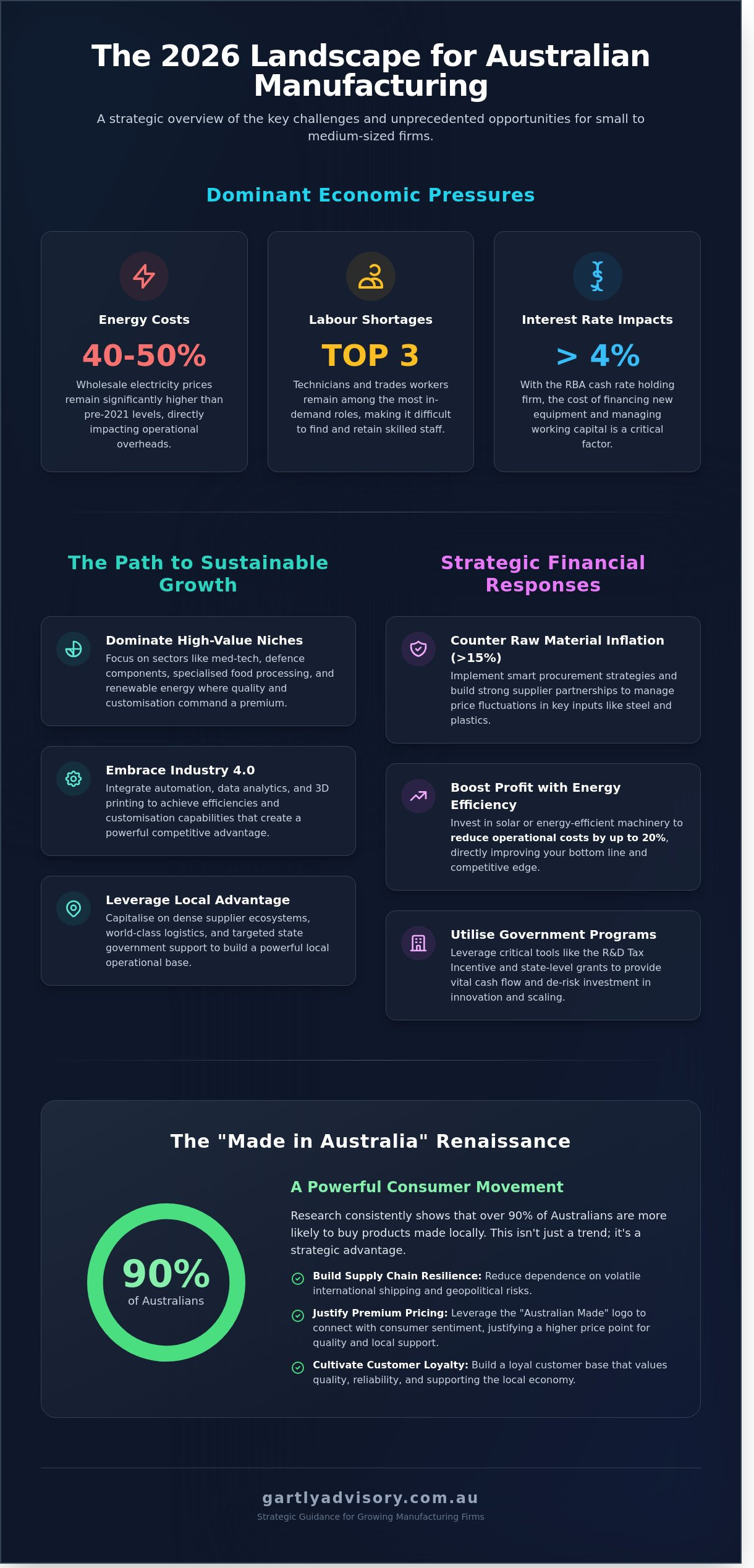
- Energy Costs: Wholesale electricity prices, despite some recent moderation, remain approximately 40-50% higher than pre-2021 levels, directly impacting operational overheads.
- Labour Shortages: According to Jobs and Skills Australia, technicians and trades workers remain in the top three most in-demand roles, making it difficult to find and retain skilled staff like welders, fitters, and machinists.
- Interest Rate Impacts: With the RBA holding the cash rate above 4% through 2024, the cost of financing new equipment, expanding facilities, or managing working capital has become a critical financial consideration.
Despite these headwinds, the opportunities for agile Small and Medium-sized Enterprises (SMEs) are immense. The future lies not in competing with low-cost mass production, but in dominating high-value niche markets. We see clients thriving in sectors like med-tech, defence components, specialised food processing, and renewable energy technology. This is where advanced manufacturing, or Industry 4.0, becomes a game-changer. By integrating automation, data analytics, and 3D printing, smaller firms can achieve efficiencies and customisation capabilities that were once the exclusive domain of large corporations. Local Victorian firms, particularly those in the industrial heartland of Melbourne’s South East, are uniquely positioned. They benefit from a dense ecosystem of suppliers, world-class logistics infrastructure, and targeted support from the Victorian State Government, creating a powerful local advantage.
Navigating the 2026 Economic Pressures
Successfully managing today’s financial climate requires a proactive, strategic approach. To counter the persistent inflation on raw materials, which has seen prices for key inputs like steel and plastics fluctuate by over 15% in recent years, smart procurement strategies and building stronger supplier partnerships are essential. Beyond procurement, energy efficiency is no longer just a corporate responsibility initiative; it’s a core competitive advantage. Investing in solar installations or upgrading to energy-efficient machinery can reduce operational costs by up to 20%, providing a direct boost to your bottom line. Furthermore, government programs like the federal R&D Tax Incentive and various state-level manufacturing grants are critical tools. They provide vital cash flow and de-risk the investment needed to innovate and scale.
The Shift Toward Reshoring
The move to bring production back to Australia, or “reshoring,” is one of the most significant trends shaping the industry. Businesses are actively seeking to build resilience and reduce their dependence on volatile international supply chains. This strategic shift is about risk management; it ensures that your production isn’t halted by a shipping crisis on the other side of the world. More importantly, this trend taps directly into powerful consumer sentiment. Research from Roy Morgan consistently shows that over 90% of Australians are more likely to buy products made in Australia. Leveraging the green-and-gold “Australian Made” kangaroo logo allows you to connect with this sentiment, often justifying a premium price point and building a loyal customer base that values quality and local support.
The Financial Engine: Mastering Metrics for Manufacturing Growth
For many Australian manufacturers, the annual Profit and Loss statement feels like a report card from the past. It tells you where you’ve been, but it offers very little guidance on where you’re going. To successfully navigate the complexities of growing a small manufacturing firm, you need to move beyond standard compliance accounting. Your financial data isn’t just for satisfying the ATO; it’s the live dashboard for your factory’s engine room, fuelling every critical decision from quoting a new job to purchasing raw materials.
Relying on “gut feel” for pricing might have worked when you started, but growth demands precision. A single miscalculation on a large order, based on an assumed material cost or labour time, can erode your profit margin entirely. Shifting to a data-driven approach means replacing assumptions with certainties, ensuring every product that leaves your workshop is priced for sustainable profitability, not just to keep the machines running.
The 3 Non-Negotiable Financial Metrics
To get started, focus on three key performance indicators (KPIs) that provide a real-time health check of your operations. These aren’t abstract numbers; they are direct measures of your factory’s efficiency and profitability.
- Gross Profit Margin: This is the ultimate measure of your production efficiency. Calculated as (Revenue – Cost of Goods Sold) / Revenue, it reveals how much money you make on each dollar of sales before accounting for overheads. A healthy margin, say 45% or higher, gives you the power to invest in new equipment and weather economic shifts. A declining margin is an early warning that your input costs or labour efficiency are heading in the wrong direction.
- Inventory Turnover: This ratio (COGS / Average Inventory) shows how many times you sell and replace your inventory over a period. “Sitting stock” is a silent profit killer. It ties up cash, incurs storage and insurance costs, and risks becoming obsolete. A manufacturer of custom steel components might aim for a turnover of 8, while a high-volume producer might target 12. A low number means your capital is gathering dust on a shelf.
- Labour Efficiency Ratio: Are you paying for presence or for productivity? This metric, calculated by dividing the standard hours required for a job by the actual hours taken, measures the true value of your workshop hours. A ratio of 95% indicates your team is working effectively. If it drops to 80%, your job costing and scheduling are likely inaccurate, directly impacting your bottom line.
Looking ahead, the very definition of production cost is evolving. We believe that in 2026, Cost of Goods Sold (COGS) for a manufacturer will be defined as the all-inclusive, digitally-tracked cost of direct materials, smart factory labour, and automated machinery overhead required to produce a finished, saleable item.
Solving the Manufacturing Cash Flow Gap
Ironically, rapid growth is one of the biggest risks to a manufacturer’s cash flow. This is the “Growth Trap”: you win a huge A$250,000 order, but you must first outlay A$110,000 for materials and wages. If your client is on a 60-day payment term, your business could be starved of cash despite being busier than ever. This is a critical challenge for any growing a small manufacturing firm.
Managing this gap requires proactive financial strategies, not reactive panic. Implementing progress payments (e.g., 40% upfront, 30% on a key milestone, and 30% on completion) is a non-negotiable for large projects. You can also strategically align your supplier payment terms with your customer invoices to smooth out the cash cycle. For significant expansion, exploring options like the Australian government support for manufacturers can provide grants and advice to help fund growth without taking on prohibitive debt.
Modern cloud accounting tools like Xero or MYOB are essential here, providing a real-time view of your cash position. They allow you to forecast potential shortfalls and make informed decisions. Having this live data is powerful, but interpreting it to build a resilient financial strategy is where partnering with an experienced business advisor provides the clarity and confidence to grow safely.
Structural Evolution: Why Your Setup Might Be Holding You Back
For many owners of manufacturing businesses, the most common objection to growth is a deeply personal one: “I can’t afford to step away from the floor.” You know every machine, every process, and every client. While this hands-on approach built your business, it’s now the single biggest barrier to its future. Your time is the most valuable asset in the company. If you’re spending 40 hours a week on tasks that could be done by a A$45/hour employee, you’re actively preventing the A$500/hour strategic work that drives real growth. This isn’t about affordability; it’s about opportunity cost.
The transition from an Owner-Manager to a true CEO is both a mental and a structural shift. It requires moving from doing the work to designing the system that does the work. This evolution starts with a hard look at the very foundation of your business. The simple sole trader or partnership structure that served you well in 2020 is unlikely to support your 2026 expansion goals. As your business takes on larger contracts, more staff, and bigger debts, your personal assets become increasingly exposed. A robust structure isn’t just paperwork; it’s a fortress for your family’s financial future and a launchpad for sustainable success.
Choosing the Right Entity Structure
Getting your business structure right is fundamental to growing a small manufacturing firm. The Australian business landscape offers several options, each with distinct advantages for asset protection and tax planning. A Proprietary Limited (Pty Ltd) company, for instance, is a separate legal entity, which means your personal assets are generally protected from business liabilities. For businesses with an aggregated turnover of less than A$50 million, the company tax rate is a flat 25% (as of the 2023-24 income year), which is often more favourable than the top marginal personal income tax rate of 45%. A trust structure, particularly a discretionary trust, offers flexibility in distributing profits to beneficiaries in a tax-effective way and can be a powerful tool for asset protection and succession planning. Choosing the right path is a critical step in preparing your business for future investors or a smooth family succession.
Defining Roles and Building a Management Layer
You cannot scale yourself. To break free from the factory floor, you must build a team that can operate effectively without your constant oversight. Your first “non-production” hire is a pivotal moment. This is often a Production Supervisor or an Operations Manager whose primary role is to manage the day-to-day workflow, freeing you to focus on strategy, sales, and supplier relationships. To empower this new layer of management, you need clear and documented Standard Operating Procedures (SOPs). SOPs are the playbook for your business; they ensure consistency, quality, and safety, making it possible to train new staff and delegate tasks with confidence. When your team has a clear framework and the authority to make decisions within it, you’re no longer just a business owner; you’re building a self-sustaining organisation. This is the essence of successfully growing a small manufacturing firm from a job into a valuable asset.
Operational Scaling: Technology and Supply Chain Resilience
True growth isn’t just about making more products; it’s about building a stronger, more efficient engine to power your production. For many Australian manufacturers, the idea of a “Smart Factory” sounds like something reserved for multinational corporations with billion-dollar budgets. That’s no longer the case. The technology that underpins smart manufacturing is more accessible and affordable than ever before, offering a direct solution to some of the biggest hurdles in the industry, including Australia’s persistent skilled labour shortage, which saw over 25,000 manufacturing job vacancies in late 2023 according to the Australian Bureau of Statistics.
Investing in automation, from advanced CNC machining to collaborative robots (cobots) for pick-and-place tasks, doesn’t just increase output. It frees up your highly skilled team to focus on complex problem-solving, quality control, and innovation instead of repetitive manual labour. This strategic adoption of technology is a critical step for growing a small manufacturing firm from a workshop into a scalable enterprise.
Leveraging ERP and Manufacturing Software
An integrated Enterprise Resource Planning (ERP) system acts as the central nervous system for your entire operation. It connects your sales orders, inventory, production scheduling, and accounting in one place, dramatically reducing the costly human errors that come from juggling multiple spreadsheets. Research from TEC (Technology Evaluation Centers) shows businesses that implement an ERP can reduce operational costs by up to 23% and administrative costs by 22%. For a growing manufacturer, the ability to generate an accurate job cost in real-time is invaluable, especially when material prices can fluctuate by 10-15% in a single quarter. Choosing a cloud-based, scalable ERP ensures the system grows with you, avoiding a costly replacement down the line.
Building Watertight Supply Chain Management
The global disruptions of 2021 and 2022 taught Australian businesses a hard lesson: the lean “Just-in-Time” supply chain is incredibly fragile. The forward-thinking approach for 2026 and beyond is a hybrid “Just-in-Case” model built on resilience, not just minimal inventory. This isn’t about stockpiling everything; it’s about smart, strategic planning. This involves:
- Supplier Diversification: Actively reduce your reliance on a single supplier or single country of origin. Creating a panel of at least two to three approved suppliers for critical components mitigates the risk of a single point of failure shutting down your entire production line.
- Data-Driven Forecasting: Use the sales and production data from your manufacturing software to build more accurate demand forecasts. According to research by McKinsey, a 10-20% improvement in forecast accuracy can unlock a 5% reduction in inventory costs and a potential 2-3% increase in revenue.
- Partnership Development: Treat your key suppliers as genuine partners. Share your production forecasts and growth plans with them. This collaborative approach builds loyalty and often puts you at the front of the queue when materials are scarce.
This proactive management transforms your supply chain from a potential liability into a competitive advantage, providing the stability needed for growing a small manufacturing firm. Unsure how to budget for a new ERP or model the financial impact of supply chain changes? Talk to us about building a financial roadmap for your operational growth.
Partnering for Success: Moving “Beyond the Numbers”
Implementing new technologies, refining processes, and expanding your market share are all powerful growth levers. Yet, the single most critical factor in successfully growing a small manufacturing firm is often the strategic partner you choose to have by your side. For many business owners, their accountant is someone they speak to once a year for tax compliance. A true growth partner, however, is a proactive advisor who helps you interpret the story your numbers are telling and uses that insight to chart a course for the future.
At Gartly Advisory, we’ve built our reputation on being that partner. We provide guidance that moves beyond simple compliance to anticipate hurdles, identify opportunities, and build a resilient financial foundation for your manufacturing business.
The Value of a Trusted Advisor
Moving from a compliance-only mindset to a strategic advisory relationship is transformative. Compliance is about recording history; advisory is about shaping the future. Instead of just ensuring your BAS is lodged on time, a trusted advisor interrogates your financial statements to find “hidden” pockets of profit and efficiency. This could mean analysing your cost of goods sold to pinpoint material wastage, assessing your gross profit margin per product line to guide production priorities, or restructuring debt to improve your monthly cash flow by over 15%.
Our proactive approach delivers tangible results. In early 2023, we were working with a local fabrication client and noticed their significant investment in developing a new, automated welding process. We identified this as a qualifying activity for the Australian Government’s R&D Tax Incentive. It wasn’t something they had considered. We guided them through the AusIndustry application process, helping them secure a A$65,000 tax offset that was reinvested directly into purchasing new equipment.
Planning Your Exit from Day One
Building a business that is “sellable” isn’t about wanting to leave; it’s about creating a valuable, robust, and efficient asset. A sellable business has clean financials, documented systems, and isn’t entirely dependent on the owner’s personal involvement. These are the same qualities that make a business more profitable and less stressful to run day-to-day. Thinking about your exit strategy from the beginning forces you to build a better company right now.
This long-term planning is also crucial for maximising your financial return when you do decide to sell. With decades of foresight, we can help structure your affairs to take full advantage of the Australian Small Business Capital Gains Tax (CGT) concessions. These powerful concessions can significantly reduce or even eliminate the tax on the sale of your business, potentially adding hundreds of thousands of dollars to your final windfall. The journey of growing a small manufacturing firm into a valuable legacy requires a clear plan. Talk to Geoff and the team about your growth journey, and let’s start building that value today.
Your manufacturing business is more than just a collection of assets and liabilities; it’s the result of your hard work, innovation, and vision. A complimentary consultation with our team is your opportunity to map out a clear trajectory for growth, ensuring the legacy you build is both profitable and resilient for years to come. Let us be your trusted partner on that journey.
Turning Your 2026 Vision into a Reality
The path to a thriving manufacturing business in Australia’s 2026 landscape is clear. It’s not about a single silver bullet, but a holistic strategy. Success hinges on mastering your financial metrics to fuel smart investment and having a corporate structure that doesn’t just support today’s operations but is built for future scale. It also demands embracing technology to build a resilient, agile supply chain that can withstand market volatility.
The journey of growing a small manufacturing firm is complex, but you don’t have to navigate it alone. True strategic growth requires a partner who looks beyond the numbers to understand your unique vision and challenges. That’s where our team’s proactive guidance makes a tangible difference.
With over 35 years of dedicated business advisory experience and the trust of the community, evidenced by our 70+ 5-Star Google Reviews, our Chartered Accountants and Business Valuebuilder Advisors are ready to support your ambition. Book a complimentary appointment with our Chartered Accountants to discuss your growth strategy. Let’s build a resilient, profitable future for your business, together.
Frequently Asked Questions About Growing Your Manufacturing Business
How much does it cost to scale a small manufacturing firm in Australia?
The cost to scale a small manufacturing firm in Australia varies significantly, but a planned expansion can range from A$100,000 for modest upgrades to well over A$1,000,000 for substantial growth. There isn’t a single figure, as the investment depends entirely on your specific growth strategy. Key cost areas include new equipment, which can run from A$50,000 for a single CNC machine to A$500,000+ for automated production lines. You must also factor in premises costs; leasing a larger industrial space in metro areas like Sydney or Melbourne can cost between A$300 to A$500 per square metre annually.
Furthermore, a physical expansion or move to a new site often involves navigating council approvals, where transport planning and traffic impact assessments are critical considerations. For manufacturers planning such a project, you can learn more about ML Traffic Engineers Pty Ltd to understand these specialist requirements.
Beyond physical assets, consider the investment in human capital and technology. Hiring and training skilled staff can cost thousands per employee, while implementing a new Enterprise Resource Planning (ERP) system to manage increased complexity can range from A$20,000 to A$150,000. A successful scaling project requires a detailed financial forecast and a robust budget. We recommend a strategic review to model these costs accurately, ensuring your growth is both ambitious and financially sustainable. Let us be your trusted partner in mapping out this journey.
What are the best tax incentives for Australian manufacturers in 2026?
While tax legislation can change with each federal budget, the most significant and enduring incentive for Australian manufacturers is the Research and Development (R&D) Tax Incentive. For eligible companies with an aggregated turnover of less than A$20 million, this program offers a refundable tax offset of 43.5%, directly boosting cash flow for innovative activities. Another powerful, though less permanent, tool has been the temporary full expensing or instant asset write-off scheme. It’s crucial to check its status with the ATO for 2026, as these policies have been used as economic stimuli and are subject to change.
Beyond these federal programs, you should also investigate state-specific grants, such as Victoria’s Manufacturing and Industry Development Fund or NSW’s Jobs Plus Program, which often provide co-funding for projects that create jobs and enhance local manufacturing capabilities. Navigating these incentives requires a proactive approach, as eligibility criteria are strict and application windows can be short. We provide the expert guidance needed to identify and secure the full range of benefits available to your firm, ensuring you don’t miss out on valuable government support.
Do I need a specialized manufacturing accountant or a general one?
You absolutely need a specialized manufacturing accountant to properly support your growth. While a general accountant can manage compliance tasks like BAS and tax returns, they often lack the deep industry knowledge required to provide strategic advice. A manufacturing specialist understands the unique financial landscape of your business, including complex inventory valuation (distinguishing between raw materials, work-in-progress, and finished goods), accurate calculation of Cost of Goods Sold (COGS), and the strategic implications of capital expenditure on machinery.
Furthermore, a specialist is proactive in identifying opportunities a generalist might miss. They can perform job costing analysis to determine the true profitability of each product line, conduct variance analysis to pinpoint inefficiencies in material or labour costs, and provide invaluable advice on accessing industry-specific government grants and R&D tax incentives. This goes far beyond standard compliance; it’s about providing the financial clarity you need to make informed decisions and drive profitability. It’s advice that goes beyond the numbers.
How can I improve my manufacturing cash flow without taking on debt?
You can significantly improve your manufacturing cash flow without taking on debt by focusing on optimising your working capital cycle. The most effective strategy is to accelerate your cash collections. If your standard payment terms are 60 days, take steps to reduce them to 30. You can achieve this by implementing stricter credit checks for new clients, sending automated invoice reminders, and offering a small 2% discount for payments made within 10 days. This simple change can dramatically shorten the time it takes for revenue to become available cash.
Simultaneously, manage your outflows more effectively. Negotiate longer payment terms with your own suppliers, moving from 30 days to 45 or 60 where possible, which allows you to hold onto your cash for longer. Also, scrutinise your inventory. Implementing lean or Just-In-Time (JIT) principles can reduce the amount of capital tied up in raw materials and finished goods sitting on shelves. These strategies strengthen your cash position organically, providing the funds for growth without the burden of interest payments.
Is it better to lease or buy new manufacturing equipment for growth?
Deciding whether to lease or buy new equipment depends on your firm’s cash position, the expected lifespan of the asset, and the pace of technological change in your sector. Buying equipment is often better for core machinery with a long, predictable life of 10 years or more. Although it requires a significant upfront capital outlay, you build equity in the asset on your balance sheet and can claim depreciation as a tax deduction over its useful life. This path is ideal for financially strong companies investing in foundational technology.
Leasing, on the other hand, is an excellent strategy for preserving cash flow and maintaining flexibility. It allows you to access state-of-the-art technology, like advanced 3D printers or robotics, for a predictable monthly operating expense without a large initial investment. This is particularly advantageous for equipment that may become obsolete in 3-5 years. Lease payments are typically 100% tax-deductible, offering a different financial advantage. We can help you model the financial impact of both options to determine the most supportive path for your growth.
What is the most important financial metric for a workshop owner to track?
The single most important financial metric for a workshop owner is the Gross Profit Margin. This metric is your first and best indicator of production efficiency and pricing effectiveness. Calculated as (Revenue – Cost of Goods Sold) / Revenue, it reveals exactly how much profit you make from producing and selling your products before any administrative or overhead costs are deducted. A healthy and stable Gross Profit Margin shows that your material costs, direct labour, and pricing strategy are well-aligned and sustainable.
A declining Gross Profit Margin is a critical early warning sign that requires immediate investigation. It could signal rising raw material prices that haven’t been passed on to customers, a drop in labour productivity, or an increase in production waste. While other metrics like Net Profit Margin and cash flow are vital for overall business health, Gross Profit Margin gives you the most direct insight into the core operational profitability of your workshop, allowing you to solve problems before they impact your bottom line.
Can I qualify for R&D tax incentives as a small manufacturing firm?
Yes, absolutely. Many owners mistakenly believe the R&D Tax Incentive is only for scientists in lab coats, but a significant number of small manufacturing firms qualify and benefit from it every year. The incentive supports activities aimed at generating new knowledge, which includes developing new or significantly improved products, processes, or materials. The key is that the outcome can’t be known or determined in advance, and the process must involve systematic experimentation to resolve technical uncertainties.
For example, if you’re experimenting with a new composite material to make your product 15% lighter, or designing a new jig and production process to reduce assembly time by 25%, those activities could qualify. The process of trial, error, and testing is central to the claim. Success is not a requirement; the incentive rewards the experimental effort. Properly documenting your hypothesis, experiments, and results is crucial for a successful claim. This is a key area where expert guidance is vital for those focused on growing a small manufacturing firm, as it can unlock significant cash flow to reinvest in your business.
How do I know when it is time to hire a factory manager?
The clearest sign it’s time to hire a factory manager is when you, the owner, are spending more than 30% of your week managing day-to-day production instead of focusing on strategic growth. If you are constantly pulled away from sales, client relationships, and business planning to solve problems on the workshop floor, you have become the primary bottleneck to your own company’s expansion. Your time is best spent working *on* the business, not just *in* it.
Other critical indicators include a noticeable increase in quality control issues or customer returns, consistent failure to meet production deadlines, or a rising employee turnover rate on the factory floor. These are symptoms of a system that has outgrown your direct supervision. Hiring a dedicated factory manager is an investment in efficiency and scalability. They will implement systems for production scheduling, quality assurance, and team management, freeing you to steer the company toward its next milestone. It’s a crucial step in growing a small manufacturing firm from a hands-on operation to a scalable enterprise.