
Foreign Resident Capital Gains Withholding Guide: Selling Property in Melbourne, Sydney & the Gold Coast (2026)
Imagine standing in a solicitor’s office in Sydney on settlement day in early 2026, expecting a full payout for your investment property, only to discover A$150,000 of your sale proceeds has been redirected straight to the ATO. For many sellers, this isn’t a hypothetical mistake; it’s the reality of missing a single piece of paperwork. Selling property in Australia is already a high-stakes process, and we know how stressful it feels when the 15% withholding rate threatens your financial plans. This foreign resident capital gains withholding guide is here to give you the clarity you need to handle the 2026 FRCGW rules without the usual headache.
At Gartly Advisory, we’ve spent over 35 years helping clients move beyond the numbers to reach their goals. We believe that a smooth property settlement in Melbourne or the Gold Coast shouldn’t be derailed by complex tax residency questions or paperwork delays. This guide provides a clear path to securing your clearance certificate or variation well before settlement day arrives. We’ll walk you through your 2026 tax obligations and share practical steps to ensure your property sale remains a success rather than a compliance nightmare.
Key Takeaways
- Understand why the 2026 shift to a 15% withholding rate and the removal of the threshold means almost every property seller in Australia is now affected.
- Learn the essential steps to secure an Australian Resident Clearance Certificate to ensure you receive your full sale proceeds at settlement.
- Discover how foreign residents can apply for a withholding variation to align the tax payment with their actual liability rather than the flat 15% rate.
- Use this foreign resident capital gains withholding guide to navigate complex ATO requirements and avoid common pitfalls when selling in Melbourne, Sydney, or the Gold Coast.
- See how proactive, “beyond the numbers” advice can help you identify valuable CGT concessions and protect your financial interests before the contract is signed.
Understanding FRCGW Rules in 2026: Why Every Seller is Affected
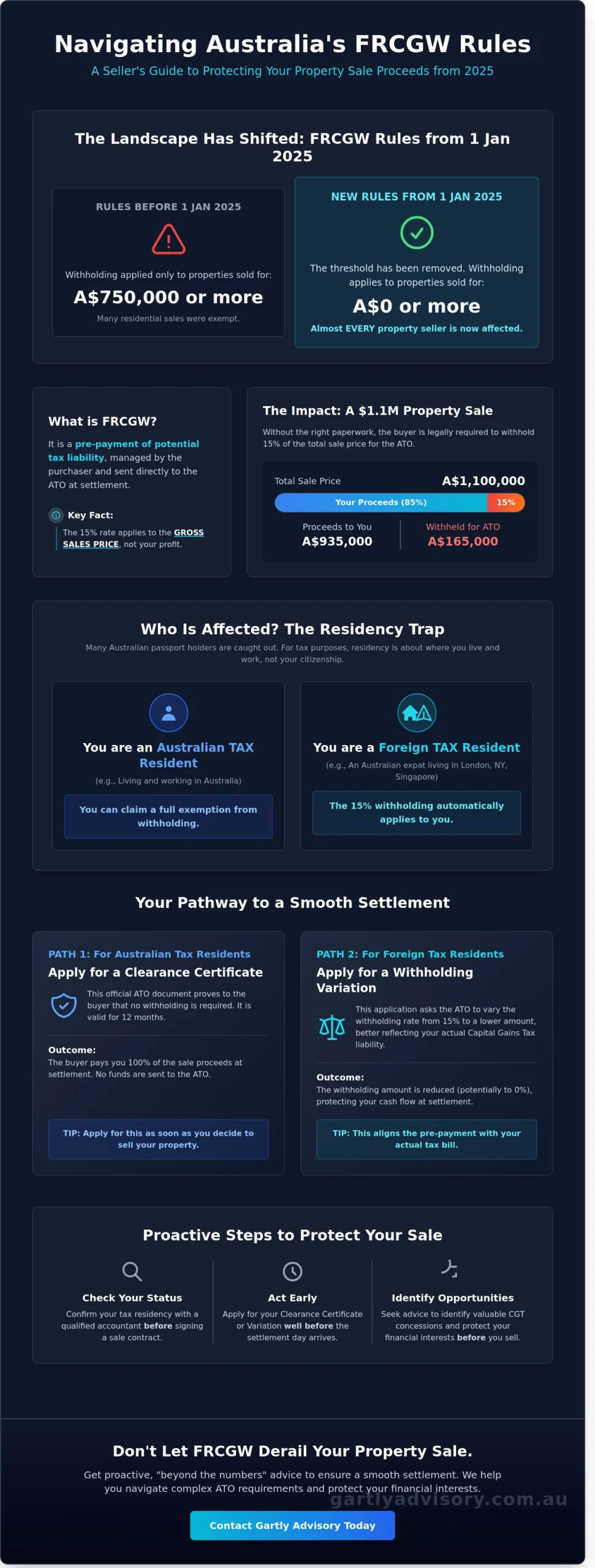
Selling property in Australia has changed significantly since the rules shifted on 1 January 2025. If you’re listing a home in Melbourne, Sydney, or the Gold Coast, you need to be aware of the Foreign Resident Capital Gains Withholding (FRCGW) regime. This isn’t a new tax, but a security measure for the Australian Taxation Office (ATO) to ensure they collect what’s owed before funds leave the country. We often describe the process to our clients with a simple definition: “The FRCGW is a pre-payment of potential tax liability, managed by the purchaser and sent directly to the ATO at settlement.”
This mechanism is closely linked to the broader framework of Understanding Capital Gains Tax in Australia. While CGT applies to the actual profit you make, the withholding tax applies to the total contract price. We’ve seen many sellers get caught out because they assume these rules only apply to non-citizens. In reality, this foreign resident capital gains withholding guide highlights that the 2026 landscape now touches almost every residential transaction in the country, regardless of the seller’s background.
The 15% Withholding Rate and the $0 Threshold
The biggest shift for 2026 is the total removal of the previous A$750,000 threshold. Previously, many residential sales in the Gold Coast or Melbourne suburbs escaped these rules because of their price point. Now, the threshold is A$0. This means every single property sold by a foreign resident triggers a 15% withholding requirement. The ATO determines the market value based on the contract price. If you sell a Sydney apartment for A$1,100,000, the buyer is legally required to withhold A$165,000 and pay it to the ATO unless you have the correct paperwork in place. This can create a massive cash flow gap if you’re counting on those funds to pay off a mortgage or fund a new purchase.
Residency Status vs. Citizenship: The Common Trap
We find that many Australian expats living in London, New York, or Singapore are blindsided by these rules. It’s a common trap to assume that your Australian passport exempts you. For tax purposes, residency is about where you live and work, not your citizenship. If you’ve been living abroad for several years, the ATO likely classifies you as a foreign resident. This distinction is vital because it determines whether you can apply for a clearance certificate. We strongly suggest conducting a tax residency audit before you even list your property. Being proactive allows us to help you determine your status and apply for variations if the 15% withholding is more than your actual tax bill would be. Don’t wait until the week of settlement to check your status; by then, the buyer’s solicitor will already be preparing to slice 15% off your proceeds.
- Tip: Always check your residency status with a qualified accountant before signing a sale contract.
- Tip: If you’re an Australian tax resident, apply for your Clearance Certificate as soon as you decide to sell.
- Tip: Remember that the 15% is calculated on the gross sales price, not your profit.
Navigating the Withholding Process: Clearance Certificates and Variations
When you sell a property in Australia valued at A$750,000 or more, the Australian Taxation Office (ATO) assumes you might be a foreign resident for tax purposes. To manage this, they require the purchaser to withhold 15% of the purchase price and pay it directly to the tax office. If you are selling a A$1.2 million terrace in Surry Hills, that is A$180,000 taken right off the top at settlement. It is vital to understand that the purchaser has a strict legal obligation here. They aren’t being difficult; they are avoiding personal penalties. If you don’t provide the right paperwork, they must remit those funds to the ATO.
This foreign resident capital gains withholding guide highlights that the process is manageable if you are proactive. For Australian tax residents, the solution is obtaining a Clearance Certificate. This document proves to the buyer that no withholding is required. For genuine foreign residents, the 15% rate might be much higher than the actual tax you owe. In these cases, you apply for a “variation” to reduce that percentage to a more accurate figure, potentially even zero.
Applying for a Clearance Certificate in Melbourne and Sydney
If you live in Australia and hold a valid tax file number, you should apply for your Clearance Certificate before your property even hits the market. In the high-speed auction environments of Melbourne and Sydney, waiting until a contract is signed is a recipe for stress. These certificates stay valid for 12 months, so there is no harm in being early. For those selling property held within a company structure or used for commercial purposes, integrating this with your small business accounting strategy ensures you don’t face unexpected cash flow gaps during settlement.
Grounds for a Variation: Reducing the 15% Hit
Foreign residents often find the flat 15% withholding rate excessive. Navigating Clearance Certificates and Variations allows you to present a case for a lower rate based on your specific financial situation. The ATO will consider a variation if you can provide evidence of the following:
- High Cost Base: If you purchased the property for a high price and your profit margin is slim, 15% of the total sale price might exceed your entire capital gain.
- Capital Losses: You may have existing capital losses from other Australian investments that offset the gain on this sale.
- Main Residence Exemptions: You might be eligible for partial exemptions if the property was once your primary home.
- No Tax Payable: If the sale will result in a capital loss, you can apply to have the withholding rate reduced to 0%.
You must provide the ATO with a calculated estimate of your tax liability to support your variation application. This isn’t a simple tick-box exercise; it requires a clear paper trail of purchase costs, improvement expenses, and prior year tax records. If you need a hand calculating these figures, our team at Gartly Advisory can help you prepare a robust application.
Pro Tip: The 28-Day Rule
The ATO typically takes up to 28 days to process these applications, though manual reviews for complex variations can take longer. In fast-moving markets like the Gold Coast, where 30-day settlements are common, you cannot afford to wait. If the certificate or variation notice isn’t in the buyer’s hands by the day of settlement, they are legally bound to send that 15% to the ATO. Once that money is sent, you cannot get it back until you lodge your Australian tax return at the end of the financial year. Avoid the wait by applying as soon as you decide to sell.
How Gartly Advisory Supports Your Property Journey Beyond the Numbers
Selling an Australian asset while living overseas involves more than just filling out forms for the ATO. It requires a partner who understands that every dollar saved in tax is a dollar added to your future investment potential. At Gartly Advisory, we position ourselves as your trusted partner, looking at the strategic tax outcome of your sale rather than treating it as a simple transaction. Our team, led by Geoff Gartly with over 35 years of experience, focuses on the “why” behind your financial decisions to ensure you aren’t overpaying on the 12.5% withholding rate.
Proactive advice is the cornerstone of what we do. We aim to identify CGT concessions, such as the main residence exemption or the 50% discount (where applicable for periods of residency), long before your sale is finalised. Waiting until the settlement date is often too late to influence the outcome. By reviewing your situation early, we help you apply for a variation certificate that reflects your actual tax liability, often reducing the amount withheld at the source from the standard 12.5% to a much lower figure, or even zero.
Strategic Tip: We strongly suggest an “exit strategy” review for all international investors. This review allows us to look at your entire portfolio to maximise your final return and ensure your funds are repatriated or reinvested with minimal friction.
Strategic Tax Planning for Property Investors
For clients managing assets through companies or trusts, the complexity increases. We provide tailored business advisory Melbourne services to help you manage these structures effectively. A critical part of our role is the precise calculation of your “Cost Base.” This isn’t just the price you paid for the property in 2015 or 2020. It includes legal fees, stamp duty, and capital improvements made over the years. Getting this right is the only way to ensure your variation application is accurate and defensible if the ATO asks questions.
Local Expertise in Victorian and NSW Property Taxes
We invite you to book a complimentary appointment to discuss your property portfolio. Whether you are selling a penthouse in Surfers Paradise or a family home in Toorak, we provide the calm, professional guidance you need to navigate the Australian tax system. Let us handle the technical details so you can focus on your next move. Our 25 years of trust in the industry is built on making these complex transitions feel simple and secure for our clients.
Take Control of Your Property Settlement Today
Navigating the property markets in Melbourne, Sydney, or the Gold Coast in 2026 requires more than just a buyer; it demands a clear strategy for managing your tax obligations. As this foreign resident capital gains withholding guide has shown, the FRCGW rules now impact a vast majority of Australian sales. You’ll need to secure your clearance certificates or variation notices well before settlement to ensure you don’t lose a significant portion of your proceeds to the ATO on closing day.
At Gartly Advisory, our team of Chartered Accountants provides advice that goes beyond the numbers. With over 35 years of experience in Australian tax law and more than 70 5-star Google reviews from local business owners, we understand how to protect your interests. We’re here to manage the complexities so you can focus on your next move with total confidence. Don’t leave your property’s financial outcome to chance when expert guidance is just a conversation away.
Talk to our experienced team at Gartly Advisory for proactive property tax support
We look forward to partnering with you to ensure your property journey is smooth and successful.
Frequently Asked Questions
Do I need a clearance certificate if my property is worth less than A$750,000?
You need a clearance certificate for every property sale in Australia regardless of the price, as the previous A$750,000 threshold was removed for all contracts signed on or after 1 July 2024. In 2026, the law requires every seller to prove their residency status to avoid a 15% withholding tax. If you don’t provide this document, the buyer must send 15% of the sale price to the ATO. We recommend applying as soon as you list your Melbourne or Sydney property to keep your settlement on track.
How long does the ATO take to process a foreign resident withholding variation?
The ATO usually processes variation applications within 28 days, though we suggest allowing 45 days for more complex investment structures. Our foreign resident capital gains withholding guide notes that while digital applications are faster, any errors in your tax file number or property details can cause delays. If your application is straightforward, you might receive your certificate in 14 days. Being proactive ensures your cash flow isn’t tied up in the tax system for months after your Gold Coast property settles.
What happens if I don’t provide a clearance certificate by the settlement date?
If you fail to provide a valid certificate by the time of settlement, the purchaser is legally required to withhold 15% of the purchase price and pay it to the tax office. This happens automatically and cannot be reversed by the buyer once the payment is made. For a A$1,200,000 property, this results in A$180,000 being diverted from your proceeds. You’ll then have to wait until you lodge your next Australian tax return to claim any credit or refund for that amount.
Can I claim the withheld amount back in my next Australian tax return?
You can claim the full withheld amount as a tax credit when you lodge your Australian income tax return for the financial year the sale occurred. If the 15% withheld exceeds your actual capital gains tax debt, the ATO will refund the remaining balance to your nominated bank account. We’ve seen these refunds processed within 14 to 28 days of a successful lodgement. Make sure you keep your “Foreign resident capital gains withholding purchaser payment notification” safe, as this document is vital for your accountant to secure your refund.