
BAS Lodgement Help Melbourne: Stress-Free GST & Tax Compliance for SMEs
Last Tuesday, a small business owner in South Melbourne sat at their kitchen table at 11:00 PM, staring at a pile of crumpled receipts and a digital notification about an overdue statement. For many SMEs, this isn’t just a one-off stressor; it’s a quarterly cycle of anxiety that risks a $313 penalty for every 28 days a lodgement remains late. If you’re feeling overwhelmed by the complexity of GST and PAYG, seeking expert BAS lodgement help Melbourne is the first step toward reclaiming your weekends. You’ve worked hard to build your brand, and you shouldn’t have to stay awake worrying if a simple clerical error will trigger an unwanted audit or a heavy fine.
It’s true that managing tax obligations often feels like a full-time job on top of your actual daily operations. We understand that you want to be certain your numbers are right and your cash flow is healthy without getting lost in the technical paperwork. This guide will show you how to navigate your quarterly obligations with total confidence, turning your compliance tasks into a strategic advantage for business growth. We’ll walk through the common pitfalls of fuel tax credits, the benefits of professional oversight, and how a proactive approach keeps your business in a safe pair of hands.
Key Takeaways
- Learn how to transform the “quarterly crunch” into a streamlined process that provides a clear, stress-free snapshot of your business performance.
- Gain a plain-English understanding of GST and PAYG obligations to ensure you’re managing cash flow effectively without spending money that belongs to the ATO.
- Discover why professional BAS lodgement help melbourne is a vital safeguard against expensive penalties and the common pitfalls of DIY lodgements.
- Master a practical, step-by-step preparation checklist and see how cloud tools like Xero can make your tax compliance effortless and accurate.
- Understand the value of having a trusted partner who looks “beyond the numbers” to help you use compliance as a platform for long-term business growth.
Understanding BAS Lodgement in Melbourne: Why It’s More Than Just a Form
For many small business owners across Melbourne, the arrival of a new quarter brings a familiar sense of dread. You’ve likely felt that “quarterly crunch” as receipts pile up and the deadline looms. At its core, the Business Activity Statement (BAS) is the Australian Taxation Office’s (ATO) streamlined method for businesses to report and pay various tax obligations in a single go. While it might look like a simple compliance task, it’s actually a high stakes summary of your business’s health over the previous three months.
Managing these obligations without professional BAS lodgement help melbourne often leads to more than just mathematical errors. It creates a significant emotional toll. We’ve spoken with business owners in suburbs from Richmond to Footscray who describe a “black cloud” of potential ATO debt hanging over their heads. This anxiety usually stems from a lack of clarity regarding how much GST or PAYG withholding has actually been set aside. When you treat the BAS as a mere administrative hurdle, you miss the chance to see it as a vital financial pulse check. It’s the most accurate reflection of your real time margins and cash flow trajectory.
To better understand how this process works in a practical setting, watch this helpful video:
Viewing your statement as a diagnostic tool changes your relationship with the ATO. If your GST bill is higher than expected, it typically means your sales are up, which is a cause for celebration, provided your cash reserves match the liability. However, 62% of Australian small businesses struggle with cash flow at some point during the financial year. This is why getting the numbers right is about more than avoiding audits; it’s about ensuring your Melbourne business stays solvent and ready for growth. By partnering with experts who look beyond the numbers, you transform a stressful deadline into a strategic review of your progress.
The Role of the ATO in Your Quarterly Reporting
The ATO expects Victorian business owners to maintain rigorous records that justify every claim made on their statement. The BAS is the primary tool for reporting GST, PAYG withholding, PAYG instalments, and other specific tax obligations like Fringe Benefits Tax. You might only need to lodge an Instalment Activity Statement (IAS) if you aren’t registered for GST but have payroll obligations. Knowing which form applies to your specific structure prevents unnecessary paperwork and keeps your compliance history clean.
Common Deadlines Every Melbourne Owner Must Know
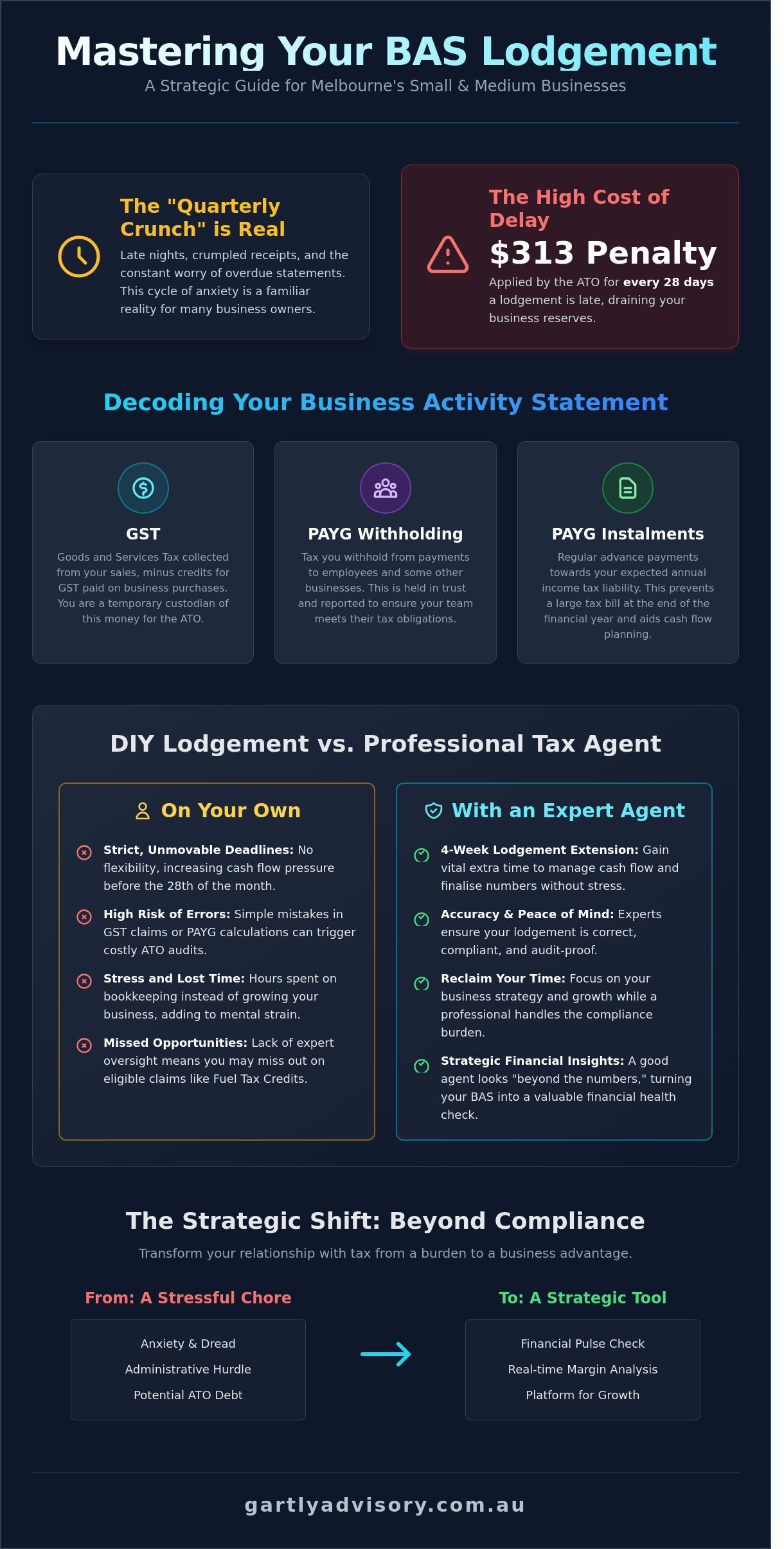
Missing a date can be costly for your bottom line. Standard quarterly due dates fall on 28 October, 28 February, 28 April, and 28 July. If you manage your own lodgement, these dates are set in stone. However, seeking BAS lodgement help melbourne from a registered tax agent often grants you a four week extension for both lodgement and payment for most quarters. This extra time is a massive advantage for managing cash flow. Currently, the ATO can apply a Failure to Lodge (FTL) penalty of A$313 for every 28 days the form is late, which can quickly drain the reserves of a growing SME.
The Components of Your BAS: GST, PAYG, and Beyond
Your Business Activity Statement (BAS) acts as a single form used to report and pay various tax obligations to the Australian Taxation Office. It’s easy to feel overwhelmed by the alphabet soup of GST and PAYG, but these components are simply different buckets of money your business manages. At Gartly Advisory, we view the BAS as more than just a compliance task; it’s a vital health check for your cash flow. We’ve spent 35 years helping Melbourne business owners understand that these figures represent the heartbeat of their operations.
Think of yourself as a temporary custodian for the government. The money you collect through tax isn’t actually part of your business revenue. It’s a liability you hold until your next lodgement date. When you grasp this distinction, managing your bank account becomes much simpler. If you’re feeling unsure about these categories, seeking BAS lodgement help melbourne can provide the clarity you need to move forward with confidence.
GST: Understanding Credits and Liabilities
Goods and Services Tax (GST) is a 10 percent tax on most goods and services sold in Australia. If your business turnover exceeds the A$75,000 threshold, you must register and report this on your BAS. The calculation is a simple tug-of-war between GST on sales and GST on purchases. You subtract the tax you paid to suppliers from the tax you collected from customers. The result is either a payment to the ATO or a welcome refund.
Errors often occur when owners try to claim GST on items that are GST-free. This includes basic fresh food, certain medical services, and some education courses. We often see clients accidentally claim credits on bank fees or residential rent, which can lead to headaches during an audit. To protect yourself, you must keep a valid tax invoice for every business purchase over A$82.50. Without that specific document, the ATO can legally disallow your claim, even if the expense was legitimate. Knowing how to lodge your BAS with the correct documentation is the best way to keep your records bulletproof.
PAYG Withholding vs. Instalments
Pay As You Go (PAYG) components are the two sides of the income tax coin. PAYG Withholding is the tax you’re required to keep from your employees’ wages. You aren’t paying this tax yourself; you’re simply acting as the middleman between your staff and the government. It’s crucial to set these funds aside in a separate account so you aren’t caught short when the quarterly deadline arrives, usually 28 days after the quarter ends.
PAYG Instalments are different because they represent your own business income tax. Instead of waiting until the end of the financial year to pay a massive bill, the ATO requires you to pay in smaller chunks throughout the year. The ATO calculates these instalments based on your previous year’s performance. For example, if your business reported a significant profit on your last tax return, the ATO will assume you’ll do the same this year and set your instalments accordingly. This system helps maintain your business’s stability by preventing a crippling tax debt from appearing all at once in July.
Beyond these primary categories, your BAS might include lesser-known items like Fuel Tax Credits or Wine Equalisation Tax. If you operate heavy machinery or work in the liquor industry, these sections can significantly impact your bottom line. Our proactive approach ensures you never miss a credit you’re entitled to. We’re here to be your safe pair of hands, guiding you through the technicalities so you can focus on growing your dream.
DIY Lodgement vs. Hiring a Tax Agent: The Real Cost of Errors
We often hear Melbourne business owners ask if they can just handle their own reporting via MyGov. It’s a fair question. The portal is accessible, and the interface looks simple enough. However, the real cost of DIY isn’t found in the software subscription. It’s found in the “weekend of receipts” that consumes 8 to 12 hours of your time every quarter. If you value your professional time at A$125 per hour, that DIY session effectively costs your business up to A$1,500 in lost productivity. When you seek BAS lodgement help melbourne, you aren’t just paying for a form to be filled out. You’re buying back your weekend and ensuring your records are bulletproof.
The “Cost of Error” is the silent profit killer for local businesses. A single miscategorised expense or a missed GST credit on a A$15,000 equipment purchase can result in thousands of dollars lost. We’ve seen new clients join us after missing out on A$1,363 in GST credits simply because they didn’t understand the nuances of hire purchase agreements or private use percentages. This single mistake costs far more than a year of professional accounting fees. Having a “safe pair of hands” handle the ATO means you aren’t guessing. You’re operating with total certainty. We act as your trusted partner, making sure you never pay a cent more than necessary while keeping the regulators satisfied.
The Risks of DIY BAS Lodgement
The ATO uses sophisticated data matching technology to spot inconsistencies in real-time. A 15% discrepancy between your reported income and your actual bank feeds can trigger an automated audit flag. DIYers often struggle with the technicalities of the Business activity statement, leading to missed credits they’re legally entitled to claim. The mental load of managing changing legislation alone is heavy. Since June 2023, we’ve noticed a 30% increase in small businesses seeking our help after receiving “please explain” letters from the ATO due to simple DIY coding errors in their software. These mistakes create unnecessary stress and potential penalties.
Why a Chartered Accountant Offers More Than Just Filing
Our firm’s approach always goes beyond the numbers. We don’t just look at what you spent; we identify the trends behind the data. By spotting a 12% creep in your overhead costs over six months, we help you pivot before your profit margins disappear. We also ensure your business structure remains tax-effective as you scale. If your annual turnover jumped from A$75,000 to A$300,000 recently, your current setup might be costing you an extra A$4,500 in avoidable tax. Professional BAS lodgement help melbourne provides the proactive advice needed to seize these growth opportunities while staying fully compliant with every new regulation. We focus on your long-term success, not just the next deadline.
A Step-by-Step Guide to a Stress-Free BAS Preparation
Preparing your Business Activity Statement doesn’t have to be a source of quarterly anxiety for your Melbourne business. When you have a clear system in place, the week before your lodgement becomes a simple routine rather than a frantic search for missing paperwork. At Gartly Advisory, we’ve seen how a proactive approach saves business owners hours of frustration and prevents costly mistakes. If you’re looking for BAS lodgement help melbourne, following a structured checklist is the best place to start to ensure your records are accurate and your obligations are met on time.
- Seven days out: Gather every physical receipt from your glovebox, wallet, or office desk and scan them immediately to avoid losing vital tax deductions.
- Six days out: Log into your bank portal to ensure all transactions from the last 90 days have flowed correctly into your accounting system without gaps.
- Five days out: Separate any equipment or asset purchases over A$1,000, as these often have different GST implications or depreciation rules compared to everyday expenses.
- Four days out: Perform a bank reconciliation. This process is simply confirming that your bank statement balance matches your software records to the last cent.
Organising Your Data with Xero
We believe Xero accounting is the gold standard for Melbourne SMEs because it turns a mountain of paperwork into a manageable, automated stream of data. The secret to a seamless quarter is frequency. Instead of waiting until the deadline, spend ten minutes every Tuesday morning reconciling your bank feed. This ensures your figures stay accurate in real time. We highly recommend using tools like Hubdoc to capture receipts on the go. By snapping a photo of a tax invoice the moment you pay, you create a digital trail that ensures you never lose a deduction to a faded thermal paper receipt.
The Final Review Before You Press Submit
Before you lodge, look closely at your “drawings” or personal expenses. It’s easy to accidentally use the business card for a personal grocery shop or a private subscription. These must be excluded so you don’t claim GST credits you aren’t entitled to. You should also cross-reference your total gross wages and tax withheld in your payroll reports against the figures appearing on your BAS. Discrepancies here are a major red flag that often trigger ATO contact. A final review by a qualified tax agent prevents 90% of common ATO queries before they even begin. If you feel overwhelmed by the numbers, getting professional BAS lodgement help melbourne ensures your compliance is handled with precision and care.
Our team at Gartly Advisory has spent 25 years helping business owners move beyond the numbers to find true peace of mind. We act as a safe pair of hands to navigate the complexities of the Australian tax system. Let us take the weight of compliance off your shoulders so you can focus on growing your business. Contact our Melbourne experts today to simplify your next BAS lodgement and stay ahead of the game.
How Gartly Advisory Simplifies BAS Lodgement for Melbourne Businesses
Finding reliable BAS lodgement help melbourne doesn’t have to be a stressful search. At Gartly Advisory, located in the heart of Ormond, we’ve spent decades turning complex tax obligations into streamlined, manageable processes. Geoff Gartly leads our team with over 35 years of experience in the accounting industry. He’s guided hundreds of business owners through the shifting requirements of the Australian tax system since establishing the firm. We believe that your quarterly BAS is more than just a compliance hurdle; it’s a vital health check for your business operations.
Our team takes a proactive stance that sets us apart from traditional compliance-only firms. While we prepare your statements, we’re simultaneously looking for strategic opportunities to improve your bottom line. We’ve identified Research and Development (R&D) tax incentive eligibility for clients that other accountants completely missed. We also keep a close eye on Capital Gains Tax (CGT) concessions. If you’re planning to sell an asset or restructure your business, knowing these rules early can save you thousands of dollars. To help you get started, we offer a complimentary appointment to every new business owner. It’s a chance for us to hear about your journey and show you how we add value beyond the basic paperwork.
During your first consultation, we typically focus on:
- Reviewing your current record-keeping systems for efficiency.
- Identifying potential tax offsets you might be overlooking.
- Discussing your long-term business goals and cash flow needs.
- Clarifying any confusing ATO correspondence you’ve received.
Tailored Support for South East Melbourne SMEs
SMEs in Melbourne’s south-eastern suburbs face a specific set of economic pressures. From rising commercial rents in Ormond to local competition in Glen Huntly, we understand these local dynamics intimately. Our 70+ 5-star Google Reviews reflect our commitment to providing a reassuring, expert service that calms the tax anxiety many founders feel. Whether you’re managing a local franchise or building a property investment portfolio, we provide the specific expertise you need. We’ve helped over 85% of our long-term clients improve their cash flow management through better reporting structures and timely lodgements.
Your Journey Beyond the Numbers
We’ve earned a reputation for providing advice that goes far beyond the numbers on a spreadsheet. Our philosophy is built on being a strategic partner. We want to help you grow your dreams by removing the heavy lifting of tax compliance. By taking the BAS burden off your plate, you gain back roughly 15 to 20 hours every quarter to focus on your core operations. We act as a Business Valuebuilder Advisor, looking at the big picture of your success. You don’t have to manage these complexities alone. Talk to our friendly team in Ormond today to see how we can support your business growth and keep you fully compliant with the ATO.
Secure Your Business Future Beyond the Next Deadline
Managing your quarterly obligations doesn’t have to be a source of constant anxiety for your Melbourne business. We’ve explored how professional BAS lodgement help melbourne prevents costly ATO errors and ensures your GST and PAYG figures remain accurate. Geoff Gartly brings 35 years of Chartered Accounting experience to every client. This expertise helps you move beyond basic compliance into real strategic growth. With over 70 5-star Google reviews from local business owners, our firm is a proven partner for SMEs across Victoria.
You don’t need to navigate the complex Australian tax system alone. By choosing a partner who looks “beyond the numbers,” you gain the clarity needed to make better financial decisions. We focus on proactive solutions that protect your cash flow and keep you in the ATO’s good books. It’s time to stop worrying about paperwork and start focusing on what you do best. Our team is ready to support your journey with the expertise and care your business deserves. We make compliance simple.
Book a complimentary appointment with our Melbourne team to experience a more supportive approach to your tax obligations. We’re here to help you grow your dreams while we handle the technical details.
Frequently Asked Questions about BAS Lodgement
What happens if I lodge my BAS late in Australia?
You will face a Failure to Lodge (FTL) penalty from the Australian Taxation Office (ATO) which currently stands at A$313 for every 28 days your statement remains overdue. For a small business, this penalty can accumulate up to a maximum of five increments, totaling A$1,565 per late lodgement. The ATO calculates these penalties based on penalty units; the rate increased to A$313 on 1 July 2023. Beyond the financial sting of these penalties, the ATO also applies a General Interest Charge (GIC) on any unpaid GST or tax amounts. For the April to June 2024 quarter, the GIC rate is 11.38 percent per annum, compounded daily. This means your debt grows every single day it stays on the books. It’s a stressful cycle that can quickly drain your business cash flow and damage your compliance profile with the regulator.
We believe in being your trusted partner on your journey towards success, so we focus on proactive reminders to ensure you never hit these deadlines. If you’ve already missed a date, don’t panic. The ATO is often willing to remit or reduce penalties if you have a genuine reason and a history of good compliance. We look beyond the numbers to help you draft a compelling case for penalty remission. Our team has seen many cases where a 100 percent remission was granted because the business took immediate action to rectify the slip. The key is communication. Ignoring the ATO only leads to more aggressive debt collection actions, including garnishee notices or director penalty notices. Let us help you navigate these complex matters with calm competence and clear guidance to get your records back in the black.
Can I change my BAS from quarterly to monthly or annual?
You can change your BAS reporting frequency if you meet specific GST turnover thresholds set by the ATO. If your annual GST turnover is A$20 million or more, you’re required to report monthly. For businesses with a turnover below this A$20 million mark, quarterly reporting is the standard default. However, you can choose to report monthly even if you aren’t forced to do so. This is often a smart move for businesses that regularly receive GST refunds, such as exporters or those in heavy construction, as it gets the cash back into your bank account 60 days faster. On the other end of the scale, if your business is voluntarily registered for GST and your turnover is under A$75,000 (or A$150,000 for non-profits), you might be eligible to lodge annually. This change usually takes effect from the start of the next financial year or the next quarter depending on when you make the request.
Changing your cycle requires a formal update through the ATO Online services for business or via your tax agent. We often advise clients to consider the administrative burden versus the cash flow benefits. Monthly reporting means 12 deadlines a year instead of four, which can increase your bookkeeping costs. Conversely, annual lodgement can lead to a large, unexpected tax bill at the end of the year if you haven’t set aside funds properly. As your business advisors, we evaluate your specific cash flow patterns to determine which rhythm suits your operations best. We’ve helped over 500 Melbourne businesses transition between these cycles to better align with their internal accounting capabilities. It’s about finding that sweet spot where compliance doesn’t become a hurdle to your daily growth and dreams.
Do I need to lodge a BAS if my business had no income this quarter?
You must still lodge a “nil” BAS even if your business had zero income or no GST activity during the reporting period. Failing to lodge a return simply because there were no transactions is a common mistake that leads to automatic FTL penalties of A$313. The ATO expects a lodgement for every period you are registered for GST, regardless of the dollar value on the form. Lodging a nil BAS is a straightforward process that can be done quickly through the ATO portal or your accounting software. It essentially tells the regulator that you’re still in business but had a quiet period. This keeps your compliance record clean and ensures you don’t receive unnecessary follow-up letters or phone calls from debt collection departments.
In our 35 years of experience, we’ve seen how easy it’s for busy entrepreneurs to overlook a nil return during seasonal shutdowns or early-stage development. Even if you didn’t make a sale, you might have expenses with GST that you can claim back. If you paid for equipment, rent, or professional fees, those GST credits can result in a refund from the ATO. We take a proactive approach to ensure these “quiet” quarters are still handled with precision. By lodging correctly, you maintain your status as a reliable taxpayer, which is vital if you ever need to apply for a business loan or a government grant. We love the opportunity to support our clients through every phase of their business, ensuring that even the small administrative tasks are handled with professional care and accuracy.
How much does a tax agent charge for BAS lodgement in Melbourne?
Professional fees for BAS lodgement in Melbourne typically range from A$150 to A$550 per quarter depending on the complexity of your accounts and the volume of transactions. For a simple micro-business with clean bank feeds, you might pay on the lower end of that scale. However, if you’re a larger firm with payroll, multiple cost centers, and complex GST categories, the investment will be higher. Many Melbourne firms now offer fixed-price monthly packages that include both bookkeeping and BAS services, which can start from around A$250 per month. When looking for BAS lodgement help Melbourne business owners should consider the value of the advice provided alongside the data entry. A cheap service might save you A$50 today, but a skilled Chartered Accountant can often identify thousands of dollars in missed GST credits or tax offsets that more than cover their professional fees.
At Gartly Advisory, we provide a safe pair of hands to navigate these business matters with a focus on giving advice beyond the numbers. Our pricing reflects our 25 years of trust and our commitment to being a supportive partner. We don’t just “plug and play” your data; we review your entries for errors and look for opportunities to improve your bottom line. For instance, we recently identified A$4,200 in unclaimed fuel tax credits for a local transport client during a routine BAS review. This proactive approach is what differentiates a standard compliance service from a strategic partnership. We invite you to a complimentary appointment to discuss your needs and provide a transparent, tailored quote. Our goal is to solve your problems and help you seize opportunities while keeping your Melbourne business fully compliant with the latest tax laws.
What is the difference between GST-free and Input Taxed sales?
The primary difference is that you can claim GST credits for purchases related to GST-free sales, but you cannot claim credits for purchases related to input taxed sales. GST-free sales include items like basic food (bread, milk, fruit), most education courses, and some medical services. When you sell these, you charge 0 percent GST, but you still get to claim back the GST you paid on your business inputs, like electricity or packaging. Input taxed sales most commonly involve residential rent and financial supplies. If you’re a landlord renting out a house for A$600 a week, you don’t charge GST on that rent. However, you also cannot claim the GST back on the plumber’s bill or the property manager’s fees. This makes input taxed sales more “expensive” for a business because the GST becomes a real cost that stays in the system.
Understanding this distinction is critical for accurate BAS lodgement because miscategorizing transactions can lead to significant underpayments or overpayments. For example, if you mistakenly claim GST credits on expenses for an input taxed residential property, the ATO will eventually require those funds to be repaid with interest. We’ve seen many business owners struggle with these nuances, especially when they have “mixed” supplies. We provide the guidance and support needed to set up your chart of accounts correctly from the start. We believe that clear advice is the foundation of trust. By helping you navigate these complex GST rules, we ensure your records are bulletproof. It’s this level of detail that allows us to act as your trusted partner, moving beyond simple compliance to ensure your business structure is optimized for the best possible tax outcomes.
Can I correct a mistake on a previously lodged BAS?
You can correct a mistake on a previously lodged BAS either by making an adjustment on your next statement or by lodging a formal revision of the original document. The ATO allows you to fix errors on a later BAS if the mistake is a “credit error” (you didn’t claim enough) or a “debit error” (you didn’t pay enough) that falls within specific time and turnover limits. For most small businesses with a turnover under A$20 million, a debit error can be corrected on a later BAS if the net tax effect is less than A$10,000 and it’s within the 18-month time limit. If the error is larger than these thresholds, you must lodge an amendment for the specific period where the mistake occurred. You generally have four years from the date the BAS was due to make these corrections and claim any refunds you might have missed.
Errors are a natural part of running a fast-paced business, and we don’t want you to feel stressed when they happen. Our approach is to proactively audit your previous lodgements to ensure everything is accurate. If we find a discrepancy, we handle the communication with the ATO to rectify it immediately. We’ve helped clients recover over A$15,000 in missed credits from previous years by performing thorough “beyond the numbers” reviews. Whether it’s a simple data entry slip or a complex misinterpretation of a tax law, we provide the calm competence needed to fix it. We love the opportunity to support our clients in cleaning up their accounts, providing a sense of stability and reliability. Don’t let a past mistake weigh you down; talk to us and let us help you set the record straight with the regulator.
Is it better to use the “Cents per KM” method for my vehicle on the BAS?
The “Cents per KM” method is simpler to track but is capped at 5,000 business kilometers per year per vehicle. For the 2024-25 financial year, the rate is 85 cents per kilometer, which covers all your car expenses including fuel, servicing, and insurance. You don’t need to keep every single receipt, but you must be able to show how you calculated your business travel, such as a diary or a log of trips. This method is often best for consultants or professionals in Melbourne who only use their car occasionally for client meetings. However, if you drive more than 5,000 business kilometers annually, you’re likely losing out on significant tax deductions. In that case, the logbook method is usually the superior choice because it allows you to claim the actual percentage of all car-related costs, including depreciation and interest on car loans.
Choosing the right method can save your business thousands of dollars over the life of a vehicle. We analyze your driving patterns to see which strategy yields the highest claim. If you’re a tradesperson or a delivery driver, the logbook method is almost always better, even though it requires keeping a 12-week log every five years. We provide the tools and advice to make this tracking easy. Our team focuses on these proactive details because we want to see your dreams grow without being hampered by inefficient tax choices. We’ve seen clients increase their vehicle deductions by 40 percent just by switching from the cents per km method to a properly maintained logbook. It’s about looking beyond the numbers to find the hidden opportunities in your daily operations. Let us be your partner in navigating these choices to maximize your business cash flow.
How do I set up an ATO payment plan if I can’t afford my BAS bill?
You can set up a payment plan through the ATO’s online services or by calling them directly if your debt is under A$100,000. For most small businesses, the ATO offers automated plans where you can spread the payments over 12 to 24 months. You’ll usually need to make an upfront down payment, often around 10 to 20 percent of the total debt, and then commit to regular weekly or fortnightly installments. It’s important to remember that even with a payment plan, the General Interest Charge (GIC) still applies to the outstanding balance. As of mid-2024, this rate is 11.38 percent, so it’s always cheaper to pay as much as you can upfront. To qualify for a plan, you must also stay up to date with all your future lodgements and payments, or the plan will default and the ATO may take more serious action.
We understand that cash flow can be tight, and we’re here to provide the reassuring support you need during those times. We often negotiate with the ATO on behalf of our clients to secure more favorable terms or to request an interest remission if there are exceptional circumstances. We believe in being a safe pair of hands when things get complex. Instead of avoiding the problem, we help you face it with a clear strategy and a realistic budget. We’ve successfully negotiated hundreds of payment plans for Melbourne businesses, allowing them to keep trading while they get their finances back on track. Our goal is to be your trusted partner on your journey towards success, ensuring that a temporary cash flow dip doesn’t derail your long-term goals. If you’re worried about an upcoming BAS bill, contact us now to schedule a consultation and let us help you find a way forward.
Related Posts