
Choosing the Right Small Business Accountant in Melbourne: A 2026 Guide
Finding the right small business accountant in Melbourne can feel like a significant and often stressful decision. You’re not just looking for someone to manage your compliance; you’re searching for a trusted partner to help grow your business. Yet, the path is often filled with uncertainty-worries about hidden fees, frustration with unresponsive advisors, and the fear that bad advice could lead to serious issues with the ATO. This is precisely why we created this guide.
Consider this your 2026 roadmap to making a confident choice. We will provide clear guidance on what to look for, the critical questions you must ask, and how to spot the difference between a simple number-cruncher and a proactive growth partner. Our goal is to empower you to build a relationship that not only ensures compliance but actively provides the support you need to seize opportunities and achieve your long-term vision.
Beyond Tax Returns: What to Expect from a Top Small Business Accountant
For many Melbourne business owners, the word ‘accountant’ brings to mind tax returns, BAS statements, and historical compliance. While these tasks are essential, they represent only the baseline of what a truly valuable financial partner can offer. The right small business accountant in Melbourne moves beyond being a historian of your past transactions to become a proactive advisor for your future, helping you shift from a compliance mindset to a growth partnership.
They are the trusted guide who translates your numbers into a strategic roadmap, identifying opportunities and mitigating risks you may not see. To better understand this partnership, this short video offers some valuable insights:
The Three Tiers of Accounting Service
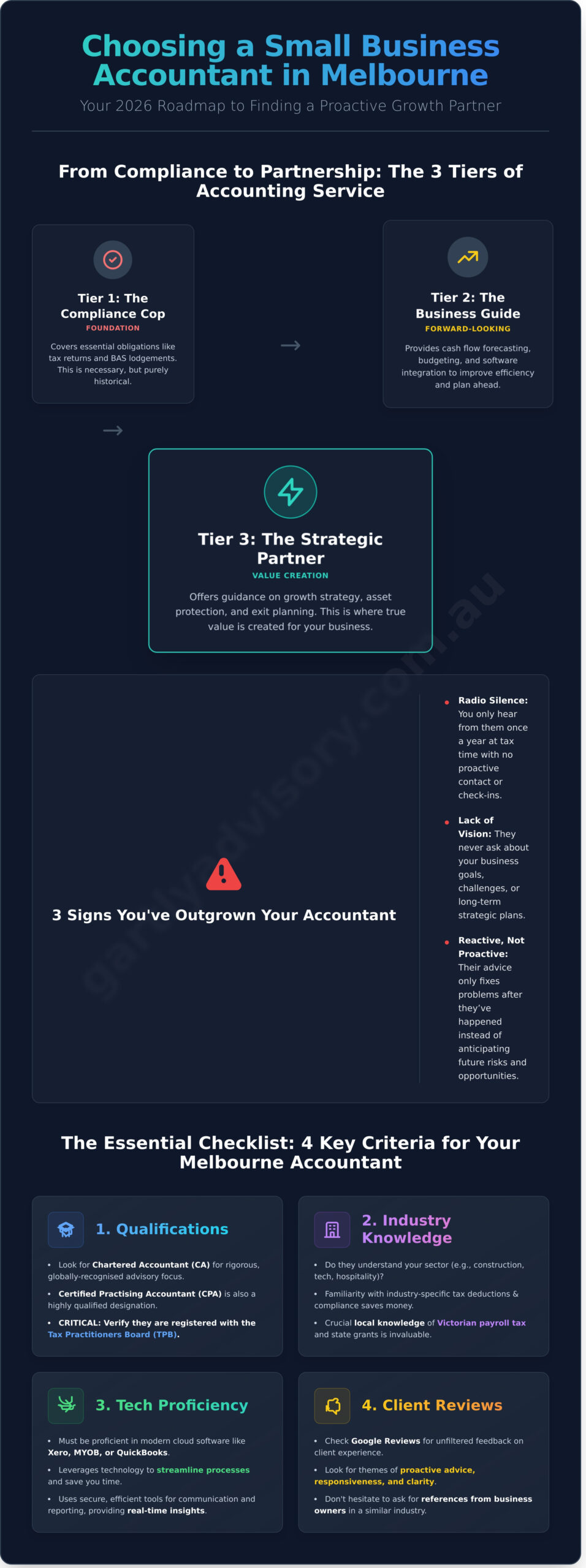
Understanding the different levels of service can help you find an accountant who aligns with your ambitions. Most services fall into one of three tiers:
- Tier 1: The Compliance Cop. This is the foundation, covering essential obligations like tax returns, BAS lodgements, and basic bookkeeping. It’s necessary but purely historical.
- Tier 2: The Business Guide. This accountant provides forward-looking support. They help with cash flow forecasting, budgeting, and integrating software to improve efficiency.
- Tier 3: The Strategic Partner. At the highest level, a proactive small business accountant in Melbourne provides guidance on growth strategy, optimal business structuring for asset protection, and even future exit planning. This is where true value is created.
Why Your Accounting Software Isn’t Enough
Platforms like Xero and MYOB are powerful tools, but they are only as good as the expertise interpreting the data. An accountant is the strategist who first ensures the information going in is accurate and then translates it into a clear story about your business’s health. This is where the practice of management accounting becomes invaluable. It’s not about reporting to the ATO; it’s about using financial data to make smarter internal decisions-to identify your most profitable services, manage costs, and seize opportunities. The software generates reports; a great accountant provides the wisdom.
Signs You’ve Outgrown Your Current Accountant
Your business is evolving, and your financial support should too. It may be time to seek a new small business accountant Melbourne if you recognise these common signs:
- You only hear from them once a year at tax time, with no proactive contact.
- They don’t ask about your business goals, challenges, or long-term vision.
- Their advice is reactive, only helping you fix problems after they’ve happened instead of anticipating them.
The Essential Checklist: 5 Key Criteria for Your Melbourne Accountant
Choosing a financial partner for your business is a significant decision. The right advisor does more than just lodge your tax returns; they provide strategic guidance that fuels growth and protects your assets. Finding the right small business accountant in Melbourne requires looking beyond the fees and focusing on the value they can bring. Use this essential checklist to ensure you find a trusted partner who truly understands your journey.
Qualifications: Chartered Accountant (CA) vs. CPA
The first step is to confirm your accountant has the necessary expertise. In Australia, the two main designations are Certified Practising Accountant (CPA) and Chartered Accountant (CA). While both are highly qualified, CAs often undergo more rigorous, globally-recognised training with a strong focus on business advisory. Regardless of their designation, it is vital to verify your accountant is registered with the Tax Practitioners Board (TPB), which ensures they meet Australia’s professional and ethical standards.
Industry Specialisation and Local Knowledge
A generic approach to accounting rarely delivers the best results. Does your potential accountant understand the unique challenges and opportunities within Melbourne’s key industries, such as construction, hospitality, or the tech sector? An advisor with experience in your field will be familiar with specific tax deductions, compliance requirements, and state-based grants that could save your business thousands. Their local knowledge is invaluable for navigating Victorian payroll tax and other state-specific regulations.
Technology & Software Proficiency
Your accountant’s technology stack should simplify your life, not complicate it. A modern firm should be proficient, if not certified, in leading cloud accounting software like Xero, MYOB, or QuickBooks. They should use secure, efficient tools for communication and reporting, giving you clear visibility of your financial position. The right small business accountant in Melbourne will leverage technology to streamline your processes, saving you time and providing real-time insights.
Client Reviews and Testimonials
Social proof offers an unfiltered look into the client experience. Before engaging a firm, check their Google Reviews. Look for recurring positive themes in the feedback, such as:
- Proactive advice: Do they identify opportunities for clients?
- Responsiveness: Are they accessible and quick to reply?
- Clarity: Do they explain complex matters in an easy-to-understand way?
Don’t hesitate to ask for references from business owners in a similar industry to yours. This provides direct insight into how they operate as a long-term partner.
The Interview: 10 Critical Questions to Ask Potential Accountants
Your initial consultation is more than just a chat; it’s an interview where you are the hiring manager. The goal is to find a trusted partner, not just a service provider. When you meet with a potential small business accountant in Melbourne, asking the right questions reveals their approach, proactivity, and the true value they can bring to your journey. Listen for answers that focus on strategic guidance and partnership, not just completing compliance tasks.
To help you find the right fit, we’ve prepared a list of critical questions. Don’t be afraid to ask about fees upfront-transparency is the foundation of a strong professional relationship.
Questions About Their Service and Approach
These questions help you understand how the firm operates and the level of support you can expect. A great accountant goes beyond the numbers to become an integral part of your team.
- Who will be my primary point of contact at the firm? Knowing you have a dedicated advisor ensures consistency and a deeper understanding of your business.
- How do you help businesses like mine grow beyond compliance? Look for answers that mention strategic advice, cash flow management, or business structuring.
- What is your process for communicating important deadlines and updates? A proactive communication system prevents last-minute scrambles and costly penalties.
- Can you provide an example of how you were proactive for a client? This reveals their ability to identify opportunities, like grants or tax savings, without being prompted.
Questions About Your Business and Their Strategy
A truly valuable small business accountant applies their expertise directly to your unique situation. These questions test their ability to listen and think strategically from day one.
- Based on my business, what do you see as my biggest financial risks? This shows they are thinking critically about protecting your assets and ensuring stability.
- What immediate opportunities do you see for tax planning? Their answer will demonstrate their experience and ability to deliver immediate value.
- How will you help me understand my financial reports? The right partner empowers you by translating complex data into clear, actionable insights.
Questions About Fees and Onboarding
Clarity around billing and processes is non-negotiable. It establishes trust and ensures there are no surprises down the line.
- Can you explain your fee structure in detail? Are they fixed-fee, hourly, or value-based? A clear structure helps you budget effectively.
- Are there extra charges for brief phone calls or emails? Understanding what’s included in your package prevents unexpected bills.
- What does your onboarding process for new clients look like? A smooth and structured onboarding process ensures an efficient and successful transition.
Ready to ask us these questions? We believe in transparency and partnership from the very first conversation. Book a complimentary consultation and let us show you how we can support your business goals.
Decoding Accounting Fees: Fixed vs. Hourly Rates in Melbourne
When you engage a small business accountant in Melbourne, understanding their fee structure is one of the most critical steps to building a successful, long-term partnership. The right model ensures you get the support you need without the stress of unexpected bills. It’s not about finding the cheapest option, but about securing the best value and establishing a relationship built on trust and transparency. A clear engagement letter should always be provided, outlining all costs before any work begins.
Let’s explore the three common pricing models you’ll encounter.
Hourly Billing: The Traditional Approach
With this classic model, you pay for the exact time your accountant spends on your file, often billed in small increments. While seemingly straightforward, this approach can lead to budget uncertainty. A complex query or an extended phone call can result in a surprisingly large invoice. More importantly, it can create a barrier to communication, making you hesitate to call with a quick question for fear of “being on the clock.”
Fixed-Fee Packages: The Modern Standard
A more modern and collaborative approach involves fixed-fee packages. You pay a set monthly or annual fee for a clearly defined scope of services, such as BAS preparation, payroll, and end-of-year tax returns. This provides complete cost certainty, making it easier to manage your cash flow. It transforms the relationship from transactional to advisory, encouraging you to reach out for guidance whenever you need it without worrying about an extra charge. Always ensure you understand what is included and how out-of-scope work is handled.
Value-Based Pricing: Aligning Cost with Results
For specific, high-stakes projects, value-based pricing directly aligns your accountant’s success with your own. Instead of tracking hours, the fee is based on the tangible value and outcome delivered to your business. This is common for complex advisory work, such as:
- Structuring the sale of a business to maximise your return.
- Implementing a tax strategy that results in significant savings.
- Guiding you through a major capital raise or acquisition.
This model ensures your advisor is focused on achieving the best possible result for you.
Ultimately, the best structure depends on your business needs. At Gartly Advisory, we believe in transparent pricing that fosters a supportive partnership. Talk to us about a fee structure that provides the guidance and certainty you need to grow your dreams.
Why a Local Ormond Accountant Offers a Strategic Edge
In an increasingly digital world, it might seem like your accountant’s location is irrelevant. However, for Melbourne business owners, choosing a local professional provides a distinct and powerful advantage. Engaging an accountant in your own community, like here in Ormond, goes beyond convenience-it’s a strategic decision that fosters a deeper partnership and provides invaluable, on-the-ground support for your business journey.
Working with a local firm means you are also reinvesting in the same local economy you operate in, strengthening the network of small businesses that make our Melbourne communities thrive.
The Power of Face-to-Face Meetings
While technology makes remote collaboration easy, some conversations are simply better in person. Discussing complex business strategies, navigating sensitive financial challenges, or planning for future growth benefits immensely from direct, face-to-face interaction. This proximity builds a stronger level of trust and rapport, transforming the relationship from a service provider to a true partner. It also offers the simple convenience of dropping off documents or having a quick, unscheduled chat when needed.
A Network of Local Experts
A well-connected small business accountant melbourne entrepreneurs can trust is a gateway to a wider ecosystem of professional support. Over years of operating in the area, a local accountant builds a reliable network of other essential experts. Need a referral to a reputable commercial lawyer, an experienced insurance broker, or a small business-friendly banker? Your local advisor can connect you with trusted professionals they know personally, saving you time and reducing the risk of a poor choice.
Understanding the Melbourne Market
The Victorian business landscape has its own unique opportunities and regulations. A local Ormond accountant possesses firsthand knowledge of this environment. They understand:
- State-based grants and incentives available to Victorian SMEs.
- Local council regulations and compliance requirements.
- Economic trends and challenges specific to the Melbourne market.
This localised insight ensures the advice you receive is not just technically correct, but strategically relevant to your specific circumstances. To truly leverage this local knowledge, partner with an expert who is an active part of your community. We invite you to visit our Ormond office to discuss how we can support your journey towards success.
Beyond the Numbers: Partnering with the Right Melbourne Accountant
Choosing the right accountant for your Melbourne business goes far beyond simple tax compliance. It’s about finding a true strategic partner who will support your growth. By using a clear checklist, asking critical questions during your interviews, and understanding the value of local expertise, you are equipping your business to make a choice that will pay dividends for years to come.
Your search for the ideal small business accountant Melbourne has to offer should lead you to a firm that is proactive, experienced, and genuinely invested in your success. At Gartly Advisory, we are those trusted partners. As Chartered Accountants with over 35 years of experience, our proactive business advisory goes beyond standard tax compliance-a commitment reflected in our 70+ 5-star Google reviews from local businesses.
Take the next step on your journey towards success. Schedule your complimentary consultation with a Gartly Advisory expert today and discover how a dedicated partner can help you achieve your goals.
Frequently Asked Questions
What’s the difference between a bookkeeper and an accountant?
A bookkeeper manages the daily financial transactions of your business, such as recording sales, purchases, and payments. Their focus is on accurate data entry. An accountant takes a broader, more strategic view. They analyse this financial data to provide high-level advice, prepare tax returns, create financial statements, and offer guidance on business structure and strategy. A bookkeeper records the past, while an accountant helps you plan for the future.
At what stage should my small business hire an accountant?
It is wise to engage an accountant from the very beginning to ensure your business structure is set up correctly for tax efficiency and asset protection. However, it becomes essential when your business starts to grow, you register for GST, hire employees, or need to prepare financial reports for loans. A proactive accountant provides crucial guidance during these key stages, helping you navigate complexity and seize opportunities for growth.
How much should a small business in Melbourne budget for accounting fees?
Accounting fees in Melbourne vary based on your business’s complexity and the level of support you require. For standard annual tax compliance and BAS lodgements, a small business might budget between A$2,500 to A$5,000 per year. For more comprehensive services, including regular strategic advice and management reporting, fees might range from A$400 to A$1,000+ per month. A quality small business accountant Melbourne firms recommend will always provide a clear fee proposal upfront.
Can a good accountant really save me more money than they cost?
Absolutely. A proactive accountant is an investment, not an expense. They provide value far beyond lodging your tax return. Through strategic tax planning, identifying eligible deductions, and advising on the most effective business structure, they can significantly reduce your tax liability. Their guidance helps you avoid costly compliance mistakes with the ATO and make smarter financial decisions, often saving you far more than the cost of their fees.
How easy is it to switch accountants if I’m not happy with my current one?
Switching accountants is a very straightforward and professional process that we can manage for you. Once you decide to partner with us, we send a formal ‘ethical clearance’ letter to your previous accountant. This letter requests the transfer of all your historical files and records. The entire process is handled seamlessly between the two firms, ensuring a smooth transition with minimal disruption to you or your business operations.
What information do I need to prepare for my first meeting with a potential accountant?
To make our first meeting as productive as possible, please bring your most recent business and personal tax returns, along with any recent financial statements like a Profit & Loss or Balance Sheet. It is also helpful to have access to your accounting software (e.g., Xero or MYOB). Most importantly, come prepared to discuss your business goals and any financial challenges you are facing so we can understand how to best support you.
Related Posts