

Keeping a Compliant ATO Logbook: Your Ultimate Guide for the 2025 year
Are you confident you’re claiming every possible dollar for your work-related car use, or does the fear of a complicated ATO logbook and a potential audit hold you back? You’re not alone. Many professionals find themselves confused between the logbook method and the cents per kilometre rate, often defaulting to the simpler option and potentially missing out on significant deductions. The process of keeping a compliant ato logbook can feel tedious, and it’s easy to worry you’re not recording the right information to satisfy the Australian Taxation Office.
As your trusted partners in navigating Australia’s tax system, we are here to provide the clarity and support you need. This comprehensive guide will walk you through clear, step-by-step instructions for both the logbook and cents per kilometre methods. We will help you understand which approach is most financially beneficial for your situation, giving you the confidence to maximise your car expense tax deductions legally and without the stress. Let us help you turn confusion into confidence and ensure you get the return you deserve.
Logbook vs. Cents Per Kilometre: Choosing the Right Method for You
When it comes to claiming work-related car expenses on your tax return, the Australian Taxation Office (ATO) provides two distinct methods. The choice you make can significantly influence the size of your refund, so understanding the difference is crucial. It’s important to note that you must select one method per vehicle for the entire financial year; you cannot switch between them or combine them for the same car.
Our goal is to provide clear guidance, helping you make an informed decision that best supports your financial position. To help you understand the practical side of tracking your travel, this video provides a helpful overview:
The Cents Per Kilometre Method: Simple but Capped
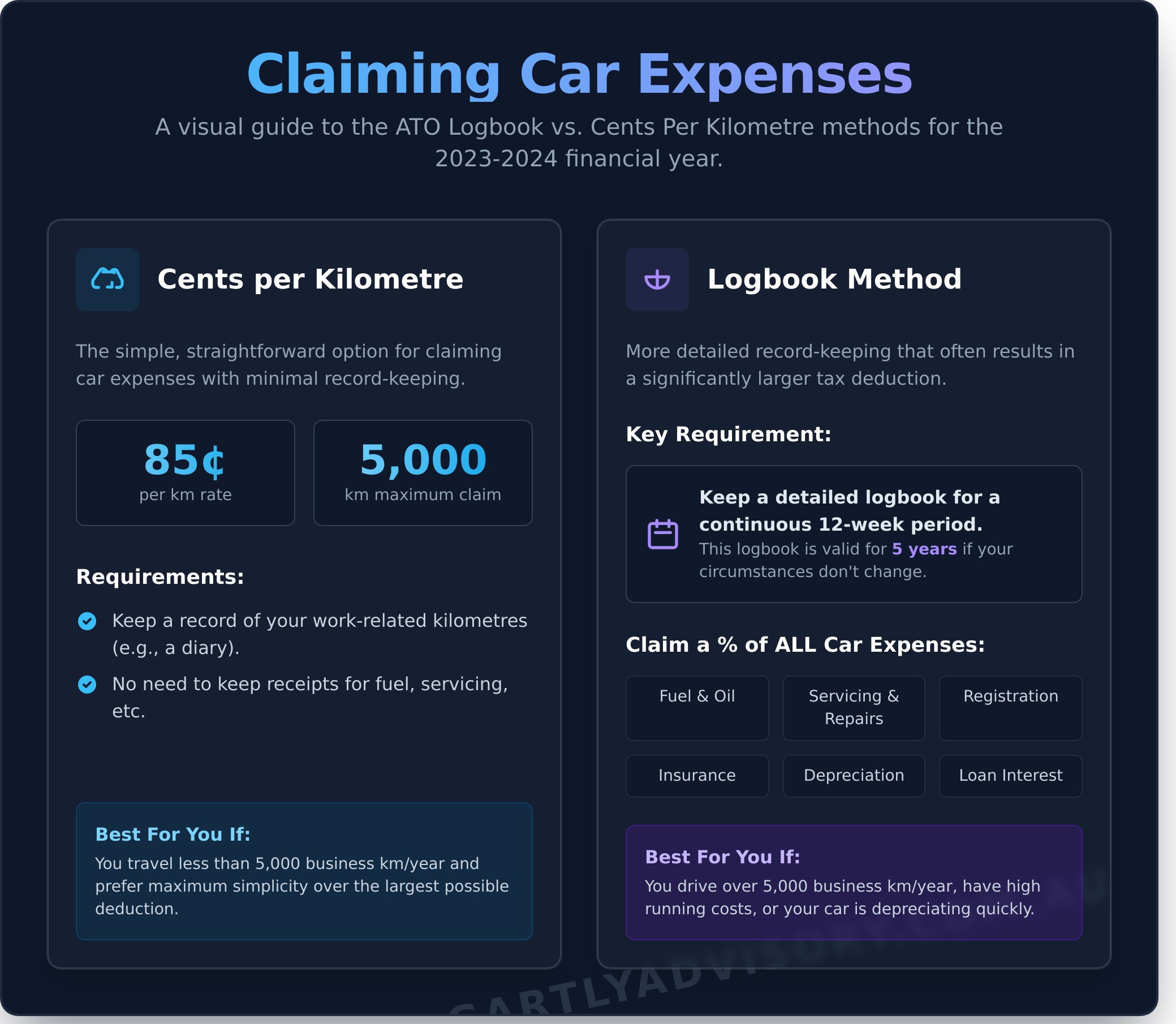
This is the most straightforward option. You can claim a set rate for each business-related kilometre you travel. For the 2024-2025 financial year, this rate is 85 cents per kilometre. The major advantage is simplicity—you only need to keep a record of your work-related trips, not every single receipt for fuel or servicing. However, the claim is capped at a maximum of 5,000 business kilometres per vehicle, per year.
The Logbook Method: More Work for a Bigger Claim
The logbook method allows you to claim the business-use percentage of your total car expenses. This requires you to keep a detailed ATO logbook for a continuous 12-week period to establish your pattern of work-related travel. This percentage can then be applied to all your actual car running costs to calculate your claim. If you’re new to this, understanding what is a tax deduction is a great starting point. Expenses you can claim include:
- Fuel and oil
- Servicing and repairs
- Registration and insurance
- Depreciation (decline in value)
- Loan interest
While this method requires diligent record-keeping, it often results in a significantly larger deduction, especially for those who travel extensively for work.
Decision Checklist: Which Method Should You Use?
To help you decide, consider the following points:
- Choose the cents per kilometre method if: You travel less than 5,000 business kilometres annually and prefer simplicity over maximising your deduction.
- Choose the logbook method if: You drive extensively for work (often over 5,000 km), your vehicle has high running costs, or it is depreciating quickly. The extra effort in record-keeping can lead to a much better tax outcome.
How to Keep an ATO-Compliant Logbook: A 12-Week Step-by-Step Guide
Navigating the requirements for an ATO-compliant logbook can seem daunting, but it is a methodical process built on accuracy and consistency. The core requirement is to maintain a detailed record for a continuous 12-week period that truly reflects your typical business-related travel. Whether you use a dedicated smartphone app or a simple notebook, following these steps will ensure your records are compliant and your claim is maximised.
What Information You MUST Record for Every Trip
Precision is vital for your ato logbook. The ATO requires specific details to validate your business-use percentage. For your 12-week period, ensure you diligently record:
- The date the logbook period begins and ends.
- The car’s odometer readings at the very start and end of the 12 weeks.
- For each individual journey: the date, start and end odometer readings, and total kilometres travelled.
- A clear and specific purpose for each business journey (e.g., “Meeting with client J. Smith at their Parramatta office” is far better than a vague “Client visit”).
Defining a ‘Business Journey’: What You Can and Can’t Claim
Understanding what the ATO considers a business journey is crucial. Generally, travel from your home to your regular place of work is considered a private trip and cannot be claimed. However, valid business travel includes visiting clients or suppliers, driving between two separate workplaces, or attending work-related conferences.
There are some important nuances. For example, if your employer requires you to transport bulky tools or equipment that cannot be securely stored at your workplace, your trip from home to work may become claimable. Understanding the full range of car expenses you can claim, including related costs like tolls and parking for business trips, is essential for accurate record-keeping.
The 12-Week Period: When to Start and How It Works
You have the flexibility to start your logbook at any point during the income year, as long as the 12 weeks are continuous. It is essential that this period is a true representation of your usual travel patterns. Avoid choosing a 12-week block that is unusually quiet or busy, as this will not provide an accurate basis for your claim.
Once completed, your logbook is generally valid for five years, provided your work circumstances do not change significantly. If you change jobs, move to a new office, or your travel patterns alter by a large margin, you will need to complete a new 12-week logbook. Feeling overwhelmed? Let us simplify your business tax compliance.
From Logbook to Tax Return: Calculating Your Deduction
You have meticulously recorded your travel for 12 continuous weeks. The challenging part is over. Now, let us guide you through the process of turning that data into a legitimate tax deduction. The calculation is more straightforward than you might think, but it relies on two crucial elements: your logbook to prove your business-use percentage, and your receipts to prove your total costs.
Think of it this way: the logbook establishes the what (what portion of your car use was for business), while your receipts establish the how much (how much it cost you to run the vehicle for the year). Both are essential for a compliant claim.
Calculating Your Business-Use Percentage
This is where your detailed record-keeping pays off. To find your business-use percentage, you simply apply a clear formula to the data from your 12-week logbook period. The ATO accepts this percentage as representative of your travel for the entire financial year, provided your circumstances haven’t changed.
The formula is: (Total Business Kilometres ÷ Total Kilometres Travelled) × 100
For example, if you travelled 3,000 km in total during your logbook period and 1,200 km were for business purposes, your calculation would be (1,200 ÷ 3,000) × 100 = 40% business use.
Gathering Your Total Car Expenses
Your business-use percentage is applied to the total running costs of your vehicle for the full financial year. This is why it is absolutely critical to keep every receipt related to your car, not just for the 12-week logbook period. Your claimable expenses include:
- Fuel and oil
- Insurance and registration
- Servicing, repairs, and tyre replacements
- Interest on a car loan
- Cleaning costs
- Decline in value (depreciation)
How Long is Your Logbook Valid For?
One of the great benefits of the logbook method is its longevity. A compliant ato logbook is valid for up to five years. You can continue to use the business-use percentage from your original logbook for the next four tax returns, as long as your circumstances remain consistent.
However, you must start a new ato logbook if:
- You purchase a new car and start using it for business purposes.
- Your job changes, significantly altering your driving patterns (e.g., moving from an office-based role to a sales representative role).
- Is there any other major change that makes your existing logbook no longer representative of your car’s usage?
Ensuring your records are accurate is key to a stress-free tax time. If you require support with calculating your deduction or want to ensure your claims are maximised, please contact our experienced team. We’re here to be your trusted partner.
Common Logbook Mistakes That Can Trigger an ATO Audit
At Gartly Advisory, we have supported business owners for over 25 years, and we understand that diligence with an ato logbook can easily slip during busy periods. However, simple errors can lead to significant penalties and unwanted scrutiny from the tax office. Based on our experience, these are the most common and costly mistakes we see—and how you can avoid them to ensure your claims are secure.
Vague or Generic Journey Descriptions
Simply writing ‘Client visit’ or ‘Business trip’ is not enough for the ATO. Your logbook entries must be specific enough for an auditor to verify the business nature of the journey. Instead of a generic note, provide clear details. For example, change ‘Meeting with client’ to ‘Meeting with John Smith at XYZ Corp to discuss Q4 projections, 123 Main St, Sydney’.
Relying on Estimates Instead of Actual Readings
Guessing your odometer readings at the end of the week or month is a major red flag. The ATO expects precise, contemporaneous records. Inconsistent or repeatedly rounded numbers (e.g., always ending in 0 or 5) can suggest your logbook is fabricated. You must record the actual start and end odometer readings for each journey. Using a dedicated logbook app can automate this process and significantly reduce the risk of human error.
Forgetting to Keep Receipts for Your Expenses
A compliant logbook is only half the equation. Its purpose is to prove your business-use percentage, not the cost of your expenses. You must also keep valid tax invoices and receipts for every car expense you claim, including fuel, insurance, registration, servicing, and loan interest. Storing digital copies in your accounting software is an excellent way to keep these organised and accessible.
Using the Same Logbook After Your Circumstances Change
An ATO logbook can be valid for up to five years, but only if it remains representative of your typical travel. If you change jobs, move to a new house, or purchase a new car, your travel patterns will likely change, invalidating your old logbook. Using an unrepresentative logbook can result in denial of your entire claim. We recommend a quick review each financial year to confirm your circumstances haven’t changed significantly.
Navigating tax compliance can be complex, but you don’t have to do it alone. If you are unsure whether your record-keeping meets ATO requirements, our team is here to provide professional guidance. Contact us to ensure your claims are accurate and audit-proof.
Partner with an Expert for ATO Logbook Compliance
Keeping a detailed vehicle logbook is a powerful way to maximise your tax deductions, but it requires precision. As we’ve covered, the key lies in choosing the correct method for your circumstances, diligently completing the 12-week record-keeping period, and avoiding common errors that can attract unwanted ATO attention. Mastering your ato logbook is more than a compliance task—it’s a strategic step towards optimising your financial position.
Navigating tax compliance can be complex, but you don’t have to do it alone. As Chartered Accountants with over 25 years of trust and 70+ 5-Star Google Reviews, we provide proactive advice that goes beyond the numbers. We are here to offer the support and guidance you need to feel confident in your claims.
Ensure your car expense claims are compliant and maximised. Schedule a consultation with a Gartly Advisory expert today. Let us be your trusted partner on your journey towards financial success.
Frequently Asked Questions About Your ATO Logbook
Can I use an app to keep my ATO logbook?
Yes, absolutely. The Australian Taxation Office (ATO) accepts logbooks kept electronically, including through dedicated smartphone apps. The key requirement is that the app records all the necessary information, such as dates, odometer readings, kilometres travelled, and a clear purpose for each journey. Using an app can provide a more convenient and accurate way to maintain your records compared to a traditional paper logbook, reducing the risk of manual errors and lost documents.
What happens if I don’t have a logbook at tax time?
Without a valid logbook, you cannot use the logbook method to claim your car expenses. This means you will be restricted to the cents per kilometre method, which is capped at a maximum of 5,000 business kilometres per car, per financial year. For many business owners and employees, this results in a significantly smaller tax deduction. Maintaining a logbook is the only way to claim your actual business-use percentage of your car’s running costs.
Do I need to keep a separate logbook for each car I use for business?
Yes, you must maintain a separate and compliant ATO logbook for each vehicle you wish to claim expenses for under the logbook method. The business-use percentage is calculated on a per-car basis, as it reflects the unique travel patterns of that specific vehicle. You cannot apply the percentage calculated from one car’s logbook to another car. Each vehicle requires its own continuous 12-week record-keeping period to establish its business use.
Can I claim travel from my home to my office?
Generally, travel between your home and your regular place of work is considered private travel by the ATO and cannot be claimed. However, there are specific exceptions. For instance, if your home serves as your primary place of business and you travel to a client’s premises, or if you are required to transport bulky tools or equipment that cannot be securely stored at your workplace, the travel may be deductible. We can provide guidance on your specific circumstances.
How do I calculate car depreciation for my tax return?
Car depreciation is calculated using either the prime cost (straight-line) or diminishing value method on the vehicle’s purchase price. Note that for cars, a cost limit applies (A$68,108 for the 2023-24 income year). Once you have the full depreciation amount for the year, you apply your logbook’s business-use percentage to determine the final deductible amount. This calculation can be complex, and professional advice is recommended to ensure compliance and maximise your claim.
What’s the difference between a business kilometre and a private kilometre?
A business kilometre is any kilometre travelled in the course of performing your work duties, such as visiting a client, travelling between two separate workplaces, or picking up supplies. A private kilometre is for any other purpose, including your daily commute to your regular office, running personal errands, or going on holiday. Your logbook entries must clearly state the purpose of each business journey to substantiate that it was not private travel.
Please get in touch with us if we can help you futher . Best wishes Geoff Gartly
Related Posts