
Managing Business Debt Advice: A Strategic Guide for Melbourne SMEs
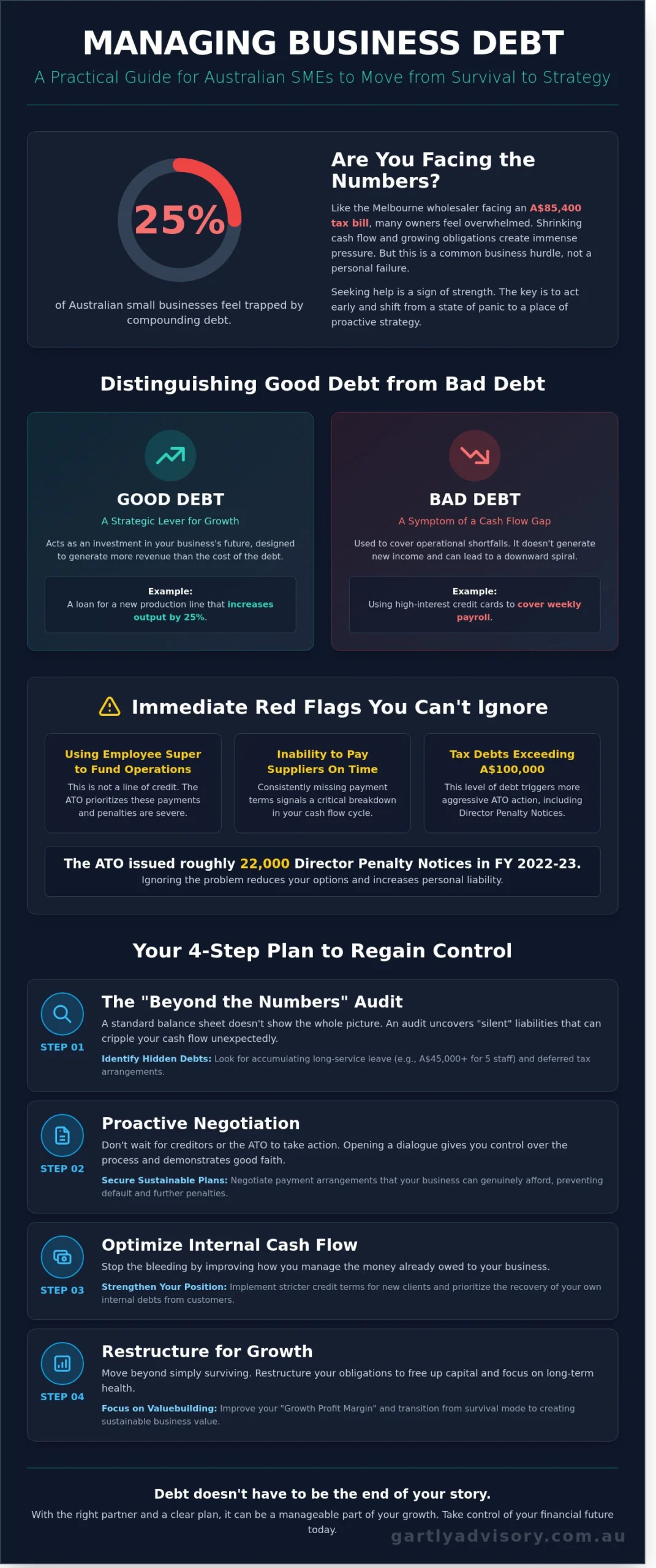
Last Tuesday, a local Melbourne wholesaler sat in our office after spending three nights staring at an ATO portal showing A$85,400 in overdue tax. Like 25% of small businesses in Australia right now, they felt trapped by compounding interest and the constant fear that a single supplier demand could trigger an insolvency crisis. If your cash flow feels like it’s shrinking while your obligations grow, you’re likely looking for practical managing business debt advice that actually works in the current Victorian market.
It’s incredibly stressful to balance the books when your profit is tied up in unpaid invoices and rising overheads. We believe that debt doesn’t have to be the end of your story. It can be a manageable part of your growth strategy with the right partner by your side. You’ll discover how to negotiate better terms with creditors, settle ATO disputes, and implement a clear 12 month plan to regain control. We’ll walk through the specific frameworks our team uses to move beyond the numbers and restore the financial stability your business deserves.
Key Takeaways
- Learn to distinguish between “good debt” used for strategic growth and “bad debt” caused by cash flow gaps while managing the emotional weight of financial pressure.
- Discover how to conduct a “Beyond the Numbers” audit to identify hidden liabilities like deferred tax and long-service leave that a standard balance sheet might miss.
- Get practical managing business debt advice on how to proactively negotiate with creditors and the ATO to secure sustainable payment plans you can actually afford.
- Improve your immediate cash flow by implementing stricter credit terms and prioritizing the recovery of your own internal debts from customers.
- Understand how to restructure your obligations to improve your “Growth Profit Margin” and transition from survival mode to long-term “Business Valuebuilding.”
Facing the Numbers: Why Managing Business Debt Starts with a Clear Head
Debt isn’t just a line on a balance sheet; it’s a heavy weight that keeps Melbourne business owners awake at 3 am. Whether you’re running a boutique in Fitzroy or a logistics firm in Dandenong, the emotional toll is significant. Many owners feel a sense of failure, yet 32% of Australian small businesses reported an increase in debt levels over the past year. Understanding that debt is a common hurdle helps you move from a place of panic to a place of action. You aren’t alone in this journey, and seeking help is a sign of strength, not weakness.
It’s essential to distinguish between different types of borrowing. Good debt acts as a strategic lever for growth, such as a loan for a new production line that increases output by 25%. Bad debt usually fills cash flow gaps caused by declining sales or poor margins. If you’re relying on credit cards to cover your weekly payroll, you need professional managing business debt advice to stop the downward spiral. Recognizing this distinction early allows you to pivot before the situation becomes unmanageable.
To better understand this concept, watch this helpful video:
Proactive management is the only reliable way to avoid severe ASIC penalties. Directors face personal liability for company debts if they allow the business to trade while insolvent. Ignoring the mounting pressure doesn’t buy you time; it actually reduces the number of tools available to save the company. By acting early, you can implement debt restructuring strategies that can preserve your legacy and protect your family assets. Gartly Advisory serves as a trusted partner during these high-pressure periods, providing the calm competence needed to navigate complex financial waters.
The Mental Shift from Survival to Strategy
Many owners stop opening mail from the ATO when they can’t pay, but this only makes the tax office more aggressive. The ATO issued roughly 22,000 Director Penalty Notices in the 2022-23 financial year. You must move from “transactional” accounting, which only looks at the past, to “advisory” support that looks at the future. Normalizing the conversation around debt in the Melbourne economy is vital. It’s a business challenge to be solved, not a personal secret to be kept. Strategic planning replaces the “survival” panic with a clear, step-by-step roadmap.
Immediate Red Flags You Can’t Ignore
Certain signs indicate your business is approaching a danger zone. If you’re consistently using employee superannuation to fund operations, you’re in a high-risk position. Super is not a line of credit, and the ATO prioritizes these payments above almost everything else. Other red flags include being unable to pay suppliers on time or having tax debts exceed A$100,000. Seeking managing business debt advice before you reach the point of no return ensures you have the best chance of a successful turnaround. Early intervention is the key to maintaining control over your business’s destiny.
The Beyond the Numbers Audit: Assessing Your True Financial Position
A standard balance sheet provides a static snapshot of your business at a single point in time. It doesn’t capture the pulse of your daily operations or the looming obligations that haven’t hit the ledger yet. When you seek managing business debt advice, the first step involves looking past the basic profit and loss statement. We need to identify the “silent” liabilities that often catch owners off guard during a cash crunch.
Hidden debt is a frequent trap. For instance, long-service leave entitlements for a team of five employees can quietly accumulate to over A$45,000 without appearing as a current debt on your primary dashboard. Similarly, deferred tax arrangements with the ATO might feel like a relief today, but they remain a priority claim on your future revenue. We’ve seen cases where businesses overlook these “zombie” debts until they manifest as an urgent payment demand or a Director Penalty Notice. You can’t manage what you haven’t measured; uncovering these figures is the only way to protect your solvency.
Real-time data is your best defense. Using cloud platforms like Xero allows us to see your position as it stands this morning, not how it looked three weeks ago. This visibility is vital for creating an accurate cash flow forecast for the next 90 days. This 12-week window is the “survival zone” where most debt issues are either resolved or spiral out of control. By mapping every expected dollar in and out, you gain the clarity needed to make hard decisions before they’re made for you. We recommend updating this forecast weekly to account for any shifts in customer payment behavior or unexpected A$2,000 repair bills.
A Checklist for Your Debt Audit
Effective audits require granular detail. Start by listing every creditor, including the ATO, commercial banks, trade suppliers, and your staff. Categorise these by interest rate and “operational criticality.” A supplier who provides your core raw materials is more critical than a secondary utility provider. Don’t forget your Accounts Receivable. Identifying A$10,000 in overdue invoices that are more than 60 days late can provide an immediate cash injection if you fast-track collections through proactive follow-ups.
Evaluating Your Business Structure
Your legal setup determines how much of your personal life is at risk. In Victoria, the distinction between personal assets and business liabilities is sharp, but it’s also fragile if your structure is outdated. If you’re operating as a sole trader or have signed personal guarantees for business loans, your family home could be on the line. Approximately 15% of small business owners we consult realise too late that their personal assets are directly linked to their business debts. A Chartered Accountant provides the objective validation needed to ensure your structure still serves its purpose of protection and tax efficiency. We help you verify that your current setup aligns with the latest Australian regulations to keep your personal wealth safe while you navigate corporate debt. This proactive approach is the cornerstone of managing business debt advice that actually works.
Negotiating with Creditors and the ATO: Strategies for Relief
Facing a mountain of invoices feels isolating, but you aren’t alone in this struggle. We’ve spent 25 years helping Australian business owners find their footing again. The Australian Taxation Office (ATO) often gets a bad reputation as a relentless debt collector; however, they’re actually one of the most predictable creditors you’ll deal with if you’re proactive. Ignoring them is where the real trouble starts. When you present a clear, honest plan, the ATO is usually willing to listen. They want your business to succeed because a healthy business continues to pay taxes in the future.
The Art of the ATO Payment Arrangement
The General Interest Charge (GIC) is currently set at 11.38% for the January to March 2024 quarter. This rate adds up quickly, making your debt grow even when you’re trying to pay it down. We often help clients request GIC remissions by showing that their circumstances were beyond their control or that paying the full amount causes serious hardship. A viable proposal must show you can meet current tax obligations while chipping away at the old debt. The ATO typically looks for a significant upfront payment, often 20% of the total debt, to prove your commitment. We love the opportunity to support our clients by looking “beyond the numbers” to find a sustainable pace. You can find more details in our Guide to Setting Up an ATO Payment Plan.
Communicating with Your Bank
Banks hate surprises. If you wait until a payment bounces, you’ve already lost your best leverage. Seeking professional managing business debt advice is the first step toward regaining control. A common strategy involves preparing a “Case for Support.” This document isn’t just a plea for help; it’s a professional package including a 12-month cash flow forecast and a clear explanation of why the business is struggling. Hardship provisions might pause your principal payments for three to six months, giving you vital breathing room.
Refinancing is another option if your equity position is strong, potentially lowering your interest rate by 1.5% to 2.5% compared to unsecured business loans. Debt consolidation can simplify your life by rolling high-interest credit cards into a lower-rate term loan. It’s a double-edged sword, though. While it improves immediate cash flow, it often turns short-term debt into a long-term burden. You must ensure the underlying cash flow issues are fixed, or you’ll find yourself back in the same position within 12 months.
Maintaining supplier relationships is just as critical as managing the bank. These partners keep your doors open. To protect these links, consider these steps:
- Early Warning: If you can’t pay a bill, tell the supplier 14 days before the due date.
- Micro-Payments: Offer to pay A$500 a week instead of A$2,000 at the end of the month.
- Prioritise: Identify the 20% of suppliers who provide 80% of your essential goods and keep them paid first.
Our team provides managing business debt advice that prioritises these relationships. We understand the tax system and the banking sector, but we also understand the human element of running a business. Let us be your trusted partner on your journey toward success by helping you negotiate from a position of transparency and strength. Proactive communication turns a crisis into a manageable transition.
Internal Debt Recovery and Cash Flow Optimization
The most immediate solution to a mounting debt pile isn’t always a new loan. Often, the capital you need is already within your business, trapped in unpaid invoices or stagnant assets. We’ve found that the fastest way to pay down your own creditors is to aggressively collect what’s owed to you. If your “Days Sales Outstanding” (DSO) sits above the Australian small business average of 36 days, you’re essentially providing interest-free loans to your customers while you pay interest on your own liabilities. This internal drain is a primary reason why many Melbourne business owners seek managing business debt advice to regain control of their liquidity.
Chasing Your Own Debtors
You shouldn’t be the bank for your customers. Automating your follow-up process in Xero can reduce your payment wait times by up to 15 days. Set up automated reminders to go out three days before a due date, on the due date, and then at seven-day intervals afterward. While automation handles the bulk of the work, a personal phone call remains the most effective tool for invoices overdue by more than 14 days. A polite, supportive conversation often uncovers a simple administrative error that a debt collection agency might turn into a relationship-ending dispute. We recommend offering a 2% discount for payments made within 7 days. This small concession is frequently cheaper than the interest accumulating on your own business loans.
Implementing stricter credit terms is equally vital. If you’ve historically offered 30-day terms, consider shifting new clients to 14 days or requiring a 50% deposit upfront. This shift protected one of our manufacturing clients from a A$40,000 cash shortfall last year, allowing them to meet their own supplier obligations without dipping into a high-interest line of credit.
Expense Rationalisation
Reducing overheads doesn’t mean “cutting the muscle” of your operations; it means trimming the fat that accumulates during periods of growth. We suggest applying the “Three-Month Rule” to every recurring cost. If a software subscription, professional membership, or marketing channel hasn’t produced a measurable return on investment in the last 90 days, it’s time to cancel it. Small margins lead to big debt repayments over time. Saving A$500 a month on non-essentials adds up to A$6,000 a year, which could wipe out a significant portion of a business credit card balance.
Local Melbourne businesses should also look at their utility and service contracts. In Victoria, the energy market is highly competitive. Using the Victorian Energy Compare service or negotiating directly with providers like Origin or AGL can often shave 10% to 15% off annual power bills. These savings might seem minor in isolation, but they provide the “free” cash flow necessary to accelerate your debt reduction strategy.
If you’re considering selling assets to clear debt, the Small Business CGT Concessions are a powerful tool to unlock capital. Under these Australian tax rules, you might be eligible for the 15-year exemption, the active asset reduction, or the retirement exemption. These can potentially reduce a capital gains tax liability to zero, ensuring that every dollar from an asset sale goes toward your debt rather than the ATO. This is a complex area where proactive planning makes a massive difference to your final outcome.
If your current cash flow isn’t keeping up with your repayments, let us help you find the hidden capital in your business. Talk to our experienced Melbourne advisors to build a debt recovery plan that works for your specific situation.
Turning Debt into a Growth Catalyst: Partnering for Long-Term Success
Debt often feels like a heavy weight, but it can be the fuel that drives your next stage of expansion. When we look at restructuring, our primary goal is to improve your Growth Profit Margin. This metric represents the cash available to reinvest in your operations after you have serviced your debt and covered your operating costs. By moving high-interest short-term liabilities, which might carry rates of 12% or higher, into more manageable long-term structures at 6.5%, you can significantly lower your monthly repayments. This shift allows you to move from simple debt management into what we call Business Valuebuilding. A company that has a clear handle on its liabilities is far more attractive to buyers or partners. We have seen businesses increase their valuation multiple from 3x to 5x simply by cleaning up their balance sheets and showing consistent, predictable cash flow.
Regular advisory meetings are the best way to stay on track and avoid the common pitfalls that lead back into financial trouble. These sessions aren’t just about reviewing the past; they are proactive strategy meetings designed to stop you from falling into future debt traps. Having a safe pair of hands to guide you means you aren’t making high-stakes decisions in a vacuum. You get the benefit of Geoff Gartly’s 35 years of experience to ensure your financial foundation remains rock solid. This level of support provides the confidence you need to take calculated risks that lead to genuine growth rather than just staying afloat.
- Strategic Restructuring: Converting expensive debt into lower-cost options to free up working capital.
- Value Enhancement: Improving your balance sheet to make the business more “saleable” or “investor-ready.”
- Proactive Oversight: Using monthly or quarterly reviews to catch cash flow gaps before they become crises.
- Expert Guidance: Leveraging decades of professional experience to navigate complex Australian tax and finance regulations.
Creating a Resilience Plan
In the 2023-24 financial year, the ATO increased its debt collection activities significantly, with small business tax debt reaching over A$34 billion. To avoid these surprises, you need a dedicated resilience plan that includes a tax emergency fund. We recommend setting aside 15% to 20% of every invoice into a separate high-interest account specifically for GST and income tax obligations. This proactive tax planning ensures you’re never scrambling at the end of the quarter. When your books are clean and your tax is managed, your business remains investor-ready at all times. Even after a debt crisis, showing a buyer that you have a disciplined resilience plan in place builds immense trust and protects your hard-earned equity.
Partnering with Gartly Advisory
We take a proactive approach to small business accounting right here in Ormond. Our team understands that you need more than just a tax return; you need a partner who looks at the big picture. We’ve spent 25 years building trust with Melbourne business owners by offering guidance that goes beyond the numbers. Whether it’s securing an R&D grant or providing expert managing business debt advice, we’re here to help you grow your dreams. If you’re ready to move beyond the stress of liabilities and start building real value, we invite you to schedule a complimentary consultation with Geoff Gartly today. Let’s work together to turn your financial challenges into opportunities for long-term success.
Take the Next Step Toward Financial Resilience
Managing debt isn’t just about paying bills. It’s about taking control of your cash flow and turning liabilities into a platform for future expansion. You’ve seen how a clear audit and strategic negotiations with the ATO can provide the breathing room your Melbourne SME needs to thrive. Success comes from being proactive rather than reactive. When you seek expert managing business debt advice, you’re investing in a strategy that looks beyond the numbers to protect your legacy.
With 35+ years of experience as Chartered Accountants and Business Valuebuilder Advisers, we’ve helped hundreds of local owners navigate complex financial waters. Our 70+ 5-Star Google Reviews reflect our commitment to being a supportive partner on your journey. You don’t have to carry this burden alone. Our team provides the calm competence required to settle disputes and optimize internal recovery. We’ll help you find the hidden opportunities that often hide behind financial stress.
Talk to us and let us help you manage your business debt. We’re ready to help you turn these challenges into your greatest opportunities for long-term success.
Frequently Asked Questions
How do I know if my business is insolvent?
You’ll know your business is insolvent if it can’t pay its debts when they’re due for payment, regardless of how many assets you have on your balance sheet. In Australia, the Corporations Act 2001 uses two main tests to determine this status, which are the cash flow test and the balance sheet test. The cash flow test is the most critical one because it looks at your actual liquidity. If you’re constantly juggling creditors or choosing which bills to pay while letting others slide past 90 days, you’re likely facing insolvency. You shouldn’t ignore these signs because continuing to trade while insolvent can lead to personal liability for directors. We’ve seen many business owners wait too long to seek help, thinking a big contract is just around the corner, but the law requires a more objective look at your bank account today.
There are specific red flags you can look for right now to assess your situation. These include a history of dishonoured cheques, an inability to borrow more money from your bank, or entering into payment arrangements with the ATO that you can’t actually keep. If your suppliers have put you on “cash on delivery” terms or have started legal proceedings to recover funds, these are clear indicators of financial distress. We use our 35 years of experience to help you look beyond the numbers and understand the reality of your financial position. It’s better to address these issues early so we can work together to find a path toward recovery or a structured exit. Don’t wait for a statutory demand to land on your desk before you take action to save your livelihood.
Can the ATO take my personal house for business debt?
The ATO usually can’t seize your personal home for company debts because your company is a separate legal entity, but there are major exceptions that pierce this corporate veil. Your house is at risk if you’ve signed a personal guarantee for a business loan or if the ATO issues a Director Penalty Notice. If you’re a sole trader or in a partnership, you don’t have the protection of a company structure, meaning your personal assets are directly tied to your business obligations. In those cases, the ATO can pursue your home to satisfy a tax debt if they’ve exhausted other recovery options. They’ll typically try to negotiate a payment plan first, but they have the power to initiate bankruptcy proceedings which could force the sale of your property to pay off what’s owed.
For company directors, the danger often comes from the Director Penalty Notice system. If you haven’t reported your BAS or superannuation on time, the ATO can make you personally responsible for those specific amounts. This means your family home, which you thought was safe behind your Pty Ltd structure, is suddenly on the line. We focus on providing managing business debt advice that prioritises asset protection by ensuring all your compliance is up to date. Since the ATO’s General Interest Charge is currently 11.38%, these debts grow incredibly fast. It’s vital to act within the 21 day window after receiving a notice to protect your personal assets. We’ve helped many clients navigate these scary situations by acting as a supportive partner and negotiating directly with the tax office to keep their homes safe.
What is a Director Penalty Notice (DPN) and why is it dangerous?
A Director Penalty Notice is a formal notice the ATO issues to make directors personally liable for a company’s unpaid tax, specifically PAYG withholding, GST, and superannuation. It’s dangerous because it removes the limited liability protection that usually comes with running a company. There are two types of DPNs, which are “non-lockdown” and “lockdown” notices. If you’ve lodged your returns on time but haven’t paid, you get a non-lockdown DPN, which gives you 21 days to pay or put the company into liquidation to avoid personal liability. However, if you haven’t even lodged your returns within three months of the due date, you get a lockdown DPN. In this case, you’re personally liable for the debt immediately, and closing the company won’t stop the ATO from coming after your personal bank accounts or house.
This system is designed to stop directors from using unpaid tax and super to fund their business operations. The ATO has become much more aggressive with these notices recently, sending out thousands of letters to businesses that have fallen behind. It’s not just the current directors who are at risk; even new directors can become liable for historical debts if they don’t rectify them within 30 days of joining the board. Because we’ve spent 25 years building trust with our clients, we make sure you understand these risks before they become emergencies. The speed of the 21 day deadline is what catches most people off guard. You don’t have time to wait or hope for the best when a DPN arrives. You need a proactive plan to address the debt and protect your personal financial future from being wiped out by company mistakes.
Is it better to get a business loan to pay off tax debt?
Choosing a business loan to pay tax debt depends on comparing the ATO’s 11.38% interest rate with the terms offered by a commercial lender. Many business owners find that the ATO is actually their most expensive creditor because the General Interest Charge compounds daily. If you can secure a bank loan or a line of credit with a lower interest rate, it’s often a smart move to pay off the tax office and simplify your monthly commitments. However, you must be careful about the security required for a new loan. Banks will often want a mortgage over your home, whereas the ATO debt might not be secured against your property yet. You’re essentially trading an unsecured or partially secured debt for a fully secured one, which increases your personal risk if the business doesn’t improve.
You also need to consider the impact on your cash flow. A bank loan usually has fixed monthly repayments, while the ATO might agree to a flexible payment plan if you have a good track record. We provide managing business debt advice that looks at the long term viability of your company, not just the immediate interest rate. If your business is struggling to make a profit, taking on more debt to pay old debt is often just a temporary fix that leads to a bigger collapse later. We help you crunch the numbers to see if the loan is a bridge to success or just a way to delay the inevitable. Our role as your trusted partner is to ensure you aren’t just shifting debt around, but actually solving the underlying cash flow problems that caused the tax arrears in the first place.
How can a Chartered Accountant help with debt negotiation?
A Chartered Accountant helps with debt negotiation by acting as a professional intermediary between you and your creditors, using financial data to prove what you can realistically afford to pay. We understand the “language” that banks and the ATO speak, which allows us to present your case in a way that builds credibility. When you try to negotiate yourself, it’s easy to get emotional or make promises you can’t keep. We take a different approach by preparing detailed cash flow forecasts and business plans that show your creditors a clear path to being paid. This professional transparency often leads to better outcomes, such as the remission of interest charges or longer payment terms that give your business the breathing room it needs to survive.
Our firm goes beyond the numbers to understand the story behind your debt. We can often identify errors in the ATO’s calculations or find tax credits you haven’t claimed, which can reduce the total amount you owe before negotiations even begin. For example, we might successfully argue for a reduction in the 11.38% interest rate based on your previous compliance history or specific hardships your business has faced. Having an experienced advisor by your side shows creditors that you’re serious about fixing the problem and that you have professional guidance to ensure the plan succeeds. We’ve spent decades helping Melbourne businesses navigate these disputes, and that reputation for integrity helps us get a foot in the door with credit managers who might otherwise be unwilling to listen. We’re here to support you through every step of the conversation.
What happens if I can’t pay my staff superannuation on time?
Missing super payments for your staff by the quarterly due date triggers the Superannuation Guarantee Charge, which is a much more expensive and complex penalty system. You lose the tax deduction for the super payment, and you must pay an additional 10% administrative fee plus interest, which is currently set at 10% per annum. You’re also required to lodge a Superannuation Guarantee Charge statement with the ATO, which calculates the debt based on the employee’s total salary and wages, including overtime, rather than just their ordinary time earnings. This means the debt can be significantly higher than the original super amount you missed. It’s a common trap for business owners who think they can use super money to pay other bills during a slow month.
The ATO takes unpaid super very seriously because it’s considered part of the employee’s compensation. They have sophisticated data matching systems that alert them almost immediately when a payment is missed. If you don’t lodge your SGC statement within a month of the due date, you face additional penalties that can reach 200% of the original debt. This is one of the fastest ways for a director to become personally liable through a Director Penalty Notice. We always advise our clients to prioritise superannuation above almost every other expense. If you’re struggling, talk to us early so we can help you find ways to manage your cash flow without dipping into your employees’ retirement funds. It’s much cheaper to pay on time than to deal with the non-deductible penalties and the intense scrutiny that follows a missed super deadline.
Are there free debt help services for Melbourne small businesses?
Yes, Melbourne business owners can access several free services like the Small Business Debt Helpline at 1800 413 914, which provides independent and confidential financial counselling. This service is funded by the federal government and is specifically designed to help small businesses that are struggling with debt or facing the threat of closure. They can help you understand your options, such as small business restructuring or voluntary administration, without the pressure of a sales pitch. Additionally, the Victorian Small Business Commission offers low cost mediation services to help resolve disputes with landlords or creditors, which can prevent expensive legal battles from draining your remaining cash reserves. These resources are excellent starting points for gathering basic information about your rights and obligations.
While these free services are great for initial guidance, many business owners eventually need the specific, hands on support that a dedicated advisor provides. We often work alongside these services to implement the technical accounting and tax strategies needed to fix a business. For instance, a free counsellor might identify that you have a tax problem, but you’ll still need a Chartered Accountant to prepare the amended returns and negotiate the complex GIC remissions with the ATO. We’re proud to be part of the Melbourne business community and often offer a complimentary initial appointment to help you understand how our 25 years of trust can help you move forward. Whether you start with a free helpline or come straight to us, the most important thing is that you don’t stay silent. There’s a support network available in Victoria to help you navigate these challenges and find a way back to profitability.
Related Posts