
Property Investment Accountant Melbourne: A Guide to Maximising Your Returns
Navigating Melbourne’s property market is an exciting journey, but it comes with significant financial complexities. Are you confident your portfolio is structured for maximum growth and asset protection? Do you worry that a simple mistake with Capital Gains Tax could cost you thousands, or that your current accountant may not grasp the specific strategies needed to maximise your returns? These concerns are common, and they highlight the critical difference between general accounting and specialised advice from a professional property investment accountant in Melbourne.
This guide is designed to provide you with clarity and confidence. We will be your trusted partner, exploring how specialist guidance can help you legally minimise your tax obligations, choose the right ownership structure for your goals, and avoid the costly errors that can undermine your hard-earned success. It’s time to ensure your investment is working as hard for you as it possibly can.
Key Takeaways
- Understand the crucial difference between a generalist accountant and a specialist property investment accountant in Melbourne who provides proactive strategies for wealth creation, not just tax compliance.
- Engaging an accountant before you purchase a property is a vital step to correctly structure your investment for long-term tax efficiency and growth from day one.
- A skilled property investment accountant in Melbourne helps you leverage key Australian tax laws, including depreciation schedules and capital gains rules, to legally minimise your tax.
- Learn the essential questions to ask a potential accountant to verify they have genuine expertise and are the right long-term partner for your investment journey.
Why a Specialist Property Accountant is Your Most Valuable Asset
Successful property investment requires more than just finding the right location; it demands a sophisticated financial strategy to maximise returns and minimise tax. While any accountant can lodge a tax return, a specialist provides the proactive guidance necessary to build long-term wealth. Engaging a dedicated property investment accountant in Melbourne means partnering with an expert who looks beyond annual compliance to focus on your entire investment journey, from initial purchase to eventual sale.
To better understand the importance of correct structuring from the very beginning, this video offers valuable insights:
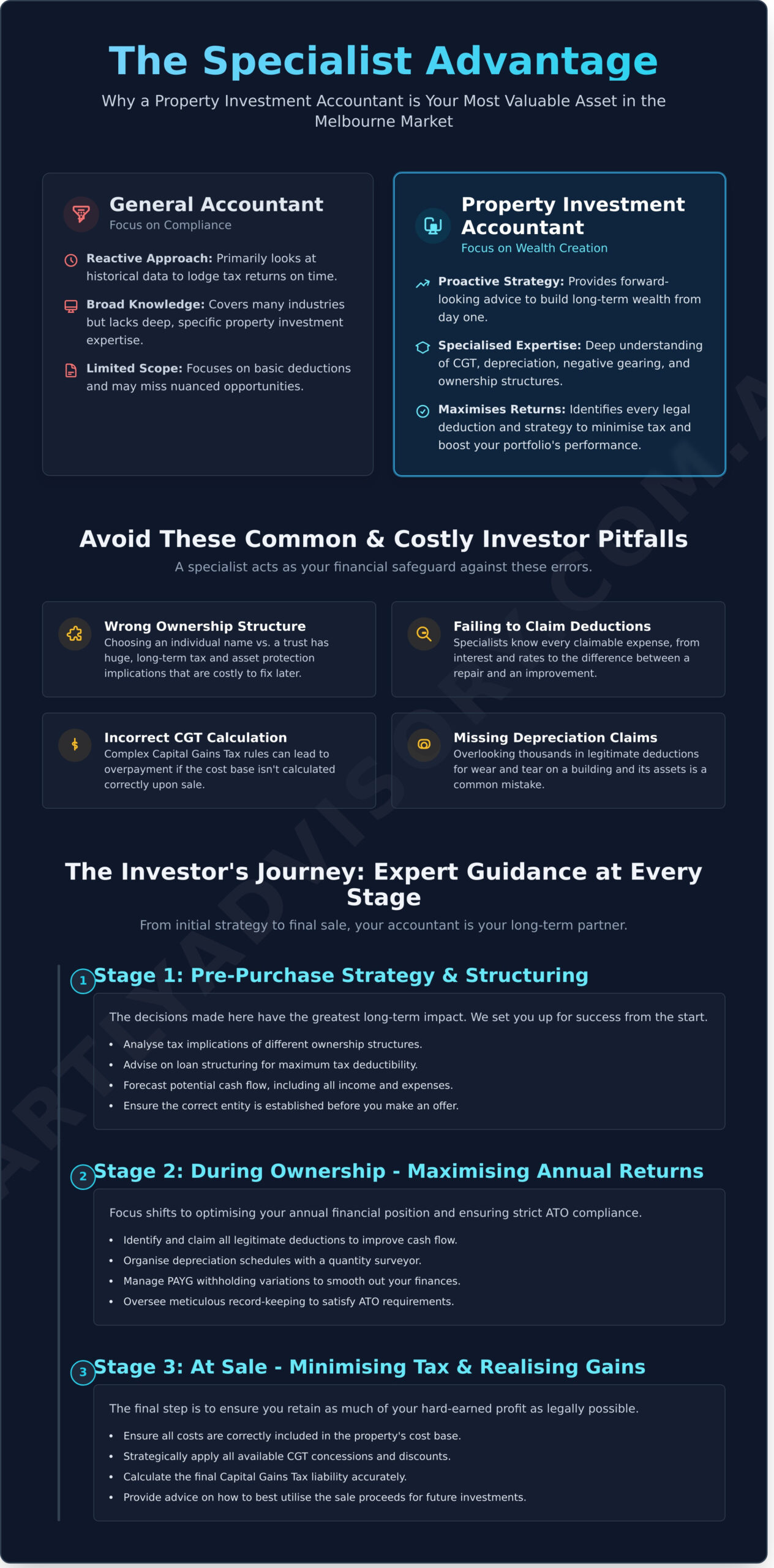
General Accountant vs. Property Specialist: The Core Differences
The distinction between a generalist and a specialist is crucial. A general accountant often focuses on historical data and ensuring your tax returns are lodged on time. In contrast, a property specialist provides forward-looking advice. They have a deep, nuanced understanding of property-specific legislation, including the complexities of Capital Gains Tax (CGT), negative gearing, and depreciation schedules. While the fundamentals of understanding real estate investment are accessible, navigating Australia’s intricate tax laws requires a seasoned expert who can identify both opportunities and risks that a non-specialist would likely miss.
Common & Costly Mistakes a Specialist Helps You Avoid
Without expert guidance, investors can easily make costly errors that erode their profits and create significant tax burdens. A proactive property investment accountant in Melbourne acts as your trusted partner, helping you steer clear of common pitfalls, including:
- Choosing the wrong ownership structure: Deciding whether to buy in an individual name, joint names, a trust, or an SMSF has profound long-term tax and asset protection implications. Getting this wrong from the start is difficult and expensive to fix.
- Failing to claim all legitimate deductions: Specialists know precisely what you can claim, from interest and council rates to the subtle differences between a repair (immediately deductible) and an improvement (depreciable).
- Incorrectly calculating Capital Gains Tax: Upon selling a property, CGT rules can be complex. A specialist ensures all costs are correctly included in the cost base to minimise your tax liability.
- Missing out on depreciation claims: Many investors overlook thousands of dollars in legitimate deductions for the wear and tear on a building and its assets. A specialist will advise on obtaining a quantity surveyor’s report to maximise these claims.
The Investor’s Journey: How an Accountant Supports You at Every Stage
Successful property investment is a long-term journey, not a single transaction. The most astute investors understand that effective financial management is a continuous process that begins long before a contract is signed and extends well beyond the final sale. Engaging a proactive property investment accountant in Melbourne from the outset ensures every decision is optimised for financial growth and tax efficiency. Let us be your trusted partner, providing expert guidance at each critical phase of your investment journey.
Stage 1: Pre-Purchase Strategy & Structuring
The decisions you make before you buy have the most significant long-term impact on your tax outcomes and asset protection. We provide crucial guidance at this foundational stage to set you up for success. Our support includes:
- Analysing the tax implications of different ownership structures (e.g., individual name, joint, company, or trust).
- Advising on the best way to structure loans for maximum tax deductibility.
- Forecasting your potential cash flow, accounting for all income and expenses.
- Ensuring you have the correct entity established before making an offer.
While the tax laws are specific to Australia, the principle of seeking expert guidance before purchasing is universal. For comparison, Canadian investors might work with a property investment firm like PRG MFT to identify opportunities before bringing in an accountant to handle the structuring.
Stage 2: During Ownership – Maximising Annual Returns
Once you own the property, our focus shifts to optimising your annual financial position and ensuring strict compliance. We proactively manage your investment’s performance to improve your cash flow and minimise your tax liability year on year. This involves identifying all claimable deductions, organising depreciation schedules through a quantity surveyor, and managing PAYG withholding variations to smooth out your cash flow. Meticulous record-keeping is key to satisfying ATO requirements and maximising your returns.
Stage 3: At Sale – Minimising Capital Gains Tax (CGT)
When the time comes to sell, strategic planning is essential to protect your profits from excessive tax. We help you navigate the complexities of CGT to ensure you retain as much of your capital gain as possible. This includes accurately calculating the property’s cost base, applying all eligible discounts and concessions, and advising on the strategic timing of the sale. We ensure you comply with all regulations, referencing the official Australian Taxation Office guidelines on property tax to secure the best possible outcome for you.
Essential Tax Strategies for Melbourne Property Investors
Owning an investment property is just the beginning. The key to maximising your returns lies in strategic management, leveraging Australia’s tax laws to your advantage. It’s about understanding the intricate balance between rental income, deductible expenses, and long-term capital growth. With state-based regulations like Land Tax, local Melbourne knowledge is not just beneficial-it’s essential for your success.
Navigating Negative Gearing and Positive Cash Flow
Negative gearing occurs when your property’s expenses, such as interest and maintenance, exceed your rental income. This resulting loss can be used to reduce your taxable income from other sources, like your salary. While it is an effective short-term tax reduction strategy, the long-term goal is for capital growth to eventually turn your investment into a positive cash flow asset. A careful assessment with your advisor is crucial to determine if this approach aligns with your financial goals.
The Power of Depreciation: Claiming Wear and Tear
Depreciation is one of the most powerful deductions available to investors. It allows you to claim the natural wear and tear of the building’s structure (capital works) and its assets like carpets and appliances (plant and equipment). A detailed depreciation schedule from a qualified Quantity Surveyor is a non-negotiable investment to maximise these claims. This non-cash deduction improves your tax position by reducing your taxable income, and adhering to the official Australian Taxation Office (ATO) guidelines is paramount for compliance.
Understanding Victorian Land Tax Obligations
As a Melbourne property investor, you must be aware of Victorian Land Tax. This annual state tax is levied on the total taxable value of all land you own, excluding exemptions like your principal place of residence. The State Revenue Office (SRO) uses property valuations to calculate your liability based on set thresholds. The right ownership structure can significantly minimise your land tax bill, a complex area where a specialist property investment accountant melbourne provides critical guidance.
Advanced Structures: Beyond Individual Ownership
Holding property in your individual name isn’t always the most effective strategy. Structures like a family (discretionary) trust can offer superior asset protection and tax flexibility by distributing income to beneficiaries on lower tax rates. For some, using a Self-Managed Super Fund (SMSF) to purchase property is a viable path to building retirement wealth, though it comes with strict regulations. Let us help you find the optimal structure for your goals.
How to Choose the Right Property Accountant in Melbourne
Selecting the right financial partner is one of the most critical decisions you will make on your investment journey. While many accounting firms can lodge a tax return, not all possess the specialised knowledge required to navigate the complexities of property investment. Your accountant should be more than a compliance officer; they should be a proactive strategist who provides guidance to maximise your returns and protect your assets. Finding the right property investment accountant in Melbourne is crucial for your long-term success.
Key Questions to Ask a Potential Accountant
To verify genuine expertise, ask targeted questions during your initial consultation. A truly experienced advisor will welcome them.
- How many property investors do you currently work with? A high number indicates familiarity with common challenges and opportunities.
- Can you provide examples of strategies you’ve implemented? Listen for discussions about optimising depreciation schedules, structuring ownership for asset protection, or managing Capital Gains Tax (CGT).
- Are you a Chartered Accountant and a registered tax agent? These are essential credentials that demonstrate a high level of professional training and legal authority in Australia.
- What is your approach to communication? You need a partner who is accessible and provides clear, proactive advice, not just an end-of-year report.
Red Flags to Watch For
Equally important is knowing what to avoid. Be cautious if a potential accountant:
- Struggles to clearly explain complex topics like negative gearing, CGT implications, or the benefits of a trust structure.
- Doesn’t ask about your long-term financial goals, focusing only on the immediate tax return.
- Offers advice that sounds aggressive, non-compliant, or “too good to be true,” which could attract unwanted ATO attention.
- Lacks a portfolio of testimonials, case studies, or positive reviews from other property investors.
The Gartly Advisory Difference: Your Trusted Partner
At Gartly Advisory, we are not just number crunchers; we are your strategic partners on the path to financial success. We pride ourselves on a proactive, ‘beyond the numbers’ approach that has been refined over 35 years of Chartered Accounting experience in Melbourne. Our specialised expertise in property investment, SMSFs, and optimal business structures ensures your portfolio is built on a solid and tax-effective foundation. With a proven track record supported by over 70 5-star Google reviews, we are the property investment accountant in Melbourne that investors trust. Let us provide the guidance and support you need to grow your dreams.
Your Next Step Towards Property Investment Success
Navigating Melbourne’s dynamic property market requires more than just finding the right property; it demands expert financial strategy. The right accountant supports you at every stage, from structuring your purchase to implementing powerful tax strategies that maximise your returns and protect your assets for the long term.
When choosing your advisor, experience and specialised knowledge are non-negotiable. As a leading property investment accountant Melbourne investors rely on, Gartly Advisory offers a partnership built on trust and proactive guidance. Our Chartered Accountants combine over 35 years of dedicated experience with a deep understanding of property, SMSF, and business structures, a commitment reflected in our 70+ 5-Star Google Reviews.
Are you ready to build a successful property portfolio with a trusted partner by your side? Schedule a complimentary appointment to discuss your property investment goals. Let us help you turn your property ambitions into a reality.
Frequently Asked Questions About Property Investment Accounting
What’s the difference between a tax agent and a property investment accountant?
While a tax agent focuses primarily on lodging your annual tax return and ensuring compliance, a specialist property investment accountant offers strategic, forward-looking advice. We go beyond the numbers to help you with structuring your purchase, optimising cash flow, planning for Capital Gains Tax, and maximising deductions. We act as a trusted partner on your investment journey, providing proactive guidance to help you build and protect your wealth, not just meet your obligations.
How much does a specialist property accountant in Melbourne typically cost?
The cost for a specialist accountant varies with the complexity of your portfolio. For a standard individual tax return with one rental property, fees in Melbourne typically range from A$500 to A$1,500 annually. This investment ensures you receive expert guidance to maximise your deductions and maintain full compliance. At Gartly Advisory, we provide a clear, upfront quote after a complimentary consultation to understand your specific needs and goals.
What records do I need to keep for my investment property?
The Australian Taxation Office (ATO) requires you to keep detailed records for at least five years. This includes the contract of sale, loan documents, proof of all rental income, and receipts for every expense. Key expenses to track are council and water rates, insurance, property management fees, repairs, and maintenance. Organised records are essential for substantiating your claims and ensuring you capture every legitimate deduction. We can support you in establishing a simple, effective system.
Can I claim the interest on the loan for my investment property?
Yes, the interest you pay on the loan used to purchase your investment property is generally tax-deductible in Australia. It is crucial to ensure the loan is structured correctly, especially if it’s linked to your personal home loan, to accurately apportion the deductible interest. As your dedicated property investment accountant in Melbourne, we provide expert advice to ensure your financing is structured optimally for tax purposes, helping you confidently claim all eligible expenses.
Is it too late to get accounting advice if I’ve already bought a property?
It is never too late to seek professional guidance. While engaging an accountant before you buy is ideal for structuring advice, significant value can be added at any stage. We can review your current situation, ensure you are claiming all available deductions (including depreciation), and help you plan for the future. Our role is to provide support wherever you are on your investment journey, helping you solve problems and improve your financial position moving forward.
How often should I meet with my property accountant?
We recommend meeting with your accountant at least once a year, ideally before 30 June, for strategic tax planning. However, we encourage you to connect with us whenever a significant event is on the horizon-such as refinancing, undertaking a major renovation, or considering a sale. As your trusted partner, we believe proactive communication is key to seizing opportunities and making the most informed decisions for your property portfolio.
Related Posts