

Setting Up a Family Trust in Australia: A Step-by-Step Guide
Does the thought of protecting your family’s assets bring up a wave of confusing terms like ‘settlor’, ‘appointor’, and ‘trustee’? You’re not alone. For many, the path to establishing a secure financial future for their loved ones feels complex and fraught with the risk of costly mistakes. The good news is that it doesn’t have to be. This guide is designed to provide clear, practical guidance on setting up a family trust in Australia, removing confusion and empowering you to move forward.
We believe in offering support that goes beyond the numbers. In this article, we will walk you through each stage of the journey, from defining the key roles and responsibilities to understanding the costs and ongoing obligations. Our goal is to provide you with a straightforward roadmap that gives you the confidence to protect your assets and have informed discussions with your financial partners. Let us help you take this important step towards securing your family’s legacy for generations to come.
Key Takeaways
-
The success of your trust hinges on appointing the right people to key roles; understanding the responsibilities of the Trustee and Appointor is your essential first step.
-
Our guide breaks down the legal process of setting up a family trust australia into a clear, 7-step checklist to ensure you meet all legal requirements with confidence.
-
Establishing the trust deed is only the beginning; learn the correct procedures for funding your trust and managing its ongoing annual compliance to keep it effective.
-
Proactively identify common pitfalls, such as incorrect asset transfers or poor record-keeping, to protect your structure and avoid costly future errors.
Table of Contents
-
Before You Begin: Understanding the Key Roles in a Family Trust
-
The 7-Step Process for Setting Up a Family Trust in Australia
-
Common Pitfalls to Avoid When Setting Up a Family Trust Australia
Before You Begin: Understanding the Key Roles in a Family Trust
Before diving into the process of setting up a family trust in Australia, it’s crucial to understand its fundamental structure. A common misconception is that a trust is a legal entity like a company; in reality, it’s a legal relationship. Think of the Trust Deed as a ‘financial rulebook’ you create for your family’s assets, and the people you appoint are the guardians of that rulebook. Choosing these guardians wisely is the single most important decision you will make.
A Trust structure is fundamentally different from holding assets in your personal name. When you own an asset personally, you are both the legal and beneficial owner. In a trust, these roles are separated. The trustee is the legal owner, but they manage the assets for the benefit of others (the beneficiaries), as governed by complex principles of Australian trust law. This separation is what provides the key benefits of asset protection and tax flexibility.
The Core Parties: Settlor, Trustee, and Appointor
Three key roles must be filled when establishing a trust. Getting this right is a vital part of the guidance we provide.
-
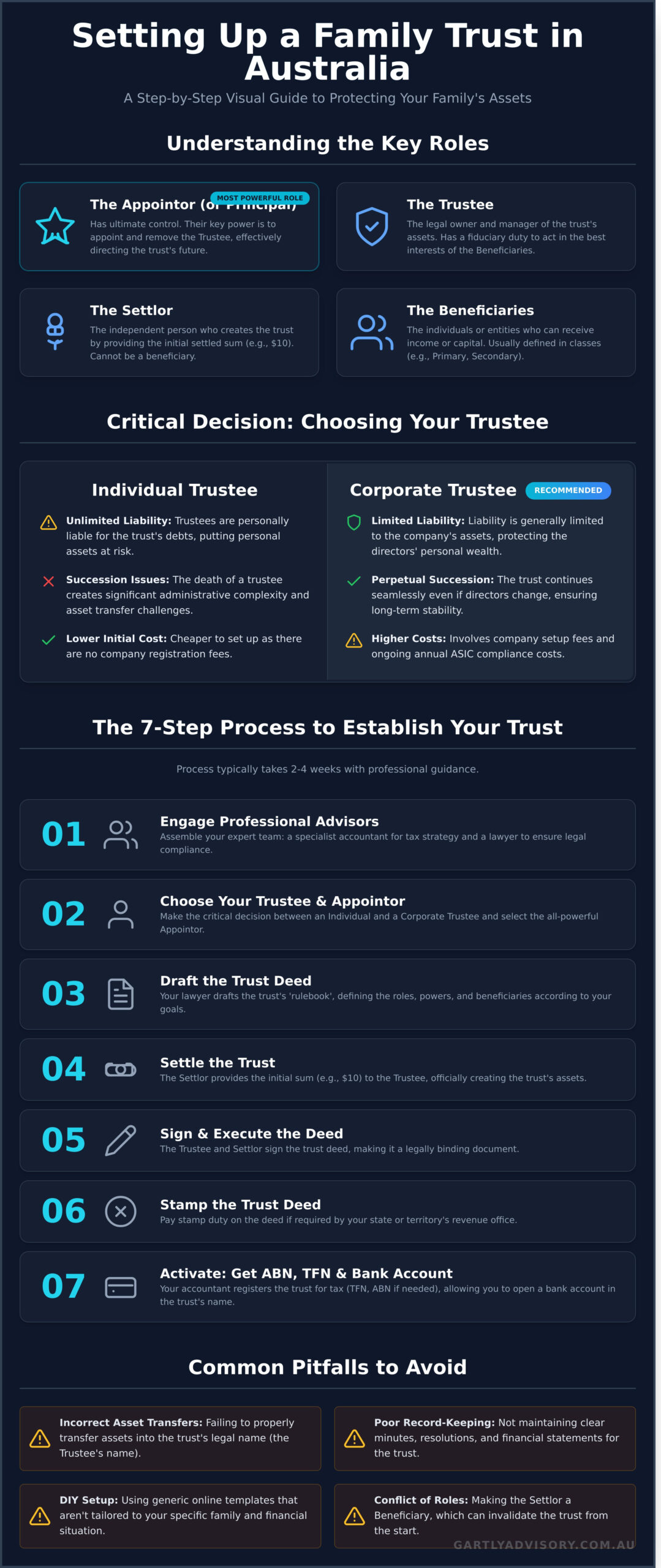
Settlor: This is the person who officially creates the trust by ‘settling’ an initial sum of money (e.g., A$10). The settlor must be independent and cannot be a beneficiary of the trust.
-
Trustee: The legal owner and manager of the trust’s assets. The trustee has a fiduciary duty to act in the best interests of the beneficiaries and manage the trust according to the deed.
-
Appointor (or Principal): This is the most powerful role. The appointor has the ultimate authority to appoint and remove the trustee, giving them effective control over the trust’s direction.
Individual vs. Corporate Trustee: A Critical Decision
One of the first practical decisions in setting up a family trust in Australia is choosing the type of trustee. Each has distinct advantages and disadvantages.
-
Individual Trustee: Often cheaper to set up initially. However, the trustees are personally liable for the trust’s debts (unlimited liability). If an individual trustee passes away, it can create significant administrative and succession challenges.
-
Corporate Trustee: A company acts as the trustee. While this involves higher setup and ongoing annual ASIC fees, it offers superior protection. Liability is generally limited to the company’s assets, not the directors’ personal wealth. It also provides perpetual succession, meaning the trust continues seamlessly even if directors change.
For any significant assets or business operations, we strongly recommend a corporate trustee as a trusted partner for enhanced asset protection and long-term stability.
Beneficiaries: Who Can Benefit from the Trust?
Beneficiaries are the individuals or entities who can receive distributions of income or capital from the trust. In a typical ‘discretionary trust’, the trustee has the discretion to decide which beneficiaries receive a distribution and how much they get. This flexibility is a core feature. Beneficiaries are usually defined in classes, such as:
-
Primary Beneficiaries: The main individuals you intend to benefit, such as yourself and your spouse.
-
Secondary Beneficiaries: A wider group, often including children, grandchildren, and their spouses, as well as related companies or charities.
The 7-Step Process to Legally Establish Your Family Trust
While the process of setting up a family trust in Australia is methodical, it is not a DIY task. Engaging professional guidance is crucial to ensure your trust is structured correctly from day one, avoiding costly errors and future complications. With expert support, the entire process-from initial consultation to having an active trust with a bank account-typically takes between two and four weeks. The following steps provide a clear checklist for establishing your trust legally and effectively.
Step 1: Engage Your Professional Advisors (Accountant & Lawyer)
Your journey begins by assembling the right team. You need both a specialist accountant and a lawyer working in tandem. An experienced accountant, like our team at Gartly Advisory Pty Ltd, acts as your strategic partner. We provide the essential guidance to structure the trust for optimal tax effectiveness and robust asset protection. A lawyer’s role is to then draft a high-quality, customised trust deed that legally reflects this strategy and protects your family’s interests for decades to come.
Step 2: Settle the Trust and Finalise the Trust Deed
With the structure decided, the trust is formally created. This involves a ‘settlor’-a person independent of the beneficiaries-providing an initial ‘settled sum’ (often a nominal amount like A$10) to the trustee. The trustee and settlor then sign the trust deed, which officially brings the trust into existence. This deed is the trust’s constitution; it governs every aspect of its operation. For a deeper understanding of the core components, the Australian Government’s guide to trusts provides a foundational overview of these roles. Using a cheap, generic template for your deed is a significant risk that can undermine its entire purpose.
Step 3: Stamp the Trust Deed (If Required by Your State)
Depending on your location, the executed trust deed may need to be stamped by the relevant state revenue office. For example, New South Wales currently requires deeds to be stamped, which incurs stamp duty. In contrast, Victoria does not require stamping for a standard discretionary trust. As regulations can change, it’s vital to confirm the current requirements for your specific state with your legal advisor.
Steps 4 & 5: Register for an ABN/TFN and Open a Bank Account
Once legally established, the trust needs its own financial identity. This involves applying for a Tax File Number (TFN) from the Australian Taxation Office (ATO). If the trust will be carrying on an enterprise, it will also require an Australian Business Number (ABN). Both are obtained via the Australian Business Register (ABR). Finally, you must open a dedicated bank account in the name of the trustee, clearly noted ‘as trustee for’ the family trust. All trust income and expenses must pass through this separate account.
Funding and Activating Your Trust: Bringing It to Life
Once your trust deed is signed and stamped, the legal entity exists, but it’s essentially an empty vessel. The next crucial step in setting up a family trust in Australia is to fund it with assets and capital. This process brings your trust to life, allowing it to begin its work of holding and managing investments for the benefit of your family. However, moving assets is a significant financial step that requires careful planning to manage tax implications and ensure flawless documentation from day one.
Transferring Assets: Property, Shares, and Business Interests
Assets must be formally transferred into the name of the trustee (e.g., "ABC Pty Ltd as trustee for the Smith Family Trust"). It’s vital to understand that transferring an existing asset you personally own, like an investment property or a share portfolio, is generally considered a disposal. This can trigger a Capital Gains Tax (CGT) event for you personally. To avoid this, it is often more strategic for the trust to purchase new assets directly using funds you have contributed.
Gifting vs. Loaning Funds to the Trust
To enable your trust to purchase assets, you need to inject cash. There are two primary methods for doing this, each with different long-term consequences:
-
Loaning Money: You can lend funds to the trust, documented by a formal loan agreement. This creates a liability on the trust’s balance sheet. The significant advantage is that the trust can repay this loan principal to you in the future, completely tax-free.
-
Gifting Money: You can make an outright gift or ‘settlement’ of cash to the trust. These funds become trust property with no obligation for repayment. This is a simpler approach but offers less flexibility for withdrawing capital later on.
We can provide guidance on which strategy aligns best with your financial objectives.
Initial Documentation: The First Trustee Minutes
Meticulous record-keeping is not optional; it is a legal requirement. Your trust’s activities must be documented from the very beginning. The first meeting of the trustee should be formally minuted, confirming key actions such as the resolution to open a trust bank account and the application for a Tax File Number (TFN) and ABN. Establishing these good habits early prevents serious compliance headaches down the track. For a detailed overview of compliance, refer to the official ATO information on trusts, which outlines the core obligations for trustees.
Ongoing Compliance: Running Your Trust Correctly Each Year
Successfully establishing your trust is a significant first step, but the real value is realised through diligent annual management. Think of ongoing compliance not as a burden, but as the essential process that protects your assets and ensures you continue to receive the full tax and succession planning benefits. After all, the work involved in setting up a family trust Australia-wide is designed to create long-term advantages that must be properly maintained.
Failing to meet your obligations can unfortunately lead to severe penalties from the Australian Taxation Office (ATO), potentially negating the very benefits you sought to create. At Gartly Advisory, we partner with you for the long term, providing the guidance and support needed to navigate these responsibilities with confidence.
Annual Financials and Tax Returns
Each financial year, your trust is required to prepare a set of financial statements, including a balance sheet and a profit and loss statement. These documents form the basis of the trust’s annual tax return, which must be lodged with the ATO. This is a fundamental compliance task that provides a clear record of the trust’s activities and ensures you meet your legal reporting duties. Our team manages this entire process seamlessly for our clients.
The Crucial June 30th Distribution Resolutions
This is one of the most critical deadlines for any trust. Before midnight on June 30th each year, the trustees must formally decide how to distribute the trust’s income among the beneficiaries for that financial year. This decision must be documented in a written trustee resolution. If this is not done correctly and on time, the trustee can be taxed on the trust’s income at the highest marginal rate, a costly and entirely avoidable outcome.
Making a Family Trust Election (FTE)
A Family Trust Election is a formal declaration made to the ATO that locks in the family group who can benefit from the trust. Making an FTE is often highly advantageous, as it allows the trust to easily pass on franking credits from share dividends and simplifies the process of utilising tax losses. However, once made, an FTE is very difficult to revoke, so it’s a decision that requires careful strategic consideration with professional advice.
Navigating these annual requirements is key to the successful operation of your family trust. Need guidance on your trust’s annual compliance? Talk to our experts.
Common Pitfalls to Avoid When Setting Up Your Trust
A family trust is an exceptional tool for asset protection and tax planning, but its effectiveness hinges on a solid foundation. With over 35 years of experience, we have seen firsthand the costly mistakes that can arise from a poorly structured setup. By understanding these common pitfalls, you can ensure your trust serves your family as intended for generations to come.
Here are the crucial lessons we’ve learned that can help you navigate the process successfully.
Using a Cheap, Off-the-Shelf Trust Deed
While the low cost of a generic, online trust deed can be tempting, it’s often a false economy. These one-size-fits-all documents may not be compliant with the latest Australian tax and trust laws, and they typically lack the flexibility needed to adapt to changing family circumstances like marriages, births, or new business ventures. The cost of engaging legal and accounting professionals to amend a flawed deed or defend it from an ATO challenge will far outweigh the initial savings.
Choosing the Wrong Trustee or Appointor
The roles of Trustee and Appointor are the most powerful positions within a trust structure. A common error is appointing someone without considering their financial acumen or personal circumstances. Appointing a person who is at high risk of bankruptcy or litigation could expose the trust’s assets. Furthermore, failing to establish a clear succession plan for the Appointor can lead to devastating family disputes over who takes control in the future. These decisions require careful strategic planning.
Mixing Personal and Trust Finances
A family trust is a separate legal structure, and it must be treated as such. One of the most critical errors is mixing personal funds with trust funds. This includes paying for personal groceries from the trust bank account or transferring personal money in without proper documentation. If the trust’s finances are not kept strictly separate, the ATO may declare it a ‘sham’. This would completely undermine its asset protection benefits and could result in significant tax penalties, undoing all your hard work.
Properly setting up a family trust in Australia requires foresight and expert guidance. Avoiding these pitfalls from day one is the key to creating a robust and effective structure. If you need support to ensure your trust is established correctly, we are here to be your trusted partner on the journey.
Your Next Step Towards a Secure Financial Future
As this guide has shown, a family trust is a powerful vehicle for protecting your assets, managing tax obligations, and ensuring your wealth is preserved for future generations. The key takeaways are clear: success depends on correctly defining the roles of trustee and beneficiaries, following the legal establishment process meticulously, and committing to ongoing compliance. Navigating the complexities of setting up a family trust australia is a significant undertaking, but the long-term benefits for your family are invaluable.
You don’t have to navigate this journey alone. At Gartly Advisory, we act as your trusted partner, providing the specialist advice needed to get it right from the start. As Chartered Accountants with over 35 years of experience in asset protection and tax strategy, we have proudly guided hundreds of Melbourne businesses and families. We go beyond the numbers to provide the clear, proactive support you need to make decisions with confidence.
Secure your family’s future. Contact us to discuss setting up your family trust today.
Frequently Asked Questions
How much does it cost to set up a family trust in Australia?
The cost for setting up a family trust in Australia typically ranges from A$1,500 to A$5,000. This investment covers the drafting of a customised trust deed and professional advice to ensure the structure aligns with your financial goals. The final price can vary based on the complexity of your assets and the level of strategic guidance required. Proper initial setup is crucial to maximising the trust’s long-term benefits and ensuring compliance.
Can a family trust run an active business?
Yes, a family trust can absolutely operate an active business. This is typically achieved by appointing a company to act as the trustee, which then runs the business on behalf of the trust. This structure provides excellent asset protection by separating business liabilities from your personal assets. It also offers significant flexibility for distributing profits among family beneficiaries in a tax-effective manner, making it a powerful vehicle for family enterprises.
How long does a family trust last in Australia?
In Australia, a family trust generally has a maximum lifespan of 80 years. This is often referred to as the "vesting date." On this date, the trust comes to an end, and the trustee must distribute all assets to the beneficiaries. This event can trigger significant Capital Gains Tax (CGT) consequences, which is why long-term strategic planning is essential. We can provide the guidance needed to manage this process effectively.
What happens to a family trust when the appointor or trustee dies?
A well-drafted trust deed will contain specific provisions for succession. When an appointor dies, their role typically passes to a nominated successor named in the deed or their will. Similarly, the deed should outline a process for replacing a trustee. Without a clear succession plan, control of the trust’s assets can become uncertain. Proactive planning is the key to ensuring a smooth transition and protecting the trust’s purpose for future generations.
Can I be the trustee, appointor, and beneficiary of my own family trust?
While legally possible in some circumstances, it is strongly advised against having one person hold all key roles, especially being the sole trustee and sole beneficiary. This can compromise the asset protection benefits of the trust, as a court may determine that the assets are effectively owned by you personally. To maintain a robust and effective structure, it is best practice to have a clear separation of these roles.
Is a family trust better than a company for asset protection?
Both structures offer valuable asset protection, but they serve different functions. A family trust excels at holding and protecting assets, separating them from personal or business risk. A company limits the liability of its shareholders. The most robust strategy often involves using both: a company acts as the trustee for a family trust that holds the assets or runs a business. This layered approach provides a superior level of protection against potential creditors.
Related Posts