

SMSF Compliance Checklist 2026: A Practical Guide for Australian Trustees
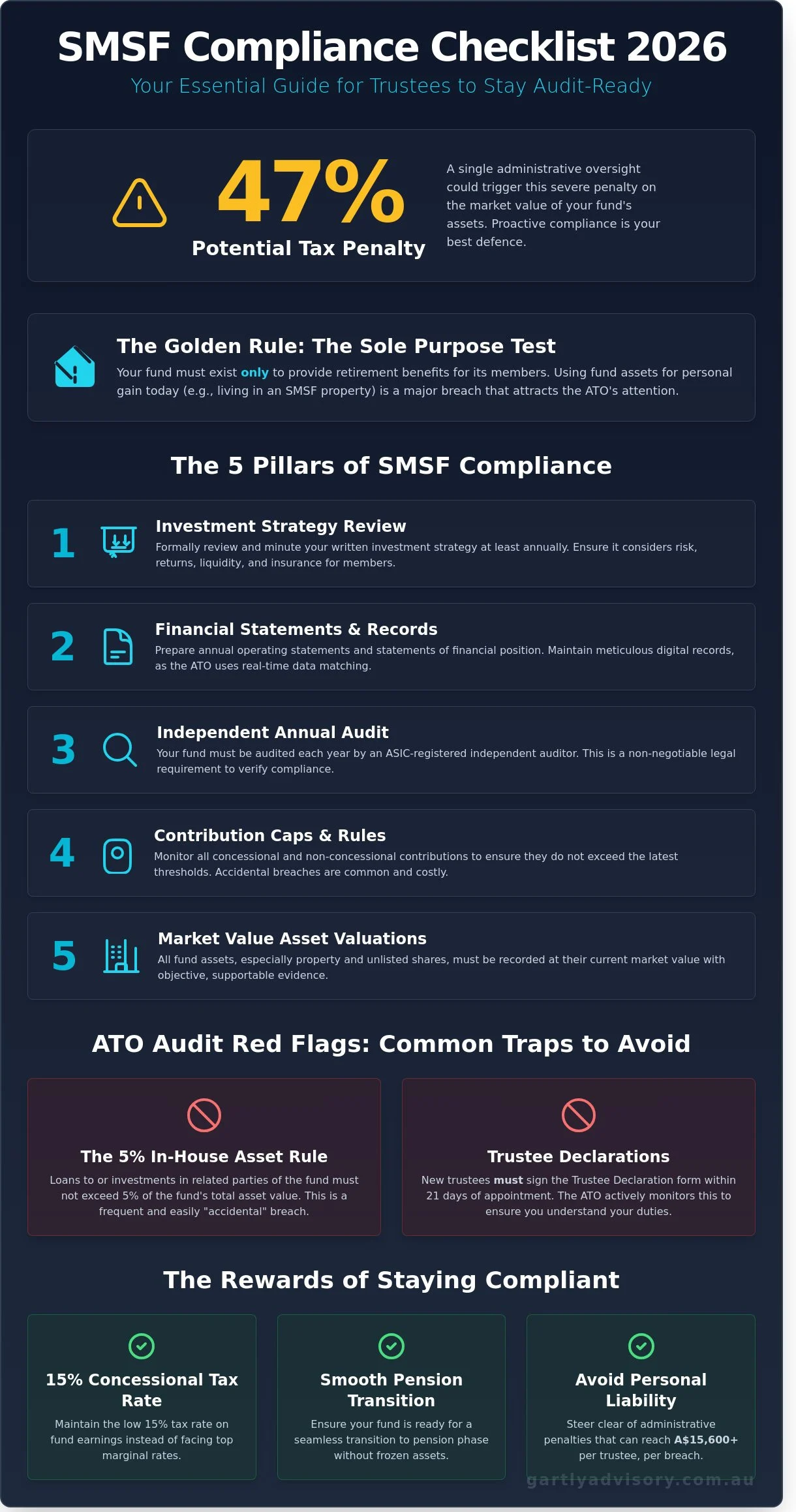
Did you know that a single administrative oversight in your self-managed super fund could trigger a tax penalty as high as 47%? For many Australian trustees, the fear of an ATO audit or a miscalculated contribution cap is enough to keep them up at night. You’ve worked hard to build your nest egg, and it’s only natural to feel protective of it. We understand that the rules feel like they’re constantly moving, which is why having a reliable SMSF compliance checklist 2026 is essential for staying on track.
You deserve to feel confident that your fund is secure and fully compliant. Our goal is to help you stay on the right side of the regulator with a comprehensive guide and expert lodgement timeline. By following these steps, you can move past the stress of paperwork and focus on what really matters: growing your retirement wealth.
This guide provides a clear roadmap of your legal obligations, from independent audit requirements to the latest contribution thresholds. We’ll show you how a proactive approach to your fund’s administration provides the peace of mind you need to look beyond the numbers and plan for the lifestyle you’ve earned.
Key Takeaways
- Understand the “Sole Purpose Test” and why it remains the non-negotiable foundation for protecting your fund’s tax-free status in 2026.
- Master the five core pillars of our SMSF compliance checklist 2026 to ensure your retirement savings stay fully protected and audit-ready.
- Identify the common “accidental” breaches, such as the 5% in-house asset rule, that often trigger ATO red flags for unsuspecting trustees.
- Get a clear, chronological roadmap of the 2025-26 lodgement deadlines so you never miss a critical date with the tax office.
- Discover how a proactive partnership with Melbourne-based experts provides the “advice beyond the numbers” you need to simplify complex regulatory requirements.
Why SMSF Compliance in 2026 is Your Foundation for Retirement
SMSF compliance isn’t just a set of administrative chores. It’s the legal framework that keeps your hard-earned retirement savings safe within the broader Australian superannuation system. Think of it as the foundation of your financial house. Without it, the structure collapses. For your SMSF compliance checklist 2026, the starting point is understanding that these rules exist to protect your tax-free status. We’ve spent 25 years helping trustees understand that compliance is the price of entry for total control over your wealth.
To better understand this concept, watch this helpful video:
The golden rule is the Sole Purpose Test. This means your fund exists for one reason only: to provide retirement benefits for its members. You can’t use fund assets for personal gain today. If you buy a residential property through the fund, you can’t live in it or rent it to a family member. If you do, you risk the dreaded 47% tax rate on the market value of your fund’s assets. That’s a massive hit to your balance. We’ve seen how stressful these audits can be, but with a proactive partner, these rules are easy to manage.
The Role of the ATO in 2026
The Australian Taxation Office (ATO) has shifted gears. By 2026, data matching and real-time reporting are the standard for all funds. They see transactions almost as they happen through the SuperStream system. A “set and forget” approach won’t work anymore. Staying ahead of your SMSF compliance checklist 2026 requirements means keeping digital records updated monthly. Every new trustee must also sign the Trustee Declaration form within 21 days of their appointment. This document confirms you understand your legal obligations. It’s a serious commitment that the ATO monitors closely through their risk-based audit programs.
The Benefits of Staying Compliant
Keeping your fund in the ATO’s good books has clear financial rewards. You maintain the 15% concessional tax rate on earnings instead of the top marginal rate. It also ensures your fund is ready for pension phase transitions. When you’re ready to retire, you want a smooth journey, not a mountain of paperwork or frozen assets. Staying compliant avoids personal liability. Administrative penalties for trustees can reach A$15,600 per breach as of recent indexation. We’re here to help you navigate these hurdles so you can focus on growing your dreams and securing your future.
The 2026 SMSF Compliance Checklist: 5 Pillars of Success
Managing your fund requires more than just high-end accounting software. While digital tools track transactions in real-time, your SMSF compliance checklist 2026 relies on professional oversight to catch the nuances software misses. Think of these five pillars as a yearly health check for your retirement savings. These core areas include investment strategy review, financial statement preparation, the independent audit, administrative record-keeping, and market value asset valuations. One critical rule for 2026 is ensuring every asset, from residential property to unlisted shares, is recorded at its current market value. The ATO expects objective and supportable evidence for these valuations, especially as market volatility fluctuates.
Investment Strategy and Financial Statements
You’ve got to review your written investment strategy at least once every 12 months. It’s not enough to just think about it; you need to formalize the review in a signed minute. Your strategy must address risk, expected returns, liquidity needs, and whether the fund should hold insurance for its members. When we prepare your operating statements and statements of financial position, we look for alignment between your actual holdings and your stated goals. If your strategy says you’re 100% in cash but you’ve just bought a A$850,000 commercial warehouse, your documentation needs an immediate update to stay compliant.
The Independent Annual Audit
Every fund needs an annual audit by an ASIC-registered independent auditor. This isn’t just a single check; it’s two distinct processes. The financial audit verifies your numbers, while the compliance audit ensures you’ve followed the super laws. If your auditor finds a breach, don’t panic. Early disclosure to the ATO usually leads to better outcomes than waiting for them to find the error. Using SMSF Association resources can help you understand the latest audit standards and what documentation you’ll need to provide. We often work as a bridge between you and the auditor to resolve queries before they become formal contraventions.
Administrative and Record Keeping Obligations
Good record keeping is the backbone of a healthy fund. You must keep minutes of all major decisions, like starting a pension or purchasing a new asset. Keep in mind that different records have different lifespans. You need to hold onto minutes and change of trustee records for 10 years, while financial records generally require a 5-year retention period. Most importantly, your fund’s bank account must stay completely separate from your personal or business finances. Mixing funds is a fast track to an ATO audit. If you’re unsure about your current record-keeping habits, our team can review your files to ensure everything is up to scratch for the 2026 financial year.
ATO Audit Red Flags: Avoiding the Compliance Traps
The Australian Taxation Office (ATO) has significantly ramped up its data-matching capabilities, flagging over 13,000 funds for potential breaches in recent annual cycles. As we look toward the next financial year, referencing your SMSF compliance checklist 2026 is the best way to catch these early. Many trustees stumble into “accidental” breaches by failing to separate personal finances from fund activities. We often see issues arise when members use the fund’s bank account for small personal expenses, thinking they’ll just pay it back later. This simple mistake triggers an immediate audit red flag.
One major hurdle is the In-House Asset rule. This regulation dictates that a fund’s investments in related parties or trusts cannot exceed 5% of the total market value of the fund’s assets. If a property market dip reduces your total fund value while your related party investment stays stable, you might suddenly find yourself at 6% or 7%. You must have a plan to sell down these assets by June 30 of the following year to rectify the breach. At Gartly Advisory, we act as your proactive partner to monitor these thresholds throughout the year, ensuring you don’t face forced asset sales at the wrong time.
Related party transactions demand absolute transparency. Every interaction between the fund and a member, or their associates, must pass the “Arm’s Length” test. This means the terms, including interest rates and payment schedules, must mirror what a total stranger would offer in the open market. The ATO looks for any sign of “sweetheart deals” that provide a tax advantage or a financial boost to a member outside of the superannuation environment.
Prohibited Loans and Financial Assistance
Lending fund money to yourself, a business partner, or a relative is strictly forbidden. It doesn’t matter if the loan is documented or if you pay a high interest rate; it’s a direct violation of the Superannuation Industry (Supervision) Act. The “No Personal Use” rule also applies to physical assets. You cannot store the fund’s collectible art in your home or spend a weekend at a holiday house owned by the fund, even if you pay market rent. Accessing your super early without meeting a condition of release results in the withdrawn amount being taxed at your marginal rate, plus potential additional penalties of up to 45%.
Property Valuation Requirements in 2026
For the 2026 financial year, the ATO requires objective and supportable data for all property holdings. A simple kerbside appraisal from a real estate agent is usually enough for a standard residential property in a stable market. However, if the property represents more than 50% of your fund’s value or is a unique commercial site, we recommend a formal valuation from a qualified valuer every three years. Staying proactive with your SMSF compliance checklist 2026 ensures your property data remains beyond reproach. Incorrect valuations lead to inaccurate member balances, which can push you over the A$1.9 million transfer balance cap or cause you to exceed your contribution limits, resulting in unexpected tax bills.
Key SMSF Deadlines and Lodgement Dates for 2026
Managing an SMSF means staying ahead of the clock. We see many trustees feel the weight of the “accounting crunch” every June because they didn’t have a clear roadmap. Using a solid SMSF compliance checklist 2026 helps you avoid late fees and keeps your fund in the ATO’s good books. It is about more than just ticking boxes; it is about protecting your retirement savings from unnecessary penalties. We believe in being proactive so you can focus on growth rather than paperwork.
The Lodgement Calendar
Your deadline depends on how you choose to lodge. If you are a new fund or you handle your own lodgements, October 31, 2025, is your critical date for the previous year’s return. Most of our clients prefer the breathing room that comes with using a tax agent. This usually pushes your deadline to February 28, 2026, or even May 15, 2026, for established funds. Along with your return, you will need to pay the A$259 ATO supervisory levy. This fee is mandatory for all funds and covers the cost of the regulator’s oversight. Don’t leave your paperwork until the final week. Getting your records to your accountant by July or August ensures you aren’t caught in the end-of-year rush.
- October 31: Deadline for self-lodgers and new funds.
- February 28 / May 15: Typical deadlines when working with a tax agent.
- June 30: The hard cutoff for all contributions to be physically cleared in your bank account.
Contribution Caps for 2026
For the 2025-26 financial year, the Concessional (before-tax) contribution cap sits at A$30,000. If you have extra room, your Non-Concessional (after-tax) cap is A$120,000. We often help clients use the “bring-forward” rule, which might allow you to contribute up to A$360,000 in a single year by using future caps. You should also look at your carry-forward unused concessional amounts if your Total Super Balance (TSB) was under A$500,000 at the end of the previous June. Always check your TSB before making large payments. If you exceed A$1.9 million, your ability to make non-concessional contributions might be restricted or cut off entirely. Small errors here can lead to extra tax, so checking your balance on MyGov is a vital step in your SMSF compliance checklist 2026.
Staying on top of these dates is easier when you have a partner who looks beyond the numbers to guide your strategy. Talk to us at Gartly Advisory to ensure your fund remains compliant and your contributions are optimized for the year ahead.
Beyond the Numbers: How Gartly Advisory Simplifies Compliance
Managing a self-managed super fund shouldn’t feel like a second full-time job. At Gartly Advisory, we’ve spent 25 years helping Melbourne families and business owners turn complex regulations into clear, actionable paths. We aren’t just here to tick boxes on your SMSF compliance checklist 2026; we’re here to be your trusted partner on your journey towards success. This means we focus on the long-term health of your fund, not just the annual paperwork that piles up on your desk.
Our “Advice Beyond the Numbers” philosophy means we look at the person behind the portfolio. We understand that your super represents decades of hard work and sacrifice. As Chartered Accountants, we handle the technical rigour of SMSF audit and tax requirements with absolute precision. This gives you the peace of mind that your fund is in a safe pair of hands. We believe in building stability and reliability through every interaction, ensuring your retirement savings remain protected and compliant against shifting ATO benchmarks. Having a professional who understands the granular details of the Australian tax system is essential for avoiding the pitfalls of non-compliance.
A Proactive Approach to Your Super
We identify tax efficiency opportunities well before the June 30 deadline arrives. If your fund holds business real property or specific franchise interests, our team provides the specific guidance needed to stay on the right side of ATO regulations. With 35 years of experience in the Ormond area, we understand the local Melbourne market conditions that affect your property valuations and rental agreements. This local context is vital when the ATO scrutinises arm’s length transactions or market value evidence in your SMSF compliance checklist 2026. We take the initiative to solve problems before they escalate, which is why our clients have trusted us for over two decades.
Your Next Steps to a Compliant 2026
A lot can change in twelve months. You should review your current investment strategy against your 2026 retirement goals to ensure they still align with your risk profile. Our specialist team is ready to conduct a thorough compliance review of your fund’s health to catch any issues before they become costly penalties. We want to help you seize opportunities for growth while maintaining a bulletproof compliance record. We invite you to a complimentary consultation to discuss your specific needs and goals. Talk to us today and let us help you secure your retirement journey. Let our experience be the foundation of your financial security.
Securing Your Retirement Future Beyond 2026
Managing your super shouldn’t feel like a constant battle with the ATO. By staying ahead of the SMSF compliance checklist 2026, you’re protecting your hard-earned assets and ensuring your fund remains a tax-effective vehicle for your retirement. Your annual return lodgement and independent audit aren’t just boxes to tick; they’re essential safeguards for your wealth. Missing a single deadline or overlooking a related-party transaction can lead to heavy penalties that impact your retirement lifestyle.
Our Melbourne-based team of Chartered Accountants brings over 35 years of experience to your side. We’ve helped hundreds of trustees navigate complex regulations, backed by more than 70 5-star Google reviews from clients who value our supportive approach. You don’t have to navigate these rules alone. Let’s ensure your fund is robust, compliant, and ready for the 2026 financial year.
Book a complimentary SMSF consultation with Gartly Advisory to get your strategy on track. We’re ready to be your trusted partner on the journey toward a secure and successful retirement.
Frequently Asked Questions
What are the mandatory compliance requirements for an SMSF in 2026?
The mandatory compliance requirements for your fund in 2026 include appointing an independent auditor at least 45 days before your annual return is due, lodging your SMSF annual return (SAR) on time, and ensuring all fund assets are valued at market value as of 30 June 2026. You’re also legally required to maintain a current investment strategy that specifically considers the insurance needs of your members. Keeping accurate records is another non negotiable task; you must keep minutes of all trustee meetings for 10 years and records of any changes to trustees for the same period. Following an SMSF compliance checklist 2026 helps you navigate these tasks without missing the critical deadlines set by the Australian Taxation Office (ATO). Our team at Gartly Advisory has spent 25 years helping trustees stay on the right side of these rules, providing a safe pair of hands so you can focus on growing your retirement savings. We believe that staying compliant isn’t just about avoiding fines; it’s about protecting your financial future and ensuring your fund meets the sole purpose test at all times.
Beyond the basic paperwork, 2026 requires a proactive approach to regulatory changes. You must ensure your fund doesn’t exceed the contribution caps, which for the 2025-26 financial year remain at A$30,000 for concessional and A$120,000 for non concessional contributions. If you’re managing a pension, you must meet the minimum drawdown requirements based on your age by 30 June. Failing to meet these standards can lead to the ATO making your fund non complying, which results in a tax rate of 45 percent on the fund’s assets. We work closely with our clients to ensure every box is ticked long before the deadline arrives. Our proactive guidance means you don’t have to worry about the complexities of the Superannuation Industry (Supervision) Act 1993. Instead, you can rely on our 35 years of experience to guide you through the maze of legislative requirements. We take pride in being more than just accountants; we’re your partners in ensuring your fund remains a robust vehicle for your long term success.
How much is the ATO supervisory levy for SMSFs in the 2025-26 financial year?
The ATO supervisory levy for the 2025-26 financial year is A$259. This amount is generally paid when you lodge your SMSF annual return and is designed to cover the costs of the ATO’s role in regulating the sector. If you’re starting a brand new fund, you’ll actually pay A$518 in your first year because the levy is paid in advance. This includes A$259 for the year you started and A$259 for the following year. It’s a small but essential cost of running your own fund. We always suggest our clients factor this into their annual budget so there are no surprises when tax time rolls around. Our role is to help you understand these costs and ensure they’re paid correctly from the fund’s bank account. We’ve seen many trustees get confused by the timing of these payments, but our team is here to simplify the process and keep your fund in good standing with the regulator.
While the levy itself is a fixed cost, the penalties for not paying it or lodging your return late are much higher. The ATO takes a dim view of late lodgements and can apply failure to lodge penalties that quickly add up to thousands of dollars. By staying ahead of the SMSF compliance checklist 2026, you ensure that the A$259 levy is the only thing you’re paying to the regulator. We focus on providing the support you need to manage these administrative tasks efficiently. Geoff Gartly’s decades of experience mean we’ve seen every variation of fund management, and we use that knowledge to provide advice beyond the numbers. We want to see your fund thrive, and that starts with getting the basics right. Let us help you navigate these annual obligations with the confidence that comes from having an expert partner by your side. We’re here to make sure your journey towards retirement is as smooth and successful as possible.
Can I use my SMSF to buy a business property that my own company rents?
Yes, you can use your SMSF to purchase a commercial property and lease it back to your own business, provided the property meets the definition of Business Real Property. This is a popular strategy for many of our business owner clients because it allows your business to pay rent to your own super fund instead of a third party landlord. However, you must ensure the lease is conducted on strictly arm’s length terms. This means the rent must be at market rates, and there must be a formal lease agreement in place just as if you were dealing with a stranger. If you charge too little or too much rent, you risk breaching the compliance rules. We’ve helped many clients navigate this complex area by ensuring they have the right valuations and documentation to satisfy an auditor. It’s a powerful way to build wealth, but it requires careful management to stay within the law.
The property must be used 100 percent for business purposes to qualify for this exemption under the Superannuation Industry (Supervision) Act. You can’t use this rule for residential property or any property that has a domestic component. Our team at Gartly Advisory takes a proactive approach to these transactions, helping you set up the structure correctly from day one. We understand the tax system and how to make it work for your business goals while keeping your fund compliant. With 25 years of trust behind us, we provide the stability and reliability you need when making such a significant investment. We don’t just look at the tax return; we look at the big picture of your business and personal wealth. By partnering with us, you gain access to seasoned experts who can guide you through the “business real property” rules and help you seize this opportunity for growth. We’re committed to being your trusted partner on your journey towards financial success.
What happens if my SMSF auditor finds a compliance breach?
If your auditor finds a compliance breach, they’re legally required to report it to the ATO via an Auditor/actuary contravention report (ACR) if it meets certain criteria. This doesn’t mean your fund is automatically in trouble, but it does mean the ATO will take a closer look at your operations. The severity of the outcome depends on the nature of the breach and whether it was an honest mistake or a deliberate act. The ATO has a range of powers, from issuing an education direction to imposing administrative penalties. In the 2025-26 period, these penalties can be significant, with some breaches carrying fines of up to A$18,800 per trustee. We work hard to ensure our clients never find themselves in this position by providing ongoing support and guidance throughout the year. Our goal is to catch potential issues before they become reportable breaches, keeping your fund’s reputation and assets safe.
When a breach is reported, the ATO may also require you to create a rectification plan to fix the issue within a specific timeframe. They might also make your fund non complying, which is the most serious outcome as it leads to the loss of your fund’s tax concessions. Our experienced team, led by Geoff Gartly, acts as your advocate during these times. We help you communicate with the ATO and work through the rectification process as quickly as possible. We believe in being proactive rather than reactive, which is why we emphasize the importance of a regular review of your fund’s activities. Our “beyond the numbers” approach means we’re always looking out for your best interests, providing the calm competence you need to navigate complex business matters. We’ve spent 35 years building a reputation for reliability, and we use that experience to protect our clients from the stress of compliance failures. Talk to us today and let us help you keep your fund on the right track.
Do I need a new property valuation every single year for my SMSF?
You don’t necessarily need a formal independent valuation from a professional appraiser every single year, but you must provide “objective and supportable data” to prove the market value of the property annually. The ATO requires that all assets be reported at their fair market value in your annual return as of 30 June. For a property, this could involve looking at recent sales of similar properties in the area, online valuation reports, or a letter from a real estate agent. However, if a significant event has occurred that could change the value of the property, such as a major renovation or a shift in market conditions, a formal valuation is highly recommended. We usually suggest our clients consider a professional valuation every three years to ensure their records are robust enough to pass an audit. This approach provides the stability and evidence needed to keep your fund compliant without incurring unnecessary costs every twelve months.
Our team at Gartly Advisory understands that property valuations are a common point of friction during the audit process. We help you gather the right evidence to support your property’s value, ensuring your fund meets the standards set by the regulator. We take a supportive and proactive role in this process, guiding you on what the ATO expects to see. By maintaining accurate valuations, you also ensure that your member balances and any pension payments are calculated correctly. This is a vital part of your long term strategy, and we’re here to make it as simple as possible. With 25 years of experience, we’ve seen how market fluctuations can impact fund compliance, and we provide the expert advice you need to stay ahead. We’re not just here to do your taxes; we’re here to be your partner in building a secure future. Our approachable team is always ready to answer your questions and provide the reassurance you need to manage your fund with confidence.
What is the deadline for lodging my SMSF annual return if I use a tax agent?
The deadline for lodging your SMSF annual return when using a tax agent is generally 15 May 2027 for the 2025-26 financial year. This extended timeframe is one of the key benefits of working with a professional firm like Gartly Advisory, as it gives you more time to gather your documents and ensure everything is accurate. However, if your fund is new and this is its first year of operation, your deadline might be earlier, typically 28 February 2027. Also, if you’ve been late with your lodgements in the past, the ATO might move your deadline forward to 31 October. We keep a close eye on these dates for all our clients, providing reminders and support to ensure you never miss a deadline. Missing these dates can lead to penalties and the loss of your fund’s “complying” status on Super Fund Lookup, which can stop your employer from making contributions.
We pride ourselves on being a safe pair of hands when it comes to meeting your regulatory obligations. Our methodical approach ensures that your return is prepared and reviewed long before the 15 May deadline. We don’t believe in last minute rushes; instead, we work with you throughout the year to keep your records up to date. This proactive style is what has earned us 70 plus 5 star Google reviews and the trust of our clients for over two decades. Geoff Gartly’s 35 years of experience mean he understands the nuances of the tax system and how to navigate it effectively for your benefit. We’re here to solve problems and seize opportunities, making sure your fund remains a successful part of your financial journey. When you partner with us, you’re not just getting a tax agent; you’re getting a dedicated team committed to your success. Let us take the stress out of tax time so you can focus on what matters most to you.
Can I pay my SMSF accounting fees from my personal bank account?
You can pay your SMSF accounting fees from your personal bank account, but you should be aware that the ATO will treat this payment as a contribution to the fund. This is known as a “deemed contribution,” and it must be recorded correctly in your fund’s accounts. It’s important to ensure that this payment doesn’t cause you to exceed your contribution caps for the year, which are A$30,000 for concessional and A$120,000 for non concessional contributions. If you’re already at your limit, paying these fees personally could result in an excess contributions tax. Generally, it’s much cleaner and simpler to pay all fund related expenses directly from the SMSF’s own bank account. This keeps your personal and superannuation finances separate, which is a core principle of good fund management. We always advise our clients to keep a clear trail of all transactions to make the audit process as smooth as possible.
At Gartly Advisory, we focus on providing practical and grounded advice to help you avoid these common pitfalls. We’ve seen how easily personal and fund expenses can become blurred, and we’re here to provide the guidance you need to keep them distinct. Our role as your trusted partner is to ensure you understand the implications of every financial decision you make. We believe in a proactive approach, helping you set up systems that make managing your fund’s expenses easy and transparent. With our 25 years of experience, we’ve developed a deep understanding of what the ATO looks for, and we use that knowledge to protect your interests. We’re committed to helping you grow your dreams while maintaining the highest standards of compliance. Whether you’re a seasoned trustee or just starting out, we offer the supportive and professional environment you need to succeed. Talk to us today and let us help you navigate the complex world of business and superannuation matters with ease.
Is a written investment strategy legally required for an SMSF?
Yes, a written investment strategy is a legal requirement under Superannuation Industry (Supervision) Regulation 4.02. This document must outline your fund’s investment objectives and the types of assets you plan to invest in to achieve those goals. It’s not enough to just have a vague idea in your head; the strategy must be documented and reviewed regularly to ensure it remains relevant to the members’ needs. Your strategy must consider several key factors, including risk and return, diversification, liquidity, and the fund’s ability to pay debts. Crucially, you must also document whether you’ve considered taking out life insurance for your members. If your auditor finds that you don’t have a valid, written strategy, they’ll mark it as a compliance breach. We help our clients draft and update these strategies to ensure they’re not only compliant but also serve as a useful roadmap for their financial future.
Having a robust investment strategy is a central part of your SMSF compliance checklist 2026. It provides the framework for all your investment decisions and helps protect you as a trustee. We take a “beyond the numbers” approach to this task, working with you to understand your personal goals and risk tolerance. Geoff Gartly and the team have 35 years of experience in guiding clients through the complexities of superannuation law. We don’t just provide a template; we provide tailored advice that reflects your unique situation. Our goal is to empower you to make informed decisions that lead to long term success. We’re here to support you every step of the way, providing the calm competence and expert guidance you need to manage your fund effectively. Trust us to be the safe pair of hands you need to navigate the regulatory landscape and achieve your retirement dreams. Contact us today to schedule a consultation and see how we can help you stay compliant and successful in 2026 and beyond.
Related Posts