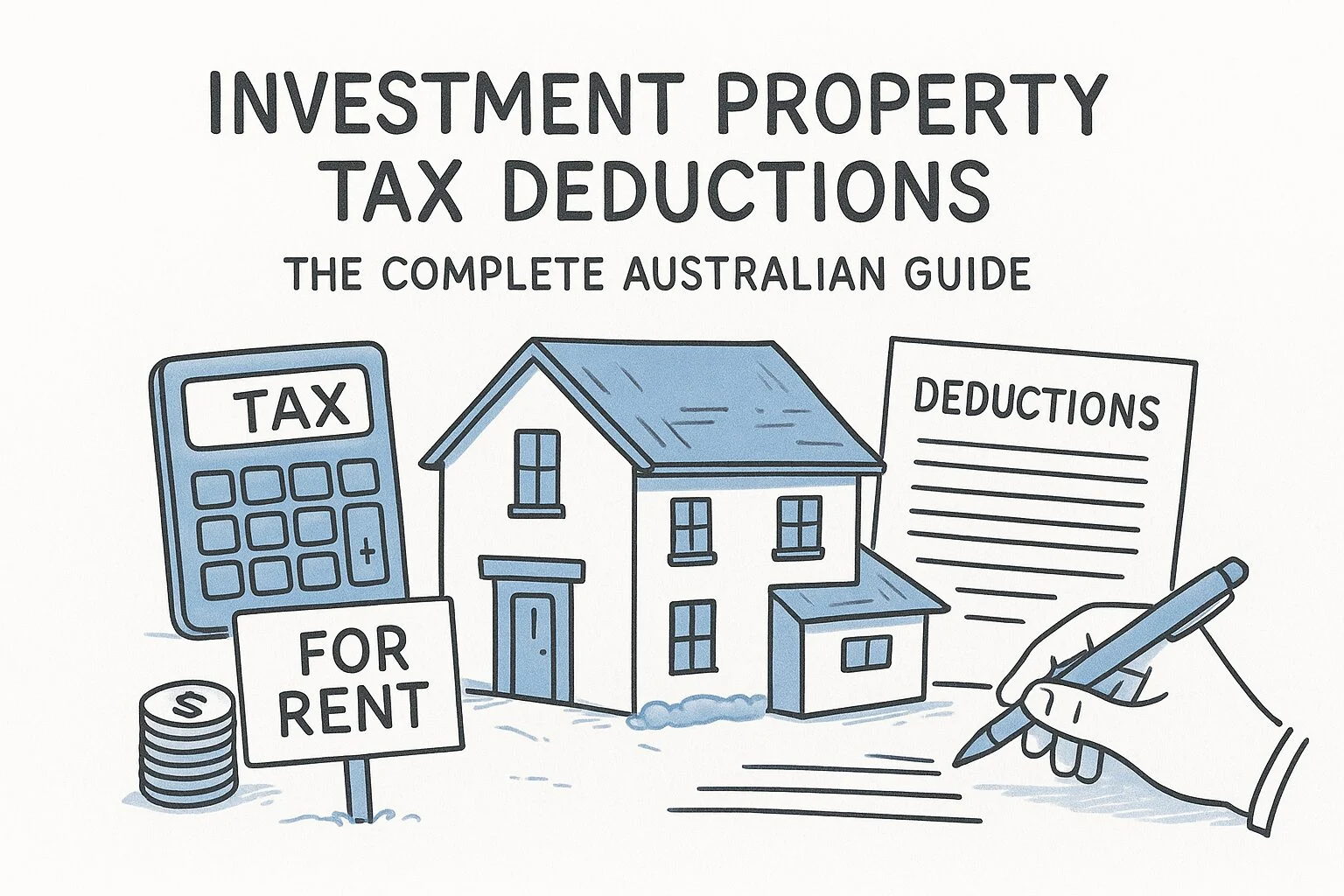
Investment Property Tax Deductions: The Complete Australian Guide
Most property investors leave money on the table every tax season, simply because they don’t know what they’re entitled to claim. Getting your tax investment property deductions right can mean thousands of dollars back in your pocket, but getting them wrong can trigger an ATO audit. Either way, it pays to know exactly where you stand.
This guide walks you through every deduction available to Australian property investors, from interest on your loan to depreciation on fixtures and fittings. We cover the eligibility rules the ATO actually enforces, not just the generic list you’ll find elsewhere, and explain how to report each deduction correctly on your tax return so nothing gets flagged or missed.
We’ve built this guide from real conversations with property-owning clients, the same questions Geoff Gartly and the team field every tax season at Gartly Advisory. You’ll find a full rundown of claimable expenses, common mistakes that cost investors money, and practical tips for keeping records that hold up under scrutiny. By the end, you’ll know precisely what you can claim and how to claim it properly.
1. Interest on your investment loan
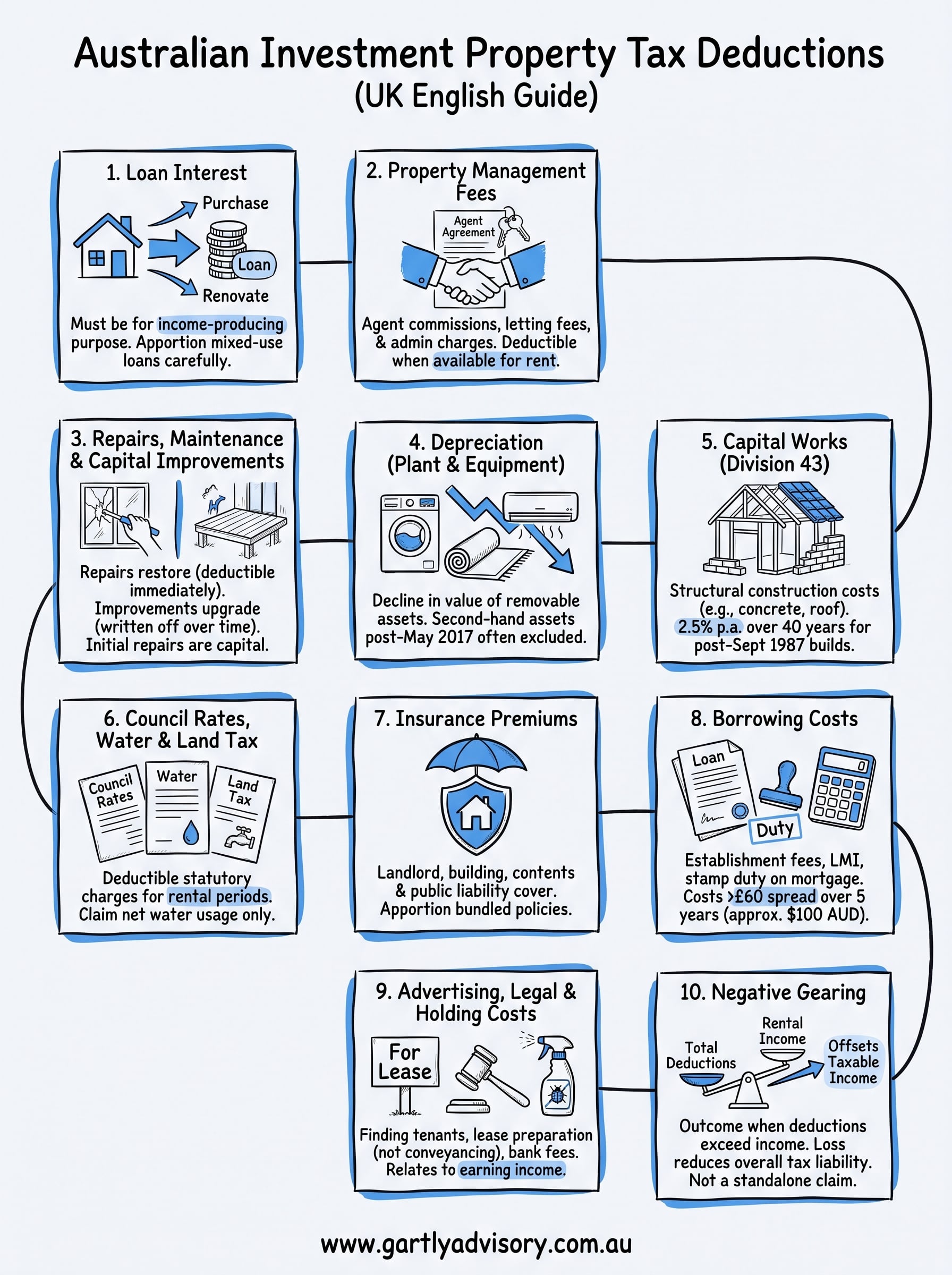
For most landlords, loan interest is the single biggest deduction available, often dwarfing every other expense combined. If you’ve borrowed money to buy, renovate, or maintain a rental property, the interest charged on that loan is generally deductible in full, provided the loan was used for an income-producing purpose. This single deduction is usually the reason tax investment property deductions matter so much to your bottom line each financial year.
What it includes
Interest deductions cover more than just your standard mortgage repayments. You can claim interest on the original purchase loan, any top-up or redraw used for property-related expenses, and interest on a loan taken out for renovations or repairs to the rental. Line fees, some ongoing loan fees, and interest on a deposit bond used to secure the property also count. What you can’t claim is the portion of interest tied to the principal repayment itself, since that’s a reduction of debt rather than an expense.
Eligibility rules
The ATO’s rule is simple in theory but tricky in practice: the loan must be used to earn assessable rental income. If you’ve mixed personal and investment borrowing, such as redrawing funds for a holiday or a car, you need to apportion the interest between deductible and non-deductible use.
Mixed-use loans are one of the most common reasons the ATO adjusts investor tax returns, so keep personal and investment borrowing strictly separate.
This is why Geoff Gartly consistently advises clients against combining an investment loan with a personal offset account or drawing on it for private expenses, since it muddies the apportionment calculation and invites scrutiny.
How to claim it on your tax return
You’ll report interest expenses at the rental schedule section of your tax return, under "Interest on loans." Keep these records ready before lodgement:
- Annual loan interest statements from your lender
- Loan account statements showing any redraws or top-ups
- A clear apportionment calculation if the loan has mixed use
- Records confirming when the loan was drawn down relative to the property settlement date
The ATO’s rental property guide sets out exactly how interest apportionment should be calculated, and it’s worth checking against your own figures before you lodge.
2. Property management and letting agent fees
If you use an agent to find tenants, collect rent, or handle maintenance requests, every dollar you pay them is deductible. Property management fees are one of the easiest deductions to get right because they’re itemised on your agent’s annual statement, yet plenty of investors still forget to claim the smaller charges bundled in alongside the standard commission.
What it includes
Agent commissions on rent collected form the bulk of this deduction, but you can also claim letting fees charged when a new tenant signs a lease, advertising costs the agent passes through, and administration charges for preparing statements or arranging repairs on your behalf. Fees for organising routine property inspections and liaising with tradespeople also count, provided the agent has actually invoiced you for the service.
Eligibility rules
The property must be genuinely available for rent, or already tenanted, for these fees to qualify. You can’t claim management fees for periods the property sat vacant because you were using it personally or hadn’t yet listed it.
Only fees tied to periods your property was rented or genuinely available for rent are deductible.
How to claim it on your tax return
Your agent’s end-of-year statement lists these charges separately from rent received, making this section straightforward to complete. Keep the statement, plus any invoices for one-off services like lease renewals, filed with your other rental deduction records for at least five years in case the ATO asks for substantiation.
3. Repairs, maintenance and capital improvements
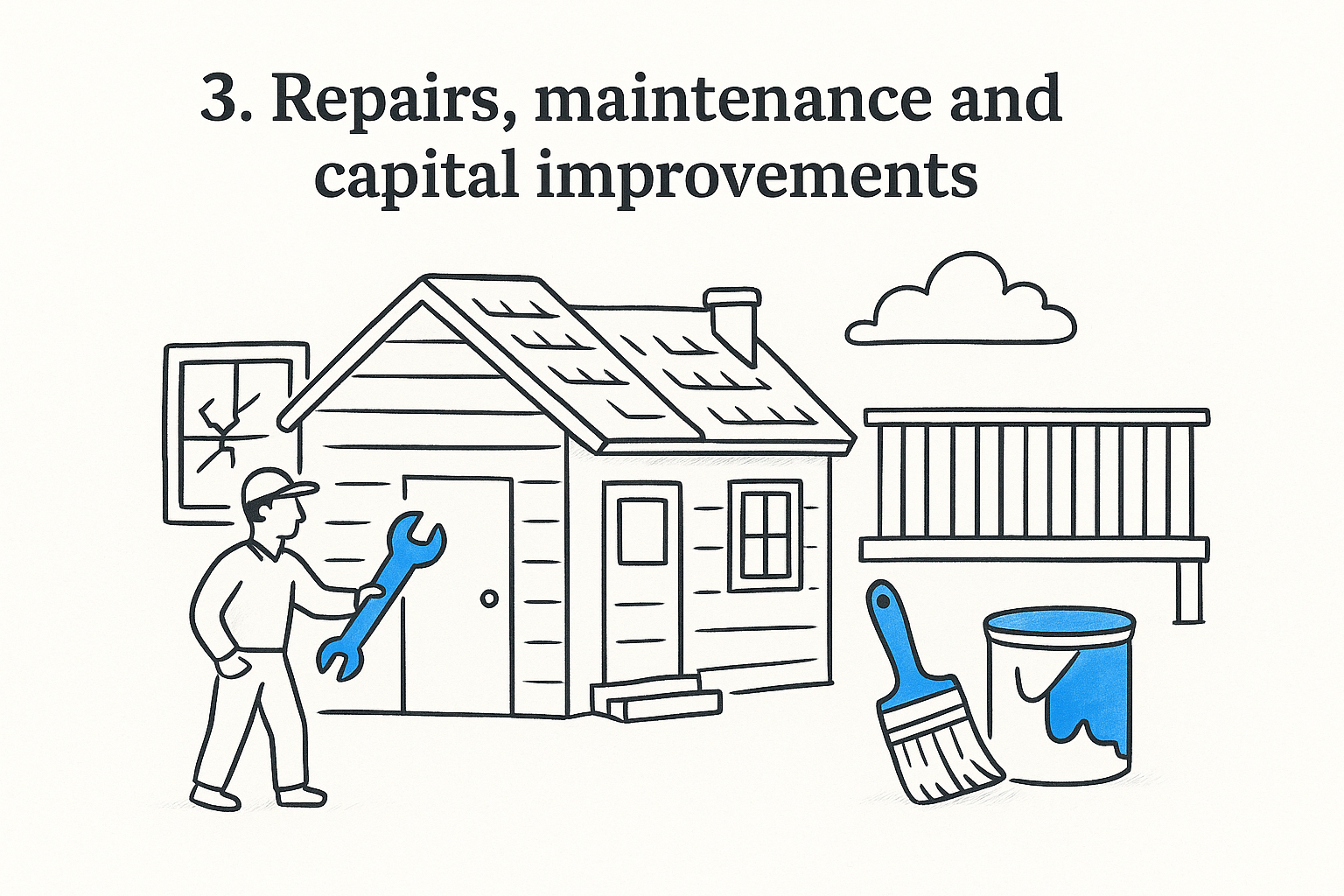
Knowing the difference between a repair and a capital improvement trips up more investors than any other deduction on this list. Repairs restore something to its original condition, while improvements upgrade it beyond that, and the ATO treats each one completely differently at tax time.
What it includes
Repairs cover things like fixing a broken window, patching a leaking roof, or replacing a few damaged floorboards. Maintenance costs such as gutter cleaning, pest control, and servicing an air conditioner also fall into this immediately deductible category. Capital improvements, on the other hand, include renovating a bathroom, adding a deck, or replacing an entire kitchen, and these get written off over time rather than claimed upfront.
Eligibility rules
The property must have been rented or genuinely available for rent when the expense occurred, and the work can’t be an initial repair for damage that existed at purchase. That first category, often called an initial repair, is treated as capital regardless of how minor the job seems.
Fixing pre-existing damage from before you owned the property is capital, not a repair, no matter how small the job looks.
Separating genuine repairs from capital works before you lodge saves you from an ATO adjustment down the track.
How to claim it on your tax return
Report repairs and maintenance under that specific label in the rental schedule, claiming the full amount in the year you paid it. Improvements instead get added to your capital works schedule, spread across future years as outlined in the ATO’s guide to rental property repairs.
4. Depreciation on plant, equipment and low-value assets
Beyond the bricks and mortar, your rental property is full of assets that wear out over time, and the ATO lets you claim that decline in value each year. Depreciation deductions on plant and equipment can add up to thousands of dollars annually, particularly in newer or recently renovated properties, yet many investors skip this claim entirely because they’ve never had a proper schedule prepared.
What it includes
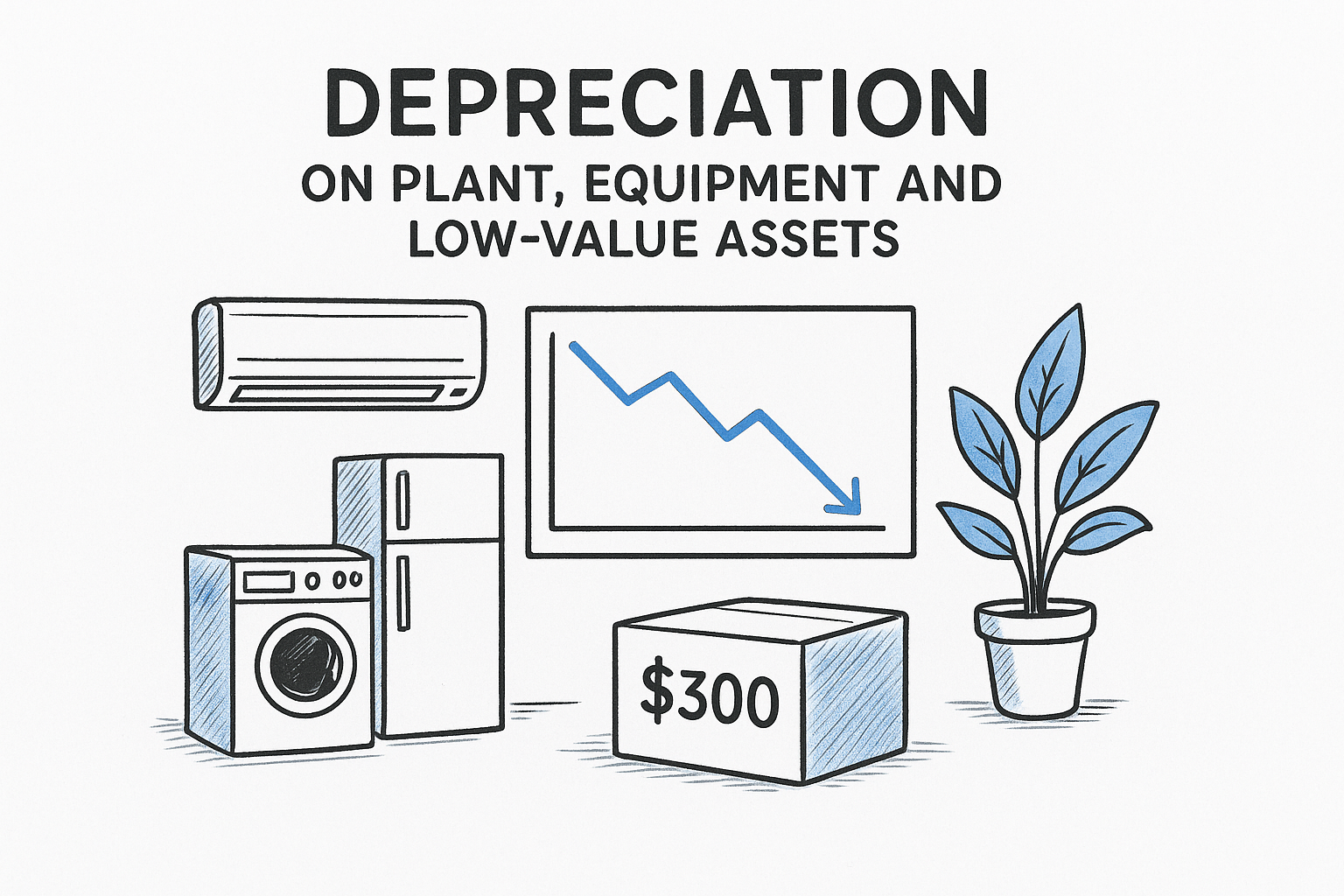
Plant and equipment covers removable items like carpets, blinds, hot water systems, air conditioners, ovens, and dishwashers. Low-value assets, generally items costing under $300 individually, can often be written off immediately rather than depreciated over several years. Items pooled together in a low-value pool depreciate at a faster combined rate, giving you a bigger deduction sooner.
Eligibility rules
If you bought your property second-hand after 9 May 2017, you generally can’t claim depreciation on existing plant and equipment already installed, only on new assets you purchase yourself. New builds and brand-new fixtures you install remain fully claimable.
Second-hand plant and equipment bought with an established property after May 2017 usually isn’t deductible, so check the purchase date carefully.
Geoff Gartly recommends getting a quantity surveyor’s report early, since it separates eligible assets from ineligible ones far more accurately than a DIY estimate.
How to claim it on your tax return
Depreciation gets reported in the rental schedule under "Capital works deductions" or "Other deductions," depending on the asset category, using figures straight from your depreciation schedule. Refer to the ATO’s guide on depreciating assets if you’re calculating this without a professional report.
5. Capital works deductions under Division 43
While plant and equipment covers removable items, the building itself qualifies for a separate deduction under Division 43. This covers the structural cost of construction, from the concrete slab to the roof tiles, and it’s often the largest single write-off available on a newer investment property, spread over decades rather than claimed in one go.
What it includes
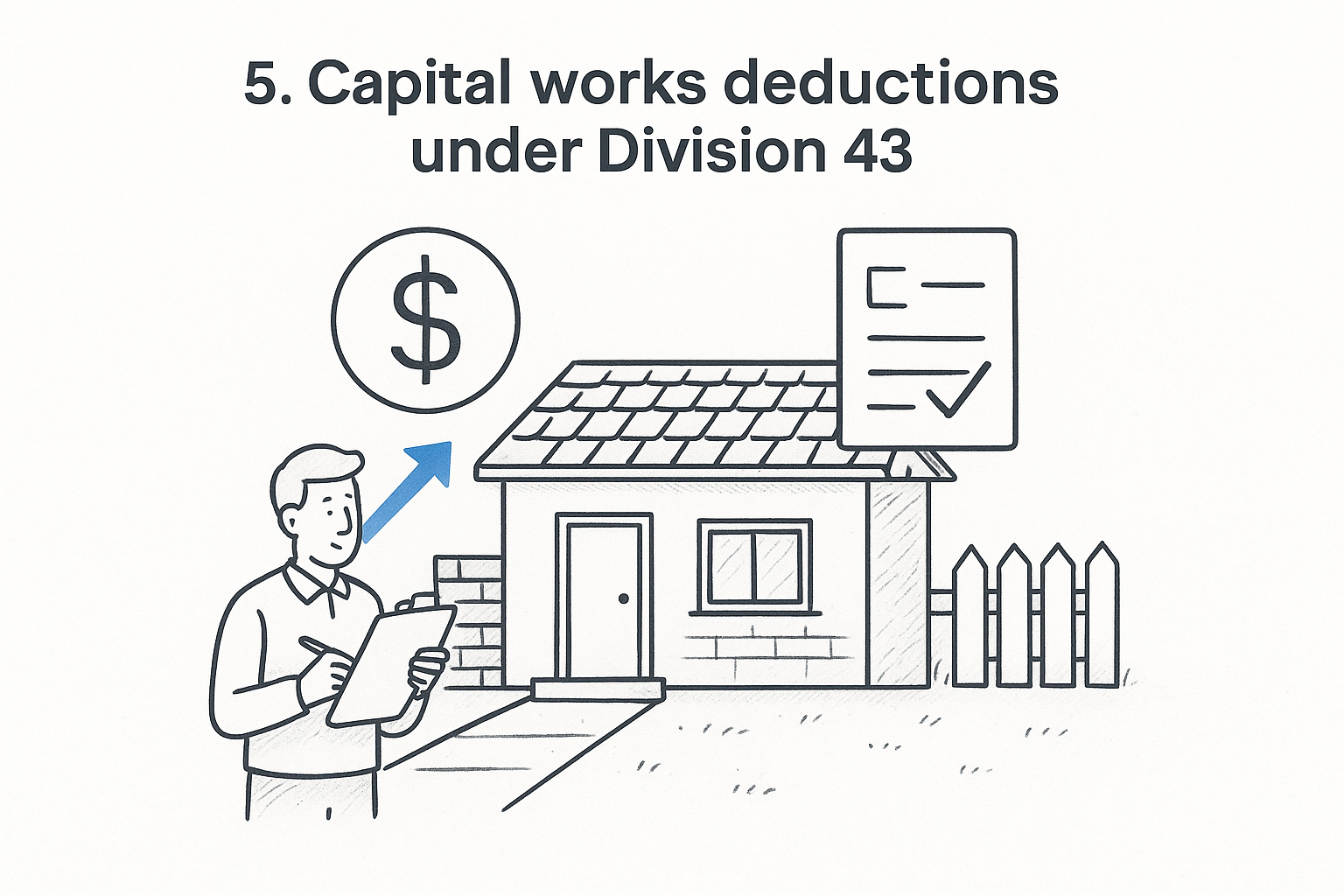
Brickwork, concrete, roofing, built-in kitchen cabinetry, and fixed tiling all fall under capital works deductions. Structural renovations like adding a room, replacing a roof, or rebuilding a fence also qualify, provided the work is genuinely part of the building rather than a removable asset. Even fees for the original architect or engineer can sometimes be added to the construction cost base.
Eligibility rules
Residential buildings where construction started after 15 September 1987 attract this deduction, claimed at 2.5% of the construction cost each year for 40 years. Older properties generally miss out entirely unless they’ve had qualifying renovations completed after that date.
If your property was built after September 1987, you’re likely sitting on a capital works deduction worth chasing up.
How to claim it on your tax return
You’ll need a quantity surveyor’s depreciation schedule to substantiate the construction cost, since the ATO won’t accept a rough estimate. Report the annual amount under "Capital works deductions" in your rental schedule, and keep the full schedule on file for the life of the property. The ATO’s guide to capital works deductions confirms exact eligibility dates and rates.
6. Council rates, water charges and land tax
Holding an investment property comes with a steady drip of statutory charges, and the good news is nearly all of them are deductible. Council rates and water charges are unavoidable running costs, while land tax applies once your property holdings cross your state’s threshold, and each one reduces your taxable rental income when claimed correctly.
What it includes
Council rates cover the standard quarterly or annual bill from your local municipality, and water charges include both the fixed service fee and any usage charges you’ve paid rather than recovered from the tenant. Land tax, assessed annually by your state revenue office, is deductible in full for investment properties, though it doesn’t apply to your main residence. Strata or owners corporation levies for ongoing administration also sit in this category, separate from any special levies raised for capital works.
Eligibility rules
These charges are deductible for the period the property was rented or genuinely available for rent, so if you lived in the property for part of the year, you’ll need to apportion the claim accordingly.
Council rates, water charges and land tax are deductible in full, provided the property was rented or actively available for rent at the time.
Where a tenant reimburses you for water usage, only claim the net amount you’ve actually paid out.
How to claim it on your tax return
Report these under their own labelled categories in the rental schedule, using council and water authority statements plus your state revenue office’s land tax assessment as substantiation. Keep every notice, even ones marked as reminders, since the ATO occasionally requests the original assessment rather than a payment receipt.
7. Insurance premiums for your rental property
Insurance is one of those costs investors budget for automatically, yet many forget it belongs on the tax investment property deductions list too. Landlord insurance, building insurance, and contents cover for a furnished rental all protect your income-producing asset, and the ATO treats the premiums as a straightforward operating expense rather than a capital cost.
What it includes
Building insurance covering fire, storm, and structural damage is deductible in full, as is landlord insurance protecting against tenant default, malicious damage, or loss of rent. If you rent the property furnished, contents insurance on items like furniture and appliances also qualifies. Even public liability cover, protecting you if someone’s injured on the property, sits inside this category.
Eligibility rules
Cover needs to relate to the period the property was rented or genuinely available for rent. Investors sometimes bundle landlord insurance with their home and contents policy for a discount, which means you’ll need an itemised breakdown from your insurer to isolate the deductible portion.
Bundled insurance policies need an itemised breakdown, otherwise you risk overclaiming or missing part of the deduction entirely.
Geoff Gartly often reminds clients that a policy renewal notice showing a single combined premium isn’t enough on its own for substantiation.
How to claim it on your tax return
Claim the premium under "Insurance" in your rental schedule, using the exact figure from your policy documents or renewal notice. Where a policy covers multiple properties or blends personal and investment cover, apportion the premium and keep your calculation on file alongside the insurer’s statement.
8. Borrowing costs and loan establishment fees
Setting up an investment loan comes with its own set of upfront charges, and most of these count toward your tax investment property deductions even though they’re separate from the interest itself. Borrowing costs sit in their own category on the rental schedule, and investors who skip this line often leave a genuine deduction unclaimed simply because the fees look like admin rather than tax-deductible expenses.
What it includes
Typical borrowing costs include loan establishment fees, lender’s mortgage insurance, title search fees, and the cost of preparing and filing mortgage documents. You can also claim stamp duty charged on the mortgage itself, not the property purchase, plus any fees paid to a mortgage broker for arranging the finance. Valuation fees required by the lender before approval also fall into this bucket.
Eligibility rules
Where total borrowing costs exceed $100, you need to spread the deduction over five years or the loan term, whichever is shorter. Costs under $100 can be claimed in full in the year you paid them, which catches out investors who assume every fee must be amortised.
Borrowing costs over $100 get spread over five years, not claimed as a lump sum in year one.
How to claim it on your tax return
Report the annual apportioned amount under "Borrowing expenses" in your rental schedule, working from your loan settlement statement and broker invoice. Keep these on file for the full amortisation period, since the ATO’s guide to rental expenses confirms exactly which fees qualify and how the spreading calculation works.
9. Advertising, legal fees and other holding costs
A handful of smaller expenses rarely get their own line in most guides, yet they add up quickly across a financial year. Advertising costs for finding tenants, legal fees tied to managing the property, and general holding costs like pest inspections or bank fees all belong on your tax investment property deductions checklist, even though none of them are as sizeable as interest or depreciation.
What it includes
Advertising covers online listing fees, signage, and photography used to attract tenants. Legal fees are deductible when they relate to preparing a lease, evicting a tenant, or recovering unpaid rent, though fees tied to purchasing or selving the property itself are capital, not deductible expenses. Bank fees on the account used to receive rent, and travel costs directly linked to inspecting the property, round out this catch-all category.
Eligibility rules
The expense must relate directly to earning rental income, not to acquiring or disposing of the asset. Legal fees for drafting a lease qualify; legal fees for the conveyancing when you bought the property don’t.
Legal fees tied to running the tenancy are deductible, but conveyancing and purchase-related legal costs are capital and get added to your cost base instead.
How to claim it on your tax return
Group these under "Other expenses" in your rental schedule, keeping invoices and receipts for each item. Where an expense sits close to the capital or private-use line, it’s worth checking with your accountant before lodging rather than guessing.
10. Negative gearing and how it reduces your tax
Once you’ve tallied every deduction above, negative gearing is what actually happens when the total exceeds your rental income. It’s not a separate claim you tick a box for, it’s the outcome of combining interest, depreciation, and running costs against what the property earns, and that shortfall reduces your overall taxable income.
What it includes
Negative gearing simply describes a rental property that costs you more to hold than it brings in. The loss, calculated after adding up interest, council rates, insurance, depreciation, and every other tax investment property deduction, gets offset against your salary or other income, lowering the tax you pay overall. It’s the cumulative effect of the deductions covered earlier in this guide, not a standalone item.
Eligibility rules
Any investor with a genuine, income-producing rental property can use negative gearing, provided the property was rented or genuinely available for rent during the period the loss occurred. There’s no separate application or threshold, though the loss must be real and properly substantiated across each underlying deduction.
Negative gearing isn’t a bonus deduction, it’s simply the tax result of your legitimate rental losses offsetting your other income.
How to claim it on your tax return
You don’t claim negative gearing directly. Your tax return calculates it automatically once you’ve entered rental income and every deductible expense in the rental schedule, and the resulting loss flows through to reduce your taxable income. The ATO’s negative gearing guidance confirms how this offset applies each financial year.
Bringing it all together for tax time
Getting every one of these ten deductions right takes more than a checklist. It takes accurate records, correct apportionment, and a clear read on what the ATO actually accepts versus what generic blog posts claim. Tax investment property deductions reward investors who track expenses properly throughout the year, not just those who scramble at lodgement time. Miss a claim and you’ve handed money back to the ATO unnecessarily. Overclaim and you’ve invited an audit.
Geoff Gartly and the team at Gartly Advisory work through this exact list with property investors every tax season, matching depreciation schedules, loan statements, and agent reports against what’s genuinely claimable. If you’d rather have someone check your figures before you lodge than find out afterwards you’ve missed something, get in touch with Gartly Advisory and let’s go through your rental property deductions properly, together.