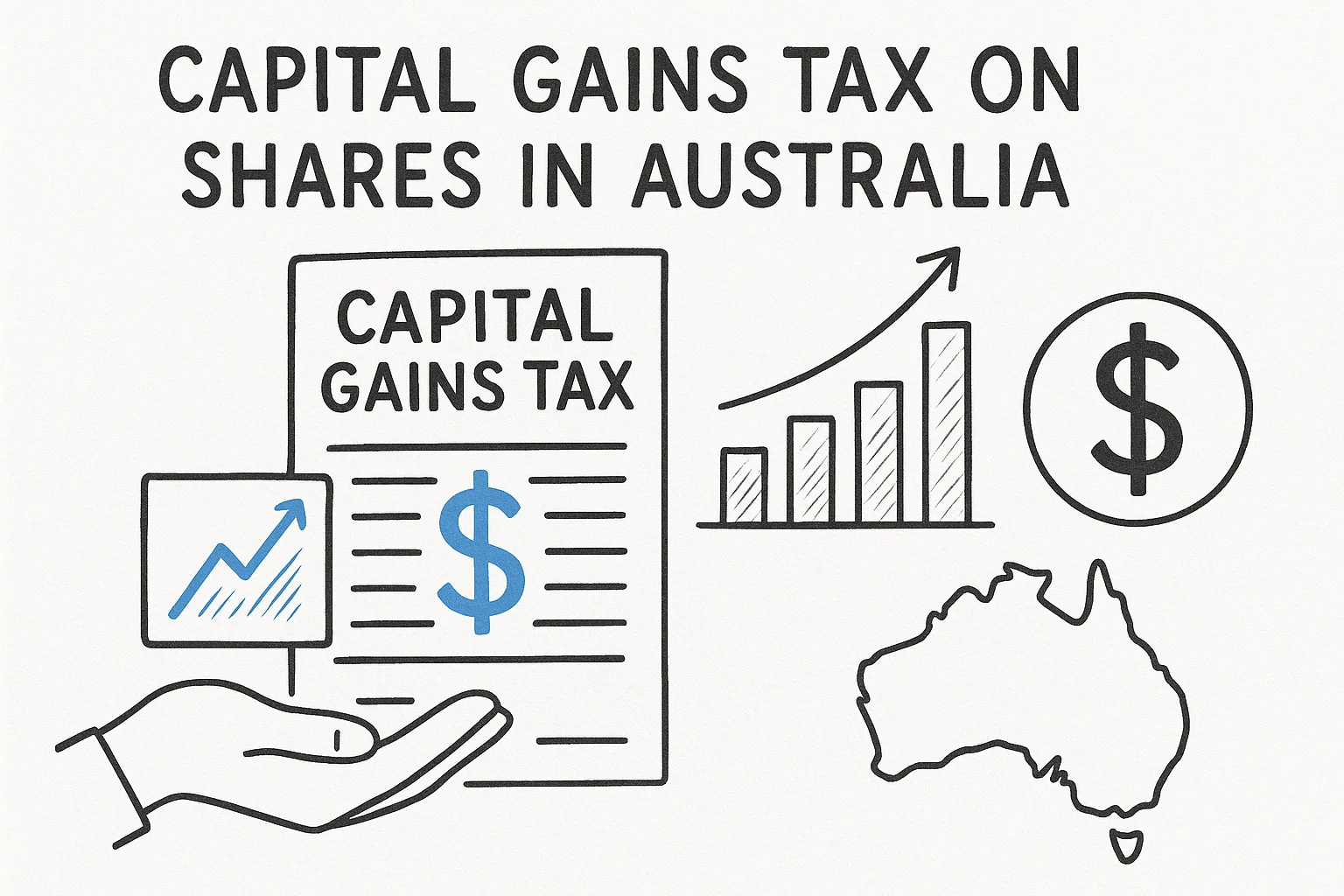
Capital Gains Tax on Shares in Australia: How It Works
Sell a parcel of shares at a profit and the tax office wants its share of the gain. That’s the reality of capital gains tax on shares Australia investors need to plan for, yet plenty of business owners and investors only think about it after the sale settles, when the options for managing the bill have already narrowed. Getting the timing wrong can mean handing over thousands more than necessary.
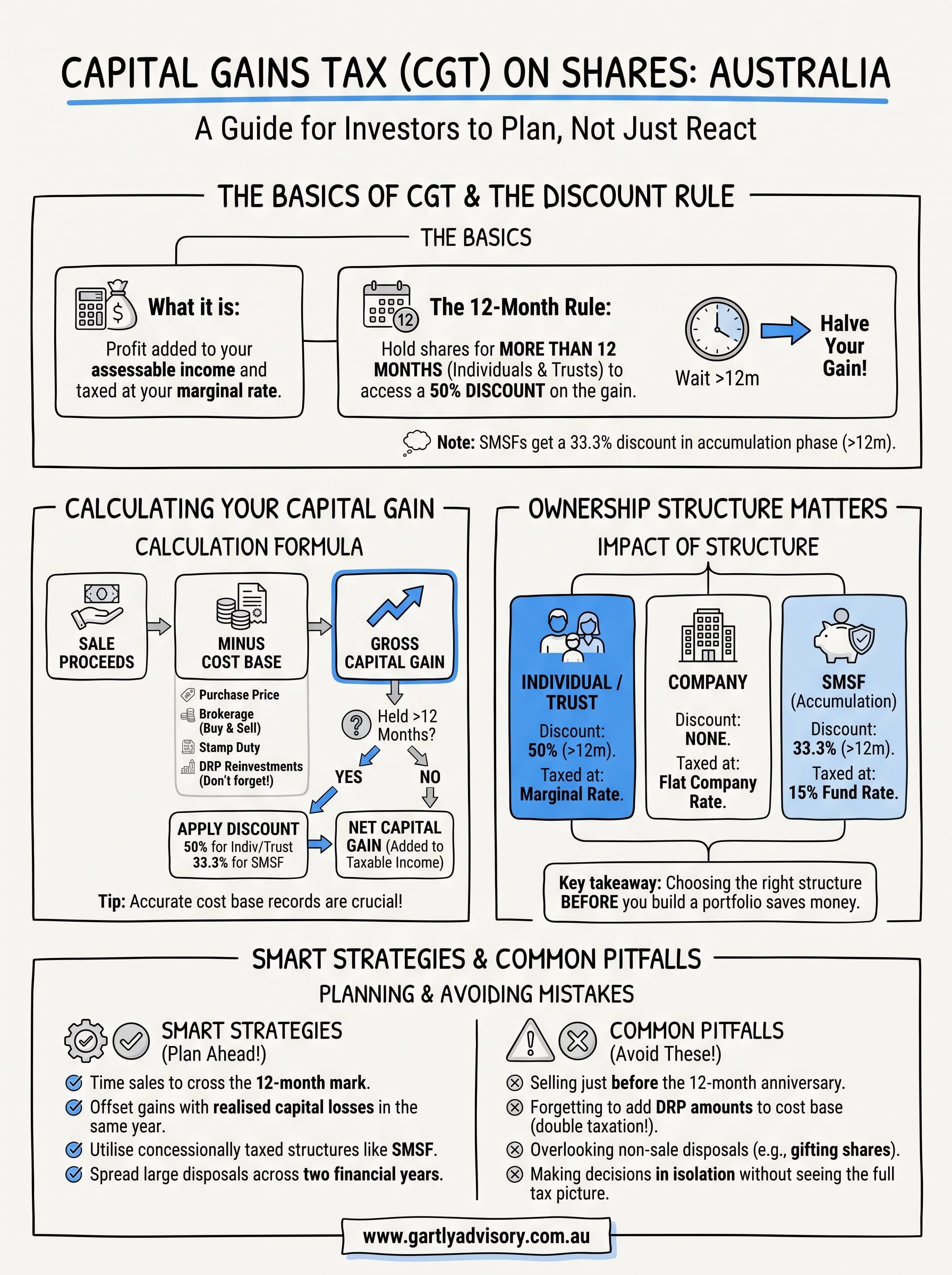
Capital gains tax isn’t a separate tax with its own rate. It’s your profit added to your assessable income and taxed at your marginal rate, though holding shares for more than twelve months can trigger a 50% discount on the gain. Understanding this mechanic, and when it applies, is the difference between an informed sale and an expensive surprise at tax time.
This article walks through how CGT is calculated on shares, the current rates and discounts, and how the ATO treats different scenarios like selling within a year, transferring shares, or holding through a company or trust. We’ll also cover practical strategies to reduce your liability, the kind of planning our team at Gartly Advisory works through with clients before they sell, not after.
Why capital gains tax matters for share investors
Many investors assume CGT only becomes relevant when they eventually sell a large parcel of shares for a windfall. That assumption costs people money. CGT applies to every disposal event, not just the obvious profitable sale of a blue-chip holding you’ve owned for a decade. Gifting shares to a family member, transferring them into a trust, using them to pay off a debt, or even a company being taken over and issuing you new shares in exchange can all trigger a capital gains event. If you’re not tracking these moments, you can end up with an unexpected tax bill months later when your accountant reconciles your share registry statements against your tax return.
It shapes decisions well before you sell
Beyond the disposal itself, CGT influences the timing and structure of everyday investment decisions. Deciding whether to sell shares in June or wait until July can shift your entire tax outcome into a different financial year, which matters if you’re expecting a lower income year ahead or trying to avoid pushing yourself into a higher tax bracket. Selling a losing parcel alongside a profitable one to offset the gain, known as tax-loss harvesting, only works if you understand how the ATO matches gains against losses. None of this is complicated once you know the rules, but it’s easy to get wrong when you’re making decisions in isolation without a full picture of your tax position for the year.
Ignore CGT until the sale is done and you’ve already lost your best chance to manage the bill.
The structure holding your shares changes everything
Where your shares sit, whether that’s in your own name, inside a company, through a family trust, or via a self-managed super fund, dramatically changes how much tax you’ll pay on the eventual gain. Individuals and trusts can access the 50% CGT discount after a twelve-month holding period. Companies cannot access this discount at all, and pay the flat company tax rate on the full gain regardless of how long the shares were held. SMSFs sit somewhere in between, with concessional treatment that makes them attractive for long-term share investors nearing retirement.
| Ownership structure | CGT discount available | Typical tax treatment |
|---|---|---|
| Individual | 50% after 12 months | Marginal tax rate on remaining gain |
| Company | None | Flat company tax rate on full gain |
| Trust | 50% after 12 months | Distributed to beneficiaries, taxed at their rates |
| SMSF (accumulation phase) | 33.3% after 12 months | 15% fund tax rate on remaining gain |
| SMSF (pension phase) | Not applicable | Generally tax-free |
Seeing the numbers laid out like this makes it obvious why so many of our clients at Gartly Advisory ask us for advice on choosing the right business structure before they start a serious share portfolio, not after they’ve already built one in the wrong entity.
Getting it wrong has real consequences
Overlooking a disposal event, misjudging your holding period, or forgetting to include reinvested dividends in your cost base are the kinds of mistakes that lead to amended assessments, penalties, and interest charges from the ATO. Property investors and business owners are often diligent about tracking capital gains on real estate, yet the same discipline doesn’t always carry over to share portfolios, particularly for people who trade regularly, which raises the separate question of whether you’re a share trader for tax purposes, or hold shares across multiple platforms and brokers. Understanding how CGT on shares works in Australia isn’t just about compliance. It’s about making sure the profit you’ve worked for actually stays in your pocket rather than disappearing into an avoidable tax bill.
How to calculate CGT on your shares
Working out a capital gains tax calculation for shares starts with a simple formula: sale proceeds minus your cost base equals your capital gain. From there, you apply any discount you’re entitled to, then add the resulting figure to your assessable income for the year. It sounds straightforward, but most of the mistakes we see at Gartly Advisory happen at the cost base step, where people forget what’s actually allowed to be included.
Work out your cost base
Your cost base isn’t just the purchase price. The ATO lets you include several costs that reduce your eventual gain, so it pays to keep every record from the day you buy the shares rather than relying on a capital gains valuation done retrospectively.
- The price you paid for the shares
- Brokerage fees on both the purchase and the sale
- Stamp duty, where it applies
- Costs of any share purchase plan participation, including employee shares and the tax that applies to them
- Dividend reinvestment plan (DRP) amounts, which increase your cost base each time a dividend is reinvested
Miss the DRP adjustments and you’ll overstate your gain, because you’re effectively paying tax twice on the same reinvested income. This is one of the most common errors we correct for clients who’ve held shares for years without professional oversight.
Apply the discount if you qualify
Once you know your raw gain, check your holding period. If you’ve held the shares for more than twelve months as an individual, trust, or in an SMSF’s accumulation phase, you apply the relevant discount before the gain is added to your taxable income. Sell within twelve months and the entire gain is taxed at your marginal rate with no discount at all, which is why the settlement date on a near-anniversary sale can be worth thousands.
A one-day difference in your holding period can be the difference between a 50% discount and none at all.
Include capital losses
Before you finalise the number, check whether you’ve realised any capital losses elsewhere in the same financial year, or carried forward losses from previous years. These get offset against your gain before the discount is applied, not after, which changes the outcome considerably. Losses can only offset capital gains, not your regular income, so they’re worth banking rather than ignoring if a parcel of shares has underperformed.
A worked example of CGT on a share sale
Numbers make this easier to grasp than formulas alone, so let’s run a real scenario through the process. Say you bought 2,000 shares in an ASX-listed company at $8.50 each, paid $55 in brokerage on the purchase, and sold the parcel three years later at $14.20 a share, paying $75 brokerage on the sale. Along the way, you received two dividend reinvestment plan allocations worth $340 in total, which get added to your cost base.
Setting up the numbers
Before calculating anything, lay out every figure you’ll need. This is where most errors creep in, usually because someone forgets the DRP amounts or the brokerage on one side of the trade.
| Item | Amount |
|---|---|
| Purchase price (2,000 x $8.50) | $17,000 |
| Brokerage on purchase | $55 |
| DRP reinvestments | $340 |
| Total cost base | $17,395 |
| Sale proceeds (2,000 x $14.20) | $28,400 |
| Brokerage on sale | $75 |
| Net sale proceeds | $28,325 |
Running the calculation
Subtract the cost base from the net sale proceeds and you get a raw capital gain of $10,930. Because the shares were held for three years, well past the twelve-month threshold, the 50% CGT discount applies, bringing the taxable gain down to $5,465. That figure gets added to your other assessable income for the year, and tax is calculated at your marginal rate on the combined total, not on the gain alone.
A discount only helps if your cost base is accurate, so sloppy record-keeping quietly costs you money before the discount even applies.
Assume this investor already earns $95,000 from their job. Adding $5,465 pushes their taxable income to $100,465, and the extra tax payable on that gain sits somewhere around $2,050 depending on their exact bracket and any Medicare levy adjustments. Compare that to selling one day before the twelve-month mark.
What changes without the discount
Selling those same shares at eleven months and twenty-nine days removes the discount entirely. The full $10,930 gain gets added to taxable income instead of half that amount, roughly doubling the tax payable on the sale to around $4,100 in this example. Waiting a single day cost this investor over $2,000 in avoidable tax, purely because the anniversary date wasn’t on their radar when they placed the sell order. This is exactly the kind of detail we flag for clients at Gartly Advisory before a sale settles, when there’s still time to adjust the timing.
Ways to legally reduce your CGT on shares
Reducing your CGT bill isn’t about clever loopholes, it’s about using the mechanisms the ATO already provides and planning your sales around them. Legitimate CGT minimisation strategies rely on timing, structure, and record-keeping rather than anything aggressive, much like the other legal ways to reduce tax in Australia, and most of them cost nothing to implement if you plan ahead of the sale rather than after it.
Time your sale around the discount threshold
Given how much the 50% discount is worth, as shown in the worked example above, checking your exact purchase settlement date before placing a sell order should be automatic. Delaying a sale by a few weeks to clear the twelve-month mark is the single easiest way to halve your taxable gain, yet it’s the strategy most commonly missed because investors focus on price movements rather than dates.
The cheapest tax strategy available to any shareholder is simply waiting until day 366.
Offset gains with losses in the same year
Pairing a profitable sale with a loss-making parcel you’ve been meaning to exit anyway can bring your net taxable gain down significantly, and any unused losses carry forward indefinitely to offset future gains. Realising a loss purely for tax purposes only makes sense if you’d have sold that parcel eventually anyway, so don’t let the tax tail wag the investment decision.
Use super and ownership structure deliberately
Superannuation, particularly through an SMSF with a specialist SMSF accountant behind it, offers concessional CGT treatment that individual ownership can’t match, with rates dropping further once a fund moves into pension phase. Structuring new share purchases through the right entity from day one, rather than restructuring an established portfolio later and triggering a fresh CGT event in the process, is where the real savings sit.
- Hold long-term parcels for over twelve months before selling
- Bank capital losses in the same year as a gain, not the year after
- Review whether super, a trust, or personal ownership suits new purchases
- Spread large disposals across two financial years to manage bracket creep
Spread large sales across financial years
Finally, splitting a substantial sale across two financial years rather than disposing of an entire holding in one transaction can keep you out of a higher tax bracket altogether. It’s a strategy our tax planning team at Gartly Advisory walks clients through well before settlement, because once the sale is done, this option disappears entirely.
Getting your share sale tax right
Capital gains tax on shares doesn’t have to be a surprise waiting for you at tax time. Once you understand the cost base rules, the twelve-month discount, and how your ownership structure shapes the outcome, you’re making informed decisions rather than reacting after the sale has already settled. Every example above shows the same pattern: the biggest savings come from planning before you sell, not from scrambling to fix things afterwards.
Getting this right consistently, across every parcel, every financial year, and every change in your circumstances, takes more than a once-off read of the rules. It takes someone checking your numbers before you place the sell order. If you’re planning a share sale, restructuring your portfolio, or simply want a second set of eyes on your cost base before tax time, talk to a trusted tax accountant in Melbourne and get it sorted properly the first time.