

Understanding and Improving Your Growth Profit Margin
For many ambitious Australian business owners, a rising revenue figure is a sign of success. But what happens when that growth doesn’t translate to a healthier bottom line? You might be celebrating new clients and larger sales, yet feeling a persistent worry that your profits aren’t keeping pace. This common challenge often points to a crucial, yet frequently overlooked, metric: the growth profit margin. It’s the key to understanding the true cost and profitability of your expansion efforts.
Navigating financial metrics can feel intimidating, but we’re here to provide clear guidance. In this article, we will walk you through how to calculate, interpret, and strategically improve this vital figure. You’ll gain the confidence to diagnose why profitability might be lagging and learn actionable steps to make smarter decisions, ensuring your growth journey is a truly successful one. Let us be your trusted partner in going beyond the numbers.
What is Growth Profit Margin? A Plain English Guide
As a business owner, it’s a familiar scenario: your sales reports show revenue climbing steadily, which should be cause for celebration. Yet, when you look at your bank account, the profit doesn’t seem to be keeping pace. This disconnect is a common challenge, and it highlights a crucial question: is your growth actually profitable? This is where understanding your growth profit margin becomes essential. It’s a powerful metric that measures the profitability of your new revenue, telling you precisely how much profit each additional dollar of sales is generating.
To grasp the foundational concept of profit margin, this short video offers a clear explanation:
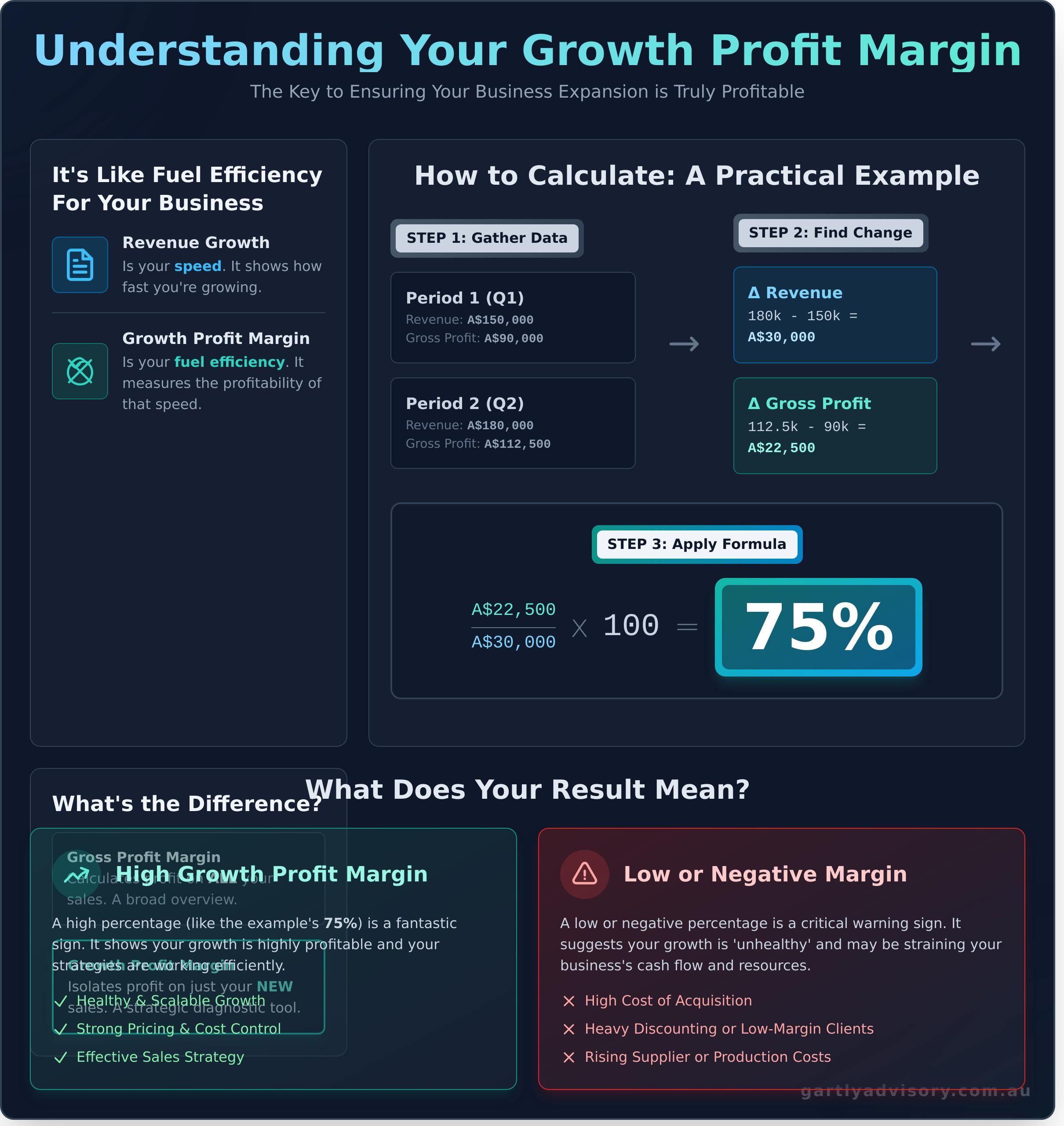
Think of your business as a high-performance car. Total revenue is your speed-how fast you’re going. But your growth profit margin is your fuel efficiency. It’s exciting to accelerate, but if you’re burning through fuel at an unsustainable rate to gain that speed, you won’t get very far. This metric ensures your engine for growth is running efficiently.
Why Revenue Growth Alone Can Be Misleading
Focusing solely on top-line revenue can mask serious underlying issues. High sales figures might be driven by strategies that actually harm your bottom line. For example, a business might achieve a A$100,000 revenue increase, but only after spending A$95,000 on aggressive marketing and deep discounts. While the revenue looks good on paper, the minimal profit gain doesn’t justify the cost and effort. Sustainable businesses, the kind we partner with our clients to build, focus on profitable revenue, not just growth for growth’s sake.
The Key Difference: Growth Profit vs. Gross Profit
It’s vital to distinguish between two related, but very different, metrics. Gross Profit Margin calculates the profit on all your sales, giving you a broad overview of your business’s overall profitability. For a foundational overview, you can explore this detailed explanation of What is Gross Margin?. In contrast, Growth Profit Margin specifically isolates the profitability of your new sales from one period to the next. This makes it an indispensable tool for strategic planning, as it tells you whether your growth strategies-be it a new product launch, a marketing campaign, or market expansion-are truly fuelling a healthier, more valuable business.
How to Calculate and Interpret Your Growth Profit Margin
Understanding the numbers behind your business growth is the first step toward making strategic, informed decisions. Calculating your growth profit margin is a straightforward process that provides powerful insights. It moves beyond simple revenue figures to reveal the true profitability of your expansion efforts. Let’s break down the calculation into simple, actionable steps.
Step 1: Gather Your Financial Data
To begin, you will need your Profit & Loss (P&L) statement. From this document, you must identify two key figures from two consecutive and consistent time periods (e.g., Quarter 1 vs. Quarter 2, or last financial year vs. this financial year).
- Revenue (or Sales): This is the total income generated from sales, typically found at the very top of your P&L statement.
- Gross Profit: This is your Revenue minus the Cost of Goods Sold (COGS). It represents the profit left over after accounting for the direct costs of producing your goods or services. For a detailed refresher, Investopedia offers an excellent guide on How to Calculate Gross Margin.
Step 2: A Practical Calculation Example
Let’s use a hypothetical Melbourne-based digital marketing agency, “Digital Bloom,” as our example. We will compare their performance from Q1 to Q2.
- Q1 Figures: Revenue = A$150,000; Gross Profit = A$90,000
- Q2 Figures: Revenue = A$180,000; Gross Profit = A$112,500
First, calculate the change in each metric:
Change in Revenue: A$180,000 – A$150,000 = A$30,000
Change in Gross Profit: A$112,500 – A$90,000 = A$22,500
Now, apply the formula:
(Change in Gross Profit / Change in Revenue) x 100
(A$22,500 / A$30,000) x 100 = 75%
Digital Bloom’s growth profit margin for this period is 75%.
What Does Your Result Actually Mean?
The percentage you calculate tells a compelling story about the quality of your growth. It reveals how much of each new dollar in revenue is converted into gross profit.
- A high percentage (like Digital Bloom’s 75%) is a fantastic sign. It indicates that your growth is highly profitable and scalable. Your pricing, cost control, and sales strategies are working in harmony.
- A low or negative percentage acts as a warning. It suggests you might be acquiring new revenue at a high cost, perhaps through heavy discounting, taking on low-margin clients, or facing rising supplier costs. This is ‘unhealthy’ growth that can strain your cash flow.
It’s important to note that a “good” margin varies by industry and business stage. A startup might accept a lower margin initially to capture market share, while a mature business should aim for stability and high profitability. As your trusted partner, we can provide the guidance to help you interpret these figures in the context of your unique journey.
Key Levers: What Drives Your Growth Profit Margin?
Understanding your business’s financial health is the first step toward improving it. Whether you’re a digital agency or a service provider like Chrisam Gardens Ltd, it is crucial to diagnose which areas have the most significant impact on your profitability. Think of this as a strategic check-up where we identify the core financial levers you can pull. Even small, carefully considered adjustments in these key areas can yield substantial improvements to your overall financial performance.
These levers directly influence the components of the growth profit margin calculation. By focusing on them, you gain precise control over the profitability of your expansion efforts. The three primary drivers are:
- Pricing Strategy and Product Mix
- Cost of Goods Sold (COGS)
- Customer Acquisition and Marketing Costs
Pricing Strategy and Product Mix
Your pricing has an immediate and direct effect on the gross profit generated from new sales. A modest price increase, if the market allows, flows straight to your bottom line. Equally important is your product or service mix. Actively promoting and selling more of your high-margin offerings over lower-margin ones can significantly lift your average profit per sale. While discounts can attract customers, relying on them too heavily will erode your margins and devalue your brand over time.
Cost of Goods Sold (COGS)
Cost of Goods Sold includes all the direct costs incurred in creating your products or delivering your services-think raw materials, direct labour, and manufacturing overheads. Any reduction in COGS directly increases the profit from each new customer. We can provide guidance on strategies to lower these costs, such as renegotiating terms with suppliers, optimising production processes to reduce waste, or finding more efficient operational methods. Managing COGS effectively is fundamental to protecting your profitability.
Customer Acquisition and Marketing Costs
This lever represents the total cost required to win new revenue. While investing in marketing is essential for growth, it is vital that this spending is efficient and profitable. Simply scaling your marketing budget without a corresponding increase in gross profit can quickly diminish your growth profit margin. As your trusted partner, we help you track the return on investment (ROI) for each marketing channel, ensuring every dollar spent is working hard to generate profitable growth for your business.
Actionable Strategies to Improve Your Growth Profit Margin
Understanding your numbers is the crucial first step; the next is taking decisive action. Improving your growth profit margin is not about drastic, reactive cost-cutting. It is about implementing smart, proactive strategies that build a more resilient and profitable business. By focusing on the key levers of your operations-pricing, efficiency, and marketing-you can drive sustainable improvements that strengthen your financial foundation.
Optimise Your Pricing and Service Offering
Your pricing structure is one of the most powerful tools for influencing profitability. A strategic approach ensures you are capturing the full value of your products or services. Consider these practical steps:
- Implement Tiered Pricing: Offer distinct packages (e.g., Basic, Standard, Premium) to cater to different customer budgets and needs, allowing you to upsell clients to higher-margin offerings.
- Focus on Profitable Services: Apply the 80/20 rule. Analyse which 20% of your services generate 80% of your profit and direct your sales and marketing efforts towards them.
- Consider Value-Based Pricing: Instead of billing based on cost or hours, price your services on the tangible results and value you deliver to your clients.
- Bundle Products or Services: Combine complementary offerings into a single, higher-value package to increase your average transaction value.
Enhance Operational and Supplier Efficiency
Efficiency gains in your daily operations translate directly to your bottom line. Small, consistent improvements can have a significant cumulative impact on your cost of goods sold and operating expenses.
- Review Supplier Agreements: Don’t let supplier relationships become stagnant. Regularly review terms and seek competitive quotes to ensure you are receiving the best possible value and pricing.
- Invest in Technology: Leverage software to automate repetitive tasks like invoicing, inventory management, or customer relationship management (CRM). This frees up valuable time and reduces manual labour costs.
- Streamline Workflows: Map your service delivery or production process from start to finish to identify and eliminate bottlenecks, redundant steps, and sources of waste.
Refine Your Sales and Marketing Approach
Acquiring new customers is essential, but optimising how you do it is critical for profitable growth. A refined approach ensures your marketing budget is working as hard as possible to attract the right kind of customer.
- Prioritise Customer Retention: It costs significantly less to retain an existing customer than to acquire a new one. Implement loyalty programs or proactive communication to build lasting relationships.
- Focus on High-ROI Channels: Analyse your marketing data. Double down on channels delivering a high return on investment and pull back from underperforming campaigns.
- Develop a Referral Program: Encourage your best customers to become advocates by creating a simple referral system that generates high-quality, low-cost leads.
Putting these strategies into practice requires careful planning and a deep understanding of your business’s unique position. If you need support in developing a robust strategy to improve your financial performance, we are here to provide expert guidance. Talk to a business advisor and let us be your trusted partner on the journey to greater profitability.
Beyond the Numbers: When to Seek Expert Guidance
Calculating and tracking your financial metrics is a crucial first step for any ambitious business owner. However, raw data-including your growth profit margin-is only a starting point. It can tell you what is happening in your business, but it often fails to explain why or what you should do next. This is where true strategic guidance becomes invaluable.
An objective, experienced perspective helps you move beyond simply recording numbers to using them to make intelligent, forward-thinking decisions. At Gartly Advisory, we have built our reputation on providing advice that goes beyond routine compliance, positioning ourselves as a trusted partner on your journey towards success.
Moving from Data to Strategic Decisions
A skilled advisor helps you understand the story behind your financial statements. We work with you to translate complex data into a clear narrative about your business’s health and potential. This proactive approach involves:
- Building robust financial models to forecast the impact of key decisions before you commit resources.
- Analysing your operational efficiency to identify opportunities for improving profitability.
- Setting realistic Key Performance Indicators (KPIs) to ensure your growth is sustainable and aligned with your long-term goals.
Building a Roadmap for Sustainable Profitability
Achieving a healthy growth profit margin isn’t a one-time fix; it requires a dedicated, long-term financial strategy. A proactive advisor provides the steady guidance needed to navigate the complexities of expansion. We offer essential support with critical areas such as cash flow management during demanding growth phases, as well as comprehensive assistance with budgeting, forecasting, and strategic planning to turn your vision into a financial reality.
Your numbers hold the key to a more profitable future. As your dedicated partner, we provide the guidance to unlock it. Let’s build your roadmap to success. Schedule a complimentary consultation.
Beyond the Numbers: Turning Your Growth Margin into a Success Story
Mastering your business’s financial health begins with understanding key metrics, and as we’ve explored, few are as insightful as your gross profit margin. This single figure tells a powerful story about your operational efficiency and the sustainability of your expansion. By focusing on strategic pricing, cost management, and operational improvements, you can directly influence this number and steer your business towards more profitable horizons.
However, interpreting the data and building a robust strategy to improve your growth profit margin can be a complex journey. That’s where expert guidance becomes invaluable. As Chartered Accountants and specialists in SME growth strategy, we bring over 35 years of experience to help businesses across Australia thrive. Our 70+ 5-Star Google Reviews reflect our commitment to being a trusted partner on your journey to success.
Ready to build a strategy for profitable growth? Schedule your complimentary consultation with Gartly Advisory today. Let us provide the support and advice you need to turn your financial goals into reality.
Frequently Asked Questions About Growth Profit Margin
What is the difference between gross profit margin and growth profit margin?
Gross profit margin measures the profitability of your total revenue within a specific period. In contrast, the growth profit margin isolates and measures the profitability of only your *new* revenue. It reveals how much profit each additional dollar of sales is contributing. Think of it as the difference between a snapshot of your overall financial health (gross margin) and a targeted measure of how healthy your expansion truly is.
How often should I calculate my business’s growth profit margin?
For most established Australian businesses, calculating your growth profit margin on a quarterly basis is a practical and effective approach. This aligns well with BAS reporting cycles and allows you to track meaningful trends. However, for fast-scaling companies or those in volatile markets, a monthly calculation provides more immediate feedback. The goal is to integrate this metric into your regular financial reviews to guide proactive, profitable decisions.
Can a business have high revenue growth but a negative growth profit margin?
Absolutely, and this scenario is a critical red flag. A business can boost revenue through aggressive discounting, entering low-margin markets, or incurring high costs to acquire new customers. This can lead to a negative growth profit margin, where every new dollar of revenue actually erodes your overall profit. It is a clear warning sign that the current growth strategy is unsustainable and requires immediate strategic review.
Are there typical industry benchmarks for growth profit margin?
While formal industry benchmarks are less common than for gross profit, the most important benchmark is an internal one. Ideally, your growth profit margin should be equal to or higher than your company’s overall gross profit margin. This demonstrates that your new business is more profitable than your existing business-a sign of healthy, scalable growth. A lower figure indicates that your expansion is diluting your company’s core profitability, which requires careful guidance.
How does focusing on growth profit margin affect my business’s cash flow?
This metric has a direct and powerful impact on your cash flow. A low or negative growth profit margin means you are spending more cash to acquire and service new revenue than the gross profit that revenue generates. This can create a severe cash crunch, even while top-line sales are increasing. Sustainable growth should fuel your cash reserves, not deplete them, making this a vital metric for financial stability.
What is the first step I should take if my growth profit margin is low?
If your analysis reveals a low growth profit margin, the essential first step is diagnosis. You must pinpoint the cause of the poor profitability. We guide our clients to carefully analyse the margins of new products, customer segments, or sales channels. Are new sales reliant on deep discounts? Have your input costs increased? Identifying the specific “why” is the critical foundation upon which a successful corrective strategy is built.
Related Posts