

What Is a Family Trust in Australia? A Plain English Guide
As your business thrives and your assets grow, you might find yourself facing a new set of challenges: how to protect your personal assets from business risks, manage a growing tax bill, and ensure your family’s future is secure. The world of finance is filled with complex jargon, and it’s easy to feel overwhelmed when planning for the long term. This is where a carefully structured family trust can become one of the most powerful tools in your financial strategy, offering both protection and peace of mind.
But what exactly is it, and how does it work here in Australia? In this plain English guide, we provide the clear, practical guidance you need. We will explore how this structure can help you safeguard the assets you’ve worked hard for, legally improve your family’s tax efficiency, and create a secure legacy for future generations. Let us support you in understanding if a family trust is the right strategy to secure your financial future and protect what matters most.
What is a Family Trust? The Key Roles Explained
Navigating the world of asset protection and wealth management can feel complex, but understanding key structures is the first step towards securing your family’s future. A family trust is a popular and effective legal structure in Australia designed to hold assets for the benefit of family members. Think of it like a secure box where you place valuable family assets-such as property, shares, or investments. This box is then managed by a trusted person for the people you want to support.
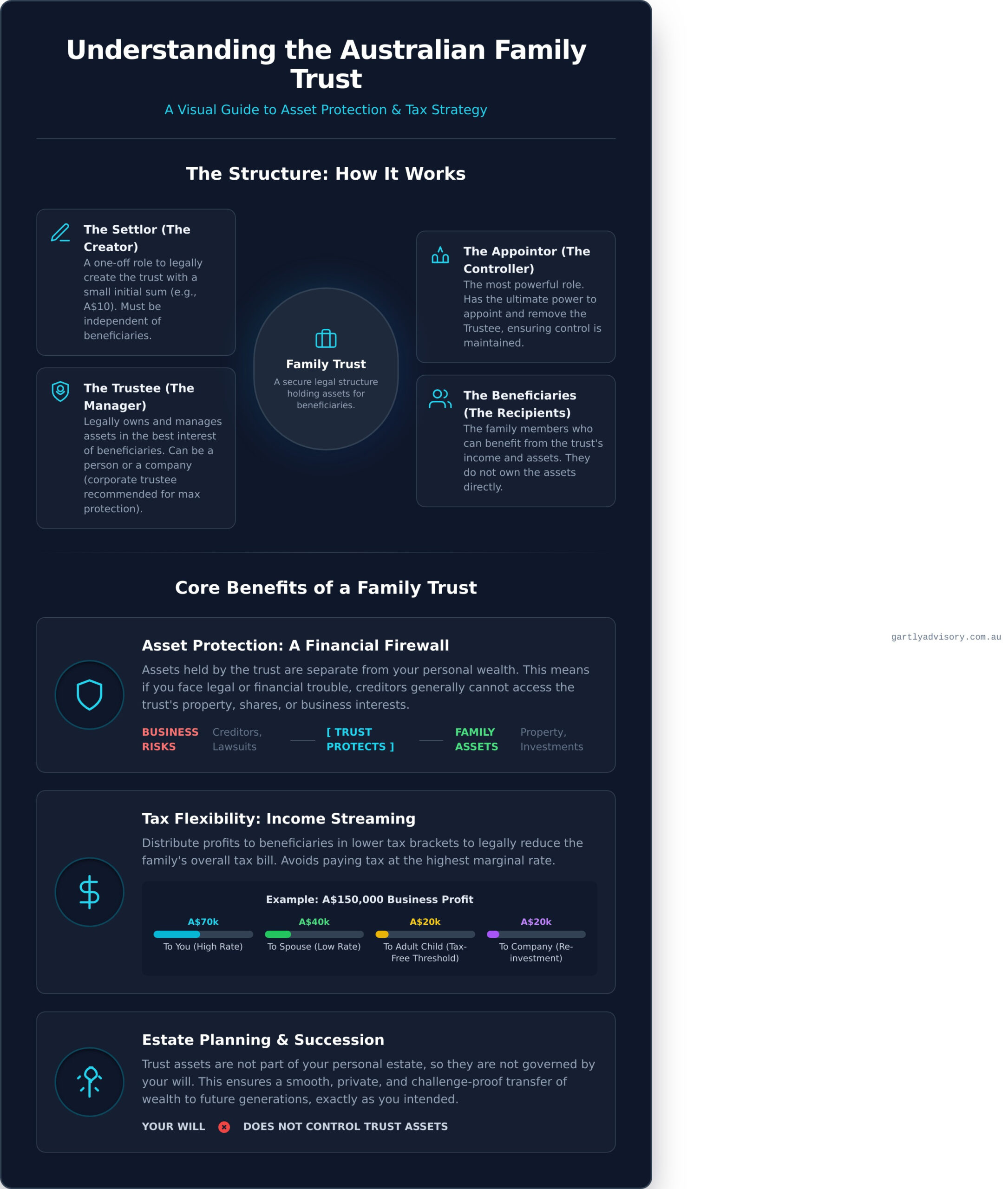
The core principle of a trust is the separation of legal ownership from beneficial ownership. This means the person or entity that legally owns and controls the assets (the Trustee) is distinct from the people who can benefit from them (the Beneficiaries). Because the trustee has the flexibility to decide how income and capital are distributed each year, it’s a type of ‘discretionary trust’. Understanding the basics of what is a trust provides a solid foundation for grasping how these powerful entities work. To make it clearer, let’s break down the four key roles involved.
The Settlor: The Person Who Starts the Trust
The Settlor is the individual who officially creates the trust. Their role is a one-off action: they provide a small initial sum of money (often as little as A$10), known as the “settled sum,” and sign the trust deed to bring it into legal existence. It is crucial that the Settlor is independent and not a beneficiary of the trust, as this can create tax complications. Once this is done, the Settlor typically has no further role.
The Trustee(s): The Legal Owner and Manager
The Trustee is the legal owner of the trust’s assets and is responsible for managing them according to the rules set out in the trust deed. This role can be held by one or more individuals or, more commonly, a company (a corporate trustee). The Trustee has a strict fiduciary duty to act in the best interests of all beneficiaries. They make all key decisions, including how to invest the trust’s assets and how to distribute any income or capital generated each financial year.
The Beneficiaries: The People Who Can Benefit
The Beneficiaries are the individuals or entities for whose benefit the trust was created. In a family trust, this is typically a wide group, including a primary individual, their spouse, children, grandchildren, and sometimes even extended family members, related companies, or charities. Importantly, beneficiaries do not have legal ownership of the trust assets. Instead, they have the right to be considered by the Trustee when income and capital are distributed.
The Appointor: The Person with Ultimate Control
While the Trustee manages the trust day-to-day, the Appointor holds the ultimate power. This person (or persons) has the authority to appoint and, crucially, remove the Trustee. This is the most powerful position within the trust structure, as it ensures the trust is always being managed by someone who aligns with the family’s long-term goals. The Appointor acts as the ultimate guardian, providing a vital layer of control and security.
The Core Benefits of a Family Trust for Asset Protection and Tax
A family trust is one of the most powerful structures available to Australian business owners and investors. When structured and managed correctly, it offers two primary advantages: robust asset protection and significant tax flexibility. These benefits work together to help you build and preserve wealth for the long term, forming a cornerstone of effective financial and estate planning. However, these advantages are only realised when the trust is managed with professional guidance.
Asset Protection: Building a Wall Around Your Wealth
Think of a trust as creating a financial firewall around your key assets. Because the trust legally owns the assets-such as property, shares, or business interests-they are held separately from your personal wealth. This separation means that if you or another beneficiary faced business failure, bankruptcy, or other legal claims, creditors generally cannot access the assets held within the trust. For the highest level of protection, appointing a corporate trustee (a company) is superior to an individual trustee, as it adds another layer of liability protection.
Tax Flexibility: Streaming Income Effectively
This is where a well-managed trust truly shines. The trustee has the discretion to distribute the trust’s income and capital gains to beneficiaries each financial year in the most tax-effective way. This is known as “income streaming.”
- Minimise your family’s overall tax: Instead of receiving all business profits at your high marginal tax rate, you could distribute a portion to a spouse with a lower income or an adult child at university, making use of their lower tax brackets.
- Access tax concessions: The trust can access the 50% Capital Gains Tax (CGT) discount for assets held for more than 12 months before distributing the gain to beneficiaries, which is vital for long-term investors.
Estate Planning and Succession
Assets held within a trust do not form part of your personal estate when you pass away. This means they are not governed by your will and are protected from the potential challenges or claims that can delay estate distribution. This provides certainty and a clear, private mechanism for passing wealth to the next generation. The ultimate control of the trust, held by the Appointor, can be passed on through your will, ensuring your legacy is managed exactly as you intended.
While the specifics of a family trust are unique to Australia, the core goal of securing one’s financial legacy is universal. For seniors approaching or in retirement, specialized guidance is often key to achieving this. In the Netherlands, for example, organizations like Senior Advies | Geeft financiële rust focus on providing exactly that kind of tailored financial planning, demonstrating a global need for such expertise.
How a Family Trust Works in Practice: A Simple Scenario
The concept of a trust can seem abstract, so let’s walk through a practical example. Meet David, a skilled tradesman who runs his own successful plumbing business. He has structured his business to be owned by a family trust, not by him personally. This simple decision provides significant flexibility and protection.
This financial year, David’s business has had a great run, generating a profit of A$150,000.
Step 1: The Trust Earns Income
The A$150,000 profit is earned by the trust, not David. As the trustee (or director of the corporate trustee), David has the legal responsibility to decide how to deal with this income before the end of the financial year on June 30. If the income is not distributed to beneficiaries, the trust itself must pay tax on it at the highest marginal rate, which is a situation every business owner wants to avoid.
Step 2: The Trustee Distributes the Income
To manage the tax liability effectively, David, acting as trustee, resolves to distribute the entire A$150,000 profit among the family members (the beneficiaries). He allocates it strategically based on their individual circumstances:
- A$60,000 to himself.
- A$50,000 to his wife, who works part-time and has a lower income.
- A$20,000 to their eldest child, who is 19 and at university.
- A$20,000 to their youngest child, who is 18 and also at university.
Step 3: The Family Pays Less Tax Overall
This is where the power of a family trust becomes clear. Instead of one person paying tax on a large income, four people pay tax on smaller, separate incomes. Each beneficiary is taxed at their own marginal rate, allowing the family to take advantage of multiple tax-free thresholds and lower tax brackets.
Let’s compare the outcomes (note: figures are illustrative):
- With the Trust: By splitting the income, the family’s total tax bill is approximately A$18,000.
- Without the Trust: If David had received the entire A$150,000 as personal income, his tax bill would have been around A$42,500.
By using the trust structure, David’s family has achieved a tax saving of over A$24,000 for the year. This money can be used to pay down their mortgage, invest for the future, or grow the business.
This strategy demonstrates how a trust can be a cornerstone of effective financial management for business owners. Could this proactive approach support your family’s financial goals? Book a consultation with us to find out.
Setting Up a Family Trust: Key Steps and Considerations
Establishing a family trust is a significant financial and legal decision that requires careful planning and expert advice. While the benefits are substantial, this is not a do-it-yourself task. Partnering with experienced professionals, including a lawyer and a Chartered Accountant, is crucial to ensure your trust is structured correctly, remains compliant, and effectively serves your family’s financial goals.
The process involves several key stages, each with important considerations. Understanding these steps will help you navigate the journey with confidence.
Drafting the Trust Deed
The trust deed is the foundational legal document of your trust-it is the official rulebook. This document must be professionally drafted by a qualified lawyer to be valid and robust. It meticulously outlines the powers and responsibilities of the trustee, identifies the potential beneficiaries, and sets the rules for how trust income and capital can be distributed. A well-drafted deed provides clarity and prevents future disputes.
Choosing a Trustee and Appointor
Making the right appointments is vital for the smooth operation and longevity of the trust.
- The Trustee: This is the legal owner of the trust’s assets, responsible for managing them on behalf of the beneficiaries. You can appoint an individual or a corporate trustee (a company). A corporate trustee is often recommended as it offers superior asset protection by separating the trust’s liabilities from your personal affairs and provides a clearer path for succession.
- The Appointor: This role holds the ultimate power-the ability to appoint and remove the trustee. This person should be chosen with extreme care, as they have ultimate control over the trust’s management.
Settling the Trust and Stamping
To bring the trust to life, a “settlor” (who cannot be a beneficiary) makes an initial small contribution, known as the “settled sum,” typically A$10. Once signed, the trust deed must be formally stamped by the relevant state or territory revenue office and the applicable duty paid. Finally, the trust must be registered with the Australian Taxation Office (ATO) to receive its own Tax File Number (TFN) and an Australian Business Number (ABN) if it will be conducting business.
Navigating these legal and financial requirements demands precision. As your trusted partner, we can provide the clear guidance needed to ensure your structure is sound from day one. Contact us to schedule a consultation and let us help you build a secure future for your family.
Risks and Responsibilities: Navigating ATO Scrutiny
While a family trust offers significant benefits for asset protection and tax planning, it comes with serious legal and financial responsibilities. These structures are a key focus area for the Australian Taxation Office (ATO), and non-compliance can lead to severe penalties. Proper administration isn’t just good practice; it’s essential for protecting your assets and ensuring the trust operates as intended. This is where ongoing professional guidance becomes invaluable, providing you with the support and expertise to remain compliant.
Understanding Section 100A and Unpaid Present Entitlements (UPEs)
The ATO is particularly focused on arrangements targeted by Section 100A of the tax act. This provision scrutinises situations where a trust distributes income to a beneficiary on paper-often one on a low tax rate-but someone else actually benefits from the funds. Any distribution must be genuinely paid or managed according to specific ATO rules regarding Unpaid Present Entitlements (UPEs). Getting this wrong can result in the trustee being taxed on that income at the highest marginal rate, completely negating any tax benefits.
The Importance of Good Record-Keeping
As a trustee, you have a legal duty to maintain meticulous records. This provides the ATO with clear evidence that the trust is being managed correctly and that all decisions are legitimate. Key responsibilities include:
- Annual Trustee Resolutions: Documenting how trust income will be distributed each year, which must be done before 30 June.
- Minutes of Meetings: Keeping records of all significant trustee decisions regarding investments and distributions.
- Separate Finances: Maintaining a dedicated bank account for the trust, completely separate from personal or business accounts, to avoid commingling funds.
Making a Family Trust Election (FTE)
A Family Trust Election (FTE) is a formal choice lodged with the ATO that defines the specific family group who can benefit from the trust. While making this election is optional, it is often necessary to access important tax concessions, such as the ability to carry forward tax losses or easily pass on franked credits from dividends. An FTE restricts who can receive distributions but provides crucial certainty for tax planning. Navigating these rules is a vital step for the long-term health of your structure. Let us help you navigate the complexities. Talk to our advisory team today.
Securing Your Family’s Future with the Right Structure
As we’ve explored, a family trust can be a powerful vehicle for protecting your assets and managing your family’s tax obligations effectively. By allowing for flexible income distribution to beneficiaries, it provides a strategic advantage for wealth management. However, it’s also a structure that comes with significant responsibilities and requires careful navigation to comply with ATO regulations.
Navigating this complexity is where expert guidance becomes invaluable. Making the right decision for your unique circumstances requires a deep understanding of both the opportunities and the risks. As Chartered Accountants with over 35 years of experience, we specialise in providing clear, proactive advice on business structuring and asset protection. Our reputation as a trusted partner for Melbourne business owners is reflected in our 70+ 5-star Google reviews.
Is a family trust right for you? Schedule a complimentary consultation with our experts.
Let us help you build a secure and prosperous future for your family.
Frequently Asked Questions About Family Trusts
How much does it cost to set up and run a family trust in Australia?
The initial setup cost for a professionally structured family trust, including drafting the trust deed and establishing a corporate trustee, typically ranges from A$1,500 to A$3,000. Ongoing annual costs are also a key consideration. These include accounting fees for preparing financial statements and a trust tax return, plus the annual ASIC review fee for the corporate trustee. You should budget for ongoing compliance costs of approximately A$1,000 to A$2,500+ per year, depending on the trust’s complexity.
Can a company be the trustee of a family trust?
Yes, and it is highly recommended. Appointing a corporate trustee (a company) offers significant advantages over an individual trustee. The primary benefits are superior asset protection, as the trust’s liabilities are separated from your personal assets, and simpler succession planning. The control of the trust can be passed on by changing the directors of the company, which is often a more straightforward process than changing the ownership of every trust asset if an individual trustee were used.
Can I use a family trust to buy a property?
Absolutely. Using a family trust to purchase property is a common and effective strategy for asset protection and tax planning in Australia. It helps to separate the investment property from your personal assets, shielding it from personal creditors. Furthermore, a trust provides flexibility in distributing rental income and capital gains among beneficiaries in a tax-effective manner each financial year. This can be a powerful tool for managing your family’s overall tax position while building wealth.
What happens to a family trust when someone dies?
A family trust does not automatically end when a person dies. The trust’s assets continue to be held for the beneficiaries. What happens next depends on the role the deceased person held. If they were the Appointor (the person with ultimate control), their will should name a successor to take over this vital role. If they were a trustee or a director of the corporate trustee, a replacement will be appointed according to the trust deed and company constitution.
How long does a family trust last?
In Australia, a family trust cannot last forever due to the “rule against perpetuities.” Most modern trust deeds specify a maximum lifespan, known as the vesting date, which is typically 80 years from the date the trust was established. On or before this date, the trust must be wound up, and all of its assets must be distributed to the beneficiaries. It is a crucial date to be aware of for long-term planning and asset succession.
What is the difference between a discretionary trust and a family trust?
In practice, there is very little difference; the terms are often used interchangeably. A “family trust” is simply the common name given to a discretionary trust that is established to benefit the members of a single family. The “discretionary” aspect refers to the trustee’s power to decide which beneficiaries receive income or capital from the trust each year, and in what amounts. This structure provides the flexibility that makes it so valuable for family wealth management and tax planning.
Can I add or remove beneficiaries from my family trust?
This is determined by the specific wording of your trust deed. Most modern deeds define beneficiaries very broadly (e.g., spouses, children, grandchildren, and even related companies), meaning new family members are automatically included without any changes. Removing a beneficiary is much more difficult and may not be possible unless the deed explicitly allows for it. It is critical to seek professional guidance before attempting to alter the class of beneficiaries to avoid unintended consequences.
Related Posts