

What Is a Small Business Advisor & Do You Need One? A Complete Guide
As a business owner, you are the CEO, marketing director, and head of finance, all rolled into one. Juggling every role is demanding, and it can feel isolating when critical decisions loom or your growth hits a plateau. If you’re making crucial choices in a vacuum or feeling overwhelmed by complex compliance, it’s a sign that you might need a different kind of support to move forward.
This is where professional small business advisors become an invaluable partner on your journey. They provide the strategic guidance and expert support needed to turn uncertainty into confidence and unlock new opportunities for sustainable growth. In this guide, we’ll explore the crucial role an advisor plays, from ensuring financial clarity to acting as a trusted sounding board for your ideas. You will learn exactly what an advisor does and how to find the right one to help you build a more resilient and successful business.
Key Takeaways
- Understand how a business advisor acts as a strategic partner, offering guidance on growth and profitability that goes far beyond tax compliance.
- Recognise the critical signs that your business is ready for professional guidance, allowing you to act proactively before challenges become crises.
- While your accountant is vital for compliance, small business advisors focus on future-proofing your strategy, helping you seize opportunities and navigate complex decisions.
- Discover the key factors to consider when choosing the right advisor, ensuring you find a trusted, long-term partner whose expertise aligns with your vision.
Beyond the Numbers: What Does a Small Business Advisor Actually Do?
Many business owners mistakenly believe an advisor’s role is limited to tax returns and bookkeeping. While those are important, they are fundamentally backward-looking tasks. True small business advisors act as your strategic partner, offering a forward-looking perspective to help you navigate challenges and seize opportunities. They go far beyond simple compliance, translating your financial data into an actionable strategy for growth. At its core, the role of a Business consultant in this capacity is to help you build a more resilient, profitable, and valuable business for the future.
To better understand this partnership, watch this helpful video on advice for business owners:
The Advisor as a Strategic Partner
A great advisor helps you look beyond daily operations to focus on the big picture. They provide the structure and guidance needed to turn your vision into reality. This strategic support includes:
- Helping you set clear, achievable long-term business goals.
- Assisting in the development of a strategic plan or business roadmap.
- Identifying opportunities for growth, expansion, or diversification in the Australian market.
- Providing accountability to keep you focused on your strategic objectives.
The Advisor as a Financial Guide
Your financial statements tell a story, and an advisor is the expert interpreter. They help you understand what the numbers truly mean for your business’s health and future. They provide practical guidance on:
- Analysing cash flow, profitability, and key performance indicators (KPIs).
- Optimising your pricing, cost management, and annual budgeting.
- Understanding the financial implications of major business decisions.
- Assisting with forecasting to prepare for future financial needs and investments.
The Advisor as an Objective Sounding Board
Running a business can be isolating. An advisor provides an unbiased, external perspective that is crucial for robust decision-making. They act as a confidential partner who can help you work on your business, not just in it. This means they will challenge your assumptions, offer fresh insights on persistent problems, and serve as a trusted confidant for sensitive matters, ensuring you always make choices with clarity and confidence.
Key Signs It’s Time to Partner with a Business Advisor
Consider this section a checklist for your business’s health and future. Too often, owners wait until a crisis hits before seeking guidance. But the most effective advice is proactive, not reactive. Engaging with an advisor is not an expense; it is a strategic investment in the growth, stability, and long-term value of your business. If you recognise your situation in the points below, it may be time to seek a trusted partner.
Your Growth Has Plateaued or Stalled
Are you working harder than ever, yet your revenue and profits remain flat? This is a classic sign that your current strategies have reached their limit. You may be unsure which new markets to enter or feel that competitors are innovating faster. An experienced advisor provides an objective, external perspective to identify operational bottlenecks, refine your strategy, and unlock the next lever for sustainable growth.
You’re Facing a Major Business Transition
Navigating a significant business event-such as a sale, acquisition, or merger-is complex and carries substantial risk. Perhaps you are preparing for retirement and need a robust succession plan, or you’re considering bringing on a major investor. These are high-stakes moments where a single misstep can have lasting consequences. Expert guidance ensures these transitions are managed smoothly and structured to your best advantage.
Financial Management Feels Overwhelming
A clear understanding of your financial position is non-negotiable for success. If you are struggling with unpredictable cash flow, have difficulty securing financing, or simply lack a clear picture of your profitability, it’s a critical red flag. Professional small business advisors bring clarity and control to your finances, helping you manage debt, improve cash flow, and use your financial data to make smarter, more confident decisions.
You Need a Stronger Support System
Running a business can be an isolating journey. You may lack a confidential sounding board for high-level strategy or need expertise in areas outside your own. A good advisor fills these gaps, acting as a partner who can challenge your assumptions and help you prepare for unforeseen risks. This need for guidance is universal, underscoring the value of a trusted external perspective to help business owners thrive.
If these challenges sound familiar, let’s talk.
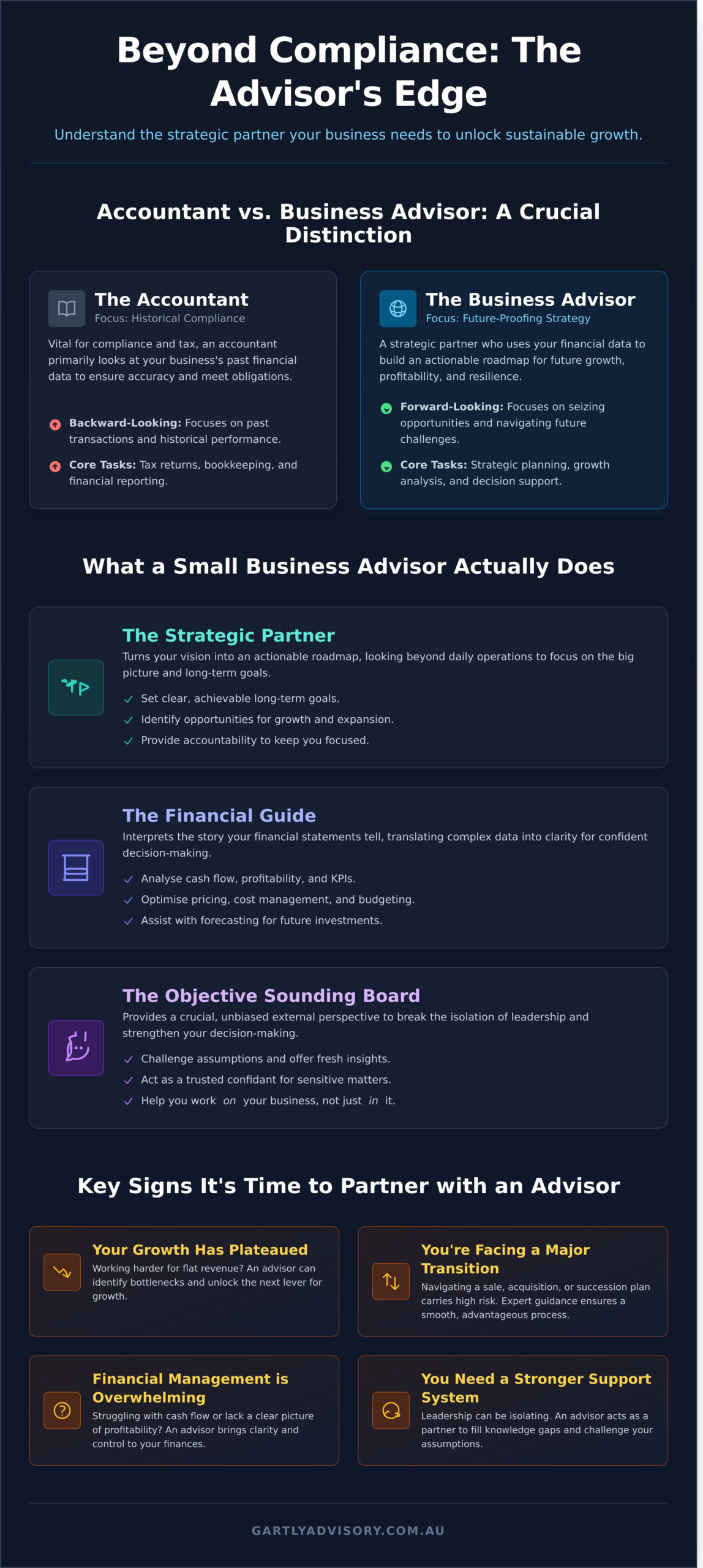
Accountant vs. Business Advisor: Understanding the Crucial Difference
For many business owners, the terms “accountant” and “business advisor” are used interchangeably. While one person can certainly be both, their core functions are fundamentally different. It’s a common misconception that can limit your business’s potential if not properly understood.
Think of it this way: a traditional accountant helps you look in the rearview mirror, ensuring everything that has already happened is accurately recorded and compliant. A business advisor, on the other hand, helps you look ahead through the windscreen, charting a course for where you want to go.
The Role of a Traditional Accountant
An accountant’s primary role is centred on historical financial data and compliance. They are the experts who ensure your business meets its legal and financial obligations. This is a crucial, non-negotiable function for any business.
- Prepares and lodges tax returns and Business Activity Statements (BAS).
- Creates essential financial reports like Profit & Loss statements.
- Ensures your records are compliant with the Australian Taxation Office (ATO).
- Manages bookkeeping and payroll to maintain accurate financial history.
The Role of a Business Advisor
Where an accountant’s work is reactive, the work of small business advisors is proactive. They use the financial data prepared by the accountant to provide forward-thinking guidance and strategic insight. Their goal is to partner with you to build a more profitable and sustainable future.
- Helps you set clear, achievable business goals and KPIs.
- Analyses financial performance to identify opportunities for growth and efficiency.
- Provides strategic advice on cash flow management, risk mitigation, and business structuring.
- Acts as a sounding board for major decisions, offering objective, data-driven support.
The Power of an Integrated Approach
The most powerful partnership is one where these two roles are seamlessly combined. A Chartered Accountant, with their deep and rigorous understanding of the financial engine of your business, makes an exceptional advisor. Their strategic advice isn’t based on theory; it’s grounded in the financial reality of your numbers.
This integrated approach means your compliance is handled flawlessly while your strategy for the future is built on a solid foundation. At Gartly Advisory, we pride ourselves on being more than just accountants; we are your trusted partners on the journey to success. We combine decades of compliance expertise with proactive, forward-thinking advice to help you solve problems and seize opportunities. Let us provide the guidance you need to look ahead with confidence. To learn more, visit gartlyadvisory.com.au.
How to Choose the Right Small Business Advisor in Melbourne
Engaging a small business advisor is one of the most significant investments you can make in your company’s future. This decision goes far beyond comparing prices; it’s about finding a long-term, trusted partner who is committed to your vision and growth. The right advisor provides not just financial guidance, but strategic foresight and unwavering support. To ensure you find the perfect fit for your Melbourne business, we recommend interviewing a few potential candidates using the following criteria.
Check Their Qualifications and Experience
Your first step is to verify their credentials and track record. Look for formal qualifications, such as being a Chartered Accountant (CA), which demonstrates a high level of professional expertise and ethical standards. A seasoned advisor has navigated a wide range of business challenges and economic conditions. Ask specifically about their experience with businesses of your size and in your industry, as this specialised knowledge can provide invaluable, practical insights.
Evaluate Their Approach and Communication Style
The right technical skills are essential, but a strong partnership relies on clear communication and a compatible approach. A great advisor listens first, seeking to understand your unique goals and concerns before offering solutions. Are they proactive with ideas to help you seize opportunities, or purely reactive? They should be able to explain complex financial matters in a way that you can easily understand, empowering you to make confident decisions for your business.
Look for Social Proof and Testimonials
A history of success is the best indicator of future performance. Before committing, look for genuine client reviews on platforms like Google to gauge their reputation in the community. Don’t hesitate to ask for case studies or speak with references from businesses similar to yours. Strong testimonials are proof that an advisor has a track record of delivering real, measurable value. See what our clients say about our partnership approach.
Utilise the Initial Consultation
Most reputable small business advisors offer a complimentary initial meeting, and this is your best opportunity to assess the fit. Prepare a list of questions about their process, fee structure, and what you can expect from working together. This meeting is a two-way interview; you are evaluating them, and they are learning about your business. You should leave the consultation feeling understood, confident, and with a clear sense of the path forward.
Take the Next Step on Your Business Journey
Navigating the complexities of running a business in Melbourne doesn’t have to be a solitary endeavour. As we’ve explored, the right advisor does more than just crunch numbers; they provide the strategic foresight needed to overcome obstacles, seize opportunities, and drive sustainable growth. Understanding the difference between an accountant and an advisor, and recognising the signs that you need help, are the first crucial steps toward unlocking your business’s true potential.
Ultimately, the best small business advisors become an extension of your team-a trusted partner committed to your vision. At Gartly Advisory, this is the core of our philosophy. As Chartered Accountants with over 35 years of experience and a reputation backed by 70+ 5-Star Google Reviews, we have earned our clients’ trust by providing proactive guidance that delivers real results.
If you’re ready to gain the clarity and support needed to achieve your goals, we invite you to take the next step. Schedule a complimentary consultation to discuss your business goals. Let us be your partner on the journey to success.
Frequently Asked Questions About Small Business Advisors
How much do small business advisors cost in Australia?
Costs vary based on experience and the scope of work. In Australia, hourly rates can range from A$150 to over A$500. Some advisors offer fixed-price packages for specific projects like business planning, while others work on a monthly retainer for ongoing support. It is essential to discuss the pricing structure upfront to find a solution that aligns with your budget and business goals, ensuring a clear return on your investment and providing you with trusted guidance.
What is the difference between a business coach and a business advisor?
While both roles aim to improve your business, their approach differs. A business coach often focuses on your mindset, accountability, and personal development as a leader. In contrast, a business advisor provides specific, expert-led strategic advice based on deep industry knowledge. They help you solve complex problems, analyse financial data, and develop tangible plans for growth, acting as a trusted partner with specialised expertise in areas like finance, operations, and market strategy.
At what stage of business should I hire an advisor?
You can benefit from an advisor at any stage of your business journey. Startups often seek guidance to validate their business model and create a solid foundation. Growing businesses need support to manage expansion, improve systems, and increase profitability. Even established businesses engage advisors to navigate challenges, plan for succession, or seize new market opportunities. The right time is when you recognise the need for external expertise to reach the next level of success.
Can a business advisor help my business secure funding or a loan?
Absolutely. A business advisor can be instrumental in preparing your business to secure funding. They help you refine your business plan, develop comprehensive financial projections, and ensure your financial records are in order. This professional preparation significantly increases your credibility with banks and investors. An experienced advisor can also provide guidance on the right type of funding to pursue and may even introduce you to their network of financial contacts, strengthening your application.
What information should I prepare for my first meeting with a business advisor?
To make your first meeting highly productive, come prepared with a clear overview of your business. This should include your business plan, recent financial statements like a Profit & Loss and Balance Sheet, and a summary of your key products or services. Most importantly, be ready to discuss your biggest challenges and your specific goals for the future. This information provides the necessary context for an advisor to offer meaningful, tailored advice from the very beginning.
Is my business too small to benefit from a business advisor?
No business is too small to benefit from expert guidance. In fact, engaging professional advisors early on can be one of the most effective investments you make. It helps you establish strong foundations, avoid common and costly pitfalls, and set a clear path for sustainable growth. A good advisor provides clarity and strategic direction, which is invaluable for sole traders and micro-businesses aiming to build a successful and resilient enterprise for the long term.
Related Posts