
GST Registration Guide: Who Needs to Register and How?
For many Australian small business owners, the excitement of a new venture is quickly met with a wave of questions about tax obligations. Terms like ‘GST turnover’ can seem complex, and the thought of making a mistake with the ATO is a common concern. This is especially true when it comes to deciding if and when you need to register for GST, a critical step that can feel both confusing and administratively daunting.
We believe that navigating your compliance duties should be straightforward, allowing you to focus on what you do best: growing your business. As a trusted partner in your journey towards success, we have created this guide to provide the clear support and guidance you need. We are here to help you solve problems and build your confidence in managing your financial responsibilities.
This comprehensive guide takes the guesswork out of your tax obligations. We’ll walk you through exactly who needs to register, demystify the key thresholds, and provide a simple, step-by-step process for getting it done right. You will also learn about the potential benefits of registering voluntarily, empowering you to make the best decision for your business with complete peace of mind.
What is GST and Who Needs to Register in Australia?
Navigating the world of business tax can feel complex, but understanding your Goods and Services Tax (GST) obligations is a fundamental step towards financial clarity. In simple terms, GST is a broad-based tax of 10% on most goods, services, and other items sold or consumed in Australia. It’s a core component of the system of Taxation in Australia, and knowing when to register is crucial for compliance. However, not every business is required to register from day one.
To help you grasp the registration process, this video provides a helpful overview:
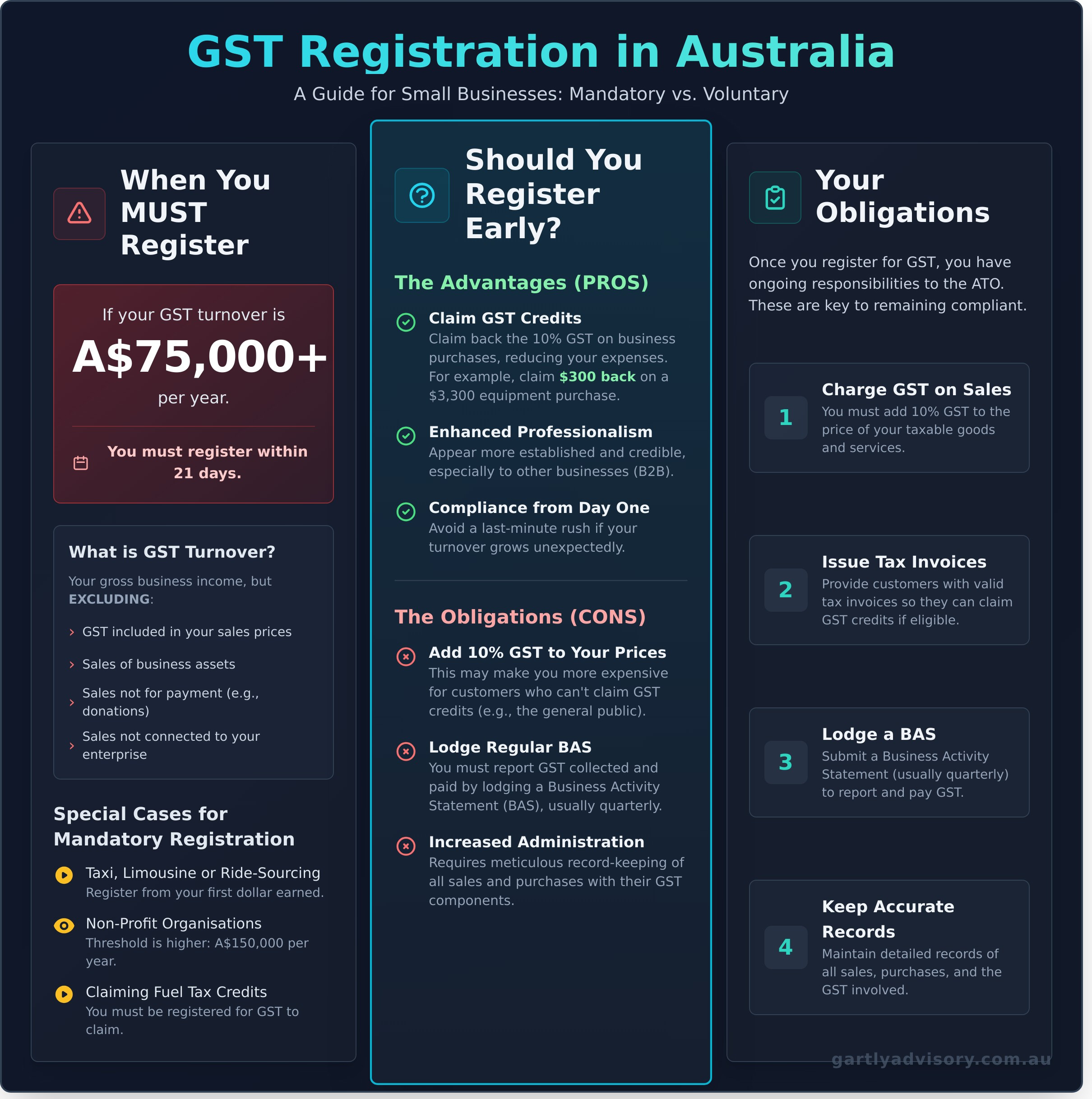
The decision to register for GST can be either mandatory or voluntary. The primary rule is clear: you must register within 21 days if your business has a GST turnover of A$75,000 or more. This isn’t just a suggestion; it’s a legal requirement designed to ensure fairness and consistency across the business landscape. Failing to register when required can lead to penalties, so it’s vital to monitor your turnover closely as your business grows.
Understanding the GST Turnover Threshold
Your ‘GST turnover’ is your gross business income (not your profit) from all your enterprises. It is important to calculate this figure correctly to determine if you need to register. This calculation includes total business income but excludes:
- GST included in the price of your sales
- Sales of business assets
- Sales that are not for payment (e.g., donations)
- Sales not connected to your enterprise
For example, a freelance graphic designer who invoices clients for A$80,000 in a financial year has met the threshold. Similarly, a retail business with A$100,000 in gross sales has also clearly met it.
Special Cases for Mandatory Registration
While the A$75,000 threshold applies to most businesses, some specific situations require immediate registration. It’s important to be aware of these exceptions to ensure you remain compliant from the start.
- Taxi, limousine, or ride-sourcing services: You must register for GST regardless of your turnover, from the very first dollar you earn.
- Non-profit organisations: The registration threshold is higher for non-profits, set at A$150,000 per year.
- Fuel Tax Credits: If your business needs to claim fuel tax credits for fuel used in machinery, equipment or heavy vehicles, you must be registered for GST to do so.
Voluntary GST Registration: Should You Register Early?
While GST registration is mandatory once your business reaches the $75,000 turnover threshold, any business in Australia can choose to register voluntarily before hitting that mark. Deciding to register for GST early is a significant strategic decision, not merely a compliance task. It has direct implications for your cash flow, pricing, and administrative workload. As your trusted partner, we believe in providing the clear guidance you need to weigh the benefits against the costs.
The Key Advantage: Claiming GST Credits
The primary benefit of registering for GST is the ability to claim GST credits, often called input tax credits. This allows you to claim back the GST included in the price of goods and services you purchase for your business, effectively reducing your operational expenses.
For example, if a new startup purchases essential office equipment for $3,300 (which includes $300 GST), a GST-registered business can claim that $300 back from the ATO. This credit then offsets the GST you collect from your own sales, lowering your final tax payment.
Other Potential Benefits of Registering
Beyond the direct financial advantage of GST credits, early registration can offer several other benefits to help position your business for success:
- Enhanced Professionalism: Being GST-registered can make your business appear more established and credible, which is particularly important when dealing with other businesses (B2B clients) who expect to receive a valid tax invoice.
- Compliance from Day One: Registering early ensures your systems are set up correctly from the beginning, helping you avoid a last-minute rush and potential compliance issues if your turnover grows faster than expected.
- Claiming on Second-Hand Goods: It allows you to claim GST credits on certain second-hand goods you purchase for the purpose of resale.
The Downsides and Obligations to Consider
It is crucial to understand that with the benefits come responsibilities. The administrative requirements are ongoing and require careful management.
- Regular BAS Lodgements: You will be required to lodge a Business Activity Statement (BAS) with the ATO, usually on a quarterly basis, to report the GST you have collected and paid.
- Pricing Impact: You must add 10% GST to your taxable sales. This could make your products or services more expensive for customers who are not registered for GST and cannot claim credits, such as the general public.
- Increased Administration: Meticulous record-keeping is non-negotiable. You must maintain accurate records of all sales and purchases, clearly identifying the GST components. The process for managing this starts with the official steps for Registering for GST as outlined by the ATO.
Before making a final decision, we recommend asking yourself these simple questions:
- Who are my primary customers-other businesses (B2B) or individual consumers (B2C)?
- Will I have significant, GST-inclusive startup costs or ongoing business expenses?
- Am I prepared for the administrative workload of regular BAS lodgements?
Answering these will help bring clarity to your decision. If you need support navigating this choice, our team is here to offer expert advice tailored to your unique business journey.
How to Register for GST: A Step-by-Step Guide
Navigating the GST registration process can feel complex, but with the right preparation, it is a straightforward step towards ensuring your business is compliant. The process itself is free when done directly through the Australian Taxation Office (ATO). The key to a smooth experience is having all your business information organised before you begin. This preparation will also help you make important decisions during the application, such as choosing the right accounting method (cash or accruals) for your circumstances.
Step 1: Gather Your Information
Before you start the application, having your details on hand will make the process much faster. We recommend preparing the following:
- Your Australian Business Number (ABN): This is essential for all tax registrations.
- Proof of Identity: You will need details from documents like your tax file number (TFN) or driver’s licence to verify your identity.
- Business Details: This includes your legal business name, structure (sole trader, company, trust), and primary business activities.
- Projected Turnover: Have a realistic estimate of your GST turnover for the next 12 months.
To access the ATO’s online services, you will need a myGovID linked to your ABN via the Relationship Authorisation Manager (RAM). This is the secure digital identity system used to access government services online on behalf of a business.
Step 2: Choose Your Registration Method
The ATO provides several ways to register for GST, allowing you to choose the method that best suits your needs. For a complete overview, you can always refer to the official Australian Taxation Office guide to GST registration. The most common options include:
- Method A: Online (Fastest): Using the ATO’s Online Services for Business is the most efficient way to register. The application is processed quickly, often providing instant confirmation.
- Method B: Through a Registered Agent (Easiest): Engaging a registered tax or BAS agent to manage the process for you provides peace of mind, ensuring all details are correct and deadlines are met.
- Method C: Phone or Paper (Less Common): These methods are available but are significantly slower and generally used only when online access is not possible.
Step 3: Completing the Registration
During the application, you will be asked to provide key details that determine your ongoing GST obligations. You’ll need to specify your desired GST registration start date, which can be backdated if necessary. You will also choose a reporting cycle-typically quarterly for most small businesses, but monthly or annually may be available depending on your turnover. Finally, you’ll select an accounting basis: cash (reporting GST on payments made and received) or accruals (reporting GST on invoices issued and bills received). Once submitted, the ATO will confirm your registration and provide your GST details.
If you prefer expert guidance to ensure every detail is handled correctly from the start, we are here to help. Let us handle your GST registration for a seamless, compliant start.
What Happens After You Register for GST? Your New Obligations
Congratulations on taking this significant step for your business. When you register for GST, you’re not just ticking a box for the ATO; you’re establishing a framework for professional financial management. These new obligations are more than just compliance tasks-they are the foundation of a transparent and scalable business. The key to managing them effectively is having a robust accounting system from day one.
Embracing these responsibilities with the right tools and support will set you on a path for sustainable growth. Here’s what you need to know.
Issuing Tax Invoices and Charging GST
Your primary new duty is to charge an additional 10% Goods and Services Tax (GST) on most of your sales. This must be clearly shown on a valid tax invoice for any sale over A$82.50 (including GST). An ATO-compliant tax invoice must include:
- The words ‘tax invoice’ stated clearly
- Your business name and ABN
- The date of issue
- A brief description of the items sold
- The GST amount (or a statement that the total price includes GST)
Lodging Your Business Activity Statement (BAS)
The Business Activity Statement (BAS) is the form you use to report and pay your GST obligations to the ATO. On your BAS, you report the total GST you have collected from your sales and claim credits for the GST you have paid on your business expenses. For most small businesses, this is done quarterly. Meeting your BAS lodgement and payment deadlines is crucial to avoid penalties and interest charges from the ATO.
Keeping Accurate Records
The ATO legally requires you to keep business records for at least five years. This isn’t just about compliance; accurate records give you a clear picture of your business’s financial health. You must keep copies of all tax invoices you issue and all receipts for expenses you claim GST credits on. Using cloud accounting software like Xero or MYOB is the most efficient way to automate this, ensuring your records are secure, accessible, and always up-to-date.
Navigating these ongoing GST requirements can feel daunting at first. At Gartly Advisory, we provide the expert guidance and support to make this process seamless. If you need a trusted partner to help manage your obligations, talk to us today.
Secure Your GST Compliance with a Trusted Partner
Understanding the $75,000 turnover threshold is the first critical step in your GST journey. While the process of registration is straightforward, the decision itself-whether mandatory or voluntary-carries significant implications for your cash flow and administrative workload. Remember, registering is not the final step; it marks the beginning of your ongoing GST obligations, such as lodging regular Business Activity Statements (BAS).
Navigating the decision to register for gst and managing your compliance can feel complex, but you don’t have to do it alone. As Chartered Accountants and specialists in small business tax, we have earned the trust of our clients for over 25 years. Our 70+ 5-Star Google Reviews are a testament to our commitment to providing clear guidance and proactive support.
Let our experienced team be your guide. Contact us to ensure your business is structured correctly and your GST registration is handled with professional care. We’re here to help you move forward with clarity and confidence.
Frequently Asked Questions
Can I backdate my GST registration?
Yes, the Australian Taxation Office (ATO) allows you to backdate your GST registration. This can be beneficial if you need to claim GST credits on significant purchases made before your registration date. However, it’s important to understand that backdating also creates an obligation to lodge Business Activity Statements (BAS) and pay any GST owed for that past period. We can provide guidance on whether this is the right strategy for your specific circumstances and help manage the process.
What happens if I fail to register for GST on time?
Failing to register for GST when you are legally required to can have serious consequences. The ATO may register you retrospectively from the date you were required to do so. This means you will be liable for 1/11th of your sales income as GST from that date, even if you didn’t include it in your prices. You may also face penalties and interest charges for late payment, making timely registration crucial for compliance and financial stability.
How long does the GST registration process take?
The process to register for GST is typically quite fast, especially when completed online. In most cases, the ATO processes applications within a few business days, and you will receive confirmation of your registration. Once processed, your Australian Business Number (ABN) record will be updated to show that you are registered for GST. If the ATO requires further information to verify your details, the process may take a little longer, but it is generally straightforward.
Do I need to charge GST to my overseas customers?
Generally, you do not need to charge GST on goods or services sold to customers outside of Australia. These sales are typically classified as ‘GST-free exports’. This means that while your customer doesn’t pay GST on the sale, you are still entitled to claim GST credits for the business expenses you incurred to make that sale. This is an important distinction that supports Australian businesses competing in the global marketplace, and we can provide advice on managing this correctly.
What is the difference between sales that are ‘GST-free’ and ‘input-taxed’?
While neither GST-free nor input-taxed sales include GST in the final price, there is a critical difference for your business. For GST-free sales (like basic foods or exports), you can claim GST credits on your related business purchases. For input-taxed sales (like residential rent or financial services), you cannot claim GST credits. Understanding this distinction is vital for accurate financial reporting and ensuring you claim all credits to which you are entitled.
Once I’m registered, can I ever cancel my GST registration?
Yes, you can cancel your GST registration under certain conditions. You are eligible to cancel if you have ceased operating your business or if your GST turnover falls below the A$75,000 threshold (and you don’t expect it to exceed it in the next 12 months). Before cancelling, you must ensure all your BAS obligations are up to date. It’s a significant step, so we recommend seeking professional advice to ensure it’s the right decision for your business journey.