
Asset Protection Strategies for Business Owners: Safeguarding Your Wealth in 2026
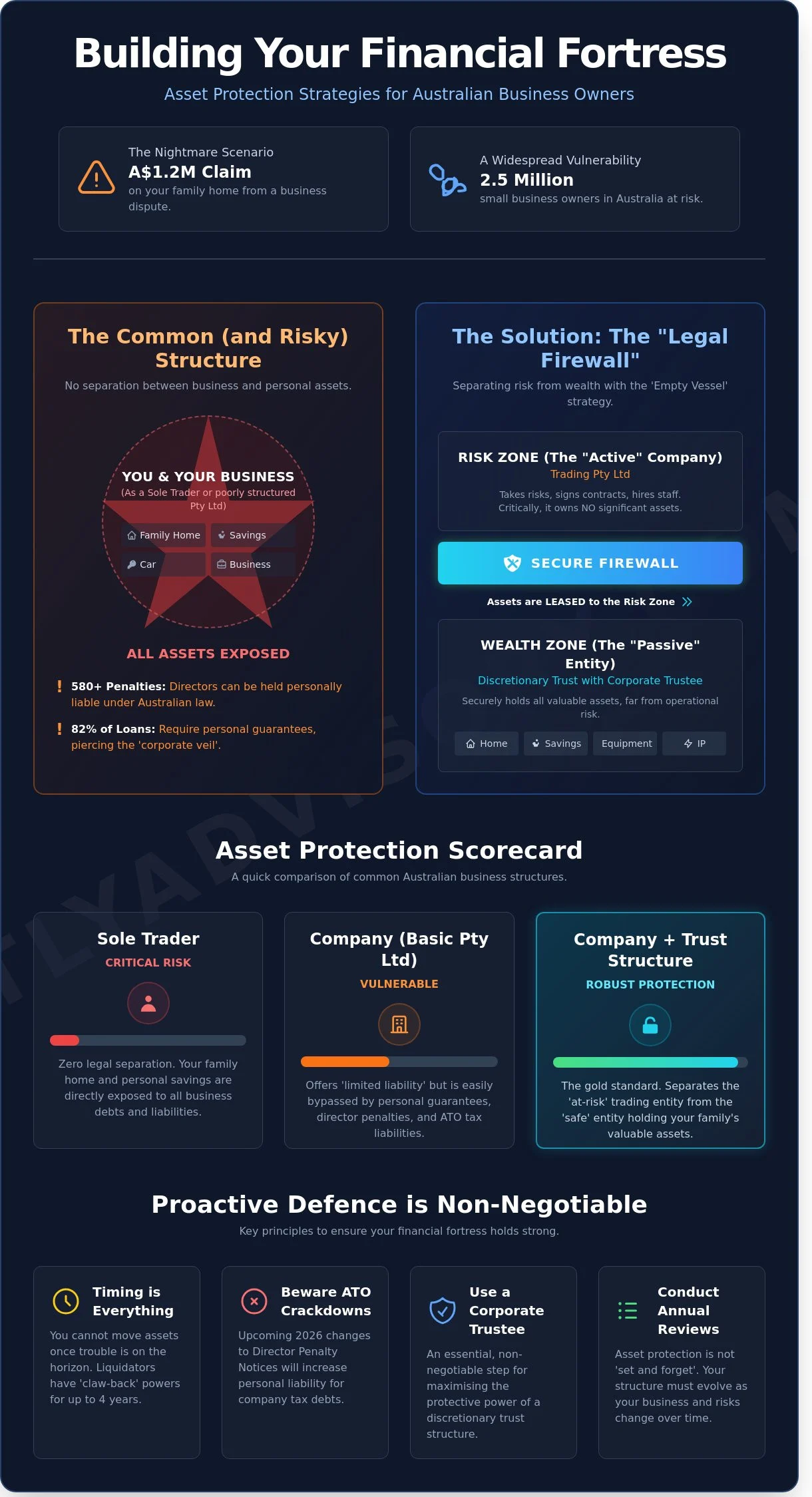
Imagine waking up to a legal notice that puts a A$1.2 million claim on your family home because of a contract dispute in your business you didn’t see coming. For the 2.5 million small business owners currently operating in Australia, this isn’t just a bad dream. It’s a structural vulnerability that keeps many directors awake at 3 am. You’ve spent years building your enterprise. However, without the right asset protection strategies for business owners, one litigious client or an unexpected downturn could wipe out your personal savings and the roof over your family’s head.
We understand that the complexity of choosing between a discretionary trust or a company structure feels overwhelming when you’re busy running a team. You shouldn’t have to risk your personal stability just to pursue your professional goals. We’ll show you how to build a clear moat between your business risks and your personal wealth using proven Australian legal structures and proactive accounting. We’ll preview the specific director liability shifts for 2026, the mechanics of separating at-risk assets, and how to ensure your wealth grows in a tax-efficient environment that protects your legacy for years to come.
Key Takeaways
- Learn how to build a “legal firewall” between your personal wealth and business liabilities by choosing the right Australian structure to act as your first line of defence.
- Discover the distinct advantages of Discretionary Trusts and Companies, and why using a Corporate Trustee is a non-negotiable step for securing your family’s future.
- Implement proactive asset protection strategies for business owners to safeguard yourself against the ATO’s 2026 crackdown on Director Penalty Notices and “locked-in” tax liabilities.
- Explore advanced wealth-moving tactics like the “Gift and Loan Back” strategy and learn how to navigate Division 7A to protect property without triggering tax traps.
- Understand why asset protection is a continuous journey that requires a supportive, proactive partner to conduct annual reviews and identify risks before they crystallise.
Understanding Asset Protection: Why Your Business Structure Is Your First Line of Defence
Asset protection isn’t about hiding money from the Australian Taxation Office or dodging legitimate debts. It’s the strategic, legal separation of your family’s wealth from your business’s potential liabilities. Think of it like a firebreak on a rural property. If a fire starts in your business “paddock,” it shouldn’t be able to jump the fence and burn down your family home. Understanding Asset Protection involves building these fences long before you ever smell smoke. It’s about ensuring that a single bad debt, a slip-and-fall lawsuit, or a contract dispute doesn’t wipe out the retirement savings you’ve spent 20 years building.
While this guide focuses on Australian financial structures, managing liability from incidents like personal injury claims requires its own specialized legal expertise. For instance, in the U.S., a firm like Oberg Law Office would be the go-to for navigating such a lawsuit, highlighting the importance of having the right legal partner for every type of risk.
To better understand how these protective layers work in practice, watch this helpful video:
In the current 2026 Australian market, where ASIC data shows small business insolvency rates have climbed by 14% since the previous year, timing is everything. You can’t wait until a creditor sends a formal letter of demand to start moving assets. Under the “Pre-existing Risk” rule, trying to shift property or cash once trouble is on the horizon is often viewed as a voidable transaction. Liquidators have the power to claw back these assets if they were moved within a specific period, which can be up to 4 years for certain transactions before a company collapses. Proactive planning is the only way to ensure your asset protection strategies for business owners actually hold up in court.
The Myth of the “Invincible” Pty Ltd Company
Many Australian entrepreneurs believe a Pty Ltd structure provides a bulletproof shield. It doesn’t. While “limited liability” is the standard, directors face 580 separate statutory penalties under Australian law that can lead to personal liability. If you sign a personal guarantee for a commercial lease or a bank loan, the corporate veil is effectively bypassed. In 2025, roughly 82% of small business bank loans in Victoria and NSW required a personal guarantee, meaning your family home is still on the line if the business fails. Being a sole trader is the highest-risk path, as no legal gap exists between your personal assets and business debts.
The Core Philosophy: Separating Risk from Wealth
The most effective asset protection strategies for business owners involve splitting entities into “Active” and “Passive” roles. Your trading entity should be an “Empty Vessel.” It signs the contracts, hires the 12 staff members, and takes the operational risks. However, it shouldn’t own the A$300,000 piece of specialized machinery or the valuable company trademarks. Those assets should stay in a separate passive holding entity or a family trust. By leasing the equipment back to the trading company, you ensure that if a lawsuit hits the trading arm, there are no significant assets for creditors to seize. This structure keeps your hard-earned wealth tucked away in a safe, separate vault, far from the daily risks of the marketplace.
The Best Business Structures for Asset Protection in Australia
Choosing the right legal framework is the first step in effective asset protection strategies for business owners. While a sole trader setup is simple to manage, it offers zero separation between your personal life and your business liabilities. To find the Best Business Structures for Asset Protection, you need to look at how different entities partition risk. In Australia, the most robust setups usually involve a combination of companies and trusts. These structures act as a firewall. They ensure that a lawsuit or a bad debt in the business doesn’t lead to the loss of your family home or personal savings.
Why a Corporate Trustee is Non-Negotiable
Using an individual as a trustee for your family trust is a common mistake that creates unnecessary risk. If a trust with an individual trustee is sued, that person’s name is on the legal documents. This potentially exposes their personal assets to the trust’s creditors. A corporate trustee is a private company whose sole purpose is to act as the trustee. You’ll pay an initial ASIC registration fee of A$576 and an annual review fee of A$310 as of July 2024. This is a small price for the safety it provides. The company holds the legal liability for the trust’s actions. This provides an essential layer of separation that keeps your name off the line for the trust’s debts.
The Role of Discretionary (Family) Trusts
A discretionary trust is a powerful tool because it separates legal ownership from the right to enjoy the assets. The trustee owns the assets, but the beneficiaries only have a “mere expectancy” of receiving anything until the trustee decides to distribute. This distinction is vital for long term safety. If a beneficiary faces personal bankruptcy, the trust assets generally remain out of reach for their creditors. The beneficiary doesn’t technically own the assets. You can find more detail on how these work in our Family Trust FAQ. These trusts also allow you to distribute income to family members in lower tax brackets. This helps build wealth faster while maintaining a high level of security.
Unit trusts work differently. They give beneficiaries a fixed interest in the trust’s assets, much like shares in a company. While this is useful for unrelated business partners, it offers less protection than a discretionary trust. If a unit holder is sued, their units are an asset that creditors can seize. For this reason, many families prefer the flexibility of a discretionary structure. It keeps the control in your hands without the vulnerability of fixed ownership.
For businesses generating high profits, a “holding company” or “bucket company” is often the smartest way to manage retained earnings. Instead of keeping large amounts of cash in an operating company that faces daily trading risks, you can distribute those profits to a separate entity. This second company holds the wealth safely away from potential litigation or insolvency issues affecting the trading arm. It is a fundamental part of sophisticated asset protection strategies for business owners who want to reinvest their success without overexposing themselves. If you’re unsure which path fits your specific goals, we can help you evaluate your current business structure to ensure it’s truly fit for purpose.
Managing Director Risk: Protecting Yourself from the ATO and ASIC
The landscape for Australian company directors has shifted significantly. In 2026, the Australian Taxation Office (ATO) has intensified its recovery efforts, issuing over 18,000 Director Penalty Notices (DPNs) in the first half of the year alone. This proactive stance means the corporate veil is thinner than ever. If your company falls behind on its obligations, your personal assets, including the family home and private savings, are directly in the firing line. Understanding how to manage these risks is one of the most critical asset protection strategies for business owners who want to sleep soundly at night, and expert guidance from firms like Gartly Advisory Pty Ltd can be invaluable.
The ATO categorizes director penalties into two distinct types: “non-locked-in” and “locked-in” penalties. If you lodge your Business Activity Statements (BAS) or Superannuation Guarantee Charge (SGC) statements within three months of their due date, the penalty is non-locked-in. This gives you a small window of safety. You can remit the penalty by paying the debt, appointing an administrator, or putting the company into liquidation. However, if you fail to lodge within that three-month window, the penalty becomes “locked-in.” At this point, even closing the company won’t save you. You become personally liable for the debt, and the ATO can use garnishee notices to take money directly from your personal bank account or even your salary from a new employer.
The Director Penalty Notice (DPN) Trap
A DPN is a formal document that makes a director personally liable for unpaid company PAYG withholding, GST, and superannuation if the debt isn’t resolved within a strict 21-calendar-day window. The ATO doesn’t need a court order to pierce the corporate veil for these specific tax debts; the notice itself creates the legal bridge to your personal wealth. When considering asset protection structuring strategies, compliance must be your first line of defense. If you receive a DPN, you must act instantly. You have exactly 21 days from the date printed on the letter, not the date you received it, to pay the debt or enter a formal insolvency process. Don’t let the letter sit on your desk for a week. Contact your advisor immediately to weigh your options before the clock runs out.
Avoiding Personal Guarantees and Indemnities
Many business owners unknowingly sign away their protection through personal guarantees in commercial leases or supplier credit applications. In 2025, data showed that 65% of small business liquidations involved at least one personal guarantee that resulted in the loss of personal property. You should always try to negotiate “limited” guarantees. For example, try to cap a landlord’s guarantee to six months of rent rather than the full term of the lease. You also need to be wary of “Shadow Directorships.” If you appoint a spouse as a director to hold assets while you make all the decisions, the law may still view you as a director. This means you both face the same risks from ASIC and the ATO, potentially doubling the threat to your family’s financial security. Keep your roles clear and your documentation precise to ensure your asset protection strategies for business owners actually work when tested.
Advanced Strategies: Moving Profits and Protecting Property
Effective asset protection strategies for business owners often involve moving wealth away from the “firing line” of daily operations. If your trading entity holds both your daily cash flow and your long-term wealth, you’re carrying unnecessary risk. We’ve spent 35 years helping clients separate these elements to ensure a single legal dispute doesn’t wipe out decades of hard work. One powerful method is the Gift and Loan Back strategy. This involves gifting the equity in your personal or business assets to a low-risk environment, like a family trust, which then loans the funds back to the business owner. You maintain control of the cash, but the trust becomes a secured creditor. This requires meticulous documentation; a handshake won’t satisfy a liquidator or the ATO. You must have formal loan agreements and, where applicable, registered security interests on the Personal Property Securities Register (PPSR).
Retained Profits and the Dividend Moat
Leaving large cash reserves in a trading company is like keeping your life savings in a cash register; it’s a sitting duck for creditors. We often recommend using a “bucket company” or a corporate beneficiary to act as a moat. By distributing profits to this second company, you cap your tax rate at 25% or 30% while physically moving the money out of the high-risk trading entity. This strategy isn’t without its hurdles. You must manage Division 7A risks carefully. If the trading company moves money to a bucket company but doesn’t actually pay the cash, the ATO may treat it as a “deemed dividend” unless a complying loan agreement is in place. These agreements typically require principal and interest repayments over 7 or 25 years. Failing to meet the June 30 deadline for these repayments can trigger significant tax penalties.
When you’re looking at the long-term horizon, these profit-moving strategies should align with your eventual exit. We suggest reviewing our Small Business CGT Concessions guide to see how your current structure impacts your tax bill when you finally sell. Proper planning now ensures you don’t just protect your profits, but you keep more of them when you transition out of the business.
Victorian Property and Land Tax Considerations
In Melbourne and across Victoria, asset protection often clashes with land tax obligations. Many business owners want to hold their business premises in a separate trust to keep it safe from trading risks. While this is a smart move for protection, Victoria’s land tax surcharges for trusts can be expensive. Since 2024, the COVID-19 debt repayment plan has added surcharges that impact many small business owners. For example, trusts often face a lower tax-free threshold of only A$25,000 compared to the A$50,000 threshold for individuals. You’re balancing the safety of your warehouse or office against a higher annual holding cost.
- The PPR Limit: Your Principal Place of Residence is usually exempt from land tax, but this exemption rarely extends to properties held in companies or certain trust structures.
- Entity Choice: Holding property in a separate “Prop Co” can provide a middle ground, offering protection while potentially accessing different tax treatments.
- Surcharge Rates: In Victoria, the trust surcharge can add 0.375% to your land tax bill, which adds up significantly on a A$2 million commercial warehouse.
Don’t let your property structure become a tax trap. If you’re unsure if your current setup is still the most cost-effective way to hold your business premises, talk to us and let us help you find the right balance between security and sustainability.
Implementing Your Strategy: The Gartly Advisory Approach
Effective asset protection strategies for business owners aren’t static documents you file away in a bottom drawer. We view protection as a continuous journey rather than a one-time destination. Our team at Gartly Advisory, backed by 35 years of experience, understands that your risk profile shifts as your business grows or as the Australian economic climate changes. An annual review is vital. It’s the only way to ensure your structures still serve their purpose as your personal wealth increases and your business liabilities evolve.
Proactive accounting serves as your early warning system. We don’t just look at the tax you owe; we look at where your risk sits. By identifying potential threats before they crystallise into legal issues, we can adjust your strategy while you still have the upper hand. This process involves a close collaboration with legal professionals. While we handle the financial structuring and tax implications, we work alongside trusted solicitors to ensure the legal “bricks and mortar” of your trusts and companies are impenetrable. This holistic approach ensures no gaps are left for creditors to exploit.
Beyond the Numbers: Proactive Risk Management
At Gartly Advisory, we act as a strategic partner to monitor your risk-to-wealth ratio. If your business holds A$500,000 in equipment but your personal home is worth A$2.5 million, the imbalance requires specific structural safeguards. We often recommend a “Clean-up” review for businesses that have operated for over 10 years. Many long-standing Victorian companies have messy historical structures that no longer comply with current standards. In 2022, we worked with a client facing a A$400,000 trade dispute. Because we had proactively moved their family home into a separate structure two years prior, their personal residence remained completely untouched during the settlement process. It’s about being ready before the storm hits.
Next Steps: Securing Your Legacy
Your asset protection plan must integrate seamlessly with your long-term goals. There is a powerful link between protecting what you have today and planning for who receives it tomorrow. This includes coordinating your business structures with your estate planning and your retirement vehicles. If you’re looking to gain more control over your retirement savings while keeping them protected, you should read our SMSF Guide for detailed insights. We help you ensure that your wealth isn’t just safe from creditors, but is also positioned to support your family for generations.
Before you finish this guide, take a moment to run through this final checklist. If you can’t confidently tick every box, it’s time to review your current exposure:
- Ownership Check: Is your family home held by the “at-risk” individual who signs business personal guarantees?
- Entity Separation: Are your high-value business assets (IP, plant, equipment) held in the same entity that signs customer contracts?
- Trust Deeds: Have your discretionary trust deeds been reviewed in the last 3 years to ensure they meet current ATO Section 100A requirements?
- Loan Accounts: Do you have “unpaid present entitlements” that could be classified as deemed dividends under Division 7A?
- Insurance Alignment: Does your professional indemnity insurance actually cover the specific risks identified in your asset protection plan?
Don’t wait for a legal claim or a business downturn to find out your assets are exposed. We invite you to take the first step toward peace of mind. Contact us today to schedule a complimentary consultation at our Ormond office. Let’s sit down, look beyond the numbers, and build a robust wall around your hard-earned wealth. We’re ready to be your trusted partner on your journey towards long-term success.
Secure Your Financial Legacy for 2026
Building a successful company takes years of grit, but a single legal dispute or tax oversight can jeopardize everything you’ve built. You now understand how a robust business structure serves as your primary shield and why staying proactive with ASIC and ATO compliance is vital for every director. Implementing these asset protection strategies for business owners is the most effective way to safeguard your family’s wealth as we approach 2026.
Gartly Advisory provides the calm competence you need to navigate these complexities. With over 35 years of chartered accounting experience and 70 5-star Google reviews, our Melbourne-based team specializes in SME advisory that goes beyond basic compliance. You don’t have to manage these risks alone; we’re here to be your trusted partner, ensuring your property and profits remain protected through every market shift. Talk to Gartly Advisory today to secure your business and personal future.
It’s time to stop worrying about the future and start building with total confidence. We’re ready to help you turn these strategies into a lasting foundation for your continued success.
Frequently Asked Questions
Can I move my assets into a trust if I am already being sued?
Moving your assets into a trust after legal action has commenced is generally ineffective and can lead to serious legal consequences. Under Section 121 of the Bankruptcy Act 1966, the courts have the power to void any transfer of property if the primary intent was to hide assets from creditors. If you’re already facing a statement of claim or a summons, a court-appointed trustee can “claw back” those assets for up to 4 or 5 years after the transfer occurred. This is why we emphasize the importance of setting up your structures during a period of “clear blue sky” when no known threats or litigation exist on the horizon. Trying to shift wealth while a process server is at your door is often viewed as a voidable transaction and won’t provide the shield you’re looking for.
Our team at Gartly Advisory works with you to build these protections proactively so they’re legally robust before any trouble starts. We’ve seen many business owners wait until a dispute arises, only to find their options are severely limited by anti-avoidance legislation. A proactive approach is the only way to ensure your family’s financial security is grounded in a stable, long-term strategy. We focus on giving advice beyond the numbers to ensure your entities are structured correctly from day one. This prevents the panic and legal vulnerability that comes from reactive, last-minute asset shifting. By acting now, you’re creating a legitimate barrier that respects Australian law while still securing your hard-earned equity for the future.
Does a Pty Ltd company protect my personal house?
A Proprietary Limited company provides a level of protection known as the corporate veil, but it’s not an absolute guarantee that your personal home is safe from business creditors. While the company is a separate legal entity responsible for its own debts, directors are often required to sign personal guarantees for commercial leases, bank loans, or trade credit over A$10,000. If your business fails to meet its obligations, these guarantees allow creditors to bypass the company and pursue your personal assets, including your family home. Furthermore, the Corporations Act 2001 contains provisions that make directors personally liable for insolvent trading if they continue to incur debt when the business can’t pay its bills. This means your house could still be at risk if the business isn’t managed with strict compliance.
To truly safeguard your residence, we often recommend that the “at-risk” director doesn’t hold the title to the family home in their own name. Implementing effective asset protection strategies for business owners involves separating the ownership of high-value assets from the individuals who are exposed to operational risks. We might suggest the home be held in the name of a “low-risk” spouse or a separate discretionary trust to create a clear legal boundary. This ensures that even if the corporate veil is pierced by a personal guarantee or a legal claim, your primary residence remains out of reach. It’s about being proactive and ensuring your home isn’t the collateral for your business’s daily risks. Let us help you review your current titles and loan documents to identify any hidden vulnerabilities before they become a problem.
What is a Director Penalty Notice and why should I worry about it?
A Director Penalty Notice (DPN) is a powerful tool used by the Australian Taxation Office (ATO) to make company directors personally liable for certain corporate tax debts. These notices specifically target unpaid Pay As You Go (PAYG) withholding, Goods and Services Tax (GST), and Superannuation Guarantee Charge (SGC) amounts. There are two distinct types of DPNs: “non-lockdown” and “lockdown” notices. A lockdown DPN is issued when a company fails to lodge its returns within 3 months of the due date. In this scenario, the penalty is permanent and you’re personally liable for the debt immediately with no way to remit the penalty other than full payment. This is a significant risk for any director because it strips away all corporate protections and puts your personal bank accounts and property in the ATO’s crosshairs.
You should worry about a DPN because the ATO has become increasingly aggressive in issuing these notices, with over 50,000 sent out in recent financial years. If you receive a non-lockdown DPN, you have a strict 21-day window from the date of the notice to take action. You must either pay the debt in full, appoint a small business restructurer, or place the company into voluntary administration or liquidation. If you miss this 21-day deadline by even 24 hours, the liability becomes personal and irreversible. This is why having a trusted partner to manage your compliance and reporting is essential for survival. We help you stay ahead of these deadlines so you never have to face the stress of a DPN landing in your mailbox. Our proactive guidance ensures your reporting is up to date, keeping your personal assets safe from automated ATO recovery actions.
Is a family trust better than a company for asset protection?
Neither structure is objectively “better” on its own; instead, they serve different, complementary roles within a comprehensive asset protection plan. A company is generally the best vehicle for trading and carrying out business operations because it caps the corporate tax rate at 25 percent for small businesses and limits liability for its shareholders. However, a family trust is often the superior choice for holding long-term investments or property because it offers more flexibility in distributing income to family members. Trusts also provide a 50 percent Capital Gains Tax discount that isn’t available to companies, which can save you hundreds of thousands of dollars when selling an asset. We often find that the most effective asset protection strategies for business owners involve a “dual structure” that utilizes both entities.
In this dual setup, the company takes on the daily risks of trading, hiring staff, and signing contracts, while the family trust holds the valuable assets like intellectual property or equipment. The trust then licenses these assets back to the company for a fee. This creates a firewall; if the trading company is sued or goes into liquidation, the valuable assets held in the trust are protected from the company’s creditors. This “separation of powers” is a hallmark of sophisticated financial planning. We work with you to determine the right balance based on your specific goals and risk profile. By looking beyond the numbers, we can design a structure that provides both tax efficiency and the highest level of protection for your family’s future wealth. It’s not about choosing one over the other, but about making them work together as a team.
How much does it cost to set up an asset protection structure in Australia?
The cost of establishing a professional asset protection structure in Australia typically ranges from A$3,500 for a simple setup to over A$15,000 for complex multi-entity groups. These costs include government registration fees, such as the A$597 ASIC fee for registering a new proprietary limited company as of July 2024. A standard discretionary family trust with a corporate trustee will usually cost between A$2,500 and A$4,000. This includes the legal drafting of the trust deed, the registration of the trustee company, and the necessary tax registrations like TFN and ABN. While you might find “off-the-shelf” documents for less, they often lack the specific clauses required to provide genuine protection during a legal challenge or an ATO audit.
Investing in a tailored structure is a small price to pay when you consider that a single legal dispute could put 100 percent of your assets at risk. We view these setup costs as a one-time insurance premium that secures your financial legacy. Beyond the initial setup, you should also budget for annual compliance costs, which include ASIC annual review fees and the preparation of separate tax returns for each entity. For a standard company and trust structure, annual accounting and compliance fees often sit between A$3,000 and A$6,000. Our team provides a clear, transparent quote before any work begins so you can plan your investment with confidence. We’re committed to being your partner on this journey, ensuring that every dollar you spend on your structure adds a measurable layer of security to your business life.
Can my spouse be held liable for my business debts?
Your spouse isn’t automatically liable for your business debts under Australian law, but there are several common scenarios where their assets could be at risk. If your spouse has signed a personal guarantee for a business loan or a commercial lease, they’re just as liable as you are for that specific debt. Additionally, if they’re a co-director of the company, they share the same legal responsibilities and risks, including potential Director Penalty Notices from the ATO. Another major risk occurs when the family home is held in joint names. If a creditor obtains a judgment against you personally, they can force the sale of the property to access your 50 percent share of the equity, which effectively displaces your spouse as well.
To prevent this, many business owners use the “Man of Straw and Woman of Substance” strategy, where the spouse with the highest business risk holds no significant assets in their name. The “low-risk” spouse holds the title to the family home and other long-term investments. However, you must be careful with Section 106 of the Family Law Act and various bankruptcy provisions that can reverse transfers made to a spouse if they were intended to defraud creditors. We help you navigate these complex rules to ensure your spouse’s financial position is protected legally and ethically. By proactively structuring your affairs, you can create a safe haven for your family’s wealth that remains untouched by the ups and downs of your business ventures. Our goal is to provide the guidance you need to keep your personal life and business risks separate.
Do I need to update my asset protection strategy every year?
You should review your asset protection strategy at least once every 12 months to ensure it still aligns with your business’s size and risk profile. A structure that worked perfectly when your turnover was A$400,000 might be dangerously inadequate once you’ve scaled to A$3 million or started hiring more employees. Changes in your personal life, such as getting married, having children, or purchasing new property, also necessitate an update to your strategy. Furthermore, the Australian legal and tax landscape is constantly shifting. For example, recent changes to Section 100A and Division 7A of the Income Tax Assessment Act have significantly impacted how trusts can distribute money, which might require a change in how your entities interact.
We recommend a formal strategy session during your annual tax planning in May or June. This allows us to look at the year ahead and identify any new risks, such as a major new contract or an expansion into a higher-risk industry. We also check if your current insurance policies, like Professional Indemnity or Public Liability, have kept pace with your business growth. If your assets have increased in value by more than 15 percent, your existing coverage might be insufficient. Being proactive with these reviews is the best way to ensure your shield stays strong. We don’t just file your tax returns; we act as your strategic partner to ensure your protection evolves as quickly as your business does. Regular updates prevent small gaps in your structure from turning into catastrophic failures during a crisis.
What happens to my business assets if I go through a divorce?
In the event of a divorce, business assets are usually treated as part of the “matrimonial pool” available for division, regardless of whose name is on the title or whether the assets are held in a trust. The Federal Circuit and Family Court of Australia has broad powers under the Family Law Act 1975 to look through complex structures like discretionary trusts. If the court determines that you have “de facto” control over the trust’s assets, they will treat those assets as your personal property for the purposes of the settlement. This can be devastating for a business, as it might force the sale of essential equipment or the liquidation of the company to pay out a former spouse’s share, which often ranges from 40 to 60 percent of the total pool.
To protect the continuity of your business, we work with you to implement safeguards like Shareholder Agreements or Binding Financial Agreements (BFAs) before a relationship breakdown occurs. These documents can pre-determine how the business will be valued and specify that any settlement must be paid out over time rather than in a lump sum that kills your cash flow. As a Business Valuebuilder Advisor, Geoff Gartly can help you understand the true market value of your business and how to ring-fence that value from personal disputes. We aim to ensure that your business remains a viable, ongoing entity regardless of changes in your personal circumstances. By having these difficult conversations early and setting up the right legal frameworks, you’re protecting not just yourself, but also your employees and the future of the company you’ve worked so hard to build.