
Business Budgeting and Forecasting Services: A Strategic Guide for Australian SMEs
With 2,729,648 actively trading businesses in Australia as of June 2025, staying ahead requires more than just hard work; it demands a clear view of the road ahead. You likely started your venture to build something meaningful, but now find yourself losing sleep over cash flow unpredictability or the 25% company tax rate for base rate entities. It’s frustrating when you’re too busy with daily operations to perform the deep financial analysis your growth deserves. We understand that managing business budgeting and forecasting services often feels like another chore on an endless to-do list, especially when you’re juggling bank covenants and ATO obligations.
It doesn’t have to be a source of anxiety. Professional budgeting and forecasting can transform your raw financial data into a proactive roadmap for stability and expansion. In this guide, we’ll show you how to move beyond manual spreadsheets to gain true financial clarity. We’ll explore how a trusted advisor acts as your co-pilot, helping you manage the 4.35% RBA cash rate and annual ASIC obligations while you focus on what you do best.
Key Takeaways
- Understand the vital difference between a static budget and a dynamic forecast to ensure your business remains agile in a shifting Australian economy.
- Discover how professional business budgeting and forecasting services turn your historical financial data into a proactive roadmap for sustainable growth.
- Learn to set realistic market assumptions by accounting for local drivers such as GST cycles, inflation, and changing labour costs.
- Gain insights into how a strategic advisory partner helps you look beyond the numbers to prepare for long-term goals like exit planning and business valuation.
The Difference Between Business Budgeting and Forecasting
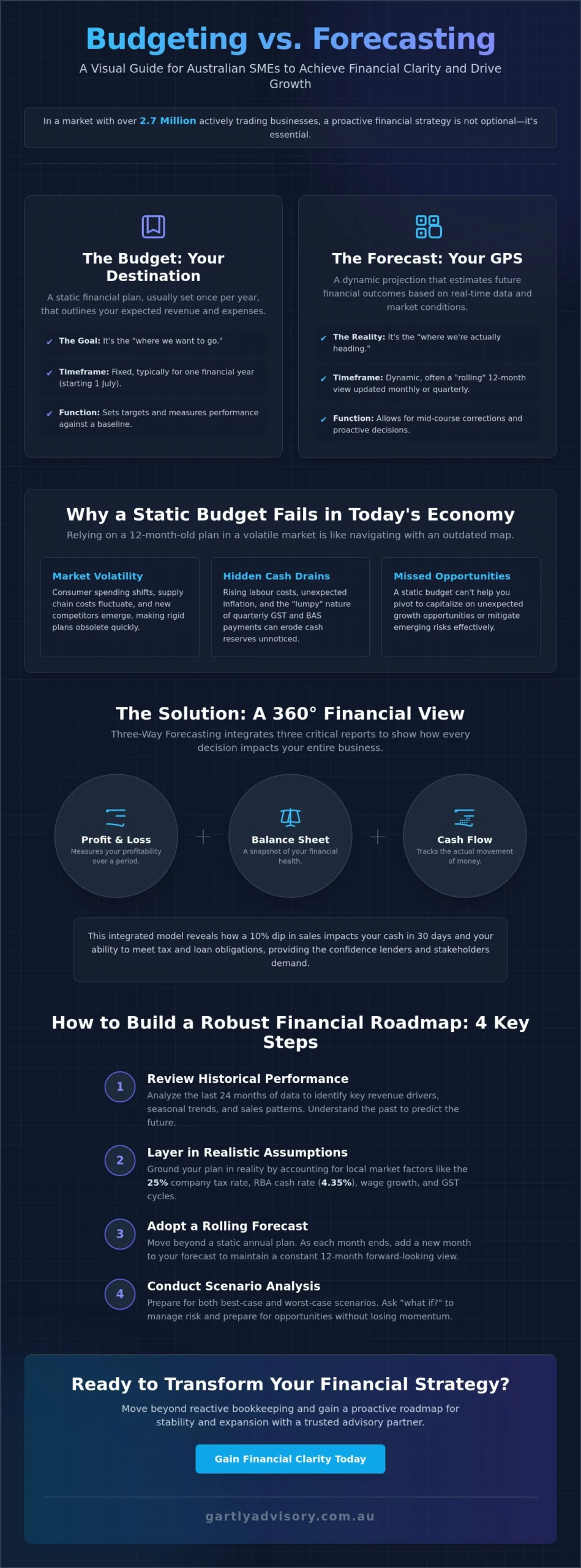
Many business owners use the terms “budgeting” and “forecasting” interchangeably, but they serve very different roles in your strategy. Think of your budget as the destination on a map; it’s the “where we want to go” for the financial year. It’s usually a static document, set before the new financial year begins on 1 July, outlining your expectations for revenue and expenses. On the other hand, a Financial forecast is your GPS. It’s a dynamic projection that looks at where you are actually heading based on real-time data and current market conditions. While the budget tells you where you intended to be, the forecast tells you if you’re actually going to get there.
Engaging professional business budgeting and forecasting services helps you bridge the gap between these two concepts. In an economy where the RBA cash rate sits at 4.35% as of May 2026, relying solely on a plan made twelve months ago is risky. Australian SMEs face constant shifts in consumer spending and supply chain costs. You need the budget to set your targets, but you need the forecast to make informed, mid-course corrections when the “real world” deviates from your original plan.
Why a Static Budget Isn’t Enough in 2026
Rigid annual budgets often fail because they don’t account for the volatility we see in the current market. With over 2.7 million actively trading businesses in Australia, competition is fierce and margins are under pressure. If you only look at your budget once a quarter, you might miss the fact that rising labour costs or shifts in GST cycles are eating your cash reserves. This is where we provide “advice beyond the numbers.” We don’t just tell you that you’ve overspent; we help you understand the “why” behind the variance. This proactive approach is a cornerstone of effective small business accounting, ensuring you stay ahead of the curve rather than reacting to problems after they’ve peaked.
The Power of Three-Way Forecasting
To get a truly clear picture, you need more than just a look at your bank balance. Three-way forecasting integrates your Profit and Loss, Balance Sheet, and Cash Flow into one cohesive model. It’s a vital tool because it shows how a sale today impacts your cash in thirty days and your tax obligations next quarter. Lenders and stakeholders in 2026 expect this level of detail. When you can show a bank exactly how you’ll meet your covenants even if sales dip by 10%, you build a level of trust that makes securing finance much smoother. It’s about seeing the full picture so you can lead with confidence.
How to Build a Robust Financial Roadmap for Your SME
Creating a financial roadmap isn’t about gazing into a crystal ball. It’s a structured process that turns your ambitions into a series of manageable, data-driven steps. To start, you must look back before you can look forward. Reviewing your historical performance from the last 24 months allows you to identify the key drivers of your revenue. Did your sales peak during specific seasonal windows, or was growth tied to a particular marketing campaign? Understanding these patterns is the first step in effective business budgeting and forecasting services.
Once you have a handle on your history, you need to layer in realistic assumptions for the Australian market. In 2026, this means accounting for a 2.7% wage growth and the 25% company tax rate for small businesses. You also have to consider the “lumpy” nature of cash flow caused by quarterly GST cycles and BAS obligations. By building these local economic realities into your plan, you ensure your roadmap is grounded in the actual environment where you operate. This level of detail is a major part of Financial Forecasting: Its Critical Role In Small-Business Success, as it prevents you from being blindsided by predictable costs.
A robust roadmap also requires agility. Instead of a “set and forget” annual budget, we recommend a rolling forecast. As each month ends, you add a new month to the end of your projection. This keeps your vision focused twelve months ahead at all times. Finally, always conduct scenario analysis. Ask yourself: “What happens if our main supplier raises prices by 10%?” or “What if sales grow 15% faster than expected?” Preparing for both the best and worst cases allows you to manage risk without losing your momentum.
Setting Meaningful KPIs for Growth
Identifying the right Key Performance Indicators (KPIs) is what separates a busy business from a profitable one. You need lead indicators that act as early warning signals for your revenue. If your number of new enquiries drops today, your revenue will likely dip in two months. Working with a specialist in business advisory Melbourne services helps you cut through the noise. We help you select the metrics that actually drive growth, ensuring you’re measuring what matters rather than just “vanity” numbers.
Leveraging Cloud Technology like Xero
Accuracy in forecasting is only possible if your data is current. This is why Xero accounting has become such a game changer for Australian SMEs. When your bank feeds are reconciled daily, your forecast reflects your actual cash position in real time. As your proactive partner, we help you set up this cloud ecosystem so you can stop guessing and start leading with confidence. If you’re ready to see what your financial future looks like, feel free to talk to us about a strategy session today.
Beyond the Numbers: The Value of a Strategic Advisory Partner
Numbers tell a story, but you need an experienced translator to turn those digits into a competitive advantage. Our business budgeting and forecasting services go beyond simple data entry; they provide the “advice beyond the numbers” that helps you sleep better at night. While the Australian government’s guide to budgeting offers a solid foundation for any SME, a strategic partner acts as your co-pilot. Whether you’re operating in the heart of Melbourne, the busy streets of Sydney, or the growing Gold Coast market, having a safe pair of hands to interpret your financial trajectory is invaluable.
This partnership becomes critical when you look at the long-term horizon. If you’re considering an exit strategy or need a business valuation, a history of accurate forecasting is your best asset. Potential buyers or investors don’t just look at what you’ve done; they want proof of what you’ll do next. By demonstrating a consistent ability to meet or exceed your projections, you build immense trust and significantly increase the value of your enterprise. It’s about proving that your success is a planned outcome, not just a stroke of luck.
Navigating Complex Business Matters with Confidence
Running a business involves more than just making sales. You have to manage ATO payment plans, meet bank covenants, and stay on top of ever-changing tax obligations. When you have a dynamic forecast, you can see a potential cash squeeze months before it happens. This allows you to negotiate with the ATO or your bank from a position of strength and transparency. Instead of reacting with panic, you’re leading with data. It’s this proactive approach that has helped us build 25 years of trust with our clients, providing them with the stability they need to grow their dreams.
Finding the Right Partner for Your Journey
Choosing who to trust with your financial future is a major decision. You aren’t just looking for someone to lodge forms; you’re looking for a mentor with deep expertise. When deciding on a tax agent or business advisor, look for a track record of longevity and personal commitment. With over 35 years of experience, we’ve seen every market cycle and helped thousands of SMEs find their way. We love the opportunity to support our clients through the “complex world of business matters,” acting as the supportive partner you need on your journey towards success.
Take the Next Step Toward Financial Clarity
Navigating the Australian business landscape requires more than just keeping your head down; it requires looking ahead with confidence. By distinguishing between your static budget and a dynamic forecast, you gain the agility needed to handle shifting costs and tax obligations. Integrating your cash flow and balance sheet into a three-way model ensures you always have the full picture for lenders and stakeholders. Effective business budgeting and forecasting services aren’t just about spreadsheets; they’re about creating a clear roadmap for your business’s stability and growth.
As Chartered Accountants with 35 years of experience and 70+ 5-star Google reviews, we’ve spent decades acting as a safe pair of hands for SMEs. We’re here to provide the advice beyond the numbers that helps you seize new opportunities and protect your margins. Talk to us and let us help you build a proactive financial roadmap today. Let us be your trusted partner on your journey towards success. We’re ready to help you turn your financial data into your greatest asset.
Frequently Asked Questions
What is the difference between a budget and a forecast?
A budget is your fixed financial target for the year, while a forecast is a live projection that updates as market conditions change. Using professional business budgeting and forecasting services ensures your budget is finalised before the new financial year starts on 1 July. In contrast, the forecast reacts to real-time shifts like the 4.35% RBA cash rate. It’s this flexibility that allows you to adjust your pricing strategy before a small variance becomes a major cash flow hurdle.
How often should my business update its financial forecast?
You should ideally update your financial forecast on a monthly basis to maintain a rolling twelve-month view of your operations. With 2,729,648 actively trading businesses in Australia as of 2025, the market moves quickly. Monthly updates help you stay proactive rather than reactive. This rhythm ensures you can identify margin pressure or unexpected labour cost increases early, giving you the time needed to pivot your strategy effectively and keep your growth on track.
Do I need professional help if I already use Xero or MYOB?
Software like Xero provides the raw data, but business budgeting and forecasting services offer the strategic interpretation needed to turn that data into a roadmap. While cloud tools automate bookkeeping, they don’t provide “advice beyond the numbers.” An experienced advisor helps you understand how specific variables, such as the 25% small business tax rate, will impact your long-term growth goals or your ability to fund a new project without risking your stability.
What is three-way forecasting and why is it important for SMEs?
Three-way forecasting is a method that integrates your Profit and Loss, Balance Sheet, and Cash Flow into one cohesive model. It’s essential for SMEs because it shows the “full picture” of your financial health. Lenders often require this level of detail to ensure you can meet bank covenants. It tracks how a single transaction moves through your entire system, accounting for GST cycles and future tax obligations, so you aren’t blindsided by hidden costs.