
Is Hiring a Business Advisor Worth It? A Guide for Ambitious Australian SMEs
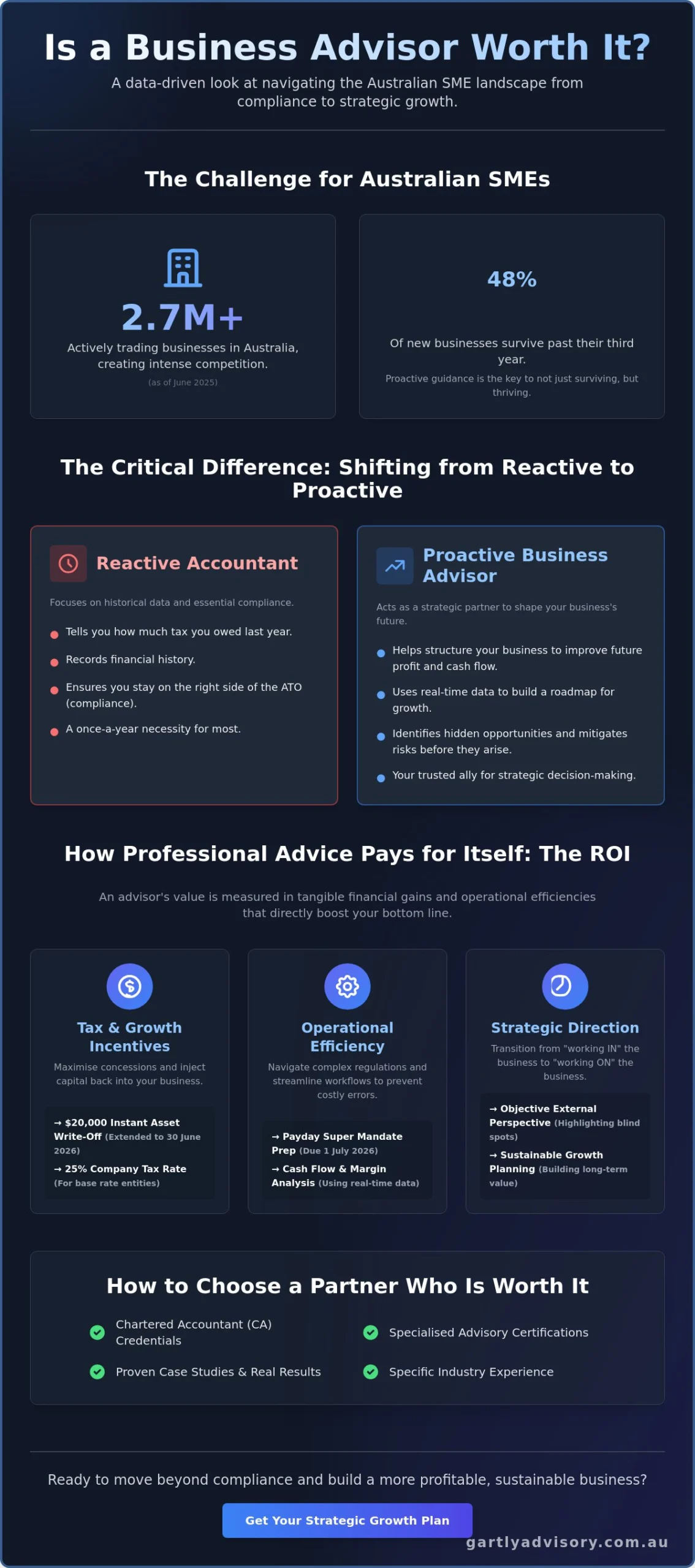
With 2,729,648 actively trading businesses in Australia as of June 2025, the competition is intense, yet only 48% of new ventures survive past their third year. If you’re feeling the weight of stagnant growth or the pressure of the upcoming July 2026 Payday Super mandates, you’re likely asking: is hiring a business advisor worth it? It’s a common concern for ambitious SME owners who feel lonely at the top and want to ensure every investment drives a measurable return.
We believe you deserve a trusted partner who looks beyond the numbers to help you manage the complex Australian market. This guide will show you how strategic guidance moves your business from basic compliance to sustainable growth, ensuring you don’t just survive, but thrive. We’ll explore the 2026 tax landscape, including the $20,000 instant asset write-off extension and 25% company tax rate, to help you calculate the true ROI of professional support.
Key Takeaways
- Understand the critical difference between a reactive, compliance-focused accountant and a proactive business advisor who looks beyond the numbers to guide your strategy.
- Learn how to measure the real ROI of professional guidance by identifying hidden tax efficiencies and operational improvements that help the service pay for itself.
- Discover how to determine if hiring a business advisor is worth it by evaluating their ability to solve complex problems like cash flow management and evolving ATO regulations.
- Get a clear checklist for selecting a trusted partner with the right Chartered Accountant credentials and specific industry experience to support your unique business journey.
What Does a Business Advisor Actually Do? (And Why it Matters)
Most Australian business owners view their accountant as a once-a-year necessity for staying on the right side of the ATO. While compliance is vital, a true business advisor acts as a strategic partner who looks beyond the numbers to identify growth opportunities you might miss. When you ask yourself, is hiring a business advisor worth it, the answer often lies in the shift from being reactive to being proactive. It’s about moving from simply recording history to actively shaping your future.
A reactive accountant tells you how much tax you owe for the previous year. A proactive business advisor helps you structure your affairs so you can improve your profit margins and cash flow for the year ahead. This distinction is critical for the 97.2% of Australian businesses that are small enterprises. With only 48% of new businesses surviving past their third year, having a seasoned expert in your corner can be the difference between closing your doors and scaling successfully.
Pro Tip: Look for a Chartered Accountant who also holds specialised advisory certifications. This combination ensures you get the best of both worlds: the rigorous ethical standards and tax expertise of a CA, paired with the forward-thinking strategy of a dedicated business mentor.
The ‘Beyond the Numbers’ Philosophy
Advisory work moves the conversation from “what happened” to “what’s next.” Instead of just looking at a static balance sheet, an advisor uses that data to build a roadmap for growth. They help you understand the “why” behind your financial results, allowing you to seize opportunities before they pass you by. This proactive approach is exactly why many entrepreneurs find that a Business consultant or advisor becomes their most trusted ally.
Modern cloud technology plays a massive role in this shift. Tools like Xero provide real-time data, which means your advisor can spot a cash flow dip or a margin squeeze as it happens, rather than six months later. If you want to see how this works in practice, our Xero Accounting Guide explains how streamlining your finances creates the clarity needed for better decision-making.
Addressing the ‘I Can Do It Myself’ Myth
Entrepreneurs are naturally resourceful people who are used to wearing many hats. However, the “DIY” mentality often creates a ceiling for growth. You might be an expert at your craft, but managing complex tax structures or navigating new regulations like the 2026 Payday Super mandates requires specialised knowledge. Trying to do it all yourself often leads to missed tax concessions and inefficient business structures that cost you more in the long run.
A professional advisor acts as a catalyst. They help you transition from “working in” the business—handling the day-to-day grind—to “working on” the business. By providing an objective external perspective, they highlight blind spots you’re too close to see. This clarity helps you solve problems faster and ensures your hard work actually translates into a more profitable, sustainable company.
Calculating the ROI: How Professional Advice Pays for Itself
ROI is the ultimate metric for any business decision. You’re likely trying to protect your profit margins, especially with the 25% company tax rate for base rate entities in the 2025-26 financial year. When you ask yourself is hiring a business advisor worth it, you have to look at the money left on the table through missed opportunities. A proactive advisor identifies efficiencies like the $20,000 instant asset write-off, which has been extended to June 30, 2026. These aren’t just tax tips; they’re direct injections of capital back into your cash flow.
Operational ROI is just as significant. With the Payday Superannuation mandate starting July 1, 2026, employers must pay super on the same day as wages. This shift requires a complete overhaul of many payroll workflows. An advisor ensures you transition to private clearing solutions before the ATO’s clearing house closes in mid-2026, preventing costly compliance errors and late fees. When you’re researching how to choose a business advisor, it’s vital to focus on those who can quantify their impact on your bottom line.
Pro Tip: Ask a potential advisor for a case study where their proactive interest led to a specific financial gain for a client. Whether it’s securing an R&D tax incentive or identifying a structural inefficiency, real results speak louder than general promises.
Maximising Australian Tax and Growth Incentives
The Australian tax system is a complex web of concessions and incentives designed to help SMEs scale. A strategic partner understands how to leverage Small Business CGT concessions or R&D incentives to your advantage. Proactive advice on small business accounting can save you thousands by ensuring you’re using the right structures, such as Trusts or Companies, for asset protection and tax health. If you’re ready to move beyond basic compliance, you might want to speak with a trusted advisor about your current structure.
The Intangible ROI: Peace of Mind and Exit Planning
Beyond the immediate cash gains, a “Value Builder” approach makes your business more valuable and less dependent on you personally. Many owners feel “lonely at the top,” bearing the full weight of every decision. An advisor acts as a sounding board, reducing the emotional stress of financial uncertainty. They also help you prepare for the future. Whether you’re looking at a succession plan or an eventual sale, an advisor ensures your business is “exit-ready,” which significantly increases its market value when the time comes to step away.
How to Choose a Business Advisor Who Is Actually Worth It
Finding the right person is the most critical step in determining if is hiring a business advisor worth it for your specific situation. You need more than just a coach who offers generic motivation; you need a professional with skin in the game. In Australia, the gold standard is the Chartered Accountant (CA) designation. This credential ensures your advisor adheres to strict ethical standards and possesses the technical depth to handle complex regulatory shifts, such as the Tranche 2 AML/CTF reforms starting July 1, 2026. These new rules will require formal risk assessments and written policies, making a highly qualified professional essential for your protection.
Pro Tip: Start with a complimentary consultation. This is your chance to test the chemistry and see if their advice feels actionable. If they don’t ask about your long-term dreams or your current cash flow pains, they aren’t the right partner for you.
Red Flags vs. Green Flags
A major red flag is an advisor who provides generic advice without referencing your real-time data or Xero reports. If they aren’t looking at your actual numbers, they’re just guessing. Conversely, a green flag is a proactive approach. You want someone who brings you ideas, like identifying a missed small business tax offset (which can be up to $1,000 for the 2025-26 year), before you even think to ask. Seeking a business advisor in Melbourne with a strong local reputation and verified reviews provides peace of mind that they understand the Victorian market dynamics.
For entrepreneurs on the other side of the country, accessing small business advisory services Perth from experts like Venta Belgarum ensures that Western Australian companies also benefit from tailored strategic planning and profitability coaching.
Making the Final Decision
When evaluating the cost, apply the 10x rule. Ask yourself if the advisor’s strategic input can help you gain ten times their fee in either saved taxes, increased profits, or improved business value. Transitioning from a basic tax relationship to a full-service advisory partnership is a significant step. It requires moving from a transactional mindset to a collaborative one where you share your challenges openly. For more vetting tips, our guide on Choosing a Tax Agent covers the essential questions you should ask before signing an engagement letter.
Take Control of Your Business Future
Navigating the Australian business landscape requires more than just keeping up with the ATO. It requires a strategic vision that turns compliance into a competitive advantage. By moving beyond reactive tax filings and embracing proactive guidance, you position your company to handle upcoming changes like the July 2026 AML/CTF reforms with confidence. Ultimately, deciding if is hiring a business advisor worth it comes down to whether you’re ready to stop working in the daily grind and start building real equity.
With over 35 years of experience as Chartered Accountants and 70+ 5-Star Google Reviews, the team at Gartly Advisory Pty Ltd has helped hundreds of local owners find clarity. As specialists in the ‘Value Builder’ framework, we’re dedicated to helping you scale sustainably while protecting your profit margins. You don’t have to carry the weight of every decision alone; let us be your trusted partner on your journey towards success.
Your next level of growth is within reach, and we’re here to help you seize it.
Frequently Asked Questions
How much does a business advisor cost in Australia?
Hourly rates for boutique advisors in 2026 range from $150 to $350, while Big 4 firms often charge over $400 to $800. For most Australian SMEs, project fees for strategy work fall between $2,500 and $30,000. Monthly retainers for ongoing support typically cost between $2,000 and $6,000. Evaluating these figures against your potential profit gains helps you determine if hiring a business advisor is worth it for your specific journey.
Is there a difference between a business coach and a business advisor?
The difference lies in the depth of technical expertise and the scope of the relationship. A business coach focuses primarily on personal development, motivation, and accountability. A business advisor, such as a Chartered Accountant, provides strategic financial oversight and tax structure guidance. They act as a proactive partner who helps you solve complex problems and seize market opportunities. They don’t just motivate; they provide the technical roadmap to improve your bottom line.
When is the best time for a small business to hire an advisor?
You should consider hiring an advisor when you feel “lonely at the top” or when growth becomes stagnant despite your best efforts. Many Australian owners seek guidance before major regulatory shifts, such as the July 2026 Payday Super mandates or the new AML/CTF reforms. If you’re struggling to move from “working in” the business to “working on” it, an external perspective identifies blind spots that are costing you time and money.
What should I prepare for my first meeting with a business advisor?
Prepare by gathering your recent financial reports from Xero and a list of your most pressing business challenges. You don’t need a formal presentation; just be ready to discuss your current cash flow, profit margins, and long-term goals. Having these details ready allows your advisor to provide actionable insights during your first consultation. This transparency helps build the foundation of a trusted partnership focused on your long-term success.