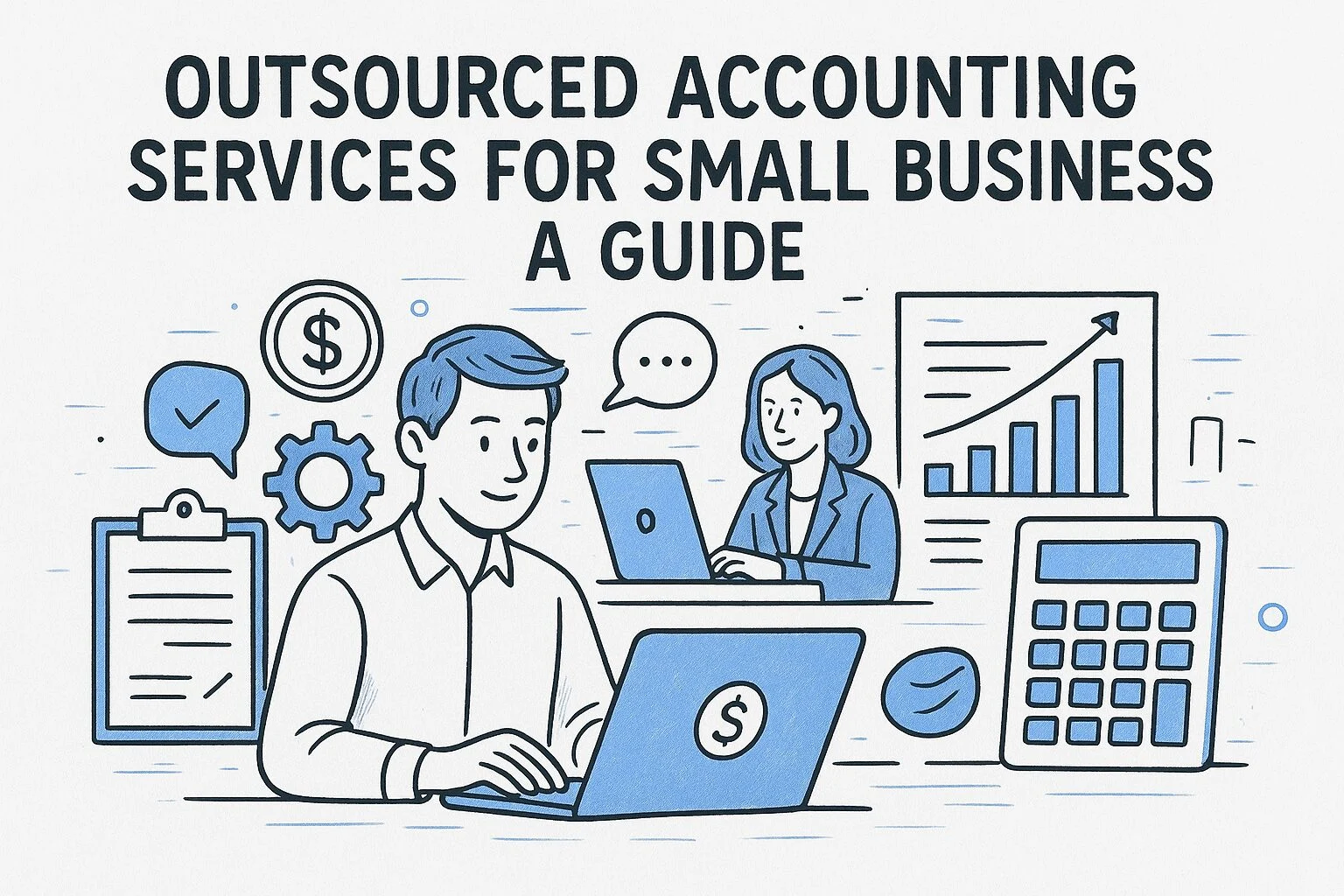
Outsourced Accounting Services for Small Business: A Guide
Most small business owners in Melbourne reach a point where the spreadsheet and the shoebox of receipts stop working. You are either paying for a full-time bookkeeper you don’t need yet, or you are doing the books yourself at 10pm when you should be running the business. Outsourced accounting services for small business exist to solve exactly this problem, giving you professional financial support without the overhead of an in-house hire.
If you are trying to work out whether outsourcing makes sense for your business, this guide answers the practical questions: what these services actually include, what they cost in the Australian market, and how to tell a genuine advisory partner from a basic data-entry provider. We will walk through provider options ranging from bookkeeping-only firms to full outsourced CFO arrangements, so you can match the service to your stage of growth.
We write this from the perspective of a firm that has spent 25+ years working alongside Melbourne business owners, including franchise operators, trades businesses, and property managers with industry-specific needs. Expect honest comparisons and clear guidance on what to look for before you sign with anyone.
Why small businesses outsource accounting
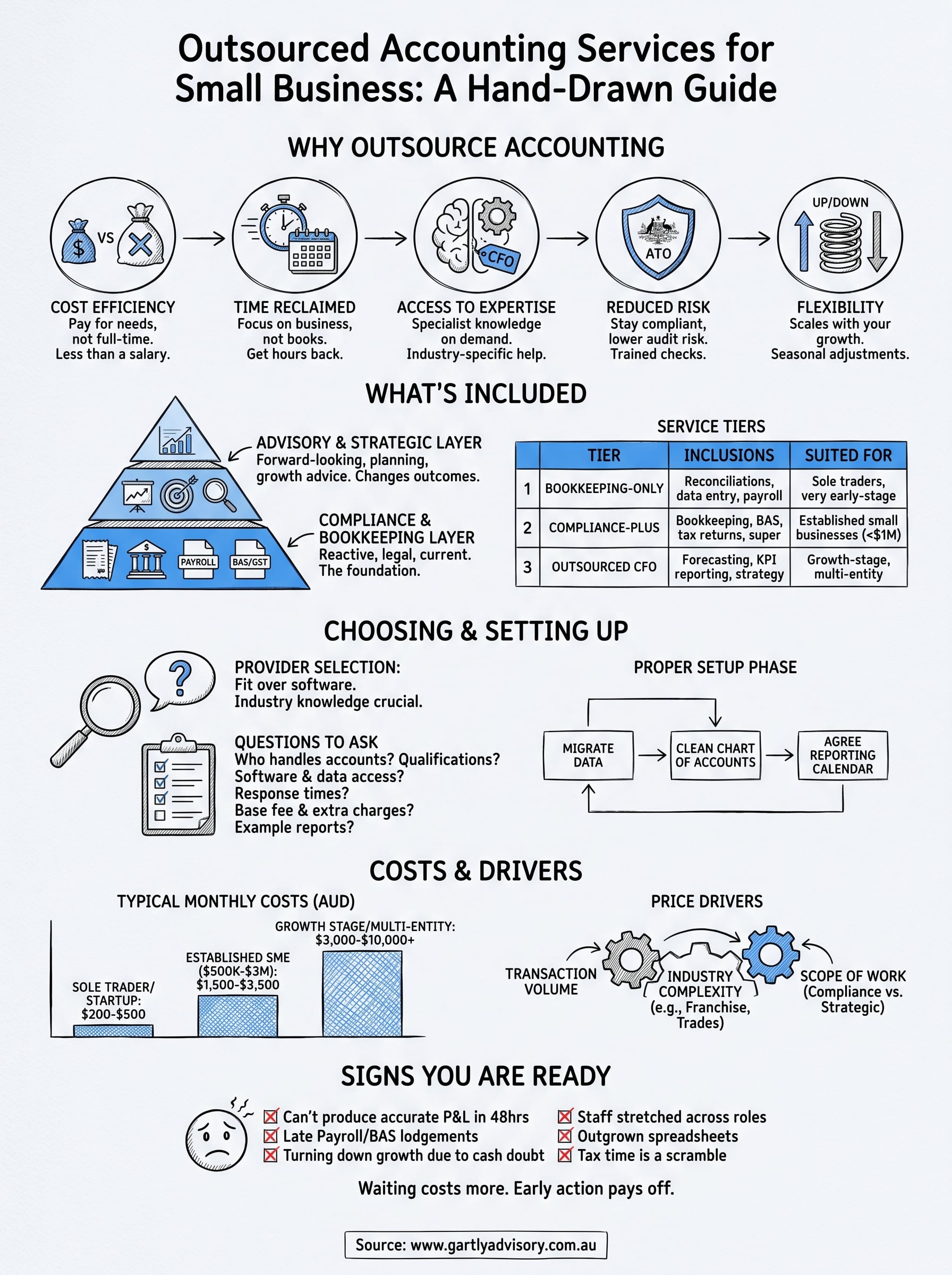
Money drives most outsourcing decisions, but not in the way people expect. A full-time bookkeeper on a Melbourne salary costs you upwards of $65,000 a year once you add superannuation, leave entitlements, and payroll tax. Outsourced accounting services let you access the same skill set, often at a more senior level, for a fraction of that cost because you’re only paying for the hours or the outcomes you actually need. For a business turning over $500,000 to $3 million, that gap between a full-time hire and a scaled outsourced arrangement is often the difference between profit and a break-even year.
Outsourcing isn’t about spending less on accounting, it’s about spending correctly on it.
Time is the second driver, and it’s the one owners underestimate until it’s gone. Every hour you spend reconciling bank feeds or chasing an invoice is an hour you’re not spending with customers or on the next contract. We see trades business owners doing their BAS on a Sunday night for years before they finally hand it over, and almost every one of them says the same thing afterwards: they wish they’d done it sooner. Reclaimed hours compound. Fifteen hours a month back in your week is nearly two extra working days, every month, for the life of your business.
Access to expertise you couldn’t otherwise afford
A small business rarely needs a full-time CFO, but it absolutely needs CFO-level thinking at certain moments, during a growth spurt, a cash flow crunch, or when you’re negotiating finance with a bank. Outsourcing gives you access to that specialist knowledge on demand rather than carrying the cost of it every week of the year. This matters most for businesses with industry quirks, caravan parks, franchises, and property managers all have compliance and reporting rules that a generalist bookkeeper simply won’t know.
Reducing compliance risk and stress
Australian tax law changes regularly, and the Australian Taxation Office does not accept "I didn’t know" as a defence for a late lodgement or an incorrect BAS. A qualified outsourced provider tracks these changes as part of their job, so you don’t have to. This lowers your audit risk considerably, because someone with technical training is checking your numbers before they go anywhere near the ATO.
Flexibility as your business changes shape
Growth is not linear for most small businesses. You might need light-touch bookkeeping in a quiet year and near-daily financial oversight during an expansion or an acquisition. In-house staff can’t flex that easily, but an outsourced arrangement scales up or down with a phone call. Seasonal businesses, in particular, benefit from paying for more support in peak months and less in the off-season, something a fixed salary simply can’t accommodate.
What outsourced accounting services typically include
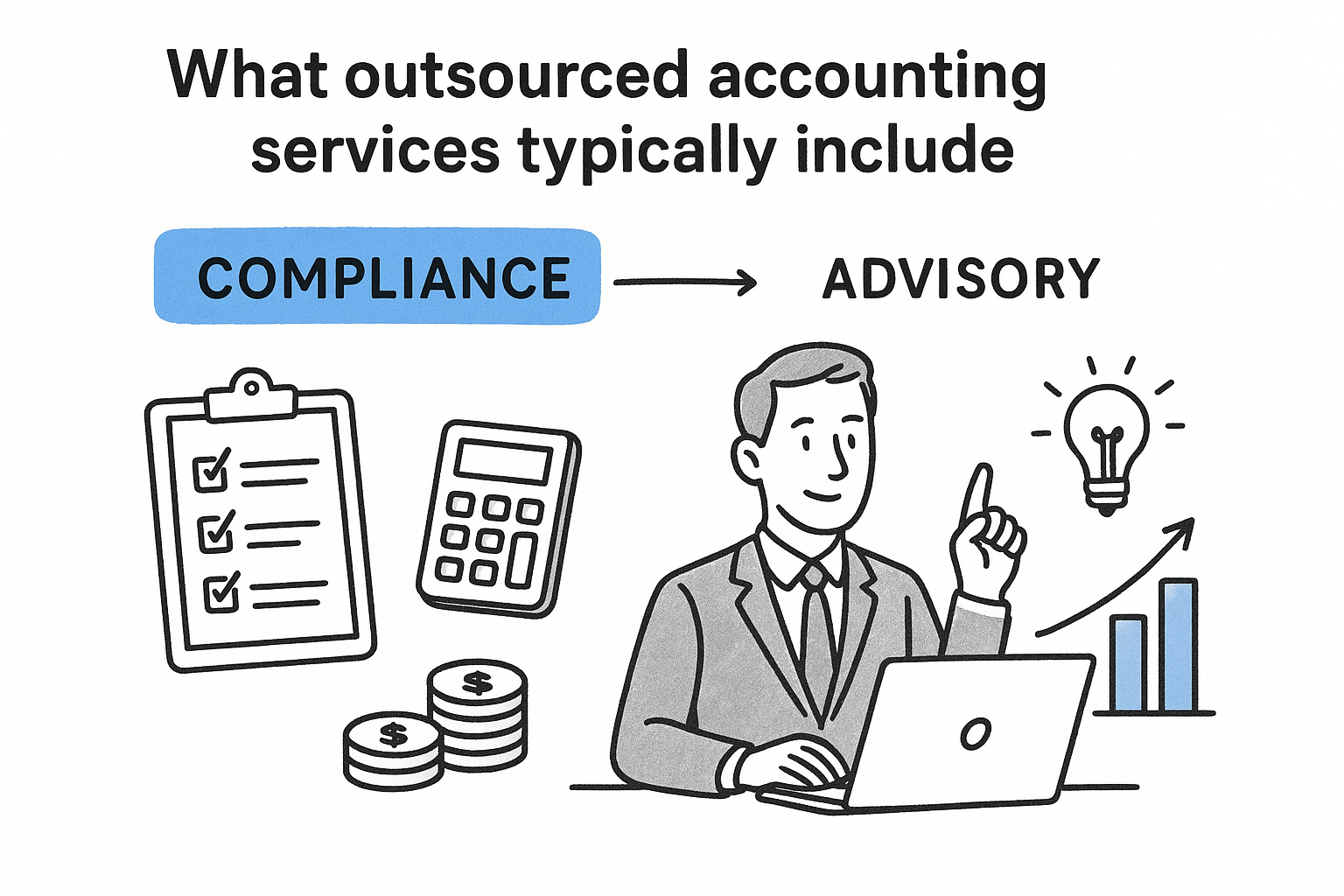
Providers differ, but most outsourced accounting services for small business sit on a spectrum from basic transaction processing through to full outsourced CFO support. Understanding where a provider sits on that spectrum matters more than comparing prices, because a cheap bookkeeping-only package won’t help you when you need cash flow forecasting or a business valuation.
The compliance and bookkeeping layer
At the foundation sits the work every business needs regardless of size: bank reconciliations, accounts payable and receivable, payroll processing, BAS and GST lodgements, and annual financial statements. This layer keeps you legal and current with the ATO, but on its own it’s reactive rather than strategic. Basic compliance is the entry point, not the destination.
The advisory and strategic layer
Above that sits the work that actually changes outcomes: cash flow forecasting, budget versus actual reporting, tax planning across the financial year rather than at tax time, and structuring advice for growth or acquisition. This is where an outsourced CFO service earns its fee, because it’s forward-looking rather than backward-looking.
If your provider only tells you what happened last quarter, you’re paying for history, not strategy.
| Service tier | Typical inclusions | Best suited to |
|---|---|---|
| Bookkeeping-only | Reconciliations, data entry, payroll | Sole traders, very early-stage businesses |
| Compliance-plus | Bookkeeping, BAS, tax returns, super | Established small businesses under $1M turnover |
| Outsourced CFO | Forecasting, KPI reporting, strategy, board-level advice | Growth-stage businesses, franchises, multi-entity structures |
Most businesses start on the left side of that table and grow into the right side as complexity increases. A good provider will tell you honestly which tier you actually need, rather than upselling you into the most expensive one from day one.
How to choose and set up an outsourced accounting provider
Choosing an outsourced accounting provider is less about credentials on a website and more about fit with how your business actually operates. Provider selection should start with a conversation about your industry, not a pitch about software. Ask whether they have handled a caravan park, a franchise network, or a trades business before, because industry-specific quirks in GST treatment, trust structures, or franchise royalty accounting trip up generalist firms constantly. Geography matters too: a provider who understands Victorian payroll tax thresholds and Melbourne-specific commercial rent rules will catch issues a remote, generic bookkeeping service never will.
The right provider asks about your business before they talk about their pricing.
Questions to ask before you sign
Before committing, run through a short checklist with any provider you’re considering. Direct questions at this stage save you from a messy exit six months later.
- Who exactly will handle my accounts, and what are their qualifications?
- What accounting software do you use, and can I access my own data at any time?
- How quickly do you respond to urgent questions outside scheduled reporting?
- What’s included in the base fee, and what triggers an extra charge?
- Can you show me an example of the monthly or quarterly report I’ll receive?
Setting up the transition properly
Once you’ve chosen a provider, the setup phase determines whether the relationship works long-term. A proper onboarding process includes migrating your historical data, setting up clean chart of accounts, and agreeing a reporting calendar before the first invoice is sent. Rushing this step is the single most common reason outsourcing arrangements fail in the first year, because unresolved data issues from your old system quietly carry forward and undermine every report that follows.
How much outsourced accounting costs in Australia
Pricing for outsourced accounting services for small business in Australia varies widely depending on turnover, industry complexity, and how much strategic work you need beyond basic compliance. Sole traders and micro-businesses often pay as little as $200 to $500 a month for bookkeeping-only support, while businesses turning over $1 million to $5 million with full compliance and advisory needs typically sit between $1,500 and $5,000 a month. Outsourced CFO arrangements for growth-stage or multi-entity businesses can run from $3,000 to $10,000 or more monthly, depending on the depth of reporting and strategic involvement required.
Cheap accounting is expensive the day you get audited or miss a deadline.
| Business stage | Typical monthly cost (AUD) | What’s usually included |
|---|---|---|
| Sole trader / startup | $200 to $500 | Bookkeeping, BAS lodgement |
| Established SME ($500K to $3M) | $1,500 to $3,500 | Compliance, payroll, tax planning |
| Growth stage / multi-entity | $3,000 to $10,000+ | Outsourced CFO, forecasting, strategy |
What drives the price up or down
Several factors push these figures higher than the averages above. Transaction volume matters most, a business processing 500 invoices a month costs more to manage than one processing 50. Industry complexity also adds cost, franchises with royalty calculations, caravan parks with mixed residential and commercial income, and trades businesses with subcontractor compliance all need more specialist time than a straightforward retail business.
Fixed fees versus hourly billing
Governed largely by provider preference rather than industry standard, pricing structures split between fixed monthly retainers and hourly billing. Fixed fees give you budget certainty and tend to suit ongoing compliance work, while hourly billing suits ad-hoc advisory projects like a business valuation or a one-off restructure. Reputable Australian providers, including those regulated under Tax Practitioners Board standards, will usually disclose their pricing model upfront rather than leaving you to guess after the first invoice arrives.
Signs your business is ready to outsource
Deciding when to make the switch is rarely obvious, because most owners wait until the pain is unbearable rather than acting on early warning signs. Readiness signals usually show up in your calendar and your bank balance before they show up in a formal decision. If you’re spending more than five hours a week on bookkeeping, or you’ve missed a BAS deadline in the last twelve months, that’s already a strong case for change.
If your accounts only get attention when the ATO chases you, you’re not managing your business, you’re managing your paperwork.
The clearest indicators
Run through this checklist honestly. Ticking two or more usually means outsourcing will pay for itself within the first quarter.
- You can’t produce an accurate profit and loss statement within 48 hours of being asked
- Payroll, super, or BAS lodgements have been late more than once
- You’re turning down growth opportunities because you don’t trust your cash position
- Your current bookkeeper or in-house staff member is stretched across roles they weren’t trained for
- You’ve outgrown spreadsheets but haven’t upgraded your systems
- Tax time feels like a scramble rather than a formality
When waiting costs you more than acting
Every month you delay outsourcing on a growing business is a month of decisions made on incomplete data. Growth-stage businesses especially feel this, because the complexity that made a spreadsheet workable at $300,000 turnover becomes unmanageable at $1.5 million. Trades businesses and franchise operators tend to hit this wall fastest, since subcontractor payments, royalty calculations, and multi-site reporting outpace what a part-time bookkeeper can realistically handle. Once you notice these patterns, the question isn’t whether to outsource, it’s how quickly you can find a provider who understands your industry well enough to fix the gaps immediately.
Getting started with the right support
Outsourcing your accounting is not about handing over paperwork you dislike doing. It is about buying back your time and getting strategic guidance you cannot afford to have on staff full-time. The businesses that get the most out of this decision are the ones that pick a provider who understands their industry, asks direct questions before quoting a price, and treats reporting as a tool for decisions rather than a compliance chore.
Wherever your business sits on that spectrum, from basic bookkeeping through to full outsourced CFO support, the right partner should feel like part of your team, not a vendor you tolerate. If you recognised your own business in the readiness signs above, waiting longer only adds risk and cost. Gartly Advisory has spent 25+ years helping Melbourne business owners make this exact move. Get in touch with Gartly Advisory to talk through what outsourced support could look like for your business.