15 Tax Deductions for Investment Property Owners You Can Claim
Own a rental property in Melbourne or anywhere else in Australia? You’re probably leaving money on the table at tax time. Most landlords claim the obvious costs like interest and property management fees, then stop there. As a result, they miss thousands of dollars in legitimate tax deductions for investment property that the ATO allows each year.
This article gives you a straight answer: a full list of what you can claim against your rental income. It covers the well-known expenses and the ones property investors consistently overlook. We’ve built this list from what actually shows up in client returns, not generic tax advice pulled from a textbook. So you’ll see deductions that apply to real Australian landlords, not theoretical scenarios.
Below you’ll find 15 categories of deductible expenses. They cover everything from loan interest and depreciation through to repairs, insurance, and travel costs. You might manage one investment property or a growing portfolio. Either way, work through this list before you lodge your return, or better still, with your accountant. That’s how you keep more of your rental income in your pocket rather than handing it to the tax office.
1. Accounting and tax agent fees
Here’s a deduction almost every landlord claims but few claim fully. The fee you pay your accountant to prepare and lodge your tax return is itself tax deductible. So is a surprising range of related costs that most people forget to add up. This is often the first line item in a list of rental property tax claims. That’s simply because everyone with a rental has to deal with it every single year.
What it covers
You can claim the cost of having a registered tax agent prepare your return. However, the deduction goes further than the invoice for lodging your paperwork. It also covers:
- Time spent by your accountant calculating rental income and expenses
- Advice on depreciation schedules and capital works claims
- Amendments to previous tax returns relating to your rental property
- Travel costs to visit your accountant, where relevant
- Fees for tax advice specific to property investment decisions
If your accountant touched your rental property numbers, chances are you can claim it.
Eligibility criteria
The golden rule with this deduction is that the fee has to relate to managing your tax affairs. General business or personal advice unrelated to your investment property doesn’t count. Your flat fee might cover your personal return, business return and rental schedule in one invoice. If so, you generally need to apportion the cost. Most accounting firms, ours included, itemise this on request so you’re not guessing at tax time. You also need to have actually paid the fee in the financial year you’re claiming it, on a cash basis. This trips people up when invoices land in July but relate to the prior year’s work.
How to claim it
Claiming this one is straightforward if you keep your paperwork in order. Follow this sequence:
- Request an itemised invoice from your accountant that separates rental property advice from other work
- Keep the invoice and proof of payment, even if paid electronically
- Include the deductible portion under the correct label in your rental property schedule
- Carry forward any unused prior-year tax agent fees if your accountant has advised you to
Don’t rely on memory here. Digital record-keeping through your accounting software or a simple folder of scanned receipts saves you from scrambling in June. Unsure how much of a combined invoice relates to your property versus your personal tax affairs? Ask your accountant to break it down in writing before you lodge.
2. Loan interest and borrowing expenses
For most landlords, this is the single largest deduction on the whole return. The interest charged on the loan you took out to buy, build, or renovate your rental property is fully deductible. It usually dwarfs every other expense on this list combined.
What it covers
Beyond the obvious interest charges, this category includes borrowing expenses incurred when you first set up the loan. Examples include loan establishment fees, lender’s mortgage insurance, title search fees, and mortgage broker commissions. If your total borrowing costs exceed $100, you spread the deduction over five years or the loan term, whichever is shorter. Redraw or line-of-credit facilities also qualify. However, you must have genuinely used the redrawn funds for the investment property, not personal spending.
Mixing personal and investment funds in one loan account is the fastest way to lose part of this deduction.
Eligibility criteria
Interest is only deductible to the extent you used the borrowed money to earn rental income. This matters enormously if you’ve ever redrawn on your investment loan to fund a holiday or pay off your family car. In that case, the ATO expects you to apportion the interest between deductible and private use from that point forward. The ATO treats fixed and variable rate loans the same way. It also makes no difference whether the loan is with a bank or a private lender.
How to claim it
Get your annual loan statement from your lender each June, since it breaks down interest paid for the financial year. Keep records showing what you spent any redrawn funds on. If your loan structure has ever changed, talk to your accountant before lodging. That way they can calculate the apportionment correctly rather than guess it.
3. Council rates and land tax
Every landlord pays these two costs. Yet plenty of investors forget land tax sits alongside council rates as a deductible expense rather than a cost you just absorb. Both are ongoing charges tied to owning the property, and both reduce your taxable rental income dollar for dollar.
What it covers
Council rates cover the local government charges for rubbish collection, roads, and other municipal services attached to your rental property. Land tax is a separate and often larger bill. Your state revenue office charges it based on the unimproved value of land you own above the tax-free threshold. Water rates and any emergency services levy charged alongside your council notice fall into the same deductible bucket. That applies provided the property was available for rent during that period.
Land tax catches out plenty of investors who assume it’s a personal cost rather than a rental deduction.
Eligibility criteria
The property needs to be genuinely available for rent, whether tenanted or actively advertised. This applies for the period you’re claiming these costs against. Did you live in the property for part of the year? Then you apportion council rates and land tax between private and income-producing use. Base the split on the number of days each applied. Land tax thresholds and rates vary by state, so a Victorian investor’s bill looks nothing like one in Queensland.
How to claim it
Keep your annual council rates notice and land tax assessment together with proof of payment. Both typically arrive once a year rather than quarterly. Enter the amounts against the correct labels in your rental schedule. Then flag any period of private use to your accountant so the apportionment is accurate.
4. Landlord insurance premiums
Many property owners assume insurance is just a cost of doing business. In fact, it sits firmly among the tax deductions for investment property owners can claim in full each year. The premium protects your rental from tenant damage, loss of rent, or building damage. It is fully deductible in the year you pay it, with no apportionment formulas.
What it covers
Landlord insurance premiums cover building cover and contents you own within the property, such as carpets or blinds. They also cover loss of rental income if a tenant defaults or the property becomes uninhabitable. Cover for legal liability, if someone gets hurt on site, also counts. Standard home and contents policies don’t count here. This deduction applies specifically to policies written for a rental property, not your own residence.
A landlord policy protects your income stream, and the premium protects your tax return too.
Eligibility criteria
You must genuinely rent out the property, or make it available for rent, for the period the policy covers. Did you occupy the property for part of the year, or use it as a holiday home between tenancies? Then you need to apportion the premium based on the days it was income-producing. Bundled policies covering multiple properties, including your own home, require a fair and reasonable split. Your accountant can help calculate it.
How to claim it
Keep the insurance certificate or renewal notice along with proof of payment, since insurers rarely send a tax summary automatically. Claim the premium in the financial year you pay it, even if the policy period straddles two tax years. Also flag any private use periods to your accountant before lodging.
5. Property management fees
If you use a property manager to handle your rental, every dollar you pay them is deductible. This is one of the easier tax deductions for investment property owners to track. It arrives as a single line on your monthly statement rather than something you need to reconstruct at tax time.
What it covers
Property managers typically charge a percentage of rent collected, plus separate fees for finding tenants, preparing lease agreements, and conducting routine inspections. All of these count. So do letting fees charged when a new tenant signs on and advertising costs the agent passes through. Any administration charges for managing repairs on your behalf also count.
If it’s on your property manager’s statement, it’s almost certainly deductible.
Eligibility criteria
The fees need to relate to a property that’s genuinely tenanted or actively available for rent. Self-managed landlords miss this deduction entirely, since there’s no agent fee to claim. However, you can still claim your own advertising and administration costs separately. Your agent might manage a mixed-use property, split between commercial and residential for instance. In that case, only the portion relating to income-producing use is deductible.
How to claim it
Most property managers issue an annual income and expense statement summarising every fee charged over the financial year. This makes the deduction almost effortless. Check that statement against your bank deposits to confirm nothing’s missing, then hand it straight to your accountant. Changed managing agents mid-year? Request a statement from each one rather than assuming the new agent has historical figures on file.
6. Repairs and maintenance
Getting this deduction wrong is one of the most common mistakes landlords make. That’s because the ATO draws a sharp line between a repair and an improvement. Only one of them is deductible in the year you pay for it. Fixing what’s broken restores the property to its original condition. In contrast, upgrading or replacing something entirely usually falls under capital works, which we cover next.

What it covers
Repairs include patching a damaged roof, fixing a leaking tap, replacing broken window glass, or repainting a wall damaged by tenants. Maintenance costs like servicing an air conditioner, cleaning gutters, or treating rising damp also qualify. These prevent deterioration rather than adding value. The distinction matters because replacing an entire kitchen bench isn’t a repair; it’s an improvement. You depreciate improvements over time rather than claiming them upfront.
A repair fixes damage, an improvement adds value, and only one of them is deductible straight away.
Eligibility criteria
The damage or wear must have occurred while the property was tenanted or genuinely available for rent. Repairs needed at the time of purchase, even if completed shortly after settlement, generally aren’t deductible as repairs. The ATO treats these as capital in nature. Ongoing maintenance during a tenancy is far more straightforward to claim than anything tied to the property’s condition when you bought it.
How to claim it
Document everything with dated invoices, before-and-after photos where possible, and a brief note explaining what caused the damage. Send these records to your accountant each year. Borderline cases between repairs and improvements are exactly where professional judgement earns its keep.
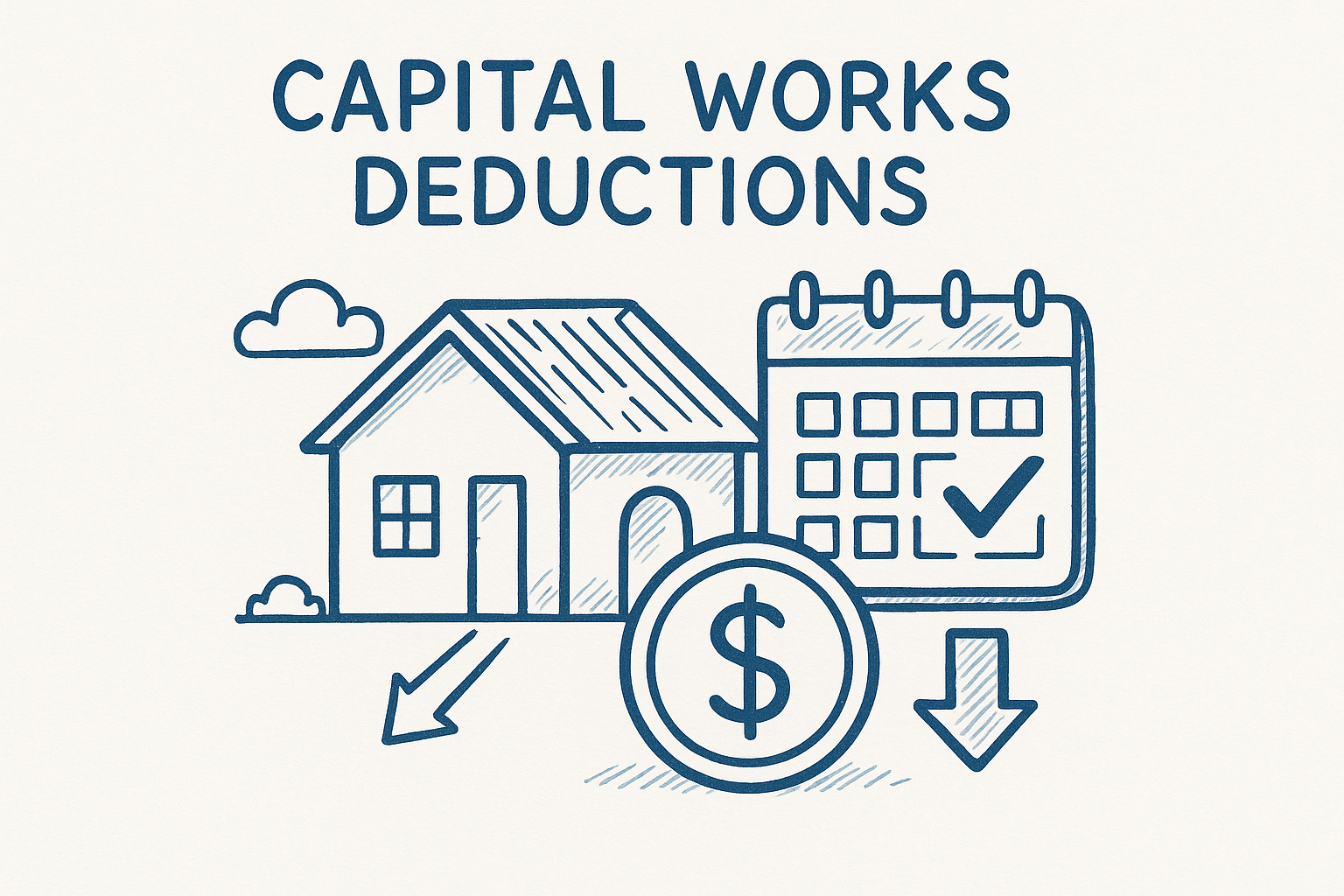
7. Capital works deductions
Buildings wear down over decades, not years. The ATO recognises this through capital works deductions, sometimes called the building write-off. Rather than claiming the full construction cost upfront, you spread it over 40 years at 2.5% annually. For most rental properties, this quietly becomes one of the largest tax deductions for investment property owners never think to claim. That’s because it doesn’t show up on a bank statement.
What it covers
Structural elements qualify here: the original building construction, extensions, garages, carports, fences, and retaining walls. Capital works deductions also cover later structural renovations, like adding a second bathroom or replacing a roof entirely rather than patching it. This is the flip side of the repairs deduction covered above. Here, you write off an improvement that adds value slowly instead of claiming it immediately.
Structural improvements don’t disappear from your tax return, they just get spread over 40 years instead of one.
Eligibility criteria
Construction generally needs to have started after 15 September 1987 for residential properties to qualify for the full 2.5% rate. Older properties can still claim renovations completed after that date, even if the original structure predates it. You need to know the construction cost, not the purchase price. That’s exactly where a quantity surveyor earns their fee.
How to claim it
Order a depreciation schedule from a qualified quantity surveyor before your first tax return on the property. That schedule becomes the backbone of your capital works claim for the full 40-year period. Your accountant applies it every year without needing to reassess construction costs from scratch.
8. Depreciation of plant and equipment
While capital works cover the building itself, plant and equipment depreciation deals with the removable, mechanical, and easily-worn items inside it. Think appliances, carpets, and blinds rather than bricks and mortar. This is a separate deduction category from the 40-year building write-off. It works on much shorter timeframes because these items simply don’t last as long as the structure around them.
What it covers
Depreciable assets include hot water systems, air conditioning units, ovens, dishwashers, carpets, blinds, and even smoke alarms. Each item has an effective life set by the ATO. You claim a portion of its value each year until you fully write it off or dispose of it. You can write off some smaller items under $300 immediately rather than depreciating them over years.
Carpets and appliances wear out fast, and your depreciation schedule should reflect that reality.
Eligibility criteria
Since 2017, investors who buy an already-tenanted established home generally can’t claim second-hand plant and equipment in it. The exception is items that are brand new when installed. This rule caught a lot of investors off guard. So check your settlement date and asset condition carefully with your accountant before assuming a deduction applies.
How to claim it
A quantity surveyor’s report lists every eligible asset alongside its written-down value and remaining effective life, updated automatically each year. Feed this schedule to your accountant annually rather than trying to estimate depreciation yourself. Incorrect claims here are one of the more common triggers for an ATO review.
9. Advertising for tenants
Finding a new tenant costs money. Every dollar spent chasing that outcome is deductible in full the year you pay it. You might be between tenants for a week or a month. Either way, advertising costs for a rental property are among the tax deductions for investment property owners can claim. There are no apportionment headaches either.

What it covers
Online listing fees on major rental platforms, professional photography for your listing, signage placed outside the property, and newspaper classifieds all qualify. Vacancy advertising also extends to the cost of preparing a listing description if you pay someone to write it. It also includes any fees your property manager passes through for marketing the property to prospective renters.
Every cent spent finding your next tenant comes straight off your taxable rental income.
Eligibility criteria
The advertising has to relate to a genuine attempt to secure a tenant for the property while you hold it for income-producing purposes. Costs incurred advertising a property you’re simultaneously trying to sell get trickier. The ATO expects you to separate rental advertising from sale advertising if both happen at once. Advertising during a period of private use isn’t deductible. So the timing needs to line up with genuine availability for rent.
How to claim it
Keep the following on file for each advertising spend:
- Invoice or receipt from the listing platform or agency
- Screenshot of the published listing where possible
- Dates the advertisement ran
Most property managers itemise advertising fees on their annual statement, so cross-check that figure against your own records before handing everything to your accountant.
10. Cleaning, gardening and pest control
Keeping a rental presentable between tenancies and tidy during a tenancy generates a steady stream of small, fully deductible expenses. On their own, a gutter clean or a lawn mow doesn’t look like much. Tallied over a year, though, these routine costs are one of the more consistent tax deductions for investment property owners can bank. No capital works calculations get in the way.
What it covers
Cleaning costs between tenancies, ongoing lawn mowing and garden maintenance, and regular or one-off pest control treatments all qualify here. This extends to carpet steam cleaning at the end of a lease, pressure washing driveways and paths, and hedge trimming. It also covers treating termites or other pests discovered during an inspection. Your property manager may arrange some of this on your behalf. If so, it usually appears as a pass-through charge on your annual statement.
Small recurring costs like mowing and pest treatments add up to a genuine deduction most landlords underclaim.
Eligibility criteria
The work needs to relate to the property while it’s tenanted or genuinely available for rent. It can’t relate to a period you were living in it or using it privately. Sometimes a tenant is contractually responsible for garden upkeep under the lease, but you cover the cost anyway. If so, keep a note explaining why. The ATO may query costs that duplicate a tenant’s obligations.
How to claim it
Hold onto invoices from cleaners, gardeners, and pest technicians, along with your property manager’s statement showing any charges they’ve arranged. Match these against bank records each year and pass the full list to your accountant rather than estimating totals from memory.
11. Body corporate and strata fees
Owning a unit or townhouse inside a managed complex means you’re almost certainly paying body corporate fees. The good news is these are deductible against your rental income. Strata levies fund everything from building insurance to common area upkeep. They’re a direct cost of holding an income-producing property. So they sit comfortably among the standard tax deductions for investment property owners can claim each year.

What it covers
Admin and sinking fund levies both qualify. They cover things like building insurance, common area cleaning, lift maintenance, and pool upkeep in larger complexes. Special levies raised for major works, like re-rendering the exterior or replacing shared plumbing, are usually deductible too. However, very large capital works levies sometimes count as capital works deductions instead of an immediate expense.
Strata levies fund the building around your investment, and most of that cost comes straight off your taxable rental income.
Eligibility criteria
Regular levies are deductible in full provided the property is tenanted or genuinely available for rent. Special levies need closer attention. The ATO looks at what the money actually paid for rather than what the strata committee called it. If part of a levy funds a genuine capital improvement, your accountant may need to split that portion out.
How to claim it
Keep your strata statements or levy notices for the full financial year, noting any special levies separately from routine ones. Pass these straight to your accountant. Flag any large one-off charges so they can check whether the full amount is immediately deductible.
12. Utilities paid on behalf of tenants
Some landlords cover water, electricity, or gas as part of the rental arrangement, particularly with share houses or fully furnished properties. These payments are fully deductible against your rental income. It’s a smaller item on most returns. Still, it’s one of the tax deductions for investment property owners overlook. Often that’s because the bill arrives in their name rather than the tenant’s.
What it covers
Water usage charges, electricity, gas, and even internet or pay TV connections qualify. That applies if you, the owner, pay the account and the tenant doesn’t reimburse you. Shared utility arrangements in properties like boarding houses or student accommodation often see the landlord footing these costs as part of the weekly rent. That makes the whole amount deductible rather than just a portion.
If a bill lands in your name and the tenant never pays you back for it, it’s your deduction to claim.
Eligibility criteria
The key test is whether you actually paid the utility without the tenant reimbursing you through a separate arrangement. Your lease may specify that tenants pay their own electricity directly to the retailer. In that case, you can’t claim it just because your name is on the property title. Mixed arrangements, where tenants pay a fixed amount toward utilities and you cover the rest, need careful apportionment.
How to claim it
Keep every utility invoice and the matching payment record. Also check your lease agreement to confirm who’s contractually responsible for each cost. Where a property manager collects and pays utilities on your behalf, their statement should already itemise these charges. That makes it easy to hand straight to your accountant.
13. Legal and professional fees
Owning a rental property occasionally means paying for advice beyond your accountant. Most of those costs count among the tax deductions for investment property owners can claim without much fuss. Legal fees tied to managing the property, rather than acquiring or selling it, are deductible in the year you pay them.
What it covers
This category includes legal costs for preparing or reviewing a lease agreement. It also includes pursuing a tenant for unpaid rent through a tribunal, and evicting a problem tenant. It also covers fees paid to a quantity surveyor for a depreciation schedule. Charges from a valuer count too, if the valuation is for loan or insurance purposes. Valuations for buying or selling the property don’t count.
Legal fees tied to running your rental are deductible, but fees tied to buying or selling it almost never are.
Eligibility criteria
The fee needs to relate to earning rental income, not to acquiring, disposing of, or improving the property’s ownership structure. Conveyancing costs when you purchased the property, and legal fees when you eventually sell, are capital in nature. Instead, they form part of your cost base for capital gains purposes. Fees for drafting the original loan documents fall under borrowing expenses, covered earlier, rather than here.
How to claim it
Request an itemised invoice from any solicitor, valuer, or surveyor you engage, clearly describing the service provided. Keep these alongside proof of payment and hand the full list to your accountant. Flag anything connected to a purchase, sale, or dispute. That way your accountant can classify it correctly rather than lumping it in with routine expenses.
14. Travel and vehicle expenses
This is the one deduction most landlords assume still applies. Getting it wrong is an easy way to trigger an ATO review. Travel expenses to inspect, maintain, or collect rent from a residential rental property used to be a straightforward claim. However, the rules changed dramatically from 1 July 2017, and plenty of investors haven’t caught up.
What it covers
For individual investors and most trusts, travel deductions for residential rental properties ended from the 2017-18 financial year onward. That means driving to inspect your property, collect rent in person, or meet a tradesperson on site is no longer claimable. That holds regardless of how far you travelled or how genuine the purpose was. The change specifically aimed to stop over-claiming on personal holidays disguised as property inspections.
If your rental is a standard residential property, travel to visit it almost certainly isn’t deductible anymore.
Eligibility criteria
The exception applies to entities carrying on a genuine property investment business, such as companies or complying superannuation funds running a large-scale operation. It also applies to commercial property investors. That’s because the ban only targets residential rentals held by individuals and most trusts. If you’re unsure whether your structure qualifies, this is worth confirming with your accountant before you claim anything travel-related.
How to claim it
Don’t assume the old rules still apply just because you remember claiming this before 2017. Check with your accountant whether your ownership structure falls into the narrow exception. If it doesn’t, direct that travel time toward using a property manager instead, whose fees remain fully deductible.
Making the most of tax deductions for investment property
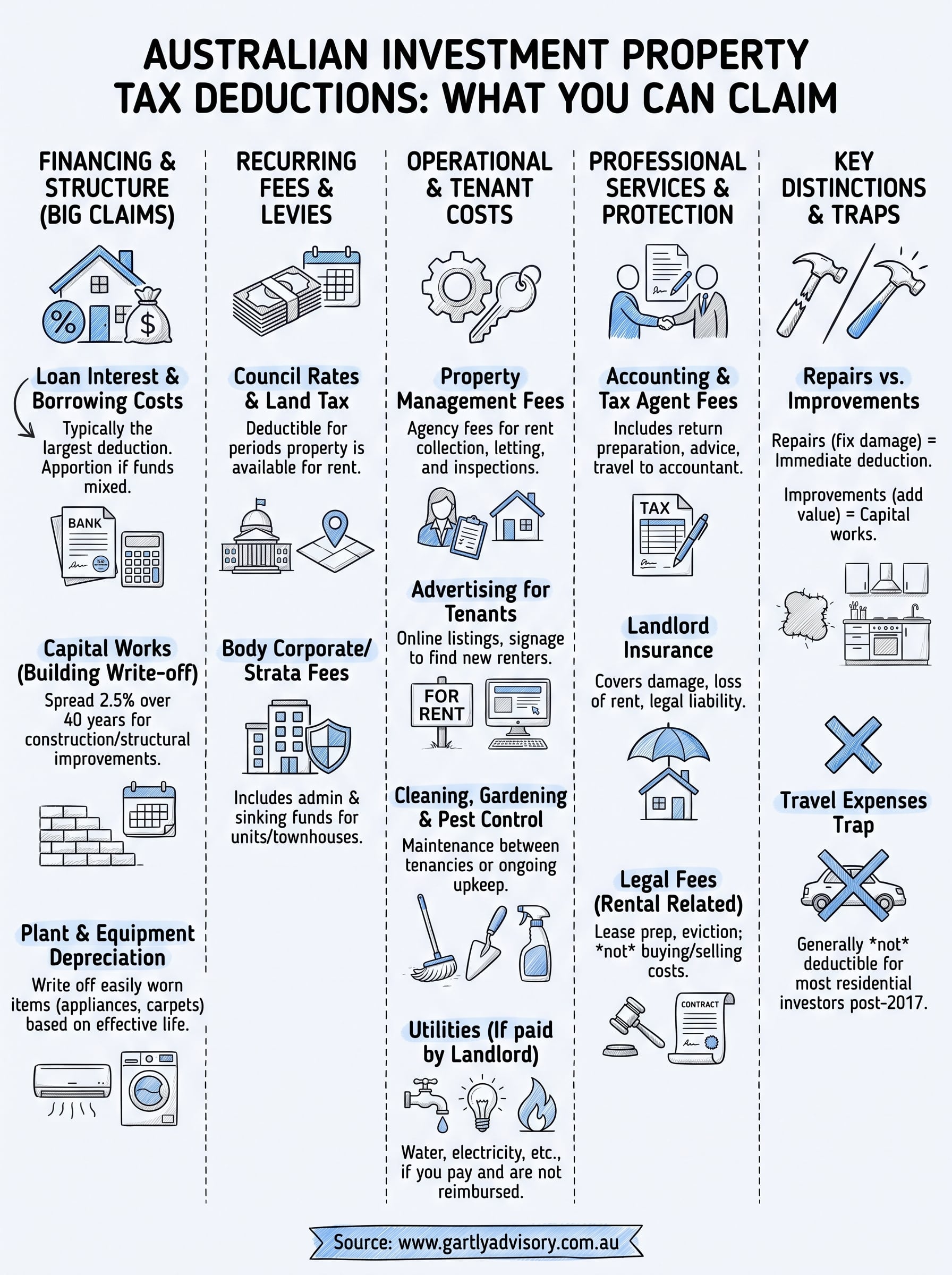
Fourteen categories, one clear message. Rental property deductions add up fast when you claim everything you’re entitled to, not just the obvious few. Loan interest and depreciation will always carry the biggest numbers. Yet smaller items matter too, like pest control, strata levies, and utilities paid on a tenant’s behalf. They separate a good return from a great one. Missing these isn’t dishonest, it’s just leaving your own money on the table year after year.
Getting this right consistently means treating tax time as a year-round habit rather than a scramble every June. Keep your invoices, statements, and depreciation schedule organised as expenses happen, and review this list before every lodgement. Want someone who deals with investment property tax deductions every day to check your return line by line? Get in touch with Gartly Advisory. Let’s make sure your next return reflects everything you’re actually owed.
Frequently asked questions about tax deductions for investment property
Common deductions include loan interest, council rates, land tax, landlord insurance, property management fees and repairs. Capital works and depreciation also add up.
For individual investors and most trusts, no. Travel deductions for residential rentals ended from the 2017-18 financial year.
No. You claim repairs in the year you pay for them. You depreciate improvements over time instead.
Yes. The fee for preparing and lodging your tax return is deductible, along with related rental property advice.