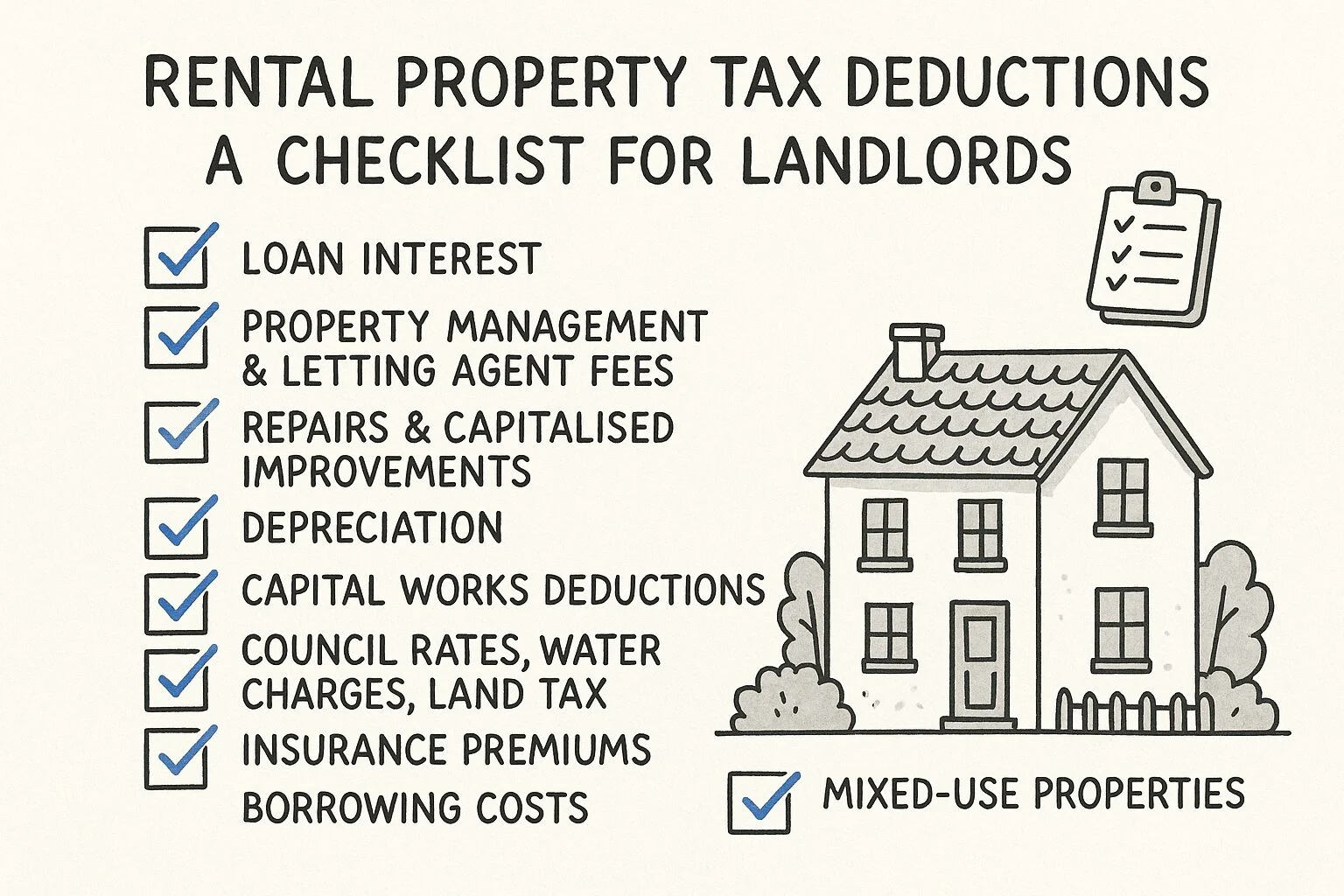
Rental Property Tax Deductions: A Checklist for Landlords
Every year, we see landlords hand back money to the ATO simply because they didn’t know an expense qualified, or they claimed something incorrectly and triggered a review. Rental property and tax deductions trip up even experienced investors, because the rules sit in an odd space between what feels reasonable and what the ATO actually allows.
This checklist answers the question directly: what expenses are tax deductible on an Australian rental property, and which ones catch people out. We cover the obvious claims like interest and agent fees, alongside the ones landlords consistently miss, such as depreciation schedules and travel restrictions that changed a few years back.
As a Melbourne firm working with property investors across Victoria, we’ve reviewed enough rental schedules to know where the genuine opportunities and the genuine risks sit. Use this as a working reference before you sit down with your accountant or lodge your rental property tax deductions claim, so nothing gets left on the table and nothing gets flagged that shouldn’t have been claimed.
1. Interest on your investment loan
For most landlords, interest on your investment loan is the single largest deduction available, often dwarfing every other item on this list combined. If you’ve borrowed to buy, renovate, or maintain a rental property, the interest charged on that loan is generally deductible in full, provided the property is genuinely available for rent. This applies to the interest component only, not the principal repayments, which is a distinction that catches out first-time investors who assume the whole mortgage payment counts.
What it covers
Interest deductions extend beyond the original purchase loan. Refinanced loans, lines of credit used to fund property improvements, and even loans taken out to cover holding costs during a vacancy period can all qualify, as long as the borrowed funds were used for an income-producing purpose. The ATO’s guidance on rental property expenses sets out the underlying test clearly: the purpose of the borrowing determines deductibility, not the security used against the loan.
How to claim it
Grab your annual loan statement from your lender and use the total interest charged for the financial year, not the repayment total. If you’ve split a loan between private and investment purposes, such as a redraw used partly for a family holiday, you’ll need to apportion the interest based on how the funds were actually used, not on the original loan balance.
Interest is usually your biggest rental deduction, but only the portion tied to income-producing borrowing counts.
Common mistakes to avoid
We regularly see landlords overclaim here, usually by accident. Watch for these traps:
- Claiming interest on a redraw facility used for private expenses, like a car or overseas trip
- Assuming a full loan is investment-related when it was originally a home loan later converted to a rental
- Forgetting to apportion interest when a property switches between private use and rental during the year
- Overlooking interest on a top-up loan used to fund renovations before the property was tenanted
Sort through these before lodging, because the ATO cross-checks loan data with lenders more readily than most investors realise, and a mismatch is one of the fastest ways to trigger a review of your entire tax deductions on rental property claim.
2. Property management and letting agent fees
If you use a property manager or letting agent to handle your rental, the fees you pay them are fully deductible in the year you incur them. This is one of the more straightforward allowable tax deductions on rental property, but landlords still leave money behind by not tracking every line item on their agent statements.
What it covers
Management fees, leasing fees for finding new tenants, and the cost of preparing lease agreements all count. So do advertising costs the agent passes through, routine inspection fees, and the administration charge many agencies add to rent statements. If your agent arranges tradespeople for repairs, their coordination fee is deductible too, separate from the repair cost itself.
How to claim it
Your property manager issues an annual statement summarising fees and income for the financial year. Use this as your primary source rather than trying to reconstruct figures from monthly statements, since totals sometimes shift with adjustments or reversed charges partway through the year.
Every dollar an agent charges to manage your rental is a dollar you can generally claim back at tax time.
Common mistakes to avoid
Watch for these when reviewing your agent’s paperwork:
- Double-counting fees already included in the annual statement by also claiming individual monthly invoices
- Missing GST components on invoices, which affects the deductible amount if you’re registered for GST
- Assuming a self-managed rental has no deductible costs, when advertising and tenant screening fees you pay directly still qualify
Cross-check the annual summary against your bank statements each year. Agencies occasionally miscategorise a charge, and that small error compounds if it repeats across several tax returns.
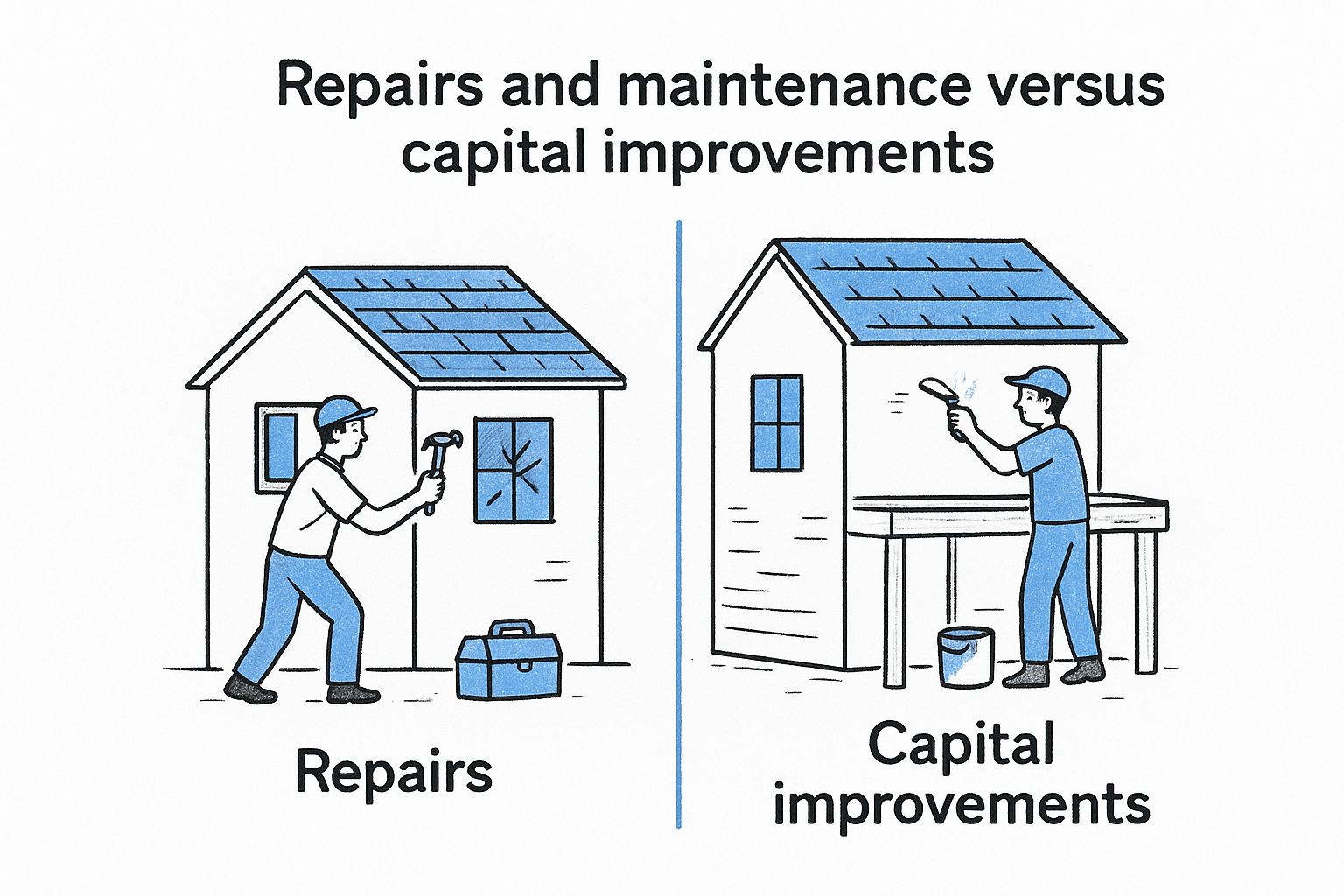
3. Repairs and maintenance versus capital improvements
This is where we see more disputes with the ATO than almost anywhere else on this list. Distinguishing a repair from a capital improvement determines whether you claim the full cost this year or spread it over several years, and getting it wrong is one of the most common allowable tax deductions for rental property errors landlords make.
What it covers
Genuine repairs restore something to its original condition, like fixing a broken window or patching a leaking roof. Capital improvements change or upgrade the asset, such as replacing a laminate kitchen bench with stone, or adding a deck that didn’t exist before. The ATO draws this line carefully, and it doesn’t always match common sense.
| Category | Example | Deduction |
|---|---|---|
| Repair | Replacing a broken tap | Immediate, full claim |
| Maintenance | Repainting faded walls | Immediate, full claim |
| Capital improvement | New bathroom renovation | Claimed over time as capital works |
How to claim it
Repairs and maintenance go straight onto your tax return in the year you pay for them. Capital improvements instead get added to your capital works schedule and depreciated over the relevant effective life, usually 40 years for structural work.
A repair restores what was already there; an improvement creates something better, and the ATO treats them completely differently.
Common mistakes to avoid
Investors often claim a full renovation as a repair because it happened alongside genuine repair work. Others miss that repairs done immediately after purchasing a run-down property are usually treated as capital, not deductible, because they’re considered part of the acquisition cost.
4. Depreciation on plant and equipment
Beyond the building itself, everything inside it wears out too, and that’s where depreciation on plant and equipment comes in. Carpets, hot water systems, air conditioners, blinds, ovens and dishwashers all lose value over time, and the ATO lets you claim that decline as a deduction each year, based on each asset’s effective life.

What it covers
Plant and equipment includes anything considered easily removable from the property, as opposed to fixed structural elements. Think ceiling fans, smoke alarms, garage door motors and freestanding furniture in a furnished rental. A crucial rule changed in 2017: if you bought a second-hand residential property, you generally can’t claim depreciation on plant and equipment that was already installed, only on new assets you purchase yourself afterwards. Commercial property and brand-new residential purchases are treated differently.
If your rental holds any plant or equipment, get a depreciation schedule before you assume there’s nothing left to claim.
How to claim it
A quantity surveyor prepares a depreciation schedule covering the full effective life of each asset, using either the diminishing value or prime cost method. This one-off report typically costs a few hundred dollars and is itself tax deductible, and it pays for itself within the first year for most established rentals.
Common mistakes to avoid
Landlords who bought an established property often assume they’ve lost this deduction entirely, when new appliances added since settlement still qualify. Others skip the schedule altogether, guessing values instead of using a compliant report, which invites ATO scrutiny during any review.
5. Capital works deductions
Separate from plant and equipment, capital works deductions cover the building’s structure itself: the bricks, concrete, roofing, and fixed fittings like kitchen cabinetry or built-in wardrobes. This is often the most overlooked item on any list of tax deductions for rental property, because the claim spreads across decades rather than landing in one lump sum, so it’s easy to forget it’s running in the background every year.
What it covers
Qualifying costs generally include the original construction cost of the property, plus any structural renovations, extensions, or fixed improvements made afterwards. Residential properties built after September 1987 typically qualify for a 2.5% annual deduction, spread over 40 years from the construction completion date, regardless of who built it or when you bought it.
How to claim it
Get a quantity surveyor’s report if the property was built within that 40-year window, since this document sets out the exact construction cost and annual deduction available. Your accountant then applies the relevant figure to your tax return each year without needing to revisit the calculation.
Capital works deductions run quietly in the background for decades, so missing the schedule means missing thousands over the life of the property.
Common mistakes to avoid
Buyers of older properties often assume no capital works deduction exists, when a later renovation by a previous owner may still qualify. Others estimate construction costs themselves rather than commissioning a proper report, and the ATO doesn’t accept guesswork here.
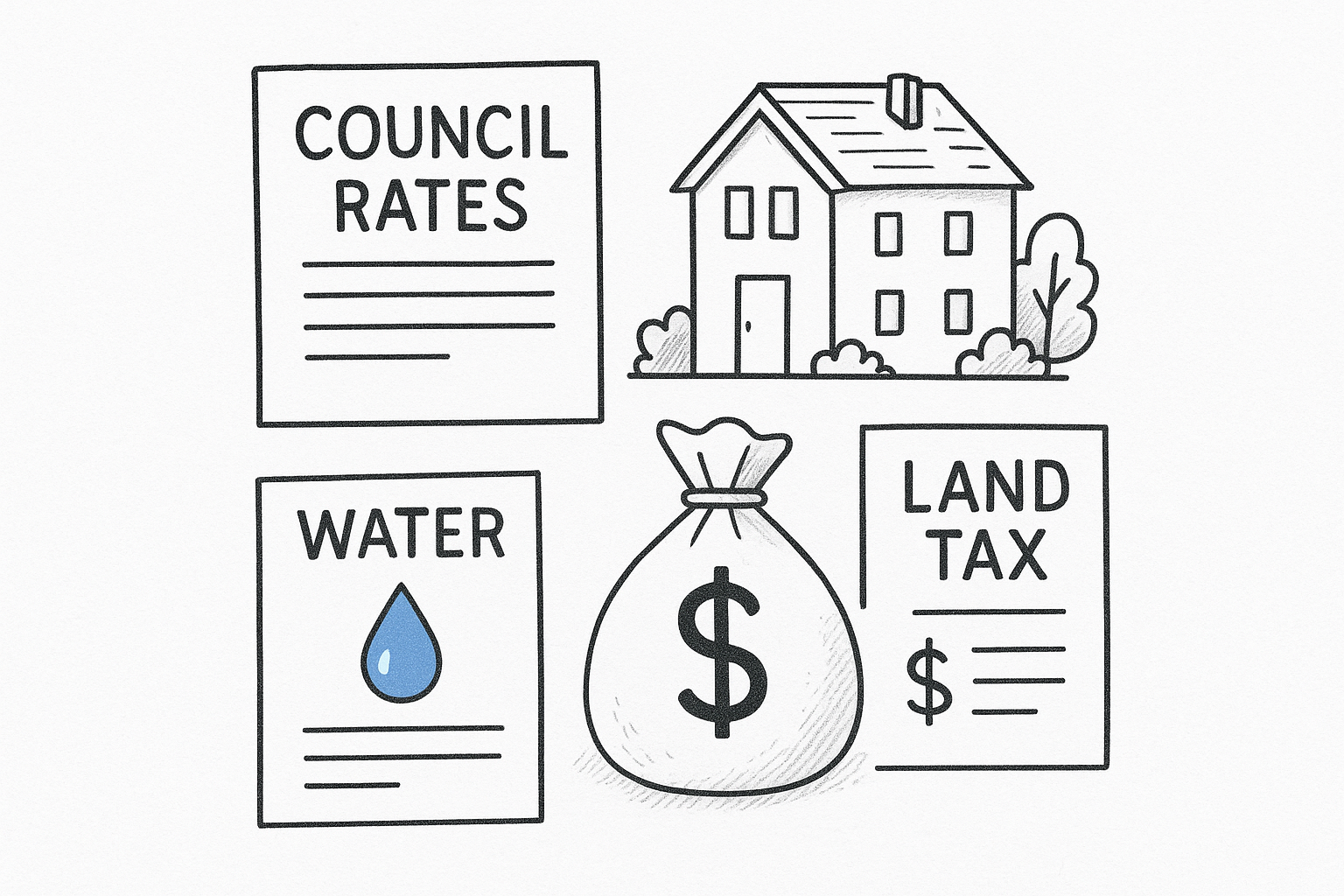
6. Council rates, water charges and land tax
Holding a rental property comes with a steady stream of statutory charges, and council rates, water charges and land tax sit among the simplest deductions to claim correctly, provided the property was rented or genuinely available to rent during the period you paid them. These aren’t glamorous claims, but they add up meaningfully across a full financial year, especially once land tax enters the picture on higher-value holdings.
What it covers
Council rates cover the local government charges tied to owning the property, while water charges include the fixed service fees your water authority bills, separate from usage charges a tenant typically pays themselves. Land tax, where it applies, is a state-based levy calculated on the unimproved value of your landholdings above a set threshold, and it’s fully deductible against the rental income the property generates.
How to claim it
Match each notice to the financial year it covers rather than the year you happened to pay it, since councils and water authorities often issue quarterly notices that straddle 30 June. Keep every notice, because your accountant needs the exact figures rather than an estimate from memory.
Council rates, water service fees and land tax are unglamorous but reliable deductions that reward careful record-keeping.
Common mistakes to avoid
Landlords sometimes claim water usage charges a tenant already reimbursed, effectively double-dipping on the same cost. Others forget land tax entirely, assuming it only applies to large commercial landholders, when many suburban investors cross the threshold once they own more than one property.
7. Insurance premiums
Landlords often underclaim here simply because they lump insurance premiums together as one annual cost rather than breaking out what’s actually covered. Landlord insurance, building insurance, and even contents insurance for a furnished rental are all deductible, and together they form a meaningful chunk of your rental property tax deductions each year.
What it covers
Building insurance protects the structure itself, while landlord insurance typically covers lost rent, tenant damage, and liability claims specific to renting out a property. If you supply furniture or appliances, a separate contents policy covering those items is deductible too. Even strata or body corporate insurance, where it’s charged as a distinct line item rather than bundled into general levies, counts as a claimable expense against your rental income.
How to claim it
Claim the premium in the financial year you pay it, even if the policy period stretches into the following year. Annual renewal notices from your insurer give you the exact figure, so keep these alongside your other property records rather than relying on a bank statement description that might not clearly identify the payment.
A landlord insurance premium usually costs a few hundred dollars and returns real protection alongside a straightforward deduction.
Common mistakes to avoid
Some investors assume home and contents cover on their own residence extends to a rental they own elsewhere, which it doesn’t. Others forget to claim the portion of a bundled multi-property policy that relates specifically to the investment property, effectively leaving a legitimate deduction sitting unclaimed on their tax return.
8. Borrowing costs
Separate from the interest itself, borrowing costs cover the expenses you paid to actually set up the loan, and they’re one of the most commonly missed rental property tax deductions because landlords assume interest is the only loan-related claim available. Where the total comes to more than $100, these costs get spread over five years or the loan term, whichever is shorter, rather than claimed in one hit.
What it covers
Typical borrowing costs include loan establishment fees, lender’s mortgage insurance, mortgage broker commissions passed on to you, title search fees, and the cost of preparing loan documents. Valuation fees required by the lender to approve the loan also qualify, though a valuation you commission for your own purposes doesn’t.
How to claim it
Add up every cost from your loan settlement statement and divide by five, or by the loan term if it’s shorter than five years. If you refinance or pay out the loan early, claim the remaining unclaimed balance in that final year rather than letting it lapse.
Borrowing costs under $100 are fully deductible immediately, but anything above that gets spread over five years.
Common mistakes to avoid
Landlords often lump borrowing costs in with interest and claim the whole amount upfront, which overstates that year’s deduction and understates future years. Others forget to close out the remaining balance when they refinance, leaving a legitimate claim unclaimed. Keep the original settlement statement, since it’s the only reliable source for these figures years later.
9. Advertising and other running costs
Beyond the major categories, a handful of smaller advertising and other running costs round out most rental schedules, and together they can add up to a decent claim if you track them properly. These are the costs that fall through the cracks because no single receipt looks significant on its own, yet across a full financial year they’re worth chasing down.
What it covers
Advertising for tenants, whether through a listing portal or a sign, is deductible in full. So are bank fees on the account you use to receive rent, accounting fees for preparing your rental schedule, tax agent fees, gardening and lawn mowing, pest control, cleaning between tenancies, and body corporate levies for general administration and maintenance. Travel to inspect your property is a common trap here: since 2017, most residential landlords can no longer claim travel expenses to visit their rental, regardless of the reason for the trip.
Small running costs rarely look impressive alone, but tallied across a year they’re a legitimate slice of your deduction.
How to claim it
Keep every invoice and receipt as it arrives rather than reconstructing them at tax time. A simple spreadsheet or a folder in your email works fine for most landlords.
Common mistakes to avoid
Landlords still claim travel costs out of habit, unaware the rules changed. Others forget accounting and tax agent fees are themselves deductible, or overlook body corporate special levies raised for capital works, which need separate treatment from ordinary admin levies.
10. Record-keeping and apportionment for mixed-use homes
Many landlords don’t run a straightforward rental. If you’ve lived in the property before renting it out, rented out a single room while staying there yourself, or used it as an Airbnb for part of the year, you’re dealing with mixed-use apportionment, and it changes almost every deduction on this list. Good record-keeping for rental property isn’t optional in these cases; it’s the only thing that lets your accountant work out what’s genuinely claimable.
What it covers
Apportionment applies to interest, rates, insurance, depreciation and utilities whenever a property serves both private and income-producing purposes during the year. A rental property tax deductions example worth remembering: a granny flat rented out while you live in the main house means you can only claim the percentage of costs tied to the rented floor space and the days it was tenanted.
Mixed-use ownership doesn’t disqualify you from deductions, it just demands a more careful calculation.
How to claim it
Calculate apportionment using floor area, number of rooms, or days rented, whichever method genuinely reflects how the property was used. Keep a simple diary noting occupancy dates and any private use, since the ATO expects a reasonable, documented basis rather than a rough guess.
Common mistakes to avoid
Owners often claim full deductions on a property that was only partly rented, or forget that private use by family and friends still counts as private, even at a discounted rate. Others skip the diary entirely and struggle to justify their apportionment years later during a review.
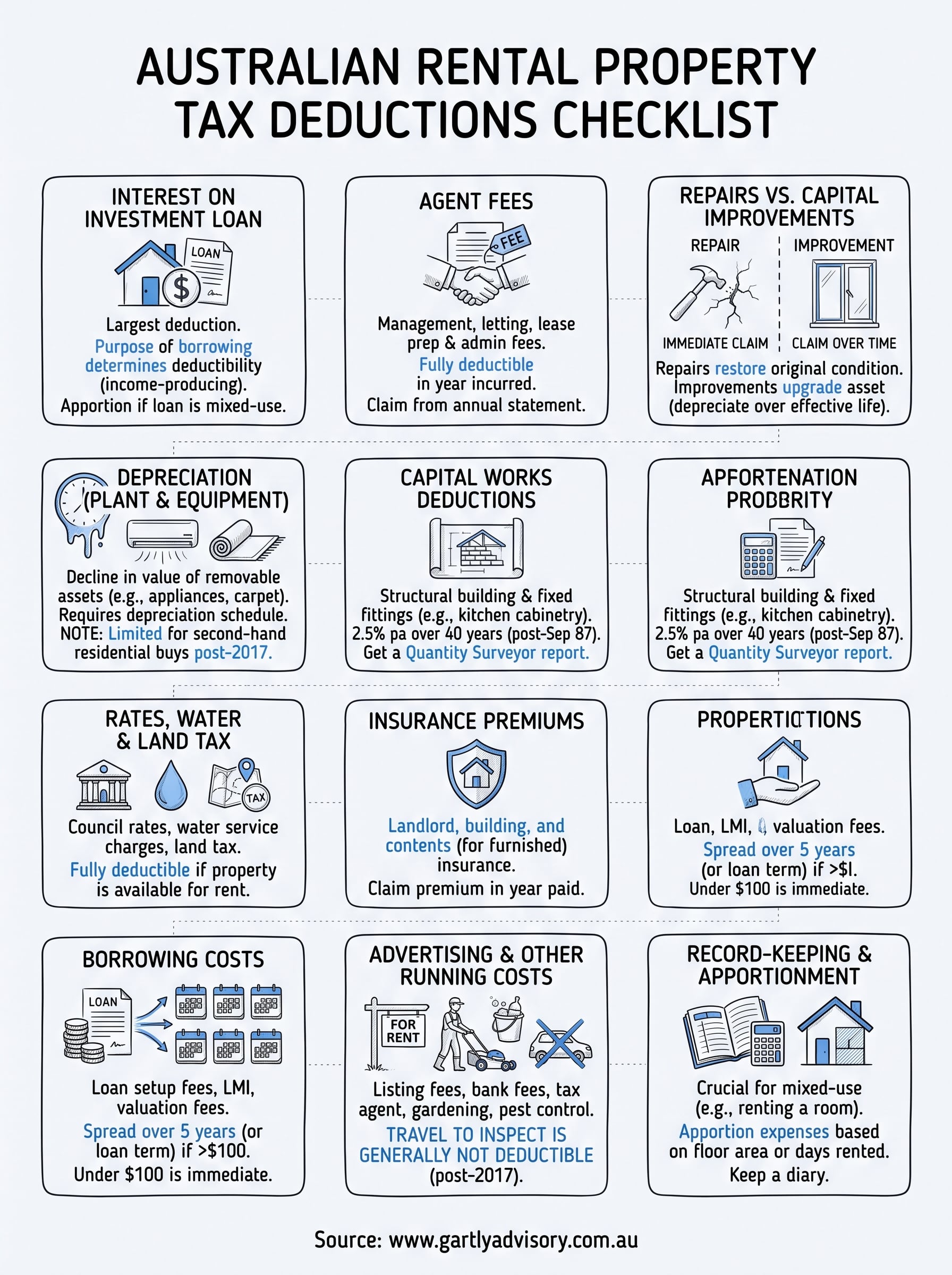
Getting your next tax return right
Run through this checklist before you lodge, and you’ll catch most of the errors that trigger an ATO review or leave money unclaimed. Rental property tax deductions reward landlords who keep clean records and apportion correctly, not those who guess or claim everything they can think of. The genuine opportunities sit in depreciation schedules, capital works reports, and borrowing costs, while the genuine risks sit in interest apportionment and repair versus improvement disputes.
If your situation involves mixed-use ownership, a recent renovation, or a loan you’ve refinanced, get a second opinion before you submit anything. A quick review from someone who reads rental schedules for a living often pays for itself many times over in deductions you’d otherwise miss. Geoff Gartly and the team at Gartly Advisory work with property investors across Melbourne every tax season, and we’d rather sort this out with you now than after the ATO comes knocking. Get in touch with Gartly Advisory to get your next return right.