
20 Tax Deductions for Rental Property Owners in Australia
If you own an investment property, you’re probably leaving money on the table at tax time. Most landlords claim the obvious costs, interest and agent fees, and stop there. But the full list of tax deductions rental property owners can claim runs much longer, and missing even a handful of them adds up to thousands of dollars a year across a portfolio.
This article gives you a straight answer to the question every landlord asks us: what can I actually claim? We’ve worked through hundreds of rental property returns for clients across Melbourne, and the same overlooked deductions show up again and again, things like depreciation schedules, borrowing costs, and travel to inspect a property. Getting these right isn’t about pushing the limits with the ATO. It’s about claiming what you’re legitimately entitled to.
Below you’ll find 20 deductions rental property owners in Australia can claim, along with practical notes on how to substantiate each one so your claim holds up if the ATO ever asks questions. If your situation involves multiple properties, renovations, or a mix of personal and rental use, this list is your starting point, and a good accountant is your next step.
1. Loan interest and borrowing costs
What it covers
Interest on your investment loan is usually the single biggest deduction a landlord claims each year. You can deduct the interest charged on your mortgage, provided the loan was used to buy, renovate or maintain the rental property. Borrowing costs are a separate category and include things like loan establishment fees, lender’s mortgage insurance, title search fees, and the cost of preparing and lodging mortgage documents. These borrowing costs deductions aren’t claimed all at once; if the total exceeds $100, you spread them evenly over five years or the loan term, whichever is shorter.
How to claim it
Grab your loan statements each June and separate the interest component from the principal repayments, since only the interest is deductible. If you’ve redrawn on the loan for a personal expense, like a holiday or a car, you need to apportion the interest, because only the portion relating to the rental property qualifies. Here’s a quick way to keep it straight:
- Keep a running log of any redraws and what they were used for
- Ask your lender for an annual interest statement specific to the investment loan
- List borrowing costs separately from interest in your records, since they’re claimed on a different schedule
- Carry forward any unclaimed borrowing cost balance to next year’s return
ATO rules and common mistakes
Mixed-purpose loans trip up more landlords than any other deduction on this list. If you’ve got one loan covering both your home and your rental property, or you’ve drawn extra funds for renovations on a different property, the ATO expects you to apportion interest based on how the funds were actually used, not how the loan is structured.
A single dollar of interest on a mixed-purpose loan is deductible only to the extent it funded the rental property, not the whole balance.
Another common error is claiming the full amount of borrowing costs in year one instead of spreading them, or forgetting about them entirely because they’re not itemised as clearly as interest on a bank statement. The ATO’s rental properties guide sets out exactly how interest apportionment works, and it’s worth reading before you lodge if your loan arrangements are anything but straightforward.
2. Property management and letting fees
What it covers
Most landlords who use a property manager pay a percentage-based fee, typically 5 to 9% of the rent collected, plus a separate letting fee when a new tenant signs on. Both are fully deductible in the year you pay them. This category also covers advertising costs for tenants, lease preparation fees, and the cost of tenant background checks if your agent charges these separately from the standard management fee.
How to claim it
Your property manager’s annual statement, often called an income and expenditure statement, lists every fee deducted from your rent throughout the year. Reconcile this against your bank deposits to confirm the figures before you hand anything to your accountant. If you manage the property yourself, keep every invoice for advertising, lease document fees, and any third-party tenant screening service, since there’s no annual summary doing the work for you.
- Request the annual statement from your agent each July
- Check that letting fees for new tenancies are itemised separately from ongoing management fees
- Keep self-managed advertising receipts in a dedicated folder
ATO rules and common mistakes
The self-managed landlord trap is the biggest issue here. Without an agent’s statement doing the reconciliation for you, it’s easy to lose track of smaller invoices, particularly for online listing fees or one-off advertising during a vacancy period.
If you self-manage, treat every advertising and letting expense like a receipt you’ll need to defend, because nobody else is tracking it for you.
Another mistake is double-counting fees already included in a bundled agent statement, such as claiming advertising separately when it’s already rolled into the management percentage shown on the statement.
3. Repairs versus capital improvements
What it covers
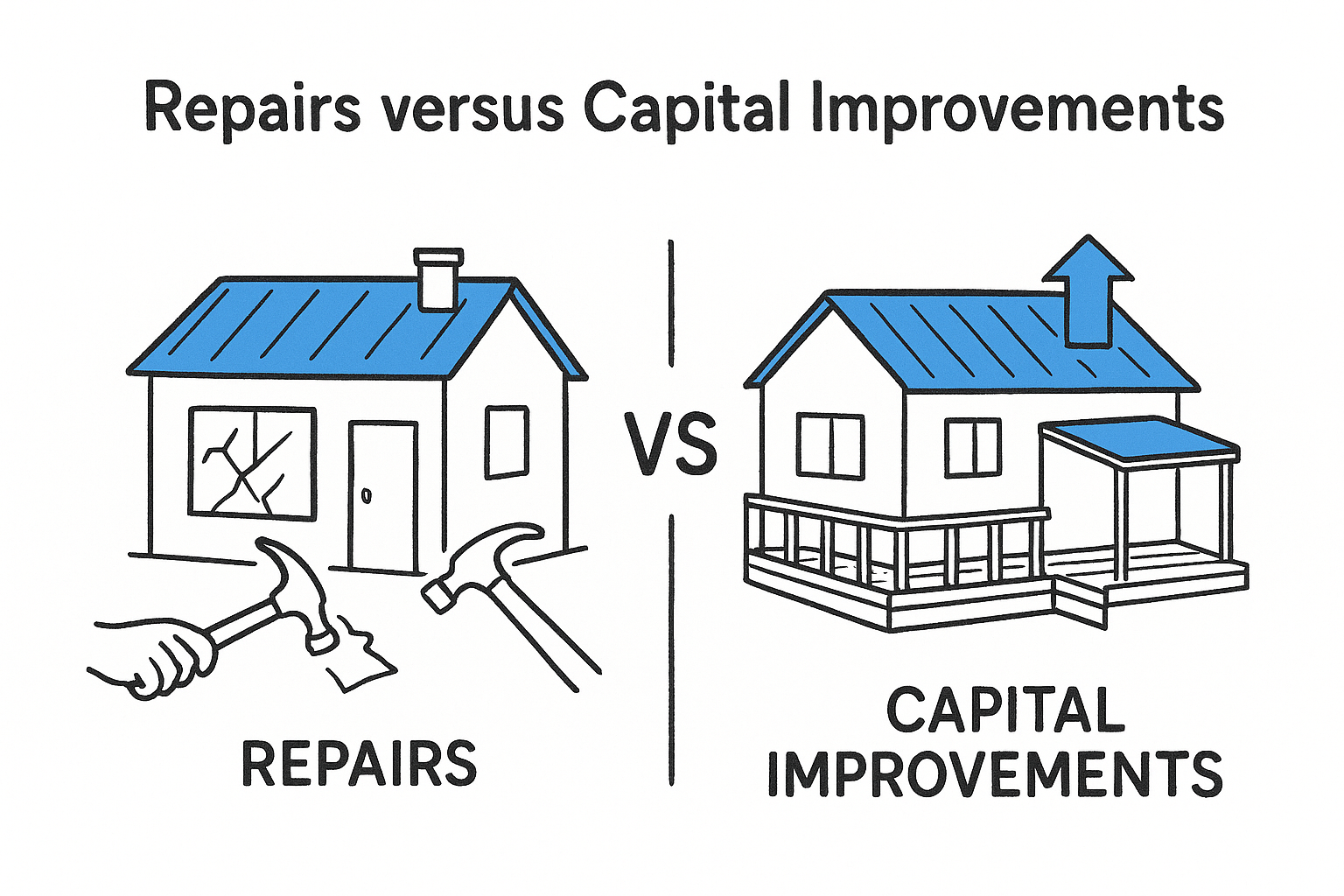
Repairs put a property back to the condition it was in before something broke, like fixing a cracked window or replacing a damaged section of guttering. These are immediately deductible repairs you claim in full the year you pay for them. Capital improvements are different: they upgrade or extend the property beyond its original state, think a new deck, a renovated kitchen, or an added carport. These fall under capital works deductions, claimed at 2.5% per year over 40 years, not all at once.
How to claim it
Sort every invoice into one of two piles the moment you receive it: repair or improvement. Ask yourself whether the work restored something or upgraded it, because that single question decides which tax treatment applies. Keep before-and-after photos where possible, particularly for larger jobs, since they help prove the work was a genuine repair rather than a renovation dressed up as one.
ATO rules and common mistakes
Initial repairs, fixing damage that existed when you bought the property, don’t count as immediate deductions at all. The ATO treats these as capital expenses, no matter how minor they seem.
A repair fixes what broke; an improvement makes something better than it was, and the ATO taxes each one completely differently.
Landlords also commonly lump an entire bathroom renovation into "repairs" because a leaking tap started the job, when only the tap fix qualifies for an immediate claim.
4. Depreciation on plant and equipment
What it covers
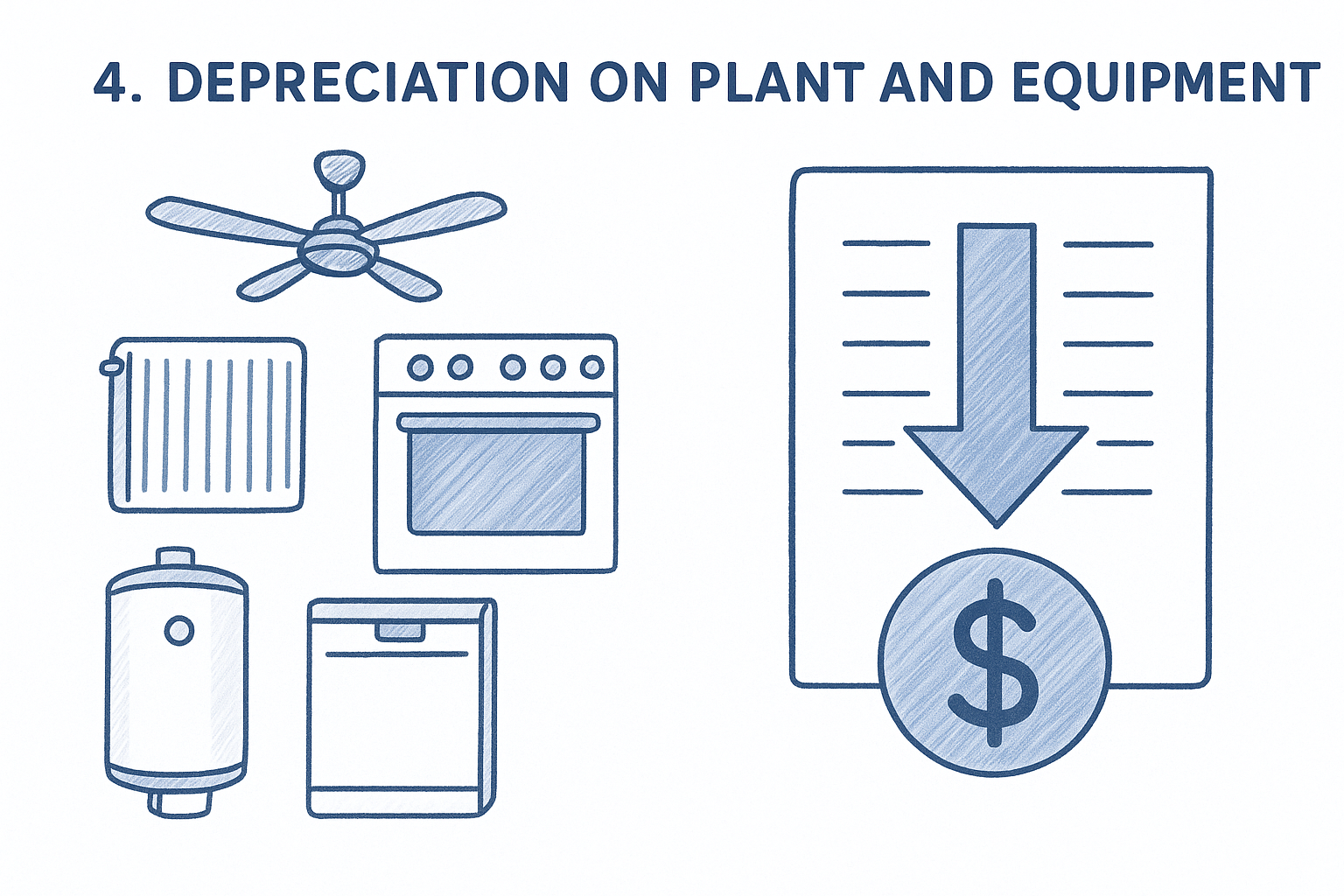
Plant and equipment depreciation applies to the removable, mechanical, and easily replaceable items inside your rental, things like carpets, blinds, ceiling fans, hot water systems, and dishwashers. Each item has an effective life set by the ATO, and you claim a portion of its value each year based on that life, using either the diminishing value or prime cost method.
How to claim it
Get a quantity surveyor’s depreciation schedule before you lodge your first return on the property. It lists every eligible asset, its value, and the annual deduction over its effective life, so you’re not guessing which method suits your situation. Update the schedule whenever you replace an item, since the old asset gets written off and the new one starts its own depreciation clock.
ATO rules and common mistakes
Rules changed sharply in May 2017. If you bought the property after 9 May 2017 and it already contained second-hand plant and equipment, you generally can’t depreciate those existing items at all, only assets you buy new yourself qualify.
Since 2017, buying an established rental with second-hand fittings usually means you inherit no depreciation on those items, only on what you install new afterwards.
The most common mistake is landlords assuming a quantity surveyor’s report automatically includes pre-existing second-hand assets when it doesn’t for post-2017 purchases, leading to inflated claims that don’t survive an ATO review.
5. Capital works deductions
What it covers
Capital works deductions cover the structural side of your property, the bricks, concrete, roofing, and fixed fittings that make up the building itself. This includes the original construction cost, plus any structural renovations like adding a room, replacing a roof, or rebuilding a fence. You claim these capital works deductions at a flat 2.5% each year over 40 years, which means a genuine construction expense keeps generating a deduction long after you’ve forgotten the invoice existed.
How to claim it
Work out the construction date first, since properties built before 15 September 1987 generally don’t qualify at all. For anything built after that date, a quantity surveyor’s report is the most reliable way to establish the original build cost, especially if you bought the property second-hand and never saw the builder’s invoice. Your accountant then applies the 2.5% rate against that figure every year until the 40-year window closes.
ATO rules and common mistakes
Getting the construction date wrong is the most frequent error we see, particularly with older properties that have had partial rebuilds. Landlords also sometimes try to claim capital works using estimates pulled from a real estate listing rather than a proper surveyor’s valuation, which won’t stand up if the ATO asks for evidence.
Without a quantity surveyor’s report, you’re guessing at a deduction the ATO expects you to prove with actual construction figures.
The ATO’s guide on capital works deductions sets out the eligible construction dates and rates in full.
6. Council rates, water rates and land tax
What it covers
Council rates, water rates, and land tax are ongoing holding costs that come with owning a rental property, and every dollar of them is deductible in the year you pay it. Council rates cover local government services tied to the property, while water rates deductions apply to the fixed supply charges and usage billed to you as the owner, not the tenant. Land tax, charged by your state revenue office once your landholdings pass a certain threshold, is fully claimable too, provided the property was rented or genuinely available to rent during that period.
How to claim it
Match each rates notice against your bank statement and file it under the financial year it was actually paid, not the year it was issued, since local councils often send notices a few weeks before the end of June. If your water usage is billed to the tenant directly through a separate account, only claim the portion you personally paid as the owner.
ATO rules and common mistakes
Apportionment causes most of the trouble here. If you lived in the property for part of the year or used it privately for a holiday, you can only claim rates and land tax for the period it was rented or genuinely available for rent.
You can’t claim a full year of council rates on a property you only rented out for six months.
Landlords also occasionally claim land tax on their own home by mistake when it’s bundled into a single assessment covering multiple properties.
7. Insurance premiums
What it covers
Landlord insurance protects you against tenant damage, lost rent, and public liability claims, and the full premium is deductible in the year you pay it. This includes building insurance, contents insurance for any furniture or appliances you supply, and specialised landlord insurance policies that cover things like malicious damage or a tenant defaulting on rent. If your policy bundles your rental cover with your home insurance, only the portion relating to the investment property counts.
How to claim it
Keep the renewal certificate and the payment receipt together each year, since insurers rarely itemise what’s covered on the bank statement description alone. If you paid a multi-year premium upfront to lock in a lower rate, check with your accountant about whether it needs to be apportioned across the years it actually covers rather than claimed entirely in the year of payment.
- File the annual renewal notice showing the premium breakdown
- Separate the rental cover from any bundled home and contents policy
- Note the cover period, not just the payment date
ATO rules and common mistakes
The ATO’s rental deduction rules require the property to have been rented or genuinely available to rent for the insurance to qualify, so a policy covering a property sitting vacant for personal use during part of the year needs apportioning.
A landlord insurance premium is only deductible for the stretch of the year the property was actually earning, or trying to earn, rental income.
Landlords also sometimes forget to claim the premium at all, assuming it’s bundled invisibly into their property manager’s statement when it’s usually paid separately.
8. Body corporate and strata fees
What it covers
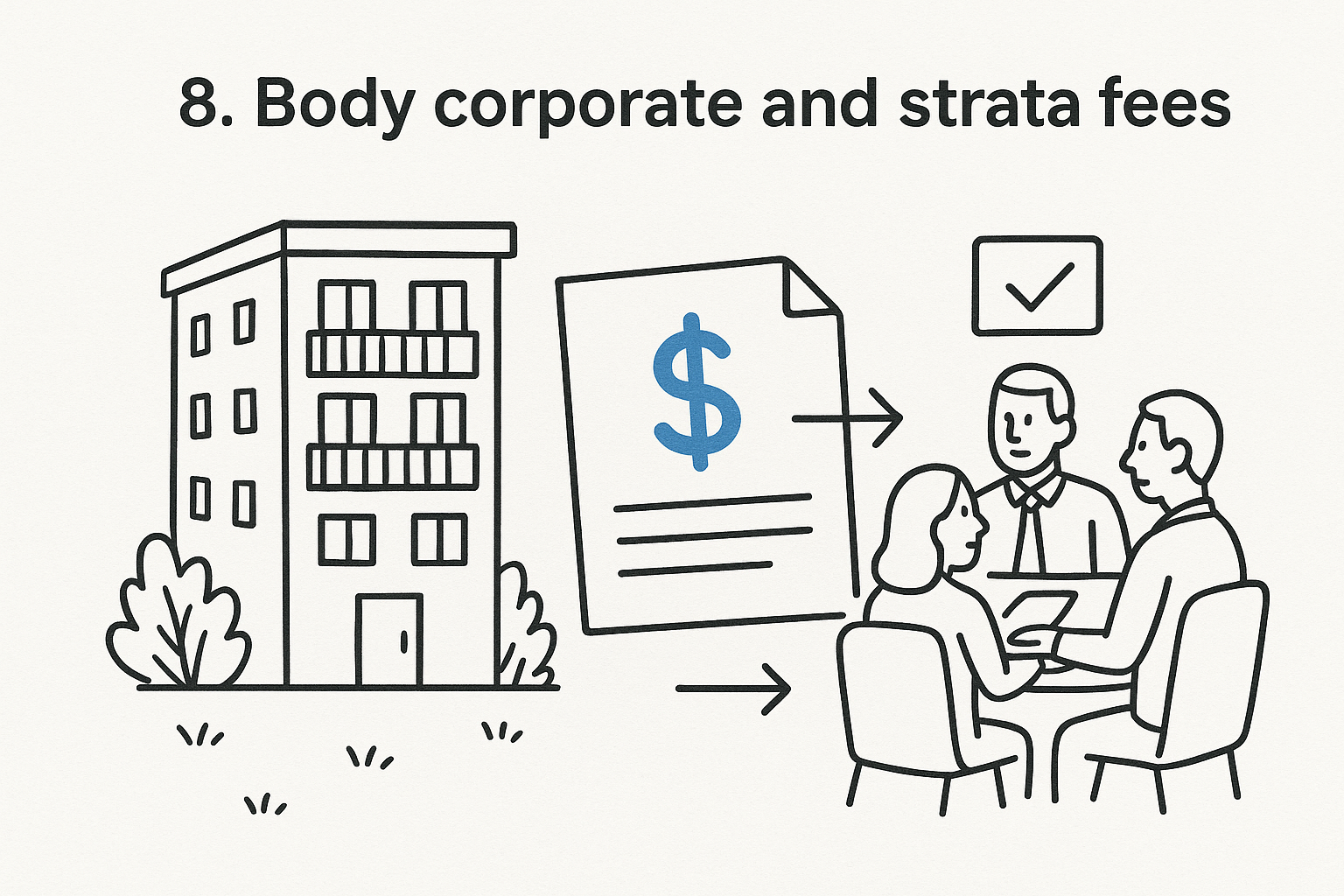
If your rental sits in a unit block or complex, you’re almost certainly paying body corporate fees to cover shared building costs like common area cleaning, building insurance, lift maintenance, and gardening for communal grounds. These strata levies are fully deductible in the year you pay them, provided they relate to general administration and upkeep rather than a special capital works fund. Among all the tax deductions rental property owners overlook, strata fees are surprisingly common victims of confusion, mainly because owners assume the whole levy is one lump sum with one tax treatment.
How to claim it
Split your annual levy notice into its component parts before claiming anything. Most strata statements separate the administrative fund from the capital works fund, sometimes called a sinking fund, and only the administrative portion gets claimed immediately as a standard deduction.
- Request an itemised levy statement from your strata manager each year
- Confirm which portion sits in the capital works fund
- File both quarterly notices and the annual summary together
ATO rules and common mistakes
Contributions to a capital works fund aren’t an immediate deduction at all. They’re generally only deductible when the strata committee actually spends that money on eligible capital works, and even then it usually flows through as a capital works deduction rather than a standard expense.
Paying into a sinking fund isn’t the same as claiming a deduction; the timing and category depend entirely on how that money gets spent.
Landlords frequently claim the entire annual levy upfront, missing this distinction and overstating their deduction for the year.
9. Pest control, gardening and property upkeep
What it covers
Routine upkeep, pest inspections, termite treatments, lawn mowing, and gutter clearing all count as fully deductible rental property maintenance costs. These aren’t repairs in the strict sense; they’re the ongoing running costs of keeping the property tenantable and protecting your asset from damage. A one-off termite treatment after an infestation is deductible the same way as a quarterly gardening contract, provided the cost relates directly to maintaining the rental rather than upgrading it.
How to claim it
Keep every invoice from your pest controller, gardener, or handyman, even the small ones, since these costs add up fast across a financial year. If a property manager arranges and pays for this work on your behalf, it usually shows up on the annual statement, so cross-check it against your own records before lodging.
- File pest and gardening invoices in the month you pay them
- Note whether the work was routine upkeep or a one-off treatment
- Reconcile agent-arranged maintenance against the annual statement
ATO rules and common mistakes
The property must have been rented or genuinely available to rent when the cost was incurred, so upkeep during a period of private use isn’t claimable. Owners also sometimes lump a significant landscaping overhaul, like installing new retaining walls, into gardening costs when it’s actually a capital improvement.
Mowing the lawn is maintenance; rebuilding the garden bed is a capital works claim, and mixing the two up understates or overstates your deduction.
10. Legal, accounting and tax agent fees
What it covers
Fees paid to prepare your tax return, specifically the portion relating to your rental property schedule, count as a deductible tax agent fee. Legal costs also qualify, but only when they’re tied to earning rental income, such as drafting a lease agreement, chasing unpaid rent through a tribunal, or evicting a difficult tenant. Legal fees deductions don’t extend to costs linked to buying or selling the property itself, since those sit in a completely different tax category.
How to claim it
Ask your accountant to itemise the invoice so the rental-related portion of the fee is clearly separated from your personal tax work. Keep every solicitor’s invoice tied to tenancy disputes or lease drafting, along with a short note explaining what the matter involved, since a bare invoice number rarely tells the ATO enough on its own.
- Request an itemised tax agent invoice each year
- File tribunal and eviction-related legal invoices separately from purchase paperwork
- Note the purpose of each legal matter alongside the invoice
ATO rules and common mistakes
Legal costs connected to acquiring, selling, or subdividing the property are capital in nature and can’t be claimed as an immediate deduction, no matter how the invoice is worded.
Chasing a tenant for unpaid rent is deductible; paying a conveyancer to buy the property never is.
Landlords also frequently claim their entire personal accounting fee against the rental property, when only the portion relating to the rental schedule qualifies under the ATO’s rental deduction guidance.
11. Advertising, stationery, phone and other running costs
What it covers
Small running costs rarely get their own line item in a landlord’s mental checklist, yet they’re just as deductible as the big-ticket items. Vacancy advertising on listing sites, printing lease documents, postage for tenant correspondence, and the portion of your phone and internet bill you use to manage the property all qualify. Even bank fees charged on the account you use to collect rent count here, provided that account is dedicated to the rental.
How to claim it
Build a simple log rather than relying on memory at tax time.
- Keep every advertising receipt from real estate portals or local classifieds
- Track phone and internet use with a rough percentage split between personal and rental purposes
- Save bank statements showing account-keeping fees on the rental’s dedicated account
- Note stationery and postage costs tied specifically to tenant paperwork
Apportioning your phone bill honestly matters more than getting a perfect figure. A reasonable estimate, backed by a note explaining your method, holds up far better than a round number with no logic behind it.
ATO rules and common mistakes
The ATO expects a reasonable apportionment for mixed-use costs like phones and internet, not a blanket claim of 100%, since almost nobody uses a personal mobile exclusively for one rental property.
Claiming your entire phone bill against one rental property rarely survives scrutiny, because almost no landlord uses that phone for nothing else.
Landlords also lose these deductions simply by not tracking them. Running cost deductions are individually small, but skipped consistently across a financial year, they quietly cost you hundreds of dollars.
12. Common expenses you can’t claim in full
What it covers
Some costs sit in a grey zone where only part of the expense relates to earning rental income. Travel to inspect your own property is one, since the ATO removed this deduction for most individual landlords back in 2017, though it still applies to some corporate owners. Private use apportionment also applies whenever you or family use the property for part of the year, whether that’s a beach house rented out for ten months and kept for Christmas, or a granny flat you occasionally stay in yourself.
How to claim it
Build a simple ratio before you touch your tax return: divide the days genuinely rented or available to rent by the total days in the year, then apply that percentage to every relevant expense.
| Expense type | Full claim allowed? | Notes |
|---|---|---|
| Travel to inspect property | No (individuals) | Removed for most landlords in 2017 |
| Rates during private use period | Partial | Apportion by days rented |
| Interest during vacant listing period | Yes | If genuinely available to rent |
ATO rules and common mistakes
Genuine availability matters more than intention. Listing a property at an unrealistic rent just to claim full deductions while secretly keeping it for personal use is a red flag the ATO actively checks.
Claiming a full year of deductions on a property you only rented for part of it is one of the fastest ways to trigger an ATO review.
Owners frequently overstate deductions by forgetting to apportion at all, assuming any rental use means every dollar qualifies.
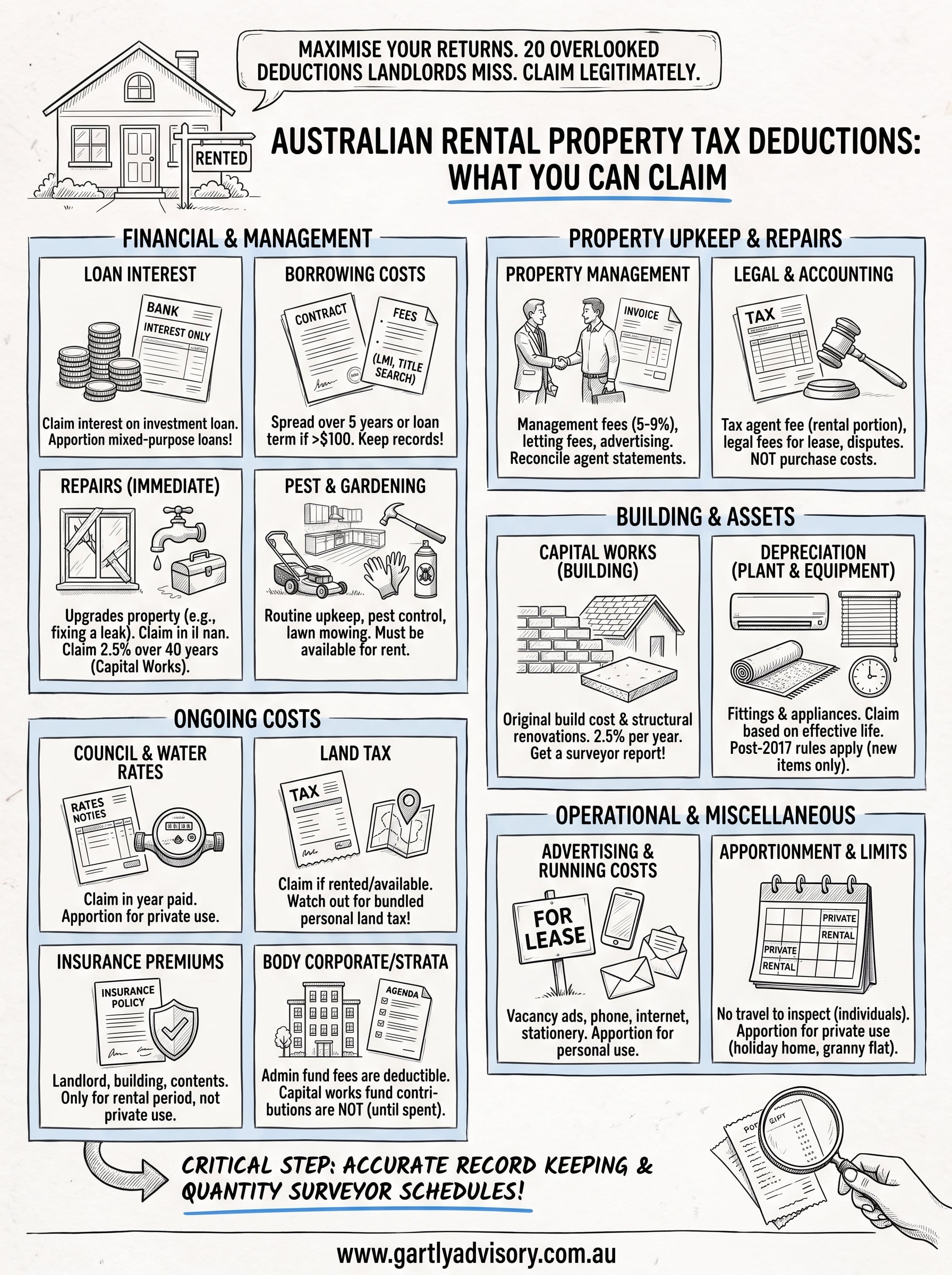
Keeping your rental deductions accurate and compliant
Twenty deductions is a lot to track across one financial year, and the gap between what you’re entitled to claim and what you actually claim usually comes down to record-keeping, not knowledge. The landlords who get the most back are the ones who file invoices as they arrive, split mixed-use costs honestly, and get a quantity surveyor’s depreciation schedule sorted before their first return rather than scrambling for one later.
This list gives you a solid starting point, but every portfolio has its own wrinkles, mixed-purpose loans, partial-year rentals, strata funds, renovations that blur the line between repair and improvement. That’s where a second set of eyes pays for itself many times over.
Geoff Gartly and the team have worked through this exact list with hundreds of Melbourne landlords, and we know where the ATO looks twice. If you want your rental return done properly this year, get in touch with Gartly Advisory and we’ll go through your property line by line.