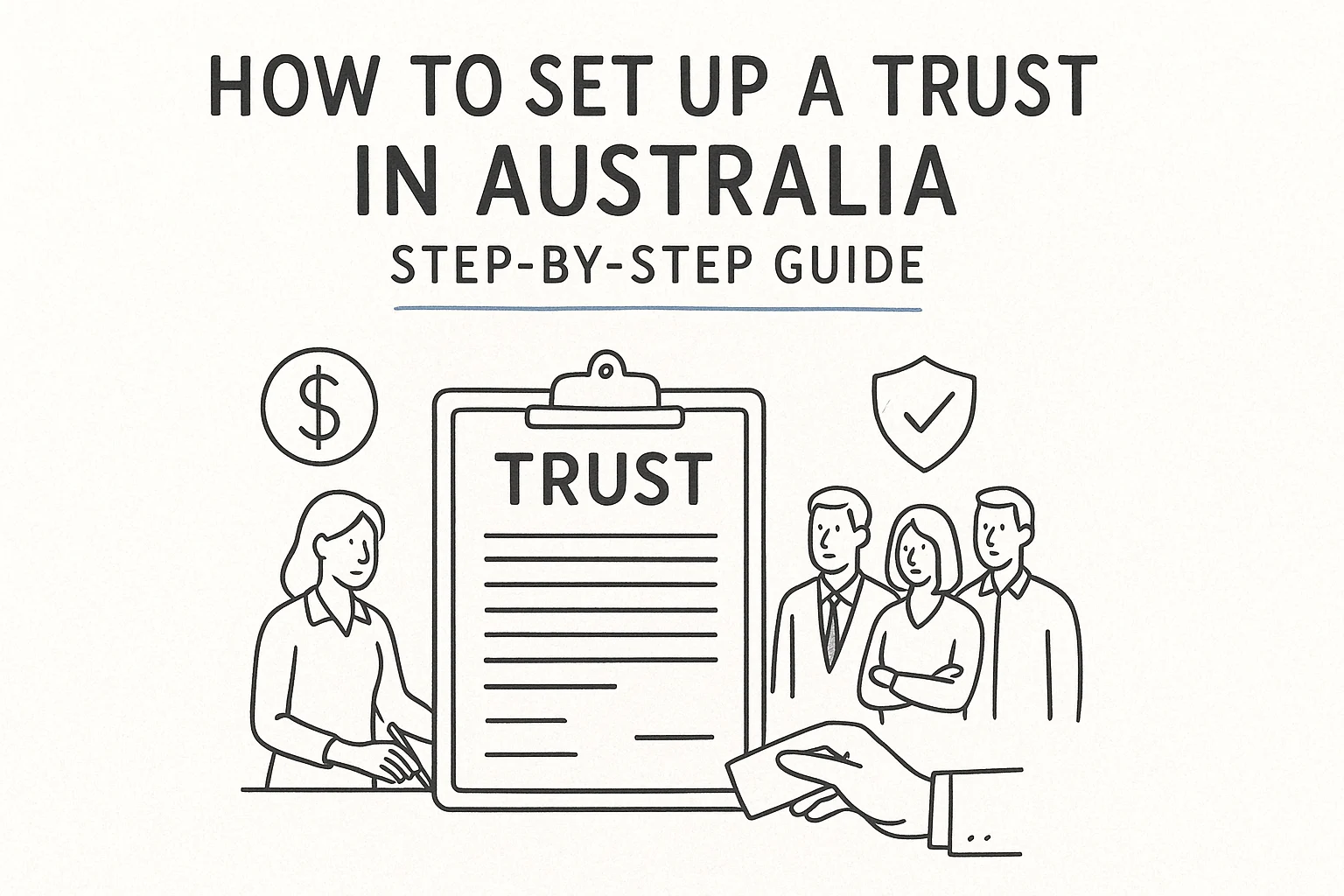
How to Set Up a Trust in Australia: Step-by-Step Guide
Setting up a trust sounds complicated until someone walks you through it properly. If you’re researching how to set up a trust in Australia, you’re probably weighing up asset protection, tax planning, or a cleaner way to pass wealth to your family, and you want to know exactly what’s involved before you commit any money to the process.
This guide answers that question directly. We’ll walk through the step-by-step process, much like our step-by-step guide to setting up a family trust, from choosing the right trust structure and appointing a trustee, through to drafting the trust deed and registering with the ATO. You’ll also get a realistic picture of setup costs and ongoing compliance obligations, so there are no surprises once the trust is running.
At Gartly Advisory, we set up and manage trusts for Melbourne business owners and families every year, and we’ve seen what goes wrong when people rush the paperwork or pick the wrong structure. This guide draws on that hands-on experience to give you a clear, practical path, whether you’re establishing a discretionary family trust, still working out how a family trust actually works, or considering a structure to protect business assets.
What is a trust and why set one up in Australia?
A trust is a legal arrangement where one party, the trustee, holds and manages assets on behalf of another party, the beneficiary. Unlike a company, a trust isn’t a separate legal entity in its own right. It’s a relationship governed by a trust deed and, in Australia, by state-based trust law and the Trustee Acts that apply in each jurisdiction. That distinction matters because it shapes how a trust structure is taxed, how liability flows, and what obligations the trustee carries once the trust is running.
The legal relationship behind a trust
Every trust involves a handful of defined roles, and getting these right from the outset avoids headaches later. The trustee holds legal ownership of the trust’s assets and makes the day-to-day decisions. The settlor is the person who establishes the trust by contributing the initial trust property, usually a small nominal sum. The beneficiaries are the people or entities who benefit from the trust’s income or assets. Many trusts also have an appointor, who holds the power to remove or replace the trustee, which is often the real position of control in a family arrangement.
| Role | What they do |
|---|---|
| Trustee | Manages trust assets, makes distribution decisions, signs contracts on the trust’s behalf |
| Settlor | Establishes the trust with an initial gift, then generally has no further involvement |
| Beneficiary | Receives income or capital distributions as set out in the deed |
| Appointor | Holds the power to appoint or remove the trustee |
Why business owners and families use trusts
Most of our clients set up a trust for one of three reasons: asset protection, tax flexibility, or succession planning. A family trust, or discretionary trust as it’s also known, lets the trustee distribute income to different beneficiaries each year, which can reduce the household’s overall tax bill when family members sit on different marginal rates. Business owners often use a trust to separate personal assets from business risk, so a lawsuit or creditor claim against the business doesn’t automatically put the family home held in a trust on the line. Families planning ahead also use trusts to control how wealth passes to the next generation, without the assets sitting exposed in a will that becomes public through probate.
A trust doesn’t eliminate tax or risk, it gives you a legal structure to manage both more deliberately.
Ownership through a trust also gives you continuity that individual ownership doesn’t. If a beneficiary divorces, goes bankrupt, or passes away, assets held properly in a discretionary trust are generally better shielded than assets held in someone’s personal name. That’s a key reason trades professionals, franchise operators, and property investors come to us specifically to explore how to set up a trust in Australia correctly rather than trying to retrofit protection after a problem has already surfaced.
Trusts versus other business structures
Regularly, clients ask whether a trust or a company suits them better, and the honest answer is that it depends on your goals. When you’re weighing up a trust against a company, a company offers a flat tax rate and clear separation of ownership through shares, while a trust offers more flexibility in how profits get distributed and stronger asset protection for family wealth. Many established businesses actually run a hybrid setup, with a trading trust operated by a corporate trustee, capturing benefits from both structures. We’ll unpack the specific trust types available, and how to pick between them, in the next step.
Step 1. Choose the right type of trust
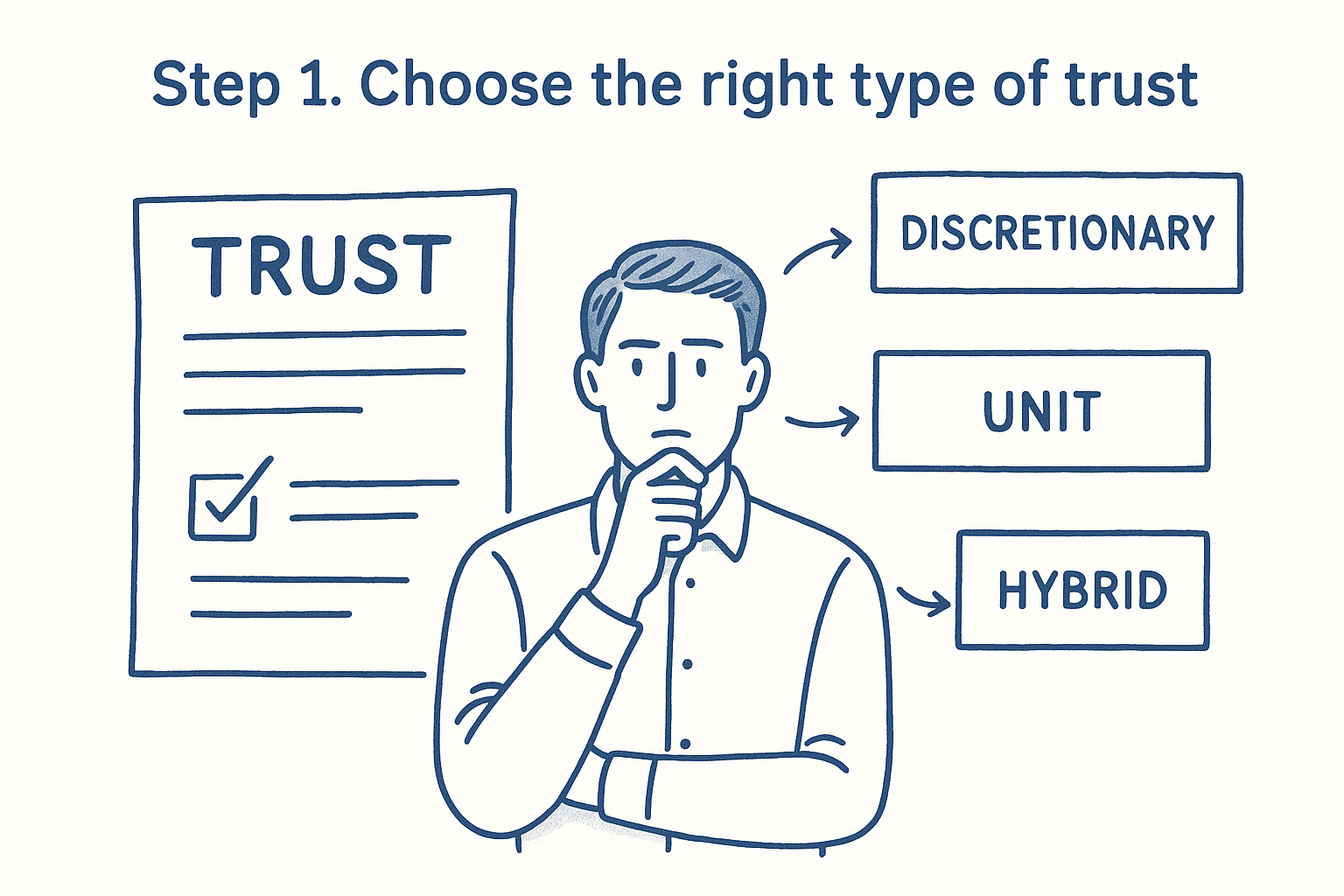
Before you sign anything, work out which structure actually matches your goals, because switching trust types later means winding up the old one and starting again, with all the cost and disruption that involves. Australian law recognises several categories of trust, but four come up again and again in our client work: discretionary, unit, hybrid, and testamentary trusts. Each one distributes income differently and suits a different situation, so it’s worth getting specific advice before you commit to a trust structure you’ll be living with for years.
Discretionary, unit, and hybrid trusts compared
A discretionary family trust gives the trustee full control over how much income or capital each beneficiary receives in a given year, which makes it the go-to choice for family tax planning and asset protection. A unit trust works more like a company, splitting the trust into fixed units that determine each beneficiary’s share, which suits unrelated parties running a joint venture or investment together, and it’s worth understanding how unit trusts compare to discretionary trusts before you choose. A hybrid trust blends the two, offering fixed units alongside some discretionary income, though lenders and the ATO scrutinise these more closely.
| Trust type | Best suited to | Income distribution |
|---|---|---|
| Discretionary (family) trust | Families, business owners, asset protection | Flexible, trustee decides each year |
| Unit trust | Unrelated investors, joint ventures | Fixed, based on unit holding |
| Hybrid trust | Complex ownership with some flexibility | Mixed fixed and discretionary |
| Testamentary trust | Estate planning, inheritances | Set out in the will, flexible for beneficiaries |
Matching the structure to your goal
Once you’ve reviewed the table, think about what you actually need the trust to do. If tax flexibility across family members is the priority, a discretionary trust almost always wins. If you’re bringing in an unrelated business partner or investor, a unit trust gives everyone clarity over their exact entitlement.
Pick the trust type based on what you need it to achieve, not on what a friend or competitor happens to use.
Specifically for business owners, we often recommend a discretionary trust with a corporate trustee, which we cover in the next step, because it adds a further layer of liability protection. If your trust question actually relates to superannuation, that’s a separate conversation entirely, best handled through proper SMSF setup and management rather than a standard family trust structure.
Step 2. Appoint a trustee
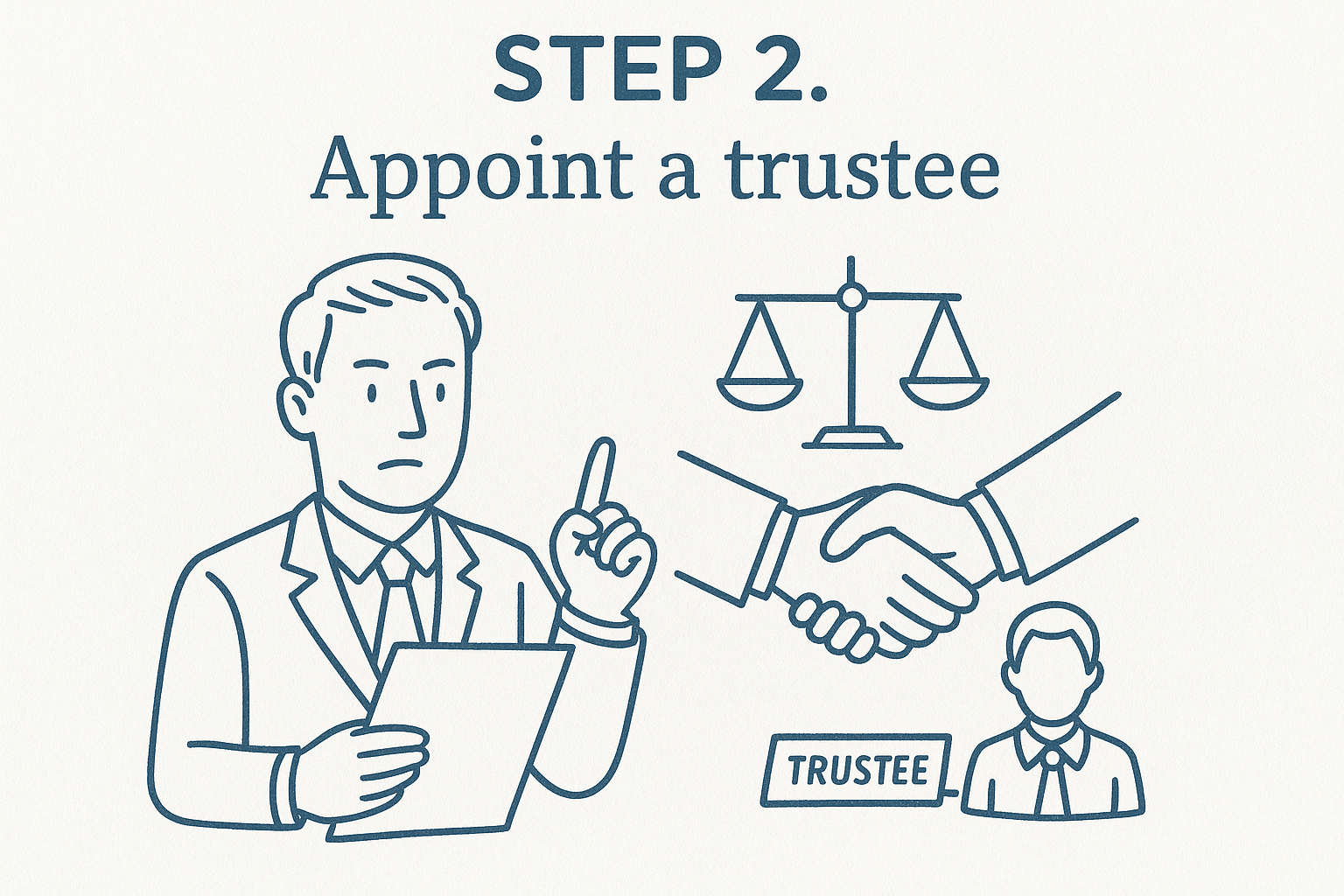
Once you know which trust structure suits you, the next decision is who actually runs it. The trustee carries legal ownership of every asset in the trust and personal liability for the decisions made in that role, so this isn’t a job to hand to just anyone. You can appoint an individual trustee or set up a corporate trustee, and for most business owners we work with, the corporate option wins because it separates trustee liability from personal assets far more cleanly.
Individual trustee vs corporate trustee
Before you decide, weigh up the practical differences between the two options, because the choice affects everything from asset protection to how easily the trust survives a change in personal circumstances.
| Factor | Individual trustee | Corporate trustee |
|---|---|---|
| Liability exposure | Personal assets at risk | Limited to company assets |
| Setup cost | Lower, no company needed | Higher, requires ASIC company registration |
| Continuity | Trust may need reworking if trustee dies or leaves | Company structure continues regardless of personnel changes |
| Asset protection | Weaker | Stronger, generally preferred for business trusts |
Generally, a corporate trustee costs more upfront because you’re setting up a company structure through ASIC specifically to act in that role, but the extra layer of protection is worth it once real assets or business risk are involved. Small family trusts with modest assets sometimes stick with an individual trustee to keep costs down, though we’d rarely recommend it once a business is trading through the structure.
What the trustee is legally responsible for
Whoever or whatever you appoint, the trustee’s obligations are set out clearly under trust law and don’t shift once the deed is signed. Specifically, a trustee must:
- Act in the best interests of the beneficiaries, not their own
- Keep trust assets separate from personal or business assets
- Maintain proper financial records and lodge tax returns
- Make distribution decisions in line with the trust deed each year
- Avoid conflicts of interest when dealing with trust property
The trustee you appoint today is the person, or company, carrying legal risk for every decision the trust makes from here on.
Thinking this through properly before the deed is signed saves a lot of restructuring later, and it’s exactly the sort of decision worth running past an adviser who works with outsourced CFO services day to day.
Step 3. Appoint a settlor and identify your beneficiaries
With your trustee sorted, turn your attention to two roles that are easy to underestimate: the settlor and the beneficiaries. The settlor is the person who technically creates the trust by contributing the initial trust property, often just $10 or $20, and signing the deed as the founder of the arrangement. Beneficiaries are everyone the trust exists to benefit, and how you define this group shapes the trust’s flexibility for decades to come.
Choosing a settlor with no ongoing role
Critically, the settlor must have no further involvement in the trust once it’s established, and should never be a trustee, beneficiary, or appointor of the same trust. Courts and the ATO look closely at this separation, because a settlor who keeps control can undermine the trust’s legal standing and expose it to challenge. For this reason, we usually recommend using an unrelated party, such as the accountant’s office manager or a family friend, purely to sign the initial settlement and then step away permanently.
A settlor who stays involved after the trust starts is a red flag that can unravel the whole structure.
Defining who benefits from the trust
Once the settlor’s role is locked in, work through exactly who should be named as a beneficiary. Most discretionary family trusts name a primary beneficiary along with a broad class of general beneficiaries, which gives the trustee room to distribute income flexibly each year without needing to amend the deed every time family circumstances change. Typical beneficiary classes include:
- The primary beneficiary, usually the person establishing the trust for their family’s benefit
- Their spouse, children, and grandchildren
- Related companies or other trusts controlled by the family
- Charities, if you want the option to distribute for philanthropic purposes
Specifically, avoid naming individuals too narrowly. A trust that only lists two named children, for example, can’t easily distribute to a future daughter-in-law or a new grandchild without a formal variation, which costs time and money. Broader, well-drafted beneficiary classes give the trustee genuine discretion later, which is the entire point of setting up a discretionary structure in the first place. If your family situation is complex, such as blended families or an intended handover of business assets, it’s worth getting proper advice on estate planning for your family before the deed is finalised, since beneficiary definitions interact directly with how the trust eventually passes on wealth.
Step 4. Draft and sign the trust deed
Now that the roles are settled, the trust deed itself is the document that turns all those decisions into a legally binding structure. The trust deed sets out the trustee’s powers, how income and capital can be distributed, what happens if a trustee resigns or dies, and the rules for winding up the trust eventually. Get a solicitor or an experienced adviser to draft this rather than downloading a generic template online, because a poorly worded deed can limit the trustee’s discretion in ways that undermine the entire reason you set the trust up.
What the trust deed must cover
Properly drafted deeds cover a consistent set of clauses, even though the wording varies between providers. At minimum, expect the deed to address:
- The trust’s name and the date it commences
- The identity of the settlor, trustee, and appointor
- The class of beneficiaries and how they’re defined
- The trustee’s powers to invest, borrow, and distribute income or capital
- The vesting date, which is when the trust must legally end (Australian trusts generally can’t run longer than 80 years)
- Procedures for replacing a trustee or appointor
A trust deed is only as strong as its weakest clause, so don’t let cost-cutting on legal drafting undo everything else you’ve set up correctly.
Signing, dating and stamping the deed
After the drafting is finalised, the settlor signs the deed first, contributing the nominal settlement sum, followed by the trustee accepting their appointment in writing. Every signature needs a witness who isn’t a party to the trust, and the deed should be dated on the day of execution, not backdated to suit a financial year or tax position. Attempting to backdate a trust deed is a serious compliance risk, and the ATO actively checks execution dates against other evidence when reviewing trust distributions.
Securely, once signed, the original deed becomes the trust’s most important legal document, and losing it creates real headaches down the track when banks, the ATO, or a buyer’s solicitor ask to see it. Store the original somewhere fireproof, keep certified copies with your accountant and any bank you deal with, and record the execution date clearly, because that date drives the next step: settling the trust, paying stamp duty, and registering with the ATO.
Step 5. Settle the trust, pay stamp duty and register with the ATO
Settlement happens the moment the settlor hands over the nominal sum, usually $10, to the trustee, and the trustee formally accepts it in writing on the deed. This small step is what actually brings the trust into legal existence, separate from simply having a signed document sitting in a drawer. Only once settlement occurs can you move on to the state and federal obligations that make the trust operational, which is why this stage always follows drafting rather than happening at the same time.
Paying stamp duty on the trust deed
Depending on which state you’re in, stamp duty on a discretionary trust deed can range from a flat nominal fee to a percentage-based charge, so check the current rules through your state revenue office before you assume it’s a non-issue. Victoria currently charges no duty on establishing a standard discretionary trust deed, but Victorian stamp duty rules can still apply if the trust acquires dutiable property, such as real estate, soon after settlement. New South Wales and Queensland apply their own thresholds and exemptions, so don’t rely on advice from a friend interstate.
Never assume your trust deed is duty-free just because someone else’s was, check your own state’s rules before you sign.
Registering the trust with the ATO
Once settlement is confirmed, the trustee needs to register the trust with the Australian Taxation Office to obtain the identifiers it needs to operate legally. Practically, that means working through the following:
- Apply for a Tax File Number (TFN) for the trust
- Register for an Australian Business Number (ABN) if the trust will carry on a business or hold investments actively
- Register for GST if turnover is expected to exceed $75,000 a year
- Register for PAYG withholding if the trust will employ staff
Submitting these applications together through the Australian Business Register speeds things up, since the ABN and TFN applications share most of the same information. Typically, a corporate trustee also needs its own separate TFN and ABN if it holds assets or operates in its own right, which catches out plenty of business owners who assumed one set of numbers covered everything. Getting registrations right from day one avoids the ATO flagging inconsistent trust distributions later, which is exactly the kind of scrutiny you want to avoid when you’re relying on a trust for genuine asset protection.
What it costs and how to stay compliant each year
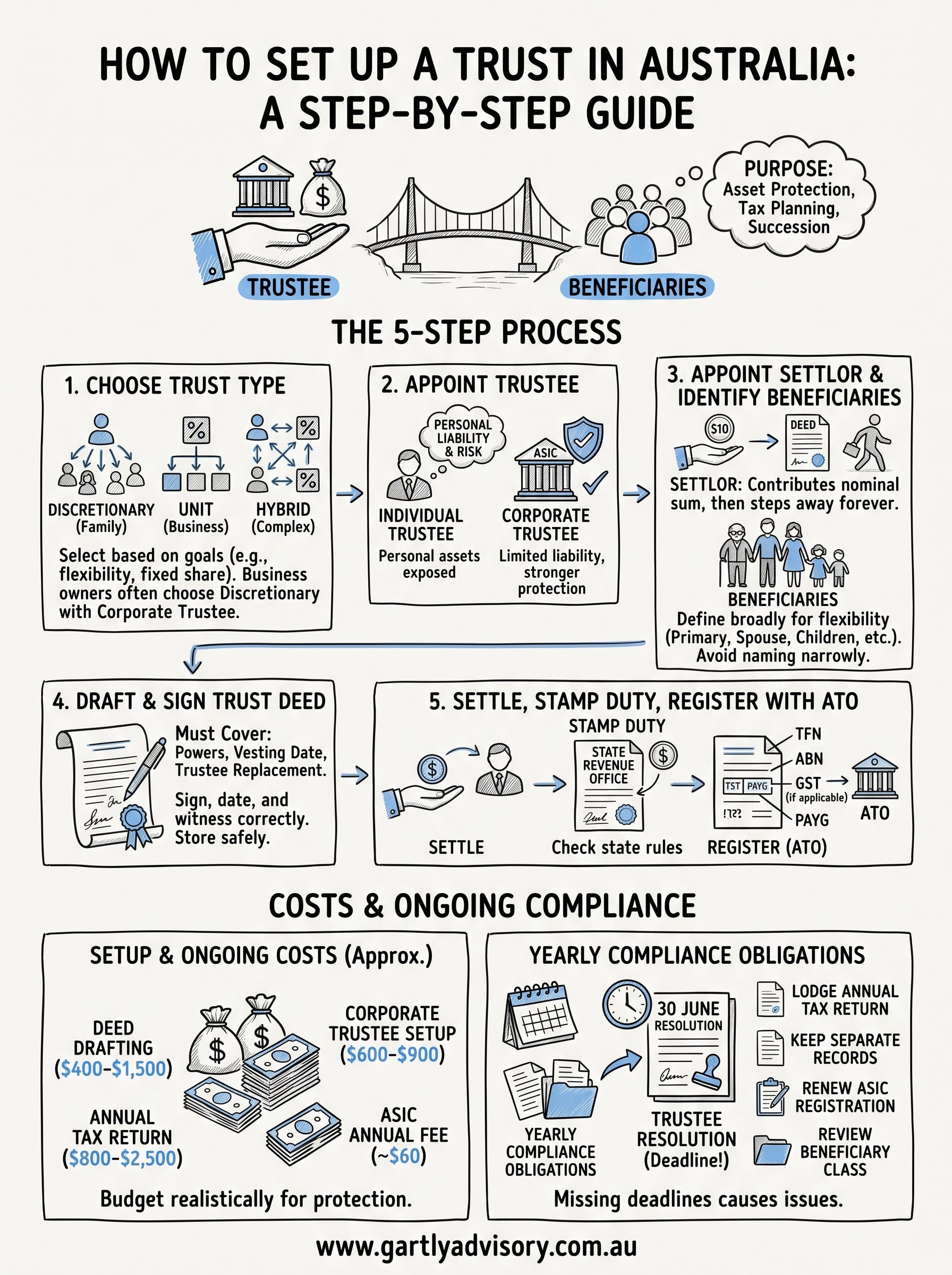
Budget realistically before you commit, because the cost of setting up a trust in Australia varies more than most people expect depending on the structure and who drafts the deed. A basic discretionary trust with an individual trustee, drafted through an online provider, might run to a few hundred dollars, while a discretionary trust with a corporate trustee, drafted by an accountant or solicitor and including ASIC registration, typically lands between $1,500 and $3,000. Ongoing costs then include annual accounting fees, ASIC’s yearly review fee for the corporate trustee, and any state land tax surcharges that apply to trust-held property.
What you’ll actually pay
Table below sets out the typical figures we quote Melbourne clients, though your state and structure will shift these numbers slightly.
| Item | Typical cost |
|---|---|
| Trust deed drafting | $400 to $1,500 |
| Corporate trustee (ASIC registration) | $600 to $900 setup, plus annual review fee |
| Stamp duty (varies by state) | $0 to $500+ |
| Annual tax return and financial statements | $800 to $2,500 depending on complexity |
| ASIC annual review fee | Approximately $60 (subject to indexation) |
A trust that isn’t budgeted for properly on an ongoing basis stops being an asset protection tool and starts being an annual headache.
Staying compliant year after year
Compliance doesn’t stop once the trust is registered, and this is where we see the most trusts fall down in practice. Each year, the trustee needs to:
- Lodge the trust’s annual tax return with the ATO, even if no income was distributed
- Prepare a trustee resolution before 30 June deciding how income will be distributed, since missing this deadline can see the trust taxed at the top marginal rate
- Keep the trust’s financial statements and minutes up to date and separate from personal or business records
- Renew the corporate trustee’s ASIC registration annually
- Review the beneficiary class periodically to check it still reflects the family’s or business’s current circumstances
Specifically, that end-of-June trustee resolution catches out more business owners than any other requirement, because it has a hard deadline tied to the financial year rather than the tax return lodgement date. Working with an adviser who provides business advisory services in Melbourne throughout the year, rather than only at tax time, keeps these deadlines from slipping through the cracks.
Getting your trust off to the right start
Getting a trust right the first time saves you thousands in restructuring costs down the track, and it protects the assets you’re setting out to protect. You now know the real sequence: pick the right trust structure, appoint a trustee who can actually carry the legal responsibility, settle the deed properly, and register with the ATO before you assume the trust is operational. Skipping any one of those steps, or rushing the deed to save a few hundred dollars, tends to cost far more later when the ATO or a court starts asking questions.
Knowing how to set up a trust in Australia is one thing, but running it well for the next thirty years is another matter entirely. That’s where an experienced adviser earns their fee, catching the trustee resolution deadline, keeping registrations current, and making sure the structure still fits your family or business as things change. If you want that support from the start, talk to Gartly Advisory about setting your trust up properly through our advisory services for Melbourne business owners.