
Chartered Accountant vs. Accountant: What’s the Real Difference for Your Business?
As your business grows, so does the complexity of your financial world. It’s a common concern for ambitious owners: is my current advisor equipped to handle what’s next? You see various titles and qualifications, and the difference between a general accountant and a Chartered Accountant can seem unclear, leaving you to wonder if you’re getting the strategic guidance your business truly needs to thrive. This uncertainty can be costly, leading to missed opportunities or, worse, poor advice when you need it most.
We believe you deserve clarity and confidence in your financial partners. In this article, we’ll move beyond the titles to provide straightforward guidance on the crucial differences in qualifications, expertise, and the long-term value each professional offers. We want to empower you to make the best choice for your company’s future, ensuring you have a trusted advisor who can support your journey, not just balance your books. Let’s explore what sets a Chartered Accountant apart and determine the right level of support for your success.
The Foundations: Understanding the Role of a General Accountant
When navigating the complex world of business matters, many owners start by looking for an accountant. However, it’s crucial to understand that in Australia, the term ‘accountant’ is unprotected-meaning anyone can use the title, regardless of their qualifications. A professional accountant, however, provides the essential groundwork for your financial health. Understanding the difference between a general accountant chartered accountant is the first step in finding the right partner for your business journey.
While a general accountant is fundamental, the path to other designations is far more structured. You can explore a global perspective in this helpful Chartered accountant overview, which highlights the rigorous standards involved in higher-level certifications.
To better understand these foundational roles, watch this helpful video:
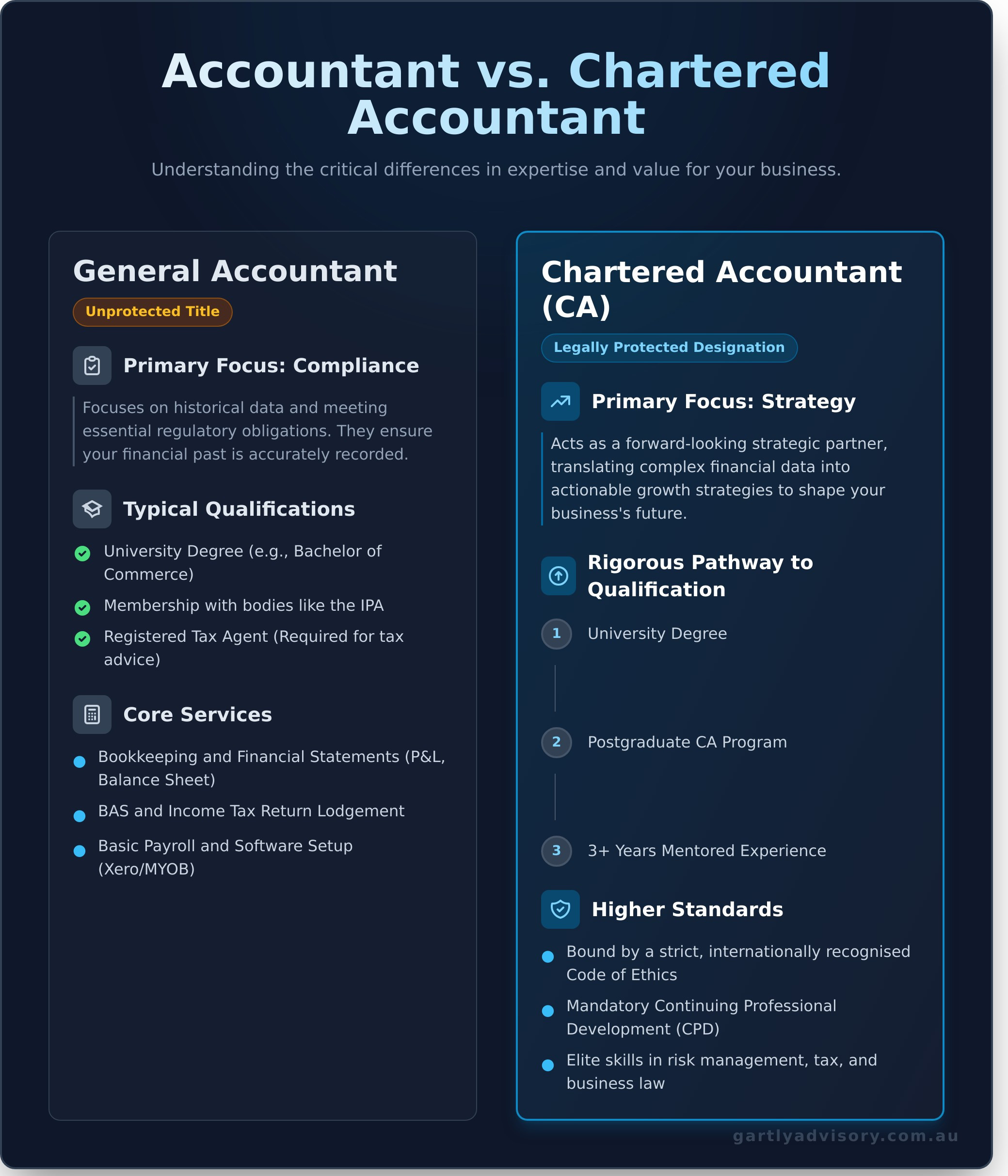
The core focus of a general accountant is often on historical data and compliance tasks. They are the trusted professionals who manage day-to-day financial record-keeping, ensuring your books are accurate and that you meet your basic obligations to the Australian Taxation Office (ATO). Their work provides a clear, reliable picture of what has already happened in your business financially, forming a stable foundation for your operations.
Common Qualifications and Memberships
A reputable accountant in Australia will have a solid educational background and relevant registrations that provide assurance of their expertise. Look for professionals who hold:
- A university degree, such as a Bachelor of Commerce or Bachelor of Business with a major in Accounting.
- Membership with a professional body like the Institute of Public Accountants (IPA).
- Crucially, registration as a Tax Agent with the Tax Practitioners Board (TPB), which is legally required to provide tax advice and lodge returns on your behalf.
Typical Services Provided
The services offered by a general accountant are vital for maintaining financial order and meeting regulatory requirements. Their support is typically centred on recording your financial past with precision and includes:
- Bookkeeping and the preparation of key financial statements like the Profit & Loss and Balance Sheet.
- Lodgement of Business Activity Statements (BAS) and end-of-year income tax returns.
- Basic payroll processing and assistance with setting up accounting software such as Xero or MYOB.
The Higher Standard: What Sets a Chartered Accountant (CA) Apart?
While both accountants and Chartered Accountants work with numbers, the CA designation is a legally protected title that represents a significantly higher standard of expertise, ethics, and professional commitment. It’s not just a job title; it’s a mark of distinction earned through years of intensive study and practical application. Understanding the key distinctions that separate a standard accountant from an accountant chartered accountant is crucial when seeking a trusted partner to provide guidance for your financial future.
Rigorous Postgraduate Education: The CA Program
To become an accountant chartered accountant, one must complete the demanding postgraduate CA Program through Chartered Accountants Australia and New Zealand (CA ANZ). This goes far beyond a standard university degree, focusing on complex, real-world business challenges rather than just theory. The program is designed to develop elite skills in strategic thinking, complex problem-solving, and risk management, ensuring CAs possess a deep understanding of the most intricate areas of tax, ethics, and business law.
Mandatory Mentored Experience
Academic knowledge is only one piece of the puzzle. To earn their designation, candidates must complete a minimum of three years of approved employment under the direct supervision of an experienced CA mentor. This mandatory mentorship bridges the critical gap between theory and practice. It guarantees that every CA has extensive, hands-on experience navigating real client issues, providing practical solutions, and delivering tangible results long before they qualify.
Code of Ethics and Continuous Development
A commitment to integrity is at the core of the CA designation. CAs are bound by a strict, internationally recognised Code of Ethics that governs their professional conduct. This commitment is central to the profession’s official definition and standards and provides clients with an essential layer of trust and accountability. To maintain their status, CAs must also undertake mandatory Continuing Professional Development (CPD) each year. This ensures they are always:
- Current: Up-to-date with the latest changes in tax law, regulations, and business trends.
- Objective: Providing impartial advice focused solely on your best interests.
- Accountable: Upholding the highest standards of professional integrity.
From Compliance to Strategy: How a CA Delivers Greater Business Value
While many business owners see an accountant as someone who lodges tax returns and reports on past performance, a Chartered Accountant (CA) is trained to be a forward-looking strategic partner. Their value extends far beyond compliance; they are equipped to help you shape your business’s future. The rigorous training and ethical standards required, as outlined in the official ICAEW definition of a chartered accountant, create professionals who can translate complex financial data into actionable growth strategies. This is the ‘beyond the numbers’ approach that truly drives success.
The difference between a standard accountant and a chartered accountant often lies in this proactive, strategic mindset, which delivers tangible value in several key areas.
Strategic Tax Planning and Structuring
A CA moves beyond simple tax returns to proactively minimise your tax liability. This involves providing expert guidance on the most effective business structure for your goals-be it a sole trader, company, or trust. They possess deep expertise in complex areas like Capital Gains Tax (CGT) concessions and can identify tax-saving opportunities that are easily missed, ensuring your structure is always working to your best advantage.
Navigating Business Growth and Complexity
As your business grows, so does its complexity. A CA acts as your trusted guide, providing crucial support for sustainable expansion. This includes:
- Developing robust cash flow management systems, budgets, and financial forecasts.
- Conducting accurate business valuations for sales, mergers, or succession planning.
- Assisting with securing financing and preparing your business to be investment-ready.
- Offering expert advice for specialised industries like property development or franchising.
Specialised Advisory Services
Chartered Accountants are often licensed to provide advice in highly regulated and complex areas. In Australia, this includes specialised guidance on Self-Managed Super Funds (SMSF), helping you navigate compliance while maximising your retirement strategy. They can also assist with long-term wealth creation, estate planning, and act as a calm, objective advisor during major business decisions or disputes. This high-level partnership is where a CA’s value becomes truly indispensable. See how our advisory services can help your business grow.
Decision Guide: Do You Need an Accountant or a Chartered Accountant?
Choosing the right financial professional is a crucial decision for your business’s health and future. The best choice depends entirely on your current stage, the complexity of your finances, and your long-term ambitions. Are you focused on straightforward compliance, or are you seeking a strategic partner to help navigate growth? Understanding the distinction between a general accountant chartered accountant is the first step. Remember, the right advice is an investment that pays for itself many times over by identifying opportunities and mitigating risks.
When a General Accountant May Be a Good Fit
For businesses at the very beginning of their journey or with very simple structures, a general accountant can provide essential services without a significant financial outlay. They are often a practical choice in these situations:
- You are a new sole trader with straightforward income and expenses.
- Your primary need is basic bookkeeping and annual tax lodgement.
- Your business operations are simple, with no trusts or complex company structures.
- Your budget is extremely limited and your compliance needs are minimal.
When to Partner with a Chartered Accountant
As your business evolves, its financial landscape becomes more complex. This is the point where the strategic guidance and rigorous training of a Chartered Accountant become invaluable. Consider partnering with a CA if:
- Your business is growing and facing more complex financial or tax challenges.
- You manage multiple entities, family trusts, or investment properties.
- You need strategic advice on tax planning, business growth, or a future exit strategy.
- You have a Self-Managed Super Fund (SMSF) or are considering starting one.
Quick Comparison Table: CA vs. Accountant
| Feature | General Accountant | Chartered Accountant (CA) |
|---|---|---|
| Title Protection | The title “Accountant” is not legally protected in Australia. | Legally protected title; requires membership with Chartered Accountants Australia & New Zealand (CA ANZ). |
| Education | Varies; can range from a TAFE diploma to a university degree. | An approved university degree, plus completion of the rigorous, post-graduate CA Program. |
| Experience | No mandated practical experience is required to use the title. | A minimum of three years of approved, mentored practical experience. |
| Ethics | Adheres to general professional standards. | Bound by CA ANZ’s strict Code of Ethics and continuous professional development requirements. |
| Best For… | Basic compliance, simple tax returns, and straightforward bookkeeping. | Strategic advice, complex tax planning, business growth, SMSFs, and assurance services. |
Ultimately, the decision rests on whether you need someone to simply report on the past or a trusted partner to help you build the future. If you’re ready to move beyond basic compliance and focus on strategic growth, the expertise of a Chartered Accountant is a powerful asset. Talk to our team to see how we can support you on your journey.
Your Next Step: Partnering with a Strategic Financial Advisor
Choosing your financial advisor is a pivotal decision for your business’s future. While a general accountant is essential for compliance, the real difference lies in strategic value. Understanding the distinction between a standard accountant chartered accountant expertise is the first step towards unlocking your business’s true potential. A CA doesn’t just manage your books; they provide forward-thinking guidance to help you seize opportunities and navigate challenges with confidence.
If you’re ready to move beyond the numbers and partner with a proactive advisor, Gartly Advisory is here to help. With over 35 years of professional experience, 70+ 5-Star Google Reviews, and certification as a Business Valuebuilder Advisor, we have the proven expertise to support your journey towards success.
Take the next step in securing your business’s financial future. Schedule a complimentary consultation with a Chartered Accountant today. Let us be your trusted partner in building a stronger, more profitable business.
Frequently Asked Questions
What is the difference between a Chartered Accountant (CA) and a Certified Practising Accountant (CPA)?
In Australia, both CAs and CPAs are highly respected and qualified professionals. The key difference lies in their training focus. The Chartered Accountant (CA) program, governed by CA ANZ, has a strong emphasis on technical accounting, audit, and complex financial advisory. The Certified Practising Accountant (CPA) program often has a broader focus on business management, strategy, and leadership. Both require extensive education, experience, and ongoing professional development to maintain their designation.
Is a Chartered Accountant more expensive than a regular accountant?
While hourly rates for a Chartered Accountant may be higher, it’s essential to consider the value provided. This fee reflects extensive postgraduate education, rigorous training, and a commitment to ongoing professional development. For complex financial matters or strategic business advice, the investment in a CA can lead to greater savings and opportunities, offering a superior return. The cost ultimately depends on the complexity of your needs, not just the professional’s title.
How can I verify if an accountant is a registered Chartered Accountant?
Verifying a professional’s credentials is a crucial step in building trust. To confirm if an individual is a registered Chartered Accountant, you can use the official online directory provided by Chartered Accountants Australia and New Zealand (CA ANZ). Simply visit their website and search for the member’s name. This ensures you are partnering with a qualified professional who is held to the highest ethical and professional standards, giving you complete peace of mind.
Do I need a Chartered Accountant to manage my Self-Managed Super Fund (SMSF)?
While you don’t legally need a CA to manage your SMSF, the Australian Taxation Office (ATO) requires an annual audit by a registered SMSF auditor. Given the complex compliance rules and severe penalties for breaches, partnering with a specialist is highly advisable. A Chartered Accountant with SMSF expertise provides the strategic guidance and support needed to navigate regulations, manage investments, and ensure your fund remains compliant, protecting your retirement savings.
Can a general accountant provide business advisory services?
Many general accountants can provide basic business advice, often focused on compliance and tax. However, a key difference between a general accountant and a Chartered Accountant is the depth of strategic advisory training. CAs are specifically trained to go “beyond the numbers,” offering proactive guidance on business growth, risk management, and long-term strategy. For true business partnering and forward-looking advice, a professional with dedicated advisory expertise is invaluable.
At what stage of business growth should I switch to a Chartered Accountant?
You should consider engaging a Chartered Accountant when your business faces increasing complexity or is poised for significant growth. Key triggers include hiring your first employees, seeking investment or financing, planning for expansion, or navigating complex tax structures like capital gains or R&D incentives. A proactive CA becomes a vital partner at this stage, providing the strategic financial guidance needed to seize opportunities and manage growth effectively on your journey towards success.