
A Guide to Setting Up an ATO Payment Plan for Your Business
Navigating your business’s financial obligations can be complex, and facing a significant tax debt is a challenge no owner wants to tackle alone. The pressure from the Australian Taxation Office can feel immense, causing genuine stress about penalties, interest, and your company’s cash flow. We understand this challenge and are here to provide support. The good news is that you have a clear path forward. Proactively arranging an ATO payment plan is a responsible and effective way to manage your tax debt and protect your business from further action.
As your trusted partner in business matters, we have created this comprehensive guide to give you the clarity and confidence you need. We will walk you through the entire process step-by-step, from preparing your application to understanding what to say. Our goal is to help you secure a manageable arrangement that gets the ATO off your back, preserves your cash flow, and allows you to regain control and focus on your success.
What Is an ATO Payment Plan and Are You Eligible?
Falling behind on your tax obligations can be a stressful experience for any business owner. However, it’s important to view this not as a failure, but as a manageable financial challenge. An ATO payment plan is a formal agreement between your business and the Australian Taxation Office (ATO) that allows you to pay off an outstanding tax debt in smaller, regular instalments over an agreed period.
The ATO generally prefers to work collaboratively with businesses to find a solution rather than taking immediate punitive action. This proactive approach helps you manage your cash flow while staying compliant within the broader Australian taxation system. These arrangements can cover various business tax debts, including Business Activity Statements (BAS), income tax, and Fringe Benefits Tax (FBT).
For a quick overview of how these plans work, the video below offers some helpful insights:
Key Eligibility Criteria for Businesses
While every situation is assessed individually, the ATO has established criteria for businesses to quickly set up a payment plan, particularly through its online services. To be eligible for a streamlined process, your business generally needs to meet the following conditions:
- Have an existing tax debt of less than A$100,000.
- Have no defaulted on an ATO payment plan within the last two years.
- Ensure all required activity statements and tax returns have been lodged.
- Demonstrate the ability to meet the proposed ongoing instalment payments.
If your debt exceeds A$100,000 or you don’t meet these criteria, you can still negotiate a plan by contacting the ATO directly or having a trusted partner like an accountant do so on your behalf.
Understanding General Interest Charge (GIC)
It is crucial to understand that while a payment plan is in place, interest will likely continue to accumulate on the unpaid amount. This is known as the General Interest Charge (GIC). Entering into an arrangement prevents the ATO from applying harsher penalties for late payment, but the GIC still accrues daily on the outstanding balance until it is paid in full.
In certain limited circumstances, such as illness or natural disaster, it may be possible to request a remission of the GIC. However, this is not guaranteed and requires a strong case. Professional guidance can be invaluable when navigating these complexities.
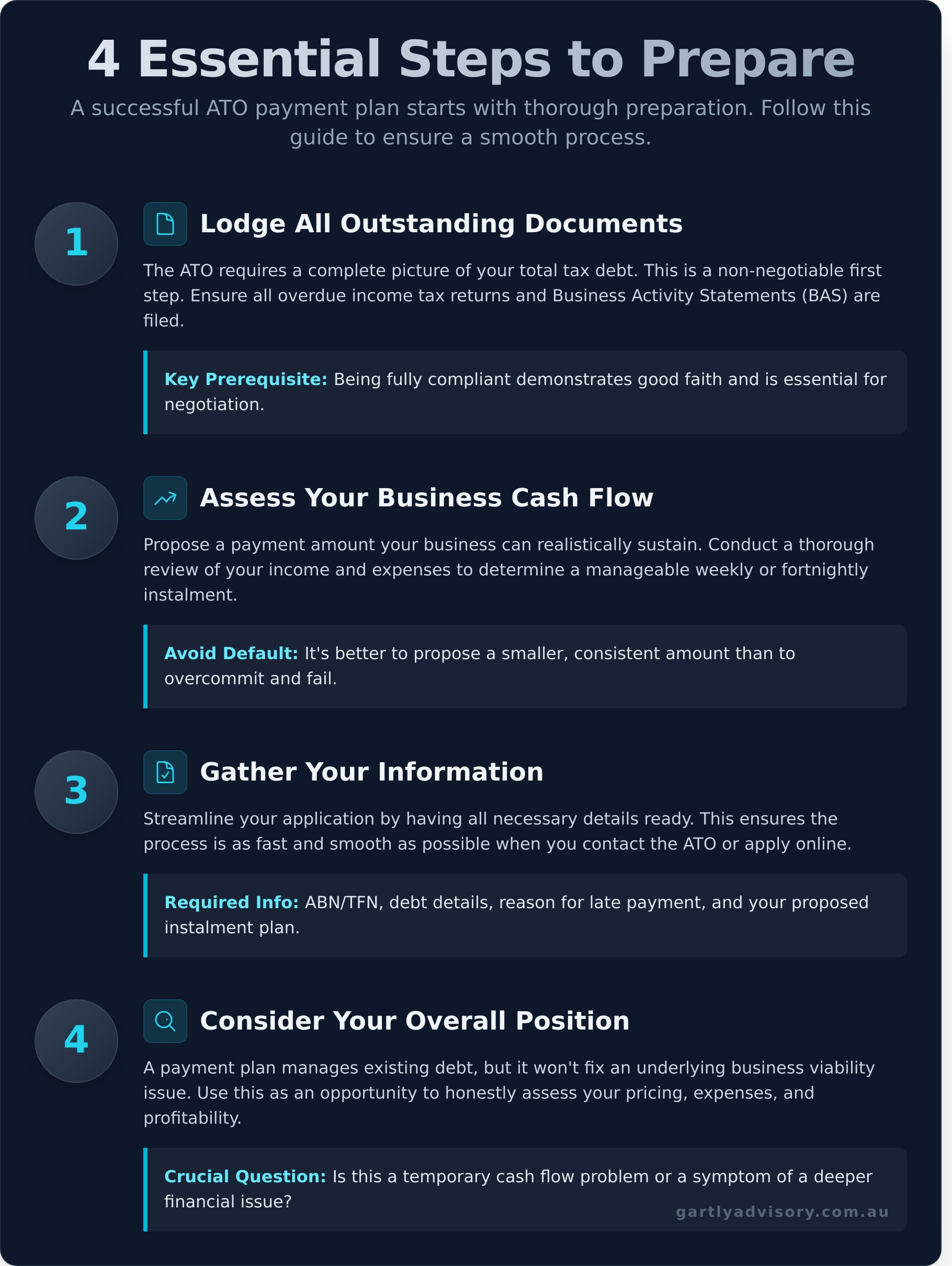
Before You Apply: 4 Essential Preparation Steps
Approaching the Australian Taxation Office for a payment arrangement can feel daunting, but thorough preparation is the key to a successful outcome. Taking the time to get organised not only increases your chances of approval but also demonstrates to the ATO that you are serious about meeting your obligations. More importantly, it helps you propose a realistic ATO payment plan that your business can genuinely afford, preventing future defaults and additional stress. These steps will help you avoid delays and ensure the application process is as smooth as possible.
Step 1: Lodge All Outstanding Returns and Statements
Before the ATO will consider a payment arrangement, they need a complete and accurate picture of your total tax debt. This is a non-negotiable prerequisite. You must lodge all overdue documents, including any outstanding income tax returns and Business Activity Statements (BAS). This ensures that the payment plan covers the full extent of what you owe, providing a clear path forward for both you and the tax office. Being fully compliant is the foundational step in negotiating in good faith.
Step 2: Assess Your Business Cash Flow
You must propose a payment amount that your business can sustain without causing further financial hardship. To do this, conduct a thorough review of your recent income and expenses. Creating a simple cash flow forecast or budget will help you identify the maximum instalment you can comfortably commit to. It is far better to propose a smaller, manageable amount you can consistently pay than to overcommit and risk defaulting on the arrangement, which can have serious consequences.
Step 3: Gather Your Information
Having all necessary details on hand will streamline your application. The ATO will require specific information to process your request for a payment plan. Before you call or apply online, make sure you have the following ready:
- Your Australian Business Number (ABN) or Tax File Number (TFN).
- The details of the tax debt you wish to include in the plan.
- A brief, clear reason for why you are unable to pay the full amount by the due date.
- Your proposed instalment amount and payment frequency (e.g., weekly or fortnightly).
Step 4: Consider Your Overall Financial Position
An ATO payment plan is a tool to manage existing debt, not a long-term solution for an unprofitable business. This is a crucial time to ask whether your difficulty in paying is a temporary cash flow problem or a symptom of a deeper issue. A payment plan helps with a debt issue, but it won’t fix a business viability issue. Use this opportunity to review your pricing, operating expenses, and overall profitability. Honest assessment now can save you significant hardship later. Need help assessing your cash flow? Our advisors can assist.
How to Set Up Your ATO Payment Plan: A Step-by-Step Guide
Once you’ve decided to proactively manage your tax debt, the next step is to set up an arrangement with the ATO. The good news is that there are several pathways available, ensuring you can find a method that suits your business’s specific circumstances. Whether your situation is straightforward or complex, engaging with the ATO is a crucial step towards financial stability. Let’s walk through the three primary methods for setting up your ATO payment plan.
Each method is a valid way to resolve your debt, and the best choice depends on your debt amount, business complexity, and comfort level in dealing with the ATO.
Method 1: Using ATO Online Services
For businesses with straightforward tax debts under the automated threshold (often around A$100,000), the fastest method is using the ATO’s online services. You can access this feature through:
- myGov: If you are a sole trader, you can link your ATO account to myGov.
- Online services for business: This is the dedicated portal for companies, trusts, and other entities.
After logging in, navigate to the accounts and payments section. The system will guide you through an eligibility check and allow you to propose a payment schedule. If your proposal meets the ATO’s standard criteria, it can often be accepted on the spot, providing immediate peace of mind.
Method 2: Calling the ATO
If you are unable to use the online services, or if your circumstances require a more direct conversation, you can call the ATO. This is a practical option if you need to discuss specific details that the automated system cannot accommodate. Before calling the ATO’s business debt line on 13 11 42, we strongly advise having all your information ready. This includes your ABN, TFN, and a clear understanding of the outstanding debt and what you can afford to pay.
Method 3: Engaging a Registered Tax Agent
For businesses facing larger debts or complex financial situations, engaging a trusted partner like a registered tax agent or Chartered Accountant is the most strategic approach. An experienced advisor provides comprehensive support by assessing your entire financial position to negotiate the most favourable terms on your behalf. While you can review the official ATO guidance on payment plans, an agent understands the nuances of these negotiations. This method removes significant stress, as your agent handles all communication, allowing you to focus on running your business.
Managing Your Plan and Avoiding Common Pitfalls
Securing an arrangement with the Australian Taxation Office is a significant step towards regaining financial control, but it’s crucial to understand that this is just the beginning. The long-term success of your ATO payment plan hinges on diligent management and an unwavering commitment to meeting its terms. Failing to do so can unfortunately unwind your progress and may lead to more serious compliance action from the ATO.
Successfully managing your plan requires a proactive approach and a clear understanding of your ongoing responsibilities. Think of it not just as paying off old debt, but as demonstrating your business’s viability and commitment to future compliance.
The Critical Importance of Sticking to the Plan
Treat your ATO instalments as a non-negotiable business expense, on par with rent or key supplier payments. The most effective way to ensure you never miss a due date is to set up automated payments directly from your business account. Defaulting on even one payment can result in the ATO cancelling the arrangement, demanding the full outstanding debt immediately, and potentially commencing firmer recovery actions.
Staying Compliant with Future Obligations
A core condition of any payment arrangement is that you must stay completely on top of all future tax and superannuation obligations. This means you must lodge and pay new commitments on time and in full, including:
- Business Activity Statements (BAS)
- Pay As You Go (PAYG) withholding
- Superannuation Guarantee contributions for your employees
Falling behind on these new obligations is one of the most common reasons for a plan to be voided, as the ATO sees it as a sign that the underlying financial issues have not been resolved.
What to Do if Your Circumstances Change
Business conditions can change unexpectedly. If you foresee a situation where you might struggle to make an upcoming instalment-perhaps due to a major client paying late or a sudden drop in revenue-it is vital to be proactive. Do not wait until you have already missed the payment. Contact the ATO or your tax advisor immediately to explain the situation. If you communicate early and honestly, it may be possible to negotiate a short-term adjustment or variation to your plan, preserving the arrangement and your good standing.
Maintaining open communication and demonstrating a genuine effort to meet your obligations will foster a better long-term relationship with the ATO. If you require guidance or support in managing these responsibilities, our experienced team is here to help you navigate the complexities.
When to Seek Professional Help for Your ATO Debt
While the ATO’s online tools and resources are a helpful first step, they are designed for straightforward situations and cannot provide the strategic, personalised advice your business may need. Recognising when to engage an experienced professional is not a sign of failure; it’s a smart investment in securing the best possible outcome for your business’s future. An expert provides not just expertise and negotiation skills, but invaluable peace of mind during a stressful time.
Complex Cases and Debts Over A$100,000
The ATO’s automated system for payment plans generally does not handle tax debts exceeding A$100,000 or cases involving complex financial circumstances. These situations require direct negotiation with an ATO case officer and must be supported by detailed financial evidence. As experienced Chartered Accountants, we can prepare the necessary cash flow forecasts and supporting documentation to build a compelling and credible case on your behalf.
The Power of Professional Negotiation
A registered tax agent understands the ATO’s internal processes, requirements, and what they look for in a viable proposal. This insider knowledge is a significant advantage. We can negotiate beyond the standard terms, advocating for a more manageable repayment schedule and, where applicable, a remission of the General Interest Charge (GIC). This professional negotiation often results in a more sustainable and favourable ATO payment plan than you could secure alone.
Beyond the Debt: Proactive Tax Planning
At Gartly Advisory, our support goes beyond just resolving the immediate debt. A good advisor helps you understand how the debt occurred and implements strategies to prevent it from happening again. We partner with you to improve cash flow forecasting, budgeting, and proactive tax planning. Our goal is to move from a reactive solution to a proactive strategy, becoming your trusted partner for long-term financial health and success.
Don’t navigate this complex process alone. Schedule a consultation to discuss your ATO debt with our experts.
Your Path Forward: Navigating Your ATO Tax Debt
Facing a tax debt can be daunting, but an ATO payment plan is a viable path toward resolving it. The key takeaways are clear: thorough preparation is non-negotiable, understanding the application process is crucial, and diligent management of your plan is essential for success. By being proactive, you can regain control of your business’s financial health and move forward with confidence.
If the process feels overwhelming or your situation is complex, remember that expert support is available. As Chartered Accountants and Registered Tax Agents with over 35 years of experience, we provide the professional guidance you need. Our reputation as a trusted partner is backed by over 70+ 5-Star Google Reviews from businesses we have successfully supported.
Feeling overwhelmed by tax debt? Let our experienced team be your trusted partner. Contact us for a confidential consultation. Taking this step today can put your business back on the path to stability and success.
Frequently Asked Questions About ATO Payment Plans
How long can an ATO payment plan be?
The duration of an ATO payment plan typically depends on your business’s specific circumstances and the total amount of the debt. For smaller debts, the ATO may automatically approve plans up to 24 months. However, for larger or more complex debts, a shorter term may be proposed. The key is to propose a repayment schedule that is both realistic for your cash flow and acceptable to the ATO, demonstrating a genuine commitment to clearing the debt.
Does an ATO payment plan affect my business credit rating?
Generally, entering into a standard payment arrangement with the ATO will not directly impact your business credit rating. These arrangements are confidential between you and the ATO. However, a credit rating can be affected if the debt remains unpaid and the ATO takes more serious action, such as initiating legal proceedings or registering a security interest on the Personal Property Securities Register (PPSR). Proactive engagement is the best way to avoid this outcome.
What is the interest rate (GIC) on an ATO payment plan?
When you have an outstanding tax debt, the ATO applies a General Interest Charge (GIC). This interest continues to accrue daily on the remaining balance throughout your payment plan. The GIC rate is set quarterly and is based on prevailing market rates. While a payment plan helps manage the principal debt, it’s important to factor in the cost of this accruing interest. Paying the debt faster will reduce the total GIC you pay.
What happens if the ATO rejects my payment plan proposal?
If your payment plan proposal is rejected, it is crucial to act quickly. The ATO will provide a reason, which often relates to a poor compliance history or a proposal they deem unsustainable. Your next step should be to contact the ATO to understand their concerns and negotiate a revised plan. Seeking professional guidance from an experienced advisor can be invaluable in these situations, as they can help you present a stronger case on your behalf.
Can I pay off my ATO payment plan early without penalties?
Yes, you can absolutely pay off your ATO tax debt ahead of schedule without incurring any penalties. The ATO encourages early repayment. Paying off your debt sooner is financially beneficial as it stops the General Interest Charge (GIC) from accruing on the outstanding balance. This means you will save money by reducing the total amount of interest you would otherwise have to pay over the full term of the agreement.
Can I get a payment plan for my employee superannuation (SGC) debt?
While possible, securing an ATO payment plan for Superannuation Guarantee Charge (SGC) debts is significantly more difficult than for other tax liabilities. The ATO takes employee entitlements very seriously and is less flexible with superannuation debts. If a plan is granted, it is often for a much shorter duration. It is vital to communicate with the ATO proactively and have a clear, viable strategy to meet these critical obligations for your staff.
Related Posts