
Chartered Accountant vs CPA for Small Business: Making the Right Choice in Melbourne
What if the biggest hurdle to your business growth isn’t your competition, but the letters following your accountant’s name? You probably feel like your current professional acts more like a historian, recording what happened last financial year for the ATO without offering a single word of strategy for the next one. Many of the 70+ local business owners who have sought our guidance initially felt stuck in a cycle of basic compliance. Understanding the nuances of chartered accountant vs CPA for small business needs is the first step toward finding a partner who actually understands your vision and your industry.
We’ll clarify the practical differences between these professional designations so you can stop feeling confused and start feeling supported. Drawing on 35 years of experience in the Melbourne market, this article explores how to choose a strategic partner who provides proactive advice that goes well beyond the numbers. You’ll learn exactly how to identify an advisor who doesn’t just manage your tax returns, but actively secures your long term compliance and business success through every stage of your journey.
Key Takeaways
- Understand the core differences between CA ANZ and CPA Australia to ensure your business is supported by a professional who meets rigorous Australian standards.
- Evaluate the chartered accountant vs CPA for small business debate by looking beyond basic compliance to find a strategic partner who identifies growth opportunities.
- Shift your mindset from hiring a once-a-year tax preparer to finding a trusted partner who offers proactive guidance on your journey toward success.
- Learn how to assess an advisor’s technology stack, specifically their expertise in Xero and cloud integration, to streamline your business finances effectively.
- Discover the practical criteria for choosing a Melbourne-based advisor who looks “beyond the numbers” to help you solve problems and seize new opportunities.
Chartered Accountant vs CPA: Decoding the Australian Designations
Choosing between a Chartered Accountant (CA) and a Certified Practising Accountant (CPA) often feels like a coin toss for many Melbourne entrepreneurs. Both designations represent the gold standard of financial expertise in Australia, and you’ll find highly successful professionals in both camps. When you’re weighing up a chartered accountant vs CPA for small business, it helps to understand what those letters actually mean for your bottom line.
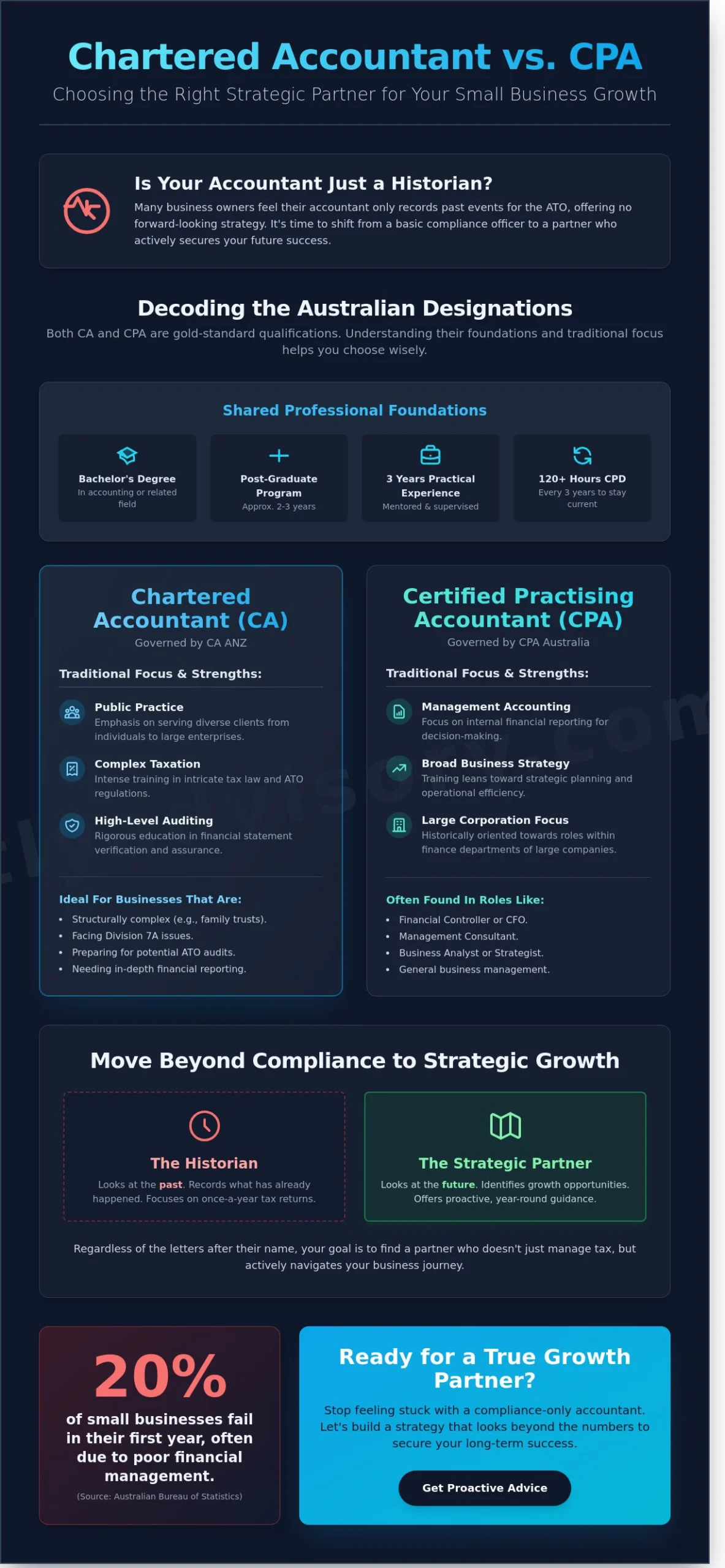
Both designations are governed by prestigious bodies: Chartered Accountants Australia and New Zealand (CA ANZ) and CPA Australia. To earn either title, an accountant must complete:
- A recognised bachelor’s degree in accounting or a related field.
- A rigorous post-graduate program that takes roughly two to three years to finish.
- Three years of mentored, practical experience under a qualified supervisor.
- A minimum of 120 hours of Continuing Professional Development (CPD) every three years to keep their skills sharp.
While the foundational training is similar, the traditional focus of each path differs slightly. Think of it this way; CAs have historically been trained with a heavy emphasis on public practice, complex taxation, and high-level auditing. CPAs, on the other hand, often lean toward management accounting and broad business strategy within large corporations. Regardless of the initials, both are highly qualified. Your choice should depend on your specific business goals and the level of technical support you need to stay compliant.
The CA Advantage for Complex Business Matters
The technical training a CA undergoes is famously intense, particularly regarding financial reporting and intricate tax law. This makes a small business accounting expert with a CA background a powerful ally if your business structure is complex. Whether you’re managing a family trust, dealing with Division 7A issues, or preparing for a potential audit, a CA’s deep dive into the Australian Tax Office (ATO) regulations provides a significant layer of security.
Dealing with the ATO requires more than just filling out forms; it requires a proactive partner who understands the nuance of the law. At Gartly Advisory, we use our CA expertise to look beyond the numbers, ensuring your business stays on the right side of compliance while identifying opportunities for growth that others might miss.
Does the Title Affect Your Tax Return?
There is a common misconception that only one type of accountant can handle your BAS or annual tax lodgments. In reality, both CAs and CPAs can be registered tax agents. The designation doesn’t limit their legal ability to lodge documents with the ATO, provided they hold a current tax agent licence.
Both types of professionals are equally capable of managing your GST, PAYG withholding, and Capital Gains Tax calculations. What matters more than the three letters after their name is their commitment to being a supportive partner. You need someone who doesn’t just process your return once a year but offers ongoing guidance to help you seize opportunities as they arise. When deciding on a chartered accountant vs CPA for small business, look for a firm that prioritises relationship-building and proactive advice over simple data entry.
Moving Beyond the Numbers: Why Your Choice Impacts Business Growth
Choosing between a chartered accountant vs CPA for small business often comes down to how much you value proactive advice over simple data entry. While many people think accounting is just about tax returns, a true partner looks through the windscreen rather than just the rear-vision mirror. They identify opportunities for growth before they even show up on a balance sheet. For a Melbourne SME, this means having someone who understands the local economic pulse and can spot trends in your specific industry, whether you’re in franchising or property development.
Data from the Australian Bureau of Statistics indicates that roughly 20% of small businesses fail within their first year; often due to poor financial management. A Chartered Accountant acts as a strategic navigator to help you avoid these pitfalls. They don’t just tell you what you spent; they explain how to spend more effectively to increase your profit margin. This level of insight turns a standard service into a genuine partnership for your journey towards success.
Strategic Advisory and Exit Planning
Growth strategy is about much more than looking at last year’s profit and loss statement. It’s about where you want to be in five or ten years. A CA provides a safe pair of hands for complex business structure reviews to ensure you aren’t paying more tax than necessary. They also specialise in long-term exit planning. Since the 2023 ASBFEO report suggests that 34% of small business owners plan to retire in the next decade, having a clear plan to maximise your business value is vital. You can find more details on how to scale effectively in this guide to business advisory in Melbourne.
Specialist Support: SMSF and Estate Planning
Your business is likely your biggest asset, but it shouldn’t be your only one. A holistic accounting service integrates your business success with your personal wealth. This is where having a self managed super fund specialist becomes invaluable. They understand the CA framework and can help you use your business profits to build a secure retirement nest egg. By linking estate planning and business succession, you ensure that your hard work benefits your family for years to come. If you’re ready to look at the bigger picture, talk to us about how we can support your long-term goals.
How to Choose the Right Accountant in Melbourne, Sydney, or the Gold Coast
Choosing between a chartered accountant vs CPA for small business isn’t just about the letters after their name. It’s about finding a partner who understands your vision. You need someone you can pick up the phone and talk to, not a person you only see once a year to sign off on your tax return. A great accountant acts as a supportive partner, helping you navigate the complex world of business matters with calm competence.
Evaluate their technology stack early in the conversation. Does the firm live and breathe cloud technology? Efficiency is the backbone of a modern business. We focus on Xero accounting because it allows for real-time financial tracking and seamless cloud integration. If your advisor isn’t suggesting tools that streamline your finances, you’re likely missing out on critical data that could drive your growth.
Reputation matters more than a fancy office. Look for social proof that reflects a long-term commitment to client success. Google Reviews are a great place to start. Look for keywords like “reliable,” “proactive,” and “supportive.” Seeing a consistent track record, such as 70+ 5-star reviews, provides the reassurance you need when handing over your financial future to a professional.
The Interview: Questions for Your Prospective CA or CPA
When you sit down for your first meeting, treat it like a job interview. You’re the employer. Ask them directly: “How do you support my business growth beyond compliance?” Compliance is the bare minimum you should expect. You want an advisor who looks for opportunities to save you money or increase your margins. Ask what proactive advice they’ve given a similar business in your industry lately. This reveals if they’re actually thinking about your success or just processing forms. A complimentary initial appointment is vital. It’s your chance to test the “supportive partner” fit without any financial pressure.
Why Location and Experience Still Matter
A firm with 25+ years of trust in the Australian market brings a level of stability that’s hard to replicate. While digital tools are great, having physical offices across Melbourne, Sydney, and the Gold Coast means we understand local nuances. Whether it’s the retail landscape in Melbourne or a tourism venture on the Gold Coast, local expertise ensures your advice is grounded in reality. This experience allows us to give advice beyond the numbers, drawing on decades of helping Australian business owners solve problems and seize opportunities. Choosing a firm with regional offices ensures you have support wherever your business journey takes you.
- Tip: Always ask about their communication style. Do they prefer email, or can you book a quick Zoom call when you have a burning question?
- Tip: Check if they offer a fixed-fee structure to avoid “bill shock” at the end of the financial year.
- Tip: Ensure they have specific experience with your business structure, whether you’re a sole trader, company, or managing an SMSF.
Finding the right fit between a chartered accountant vs CPA for small business comes down to trust. You want an expert who proactively looks for ways to grow your dreams while keeping your tax obligations in check. Let us be your safe pair of hands as you build your success across Australia.
Secure Your Business Future with Expert Guidance
Choosing between a chartered accountant vs CPA for small business success doesn’t have to be a stressful decision. While both designations represent a high level of professional training, your choice should align with your long-term vision. Remember that a great accountant does more than just file tax returns; they act as a strategic partner who understands the local Melbourne market and helps you navigate complex financial hurdles. Whether you’re focused on technical compliance or strategic expansion, the right expert provides a safe pair of hands for your finances.
At Gartly Advisory, we bring over 35 years of professional experience to every client relationship. Our team has earned more than 70 5-star Google reviews by providing specialised advice that goes far beyond the numbers. We’re here to help you solve problems and seize new opportunities as your business grows. You don’t have to manage these complexities alone. Take the first step toward clarity and confidence in your financial journey today.
Book a complimentary appointment with our Chartered Accountants today
We’re excited to partner with you and help your business thrive in the years ahead.
Frequently Asked Questions
Is a Chartered Accountant more expensive than a CPA for small business?
Fees for a Chartered Accountant or a CPA are typically comparable because both designations represent a high standard of professional training. You’ll find that costs depend more on the firm’s experience and the complexity of your business rather than the letters after the accountant’s name. A 2024 industry report indicates that 85% of Melbourne accounting firms set their rates based on the specific advisory value they provide.
Tip: Ask for a fixed-fee agreement to keep your monthly costs predictable and avoid surprise bills during tax season.
Do I need a CA or a CPA to manage my Self-Managed Super Fund (SMSF)?
You can use either a CA or a CPA for your SMSF, provided they hold the necessary ASIC limited Australian Financial Services Licence. In Australia, the Superannuation Industry (Supervision) Act 1993 requires specific compliance standards that both designations are trained to handle. We recommend checking that your adviser has at least 5 years of experience in superannuation law to ensure your fund remains compliant with ATO regulations.
Tip: Use cloud-based software for real-time visibility of your retirement savings and easier annual audits.
Can a CPA do everything a Chartered Accountant can do in Australia?
Yes, a CPA can perform the same core functions as a Chartered Accountant in Australia, including tax returns and financial reporting. When deciding between a chartered accountant vs CPA for small business, the choice often comes down to the individual’s specific industry experience. Both groups are recognised by the Tax Practitioners Board and must complete 120 hours of professional development every three years to maintain their status.
Tip: Choose an accountant with experience in your specific industry, such as retail or construction, for more tailored advice.
How often should I be meeting with my business accountant?
You should meet with your business accountant at least four times a year to stay ahead of tax obligations and cash flow. While once-a-year meetings were common in 2010, modern businesses that review data quarterly are 15% more likely to identify growth opportunities early. If you’re scaling quickly, monthly check-ins provide the support needed to navigate complex financial decisions without delay.
Tip: Schedule quarterly reviews immediately after your BAS lodgement so you can discuss actual performance figures while they’re fresh.