
How to Minimise Capital Gains Tax on Business Sale: A 2026 Guide for Australian Owners
After decades of pouring your heart, soul, and savings into your business, the idea of handing up to 47% of its final sale price to the Australian Taxation Office can feel like a devastating blow. It’s a completely valid fear, and one we hear from Australian business owners every week. You’ve earned this exit, and you deserve to reap the full rewards of your hard work. The complexity of the tax system, with its confusing jargon around ‘active assets’ and hidden deadlines, only adds to the anxiety that you might miss out on a crucial saving.
But it doesn’t have to be this way. The good news is that the ATO provides several powerful, yet often overlooked, small business CGT concessions. This guide is your clear roadmap on how to minimise capital gains tax on your business sale, potentially reducing your tax bill significantly or, in some cases, eliminating it entirely. We’ll walk you through the four key concessions, explain the eligibility tests in simple terms, and provide a strategic timeline to ensure your exit is as tax-efficient as possible, giving you the confidence to move forward.
Key Takeaways
- Discover the four powerful Small Business CGT Concessions from the ATO, which can provide far greater tax savings than the general 50% discount.
- Learn if you qualify for the 15-Year Exemption, a crucial strategy that could allow you to pay zero tax on the sale of your business upon retirement.
- Understand how to minimise capital gains tax on business sale by using smart structures like Family Trusts to legally distribute gains and lower your overall tax liability.
- Recognise why effective tax planning must begin years before you sell, and how a ‘Tax Health Check’ is the essential first step to maximising your final payout.
Understanding the CGT Landscape When Selling Your Australian Business
Selling your business is a monumental achievement, often the result of years, or even decades, of dedication and hard work. It’s a moment to celebrate. However, for many unprepared owners, this celebration is quickly overshadowed by a ‘Tax Shock’-an unexpectedly large Capital Gains Tax (CGT) bill that can claim a significant portion of their final payout. This often happens because the groundwork for tax minimisation wasn’t laid at least two to three years before the sale.
In essence, CGT is the tax you pay on the profit made from selling a ‘CGT asset’-which includes nearly every part of your business. The Australian Taxation Office (ATO) has a detailed framework for Capital Gains Tax in Australia, and for business sales, this gain is calculated on the difference between what an asset cost you (the cost base) and what you sold it for. The good news is that the ATO provides specific, powerful concessions for small businesses. Understanding your eligibility for these ‘safe harbours’ is the first step in learning how to minimise capital gains tax on business sale and protect your legacy.
Asset Sale vs. Share Sale: Which Triggers More Tax?
A fundamental decision that directly impacts your tax outcome is whether you sell the business’s assets or the shares in your company. In an asset sale, the company itself sells its individual assets like goodwill, equipment, and client lists. Tax is calculated on the gain of each asset, which can be complex but offers the buyer a clean slate, free of your company’s history and potential liabilities. Conversely, in a share sale, you sell your ownership stake (your shares) in the company. This can sometimes provide access to different tax concessions for you as the seller, but buyers are often more cautious as they inherit the entire company, including any hidden debts or legal issues. In both scenarios, accurately calculating the ‘Cost Base’-the original purchase price plus any associated costs like legal fees and improvements-is critical to determining your true capital gain.
The 2026 Eligibility Tests: Are You a ‘Small Business Entity’?
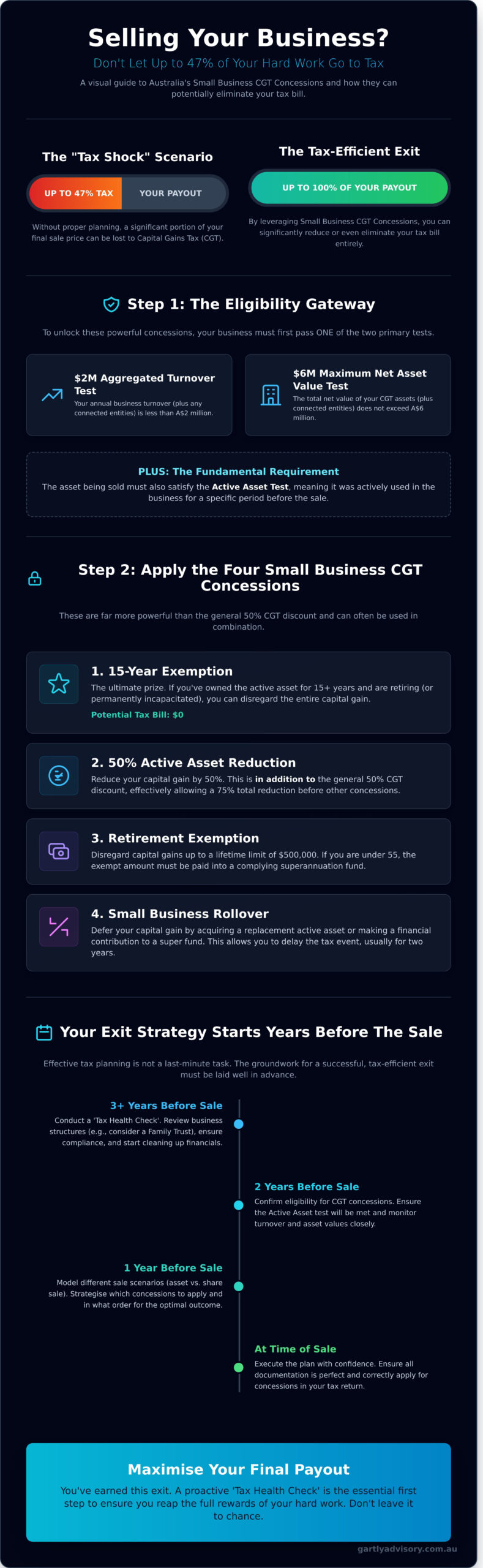
To access the four generous small business CGT concessions, you must first pass a set of crucial eligibility tests. Looking ahead to 2026, these gateways remain the foundation of any effective tax strategy. You only need to satisfy one of the following two primary conditions:
- The $2 Million Aggregated Turnover Test: Your business’s annual turnover, combined with that of any ‘connected entities’ or ‘affiliates’, must be less than A$2 million.
- The $6 Million Net Asset Value Test: The total net value of your CGT assets, and those of your connected entities, must not exceed A$6 million just before the sale.
The inclusion of ‘connected entities’ (like a spouse’s business or another company you control) is a common tripwire for many business owners. It’s vital to get a full picture of your entire financial network. Once you pass one of these tests, another layer of qualification is required. The Active Asset Test is the fundamental gateway requirement, demanding that the asset you’re selling has been actively used in carrying on a business for a specific period before the sale.
The General 50% CGT Discount vs. Small Business Concessions
When you sell a business, the Australian tax system provides two primary layers of relief to soften the Capital Gains Tax (CGT) impact. Think of them as two different tools for the same job. One is a reliable, general-purpose tool available to many, while the other is a set of specialist instruments that can achieve a far superior result. Understanding how they differ, and how they can work together, is the first step in learning how to minimise capital gains tax on business sale.
The first and most common tool is the general 50% CGT discount. It’s a straightforward incentive: if you are an individual, a partner in a partnership, or a trust, and you’ve held the business asset for more than 12 months, you can reduce your taxable capital gain by half. It’s a powerful and widely used concession.
However, this pales in comparison to the four Small Business CGT Concessions. These are significantly more potent and can potentially reduce your capital gain to zero. These concessions have specific and complex eligibility criteria, often detailed in professional resources like the official CPA Australia Tax Guide, which we use to support our clients. The best part? These two layers can often be ‘stacked’. You can first apply the 50% general discount and then apply one or more of the small business concessions to the remaining gain, creating a profound reduction in your final tax bill.
The Power of the 12-Month Rule
Patience is more than a virtue in tax planning; it’s a strategy. Holding your business asset for at least 12 months and one day is the absolute minimum requirement to access the 50% CGT discount. A poorly timed sale can be a costly mistake. For instance, we supported a Melbourne-based digital marketing agency owner who was planning her exit. Her business was valued with a capital gain of approximately $430,000. Selling at the 11-month mark would have resulted in a tax bill of over $202,000 at the top marginal rate. By simply waiting another 35 days, she qualified for the 50% discount, instantly cutting her taxable gain in half and saving over $101,000 in tax. It’s a simple rule, but one that requires careful management, especially if you’ve recently restructured, as this can inadvertently restart the 12-month clock.
Why Your Business Structure Dictates Your Tax Bill
Your business structure isn’t just an operational choice; it’s the foundation of your tax strategy. A critical point many business owners miss is that companies do not qualify for the general 50% CGT discount. If your business operates through a company structure, it will pay tax (currently 25% or 30%) on 100% of the capital gain before any profits are distributed to you.
This is why structures like Family Trusts are often considered the ‘gold standard’ for CGT purposes. A trust can access the 50% discount and provides immense flexibility. It can distribute the remaining capital gain strategically among several family members (beneficiaries), making use of their lower marginal tax rates. This can dramatically reduce the overall tax paid by the family unit compared to a single individual or a company bearing the entire burden.
Choosing the right structure from day one, or restructuring correctly well ahead of a sale, is one of the most impactful decisions you can make. It’s a decision that requires strategic advice that goes beyond the numbers, considering your long-term goals, family situation, and ultimate exit plan. As your trusted partner, we help you build the right foundation for future success.
Navigating the Four Small Business CGT Concessions
Selling your business is a significant financial event, and a key part of maximising your return is understanding how to minimise capital gains tax on business sale. The Australian Taxation Office (ATO) provides four powerful tools designed specifically for this purpose. While the rules can seem complex, getting expert guidance on these small business CGT concessions is the first step towards securing the best possible outcome. Let’s break down each one.
The 15-Year Exemption: The ‘Holy Grail’ of Exit Planning
For long-term business owners, this is the ultimate goal. If you meet the criteria, you can disregard 100% of the capital gain, meaning you pay zero tax. To qualify, you must have continuously owned the active asset for at least 15 years and be aged 55 or over and retiring, or be permanently incapacitated. For companies and trusts, the entity must have had a ‘significant individual’ (owning at least 20% of the voting rights and income/capital distributions) for the entire 15-year period. This concession takes priority; if you’re eligible, you don’t need to consider the others.
After the 15-year exemption, the ATO applies the remaining concessions in a specific order. Here’s how they work:
- The 50% Active Asset Reduction: This is a straightforward and powerful reduction. After applying any general 50% CGT discount for assets held over 12 months, you can then reduce the remaining capital gain by a further 50%. This applies automatically if the asset qualifies as an ‘active asset’ used in your business.
- The Small Business Roll-over: If you plan on reinvesting the sale proceeds into another business, this concession allows you to defer your tax liability. You have a two-year window (starting one year before and ending two years after the sale) to acquire a replacement active asset. It’s an excellent strategy for serial entrepreneurs who are selling one venture to fund the next.
- The Retirement Exemption: This concession allows you to disregard capital gains up to a lifetime limit of A$500,000. Despite its name, you don’t actually have to retire. However, if you are under 55, the exempt amount must be contributed directly into a complying superannuation fund or a retirement savings account.
The Retirement Exemption and Your SMSF
The A$500,000 retirement exemption limit is applied per individual, not per business. This means for a business owned by a couple, you could potentially apply up to A$1 million of capital gains towards this exemption. Moving these proceeds into your super, particularly an SMSF, can be a brilliant strategic move, shifting the funds into a low-tax or even zero-tax environment once you enter the pension phase. But be warned: the timing is critical. The contribution must be made by the later of the day you lodge your tax return for that year or 7 days after you receive the sale proceeds. Missing this deadline means losing the opportunity entirely.
Navigating these rules requires careful planning and proactive advice. As your trusted partner, we can provide the support and guidance needed to structure your sale in the most tax-effective way possible, ensuring you keep more of your hard-earned money.
Strategic Structuring: Protecting Your Sale Proceeds
The single biggest mistake we see business owners make is believing that tax planning starts when a buyer is found. This is a costly misconception. The most effective strategies for how to minimise capital gains tax on business sale are implemented years, not weeks, before a deal is signed. Your business structure is not just an operational vehicle; it’s a critical tool for wealth preservation. Getting it right well in advance protects the value you’ve worked so hard to build.
Waiting until the last minute slams the door on powerful opportunities and can leave you with a tax bill that is tens, or even hundreds, of thousands of dollars higher than it needed to be. Proactive structuring is your first line of defence.
Using Discretionary Trusts for CGT Flexibility
For many Australian business owners, operating through a discretionary or family trust provides unparalleled flexibility at the time of sale. The key benefit is the ability to ‘stream’ capital gains to specific beneficiaries in a tax-effective manner. Instead of the gain being taxed to a single individual at the highest marginal rate, you can distribute it among family members with lower taxable incomes, such as a spouse or adult children.
Crucially, the trust acts as a conduit. If the business asset was held for more than 12 months, the 50% general CGT discount ‘passes through’ the trust to the beneficiaries. This means they receive the discounted capital gain, significantly lowering their individual tax liability. However, a word of caution: complex ‘Trust Loss’ provisions can trap these gains if the trust has carried-forward losses from prior years, potentially forcing the gain to be taxed at the top marginal rate of 47% (including the Medicare Levy). This is a trap that requires expert guidance to avoid.
The ‘Active Asset’ Audit: Is Your Business Ready?
To access the valuable Small Business CGT Concessions, your business must pass the ‘Active Asset Test’. This requires that at least 80% of the market value of your business assets are ‘active assets’ used in the course of business. Passive assets, such as excess cash reserves, shares, or investment properties, can jeopardise your eligibility. We recommend a full balance sheet ‘clean up’ at least 12 months before a planned sale. This involves strategically managing cash levels and divesting non-essential passive assets to ensure you pass this critical 80% threshold.
How you hold property is also a major factor. A business premises owned within the company or trust is an active asset. If you own it personally and lease it to the business, it isn’t counted in the business’s asset test, which can make passing the 80% rule much easier. This decision has long-term implications for your entire financial picture, tying directly into your Estate Planning and overall exit strategy.
Thinking about these structural elements early is fundamental to a successful and tax-effective exit. It ensures every component of your financial life is working in concert to achieve the best possible outcome. To get expert guidance on how to minimise capital gains tax on business sale through smart structuring, schedule a consultation with a Gartly Advisory partner today.
Exit Planning: Why Your Tax Strategy Starts Years Before the Sale
Selling your business is one of the most significant financial events of your life. Too often, owners treat it like a transaction that happens in the final few months, only to discover they’ve left hundreds of thousands of dollars on the table for the Australian Taxation Office (ATO). The most effective strategies for tax reduction aren’t last-minute fixes; they are carefully planned and executed years in advance.
At Gartly Advisory, we see exit planning as a proactive journey, not a reactive event. It’s about building a more valuable, saleable, and tax-efficient business simultaneously. We use the globally-recognised Valuebuilder™ System to help you strengthen the eight key drivers that buyers look for. This process doesn’t just increase your final sale price; it perfectly aligns with creating a structure that is optimised for Capital Gains Tax (CGT) concessions.
The Proactive Approach: 24 Months to Exit
The single biggest mistake we see is waiting too long. Any significant changes to your business structure, such as moving the business into a trust, need time to ‘season’. The ATO looks closely at restructures made right before a sale and can apply anti-avoidance rules if it believes the primary purpose was to dodge tax. A 24-month buffer provides a strong commercial basis for your decisions. This journey begins with a comprehensive ‘Tax Health Check’ to identify your current CGT exposure and map out the most effective path forward. It is the foundational step in understanding how to minimise capital gains tax on business sale.
Just as crucial are your financial records. A potential buyer will scrutinise your books during due diligence. Clean, transparent financials for the preceding three years can build immense trust and justify a premium valuation. Messy records do the opposite, creating doubt and leading to lower offers. It all starts with a conversation about your goals. You can schedule a complimentary appointment with us to begin mapping out your ideal exit.
Your Pre-Sale Checklist: A Strategic Roadmap
Thinking ahead is the key. This checklist provides a simplified roadmap for how to minimise capital gains tax on business sale while maximising your return.
- 24+ Months Out: Engage a trusted advisor for a ‘Tax Health Check’. This is where we assess your eligibility for the Small Business CGT Concessions and identify the optimal ownership structure.
- 18 Months Out: Implement any necessary structural changes. This gives the new structure legitimacy and allows it to ‘season’ well before any sale negotiations begin.
- 12 Months Out: Begin a deep clean of your financial records. Systematically separate personal and business expenses to present a clear, accurate picture of profitability.
- 6 Months Out: Obtain a professional business valuation and prepare your sales documents. Your clean financials will now become your most powerful negotiation tool.
Beyond the Numbers: Your Life After the Sale
Effective tax planning isn’t just about saving money; it’s about funding your future. A A$150,000 tax saving isn’t just a number on a tax return. It’s the deposit on a holiday home, the seed funding for your next passion project, or the security to ensure a comfortable retirement. We connect every strategy back to your personal and lifestyle dreams.
Navigating this process can be complex and stressful. Having a Chartered Accountant with Geoff Gartly’s 35 years of experience provides the calm competence you need. We’ve been a trusted partner on this journey for hundreds of business owners, offering guidance that goes far beyond the numbers. We are here to support you in achieving the successful exit you’ve worked so hard for.
Talk to us and let us help you plan your successful exit
Secure Your Legacy: A Proactive Approach to Your Business Sale
Selling your business is a monumental achievement, but navigating Australia’s Capital Gains Tax landscape can be complex. The key takeaway is that significant savings are possible, especially through the four Small Business CGT Concessions. However, eligibility isn’t automatic. It hinges on strategic decisions made years in advance, from your business structure to your exit timeline. Ultimately, understanding how to minimise capital gains tax on business sale is not just about tax compliance; it’s about protecting the wealth you’ve worked so hard to build.
Don’t leave this critical step to chance. With over 35 years of Chartered Accounting experience, the team at Gartly Advisory is here to provide expert guidance. Our specialist ‘Valuebuilder’ advisory status and 70+ 5-star Google reviews reflect our commitment to being your trusted partner. We go beyond the numbers to secure your financial future. Book a complimentary consultation with our Melbourne business specialists today and let’s ensure your business exit is as rewarding as it should be.
Frequently Asked Questions About Capital Gains Tax on a Business Sale
Can I claim the small business CGT concessions if I sell my shares?
Yes, it’s certainly possible to claim the small business CGT concessions when you sell shares in your company. However, specific conditions must be met. The company itself must first satisfy the basic eligibility tests, such as being a CGT small business entity or passing the A$6 million maximum net asset value test. Crucially, you, as the shareholder, must be a ‘CGT concession stakeholder’ in the company just before the sale. This generally means you are a ‘significant individual’, which requires you to hold a small business participation percentage of at least 20%.
This 20% interest can be held directly or indirectly through other entities. If these conditions are met, the sale of your shares can be eligible for the same valuable concessions that apply to the sale of business assets. This is a vital consideration for anyone operating through a company structure, as it provides a direct path to reducing your personal tax liability on the sale proceeds. Navigating these rules requires careful planning to ensure every condition is satisfied.
What is the $6 million maximum net asset value test?
The A$6 million maximum net asset value (MNAV) test is a critical gateway to accessing the small business CGT concessions. It’s an alternative to the A$2 million turnover test. To pass, the total net value of all CGT assets owned by you and your connected entities must not exceed A$6 million right before the sale of the business asset. This calculation is comprehensive and includes assets that aren’t part of the business, such as investment properties or shares in other companies. It’s a snapshot of your entire asset position.
However, the Australian Taxation Office (ATO) allows you to exclude certain assets from this calculation. Most notably, you can exclude the value of your primary residence, personal use assets, and your superannuation balances. Accurately calculating your MNAV is essential; a small oversight could result in you being ineligible for any of the concessions. We strongly advise seeking professional guidance to ensure every asset is correctly identified and valued according to ATO guidelines.
Do I have to retire to claim the CGT retirement exemption?
No, you don’t have to stop working or permanently retire to claim the small business retirement exemption, despite its name. The rules are focused on how you treat the proceeds from the sale, not your employment status. If you are under 55 years of age when you make the choice to use the exemption, you are required to contribute the exempt capital gain amount into a complying superannuation fund or a retirement savings account. The funds are then preserved until you reach retirement age.
If you are 55 or older, you have more flexibility. You can still contribute the amount to your superannuation, but you also have the option to receive the funds directly as a tax-free payment. This exemption has a lifetime limit, which is currently capped at A$500,000 per individual. It’s a powerful tool for boosting your retirement savings or funding your next chapter, whether that involves full retirement or a new business venture.
What happens to the CGT if I sell my business and buy another one?
If you sell your business and plan to reinvest in another, you may be able to use the small business roll-over concession to defer your CGT liability. This valuable concession allows you to postpone paying tax on the capital gain from the sale of one business asset, provided you acquire a replacement active asset within a specific timeframe. The standard period to acquire a replacement asset runs from one year before to two years after the CGT event. This gives you a significant window to find and purchase a suitable new business or asset.
The deferred capital gain is not forgiven; it is crystallised when you eventually sell the replacement asset or if your circumstances change. For example, if the replacement asset stops being an active asset. This strategy is incredibly useful for entrepreneurs who want to grow their operations or transition into a new industry without the immediate cash flow impact of a large tax bill. It supports continuous investment and business growth in the Australian economy.
Can a company access the 50% general CGT discount?
No, a company is not eligible to access the 50% general CGT discount. This discount, which halves the taxable capital gain on assets held for more than 12 months, is only available to individuals, trusts, and complying superannuation funds. Companies are required to pay tax on 100% of their net capital gain at the relevant corporate tax rate, which is 30% or 25% for base rate entities (as of the 2023-24 financial year). This distinction is a fundamental aspect of Australian tax law and significantly impacts business structuring decisions.
The inability for companies to use this discount makes accessing the four small business CGT concessions even more critical. For many business owners operating through a company, these specialised concessions are the primary and most effective way to reduce the tax on a sale. It highlights why proactive tax planning is essential for anyone considering a future exit from their company.
How does the ATO define an ‘active asset’ for a business sale?
The ATO defines an ‘active asset’ as an asset that is owned by you and is used, or held ready for use, in the course of carrying on a business. This definition is central to the small business CGT concessions, as the asset you sell must be an active asset to qualify. This includes tangible assets like your business premises, machinery, and equipment, as well as key intangible assets such as goodwill, patents, and trademarks. The asset must have been ‘active’ for the lesser of 7.5 years or at least half of the period you’ve owned it.
Importantly, some assets are specifically excluded. Assets whose main purpose is to derive rent, interest, or dividends, such as a passively held investment property, are generally not considered active assets. Shares in a company or interests in a trust can also be active assets, but only if the underlying entity passes an 80% active asset test, meaning at least 80% of its assets by market value are active assets. Correctly classifying your assets is a non-negotiable first step in the CGT concession process.
Is there a limit on how much CGT I can avoid using concessions?
Yes, while the concessions offer substantial tax savings, some have specific monetary caps, while others are unlimited. The most powerful concession, the 15-year exemption, can eliminate the entire capital gain with no monetary limit if you’ve owned the asset continuously for 15 years and are over 55 and retiring. The retirement exemption is capped at a lifetime limit of A$500,000 for each individual. Any exempt gain you claim under this concession reduces your available cap for future business sales.
The 50% active asset reduction applies after the general 50% CGT discount (for individuals and trusts), effectively reducing the original capital gain by 75%. This concession itself doesn’t have a dollar limit. Finally, the small business roll-over allows you to defer a capital gain of any size, as long as you reinvest in a replacement asset. A key part of strategising how to minimise capital gains tax on business sale is to layer these concessions correctly to maximise their benefit within these established limits.
What is the ‘significant individual’ test for CGT concessions?
The ‘significant individual’ test is a crucial requirement for accessing the small business CGT concessions when the asset being sold is shares in a company or an interest in a trust. To pass this test, an individual must have a ‘small business participation percentage’ in the entity of at least 20% just before the CGT event. This 20% interest, which reflects both direct and indirect control and ownership, ensures that the tax benefits flow to the key individuals who are genuinely behind the small business.
An entity will be a ‘CGT concession stakeholder’ if it has at least one significant individual. The total participation percentage of all CGT concession stakeholders must be at least 90% for the entity to access the concessions at its level. For individuals selling their shares, meeting the 20% significant individual test is a personal gateway. Failing this test means you cannot personally apply the concessions to your capital gain, even if the company itself is an eligible small business entity. It’s a foundational rule that cannot be overlooked.
Related Posts