

How to Value a Small Business for Sale: The 2026 Melbourne Owner’s Guide
A 2024 industry report suggests that 34% of Australian business owners undervalue their company by as much as 25% simply because they don’t know how to value a small business for sale correctly. It’s a heartbreaking gap that often represents years of lost retirement savings or capital for your next venture. We understand that your business is more than just a set of financial statements; it’s a legacy you’ve built with hard work and late nights. It’s perfectly natural to feel overwhelmed by accounting jargon like EBITDA or worried about how Capital Gains Tax might eat into your final payout.
This guide will empower you with professional valuation methods that stand up to buyer scrutiny. You’ll move beyond the numbers to find a clear, defensible dollar range for your Melbourne enterprise. We’ll provide a roadmap to improve your business’s worth before you list it and give you the confidence to lead negotiations. From mastering valuation multiples to preparing for ATO compliance, you’re about to become the most informed person at the closing table.
Key Takeaways
- Learn why a professional valuation is the essential foundation for any successful exit, providing the reassurance and clarity you need to navigate the Melbourne market.
- Explore the four primary methods used by Australian accountants to determine how to value a small business for sale, ensuring you choose the right approach for your industry.
- Discover the science of “add-backs” and how to identify non-recurring expenses to reveal the true, hidden profit potential of your business.
- Understand how to improve your business “multiple” through proactive value-building, potentially doubling your final sale price with 12 to 24 months of preparation.
- Find out how partnering with a supportive Chartered Accountant allows you to look “beyond the numbers” to secure a deal that reflects your years of hard work.
Understanding Business Valuation: Why Your “Books” Are Only the Start
Business valuation is the formal process of determining the total economic worth of your company. It’s more than just a simple calculation; it’s a narrative about your company’s health and future potential. You might need this for a clean exit, a partnership buy-out, or a long-term succession plan. Understanding business valuation methods allows you to see your entity through the eyes of a professional investor rather than an owner. While your balance sheet tells one story, the market often tells another.
Most owners think about “Book Value,” which is essentially the net asset value recorded by your accountant. This figure is based on historical costs and depreciation. However, when you look at how to value a small business for sale, market value is usually much higher because it accounts for intangible assets like your reputation and brand. A buyer isn’t just paying for the equipment or the inventory; they’re buying the right to the profits you’ve spent years building. We often see a gap of 30% or more between what is on the books and what a willing buyer will actually pay in the Australian market.
To better understand this concept, watch this helpful video:
A sophisticated buyer doesn’t pay for what you did in 2022. They pay for what they expect to earn in 2026 and beyond. This shift in perspective is vital. When we analyse how to value a small business for sale, we focus on “maintainable earnings.” This involves stripping back one-off expenses, like a personal vehicle lease or a non-recurring legal fee, to show the true earning power of the business. Buyers want to see that the cash flow is consistent and, more importantly, transferable to them once you’ve left the building.
The Essential Information Checklist
Preparation is the difference between a smooth sale and a collapsed deal. You’ll need to gather at least five years of data to show trends. We recommend preparing the following:
- Financial Records: Detailed P&L statements, balance sheets, and tax returns from 2020 to 2025.
- Legal Documents: Current commercial leases, employment contracts for key staff, and intellectual property or trademark registrations.
- Operational Data: Standard operating procedures (SOPs), supplier agreements, and a customer concentration report showing that no single client represents more than 15% of your total revenue.
Why Professional Advice Matters in Melbourne
The Melbourne business landscape has unique nuances, from specific industry benchmarks in the CBD to local payroll tax requirements. Working with a Melbourne-based Chartered Accountant ensures your valuation holds weight. A professional valuation provides a “safe harbour,” which means you have a credible, evidence-based starting point for negotiations. This prevents you from being “low-balled” by aggressive buyers or overpricing yourself out of the 2026 market. Market Value in 2026 is the estimated amount for which an asset or entity should exchange on the date of valuation between a willing buyer and a willing seller in an arm’s length transaction, after proper marketing where the parties had each acted knowledgeably, prudently, and without compulsion.
The 4 Primary Valuation Methods for Australian Small Businesses
Learning how to value a small business for sale involves understanding that most Australian business brokers and Chartered Accountants rely on four core frameworks. We don’t just pick one at random. The right choice depends on your specific industry and whether your annual turnover is A$250,000 or A$5 million. Usually, we use a primary method and then “sanity check” it against another to ensure the figure holds up under scrutiny. For example, a local Melbourne cafe might rely on industry rules of thumb, like a multiple of weekly takings, while a logistics firm requires a more complex analysis of its cash flow.
Understanding how to value a small business for sale requires looking beyond just the bank balance. You need to consider the risk profile and the stability of your sector. You can find a helpful overview of these preparation steps in the Australian government’s guide to valuing your business. Relying on a single data point is risky. We find that 85% of successful sales in the Victorian market involve a valuation that has been cross-referenced across at least two different methodologies.
Earnings Multiples and ROI Methods
For businesses with a valuation under A$1 million, the Multiple of Discretionary Earnings is the most frequent choice. This method calculates the total financial benefit to a single owner, including their salary, superannuation, and any one-off personal expenses the business covered. If your total owner benefit is A$180,000 and the industry multiple is 2.5x, your baseline value is A$450,000. Mid-sized firms with multiple shareholders prefer EBITDA. This stands for Earnings Before Interest, Taxes, Depreciation, and Amortisation. It’s the gold standard because it strips away different accounting treatments to show a business’s true operating performance.
The Capitalised Future Earnings method is another vital tool. It involves dividing the expected future profit by a required rate of return, such as 20% or 25%. If a buyer expects A$200,000 in annual profit and wants a 25% return on their investment, they might value the business at A$800,000. This approach is common in stable industries where future performance is predictable based on the last 3 to 5 years of tax returns. If you are unsure which multiple applies to your sector, talking to an experienced advisor can provide the clarity you need to move forward confidently.
Asset-Based and Comparable Sales Methods
Sometimes the value isn’t found in the profit margin, but in what the company owns. The Net Asset Value method is straightforward; you take the total value of all business assets and subtract all liabilities. This is the go-to approach for investment companies or businesses that own significant equipment or property but have low trading profits. In contrast, the “Cost to Create” method is useful for tech-heavy firms or startups. If you spent A$350,000 and two years developing a proprietary software platform, that replacement cost forms the basis of your asking price, even if you haven’t reached full commercialisation yet.
Finally, we look at the Comparable Sales approach. This is similar to how real estate is valued. We examine data from similar businesses in the same region, such as recent sales of manufacturing plants in Melbourne’s south-eastern suburbs from 2023 or 2024. If three similar firms sold for an average of 3.2x their net profit, that provides a realistic benchmark for your own expectations. This market-based evidence is often what convinces a skeptical buyer that your price is fair and grounded in reality.
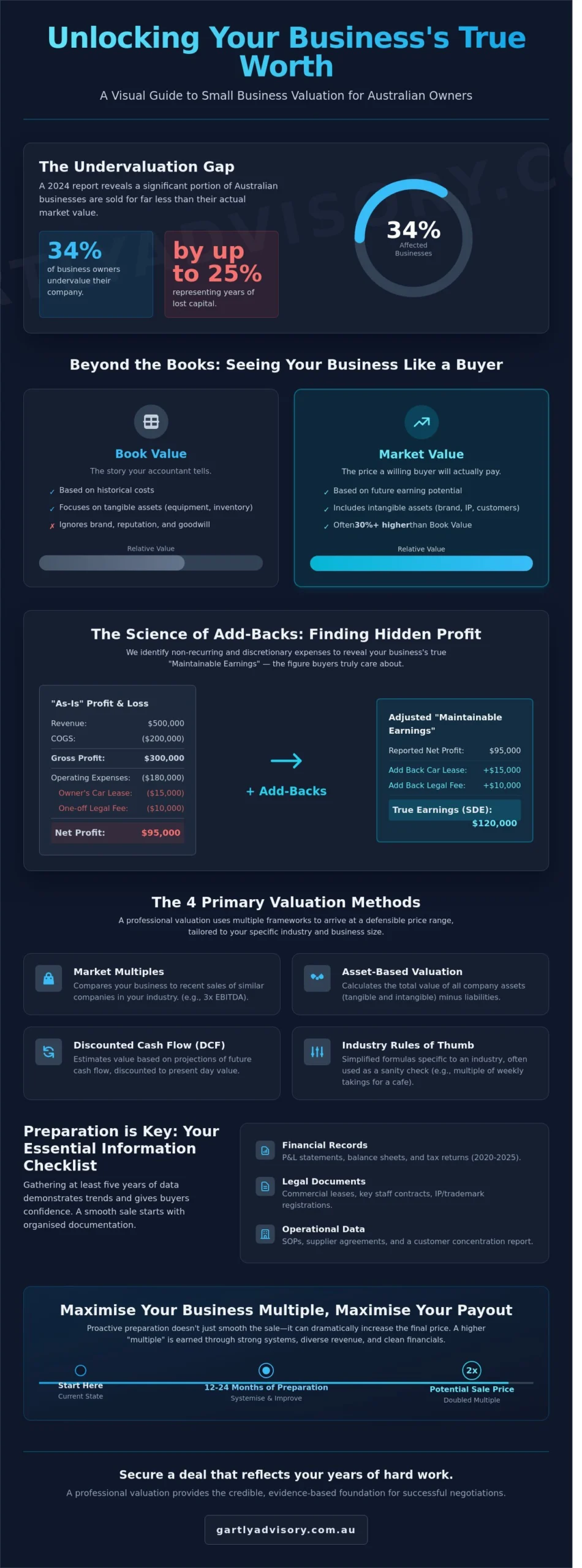
The Science of Add-Backs: Finding Your Hidden Business Value
One of the biggest hurdles we see when helping clients understand how to value a small business for sale is the “paper profit” problem. You’ve likely spent years working with your accountant to legally minimise your tax bill. While this is great for your bank account in June, it can be a nightmare when you’re trying to prove the real worth of your company to a potential buyer. Most owners tell us their profit looks low because they run personal expenses through the books. This is where the science of add-backs comes into play.
Add-backs are simply expenses that a new owner won’t have to pay. By identifying these, we transform your standard Profit and Loss statement into a “normalised” or proprietary profit statement. It’s about showing the true earning capacity of the business. However, you must avoid the “ATO trap.” Every add-back needs to be legitimate and defensible. If a savvy buyer or their auditor smells something fishy, they’ll discount your valuation immediately. You need a clear paper trail for every adjustment you claim.
Common Discretionary Expenses to Add Back
To get an accurate picture, we look for costs that are specific to your ownership. For instance, if you pay yourself a salary of A$220,000 but a manager could do the same job for A$130,000, that A$90,000 difference is a valid add-back. We also include personal motor vehicle costs, private travel, and home office expenses that won’t transfer to the buyer. Don’t forget non-recurring items; a A$15,000 one-off rebranding or a unique legal fee shouldn’t penalise your 2024 profit figures.
Calculating SDE (Seller’s Discretionary Earnings)
For most small enterprises in Australia, the most critical figure isn’t just the bottom-line Net Profit. It’s Seller’s Discretionary Earnings (SDE). This figure represents the total financial benefit available to a single full-time owner-operator. To find it, use this formula: Net Profit + Interest + Taxes + Depreciation + Amortisation + Owner Compensation. This is often the most attractive figure for a buyer because it shows exactly how much cash they can realistically expect to put in their pocket.
Understanding these four common business valuation methods often starts with getting this SDE figure right. It’s the foundation for applying an earnings multiple that reflects the market. This is where professional small business accounting becomes vital to your success. We don’t just look at the tax return; we dig into the general ledger to find every hidden dollar. Getting this right can often increase a final sale price by tens of thousands of dollars. It’s about moving beyond the numbers to show the real lifestyle and opportunity your business provides to the next owner.
When you’re learning how to value a small business for sale, remember that buyers aren’t just buying your past; they’re buying the future cash flow. By presenting a normalised profit statement, you’re providing a clear roadmap of what they can expect to earn. This transparency builds trust, which is the most valuable currency in any business transition. We’ve seen 15% increases in valuation just by properly documenting these discretionary items during the due diligence phase.
How to Maximise Your Business Value Before the Sale
Most business owners only start thinking about their exit when they feel burnt out or ready to retire. By then, it’s often too late to influence the final price. To achieve a premium result, you need to shift your mindset from “valuation” to “value building” at least 12 to 24 months before you list. This preparation period allows you to fix the structural issues that typically drag down a sale price. Understanding how to value a small business for sale is only half the battle; the other half is actively improving the metrics that buyers care about most.
The price a buyer pays is usually expressed as a multiple of your earnings. For example, a business with A$250,000 in maintainable earnings might sell for a 2x multiple (A$500,000) or a 4x multiple (A$1,000,000). That A$500,000 gap is determined by the perceived risk and the ease of transition. Buyers pay a higher multiple for businesses that offer certainty and growth potential. If your operations are messy or dependent on your personal relationships, you’ll likely be stuck at the lower end of that scale. We work with clients to identify these “value drivers” early so they don’t leave money on the table.
Transferability is the single biggest factor in securing a high multiple. Can your business survive, and thrive, without you? If you’re the primary salesperson, the chief problem solver, and the only one with the keys to the warehouse, your business isn’t an asset; it’s a job. Buyers want an investment that functions independently. We recommend spending 18 months delegating your core responsibilities to a capable management team. This proves to a purchaser that the cash flow won’t disappear the moment you stop showing up to the office.
Clean financial records are your best friend during due diligence. Transitioning to cloud-based accounting platforms like Xero or MYOB is essential. Messy, paper-based books create doubt, and doubt is a deal-killer. Having three years of clear, reconciled, and professional financial data allows a buyer’s accountant to verify your claims quickly. It demonstrates that you run a tight ship and have nothing to hide.
Reducing Risk and Increasing Certainty
Risk is the enemy of value. If 40% of your revenue comes from one client, a buyer sees a massive vulnerability. We advise diversifying your customer base so no single account represents more than 15% of your total turnover. Similarly, you should secure long-term leases and supplier contracts well in advance. Having a 5+5 year lease in place provides a buyer with the geographical certainty they need to commit. Documenting every system and process into a standard operating manual ensures a smooth handover and reduces the “key person” risk that often devalues small firms.
Strategic Tax Positioning
The “real” value of your business is not the headline figure on the sale contract. It’s the amount of cash that actually lands in your bank account after the ATO takes its share. Proper structuring is vital here. Selling a business held in a Discretionary Trust often provides more flexibility than selling one held in a standard Company structure. You should explore maximising small business CGT concessions to significantly reduce your tax liability. These concessions, such as the 15-year exemption or the 50% active asset reduction, can potentially save you hundreds of thousands of dollars in Capital Gains Tax. We’ve seen many owners lose a huge portion of their hard-earned wealth simply because they didn’t plan their tax positioning two years out. Don’t let a lack of planning turn your successful exit into a tax nightmare.
Our team has over 35 years of experience helping owners navigate these complexities. We don’t just look at the numbers; we look at the strategy that keeps more money in your pocket. Talk to our team about your exit strategy and let us help you build a more valuable, saleable asset.
Partnering with a Melbourne Chartered Accountant for Your Exit
Understanding how to value a small business for sale represents the single most important step in your exit journey. It isn’t just a mathematical exercise; it’s the blueprint for your future financial freedom. Without a realistic, data-backed figure, you risk leaving tens of thousands of dollars on the table or sitting on the market for months without a single enquiry. At Gartly Advisory, we act as your trusted partner to ensure neither happens. We’ve helped hundreds of owners in the Melbourne area turn their hard work into a tangible, high-value asset.
Our team looks well beyond the numbers to identify the hidden value drivers that a standard balance sheet might miss. During the due diligence phase, which typically lasts between 30 and 90 days, we stand by your side. We prepare the necessary financial disclosures and handle the rigorous questioning from potential buyers’ accountants. This proactive preparation often prevents the “price chipping” that occurs when buyers find inconsistencies in the books. By presenting a clear, professional financial history, we maintain the integrity of your asking price throughout the negotiation.
Beyond the technicalities, we focus on the emotional and strategic aspects of the sale. A proactive approach is what secures the highest market price. We don’t wait for a buyer to ask a difficult question; we prepare the answer months in advance. This level of readiness signals to investors that the business is a “safe pair of hands,” which is a primary driver in how to value a small business for sale in the current Australian market.
The Gartly Advisory Difference
Geoff Gartly brings over 35 years of experience to the Melbourne and Ormond business community. We aren’t just compliance experts; we’re strategic partners who have earned 70+ 5-star Google reviews by putting clients first. As a certified Valuebuilder Advisor, Geoff uses a methodology proven to increase business value by up to 71% for many owners. This system focuses on eight key drivers that buyers actually care about, such as recurring revenue and the “Hub and Spoke” score, which measures how well the business functions without you. We invite you for a complimentary appointment to discuss your business’s future and see where you currently stand.
Next Steps: From Valuation to Settlement
The path from your initial valuation to the final handover typically spans a timeline of 6 to 12 months. It begins with a deep dive into your financials and ends with a smooth settlement where you walk away with the rewards of your hard work. Choosing the best small business accountant in Melbourne is vital for managing the complex tax implications involved in this journey. We specialize in navigating the Small Business Capital Gains Tax (CGT) concessions, which can potentially save you over A$500,000 in tax if structured correctly.
Settlement isn’t just about signing a contract; it’s about ensuring all employee entitlements, GST obligations, and asset transfers are handled with precision. We provide the steady guidance you need to cross the finish line with confidence. Don’t leave your exit to chance. Contact us today to schedule your consultation and let us help you secure the best possible price for your business.
Secure Your Future with a Precise Valuation
Determining the worth of your life’s work is more than a simple calculation; it’s about capturing the true potential you’ve built over the years. You’ve seen that understanding how to value a small business for sale requires looking beyond basic profit and loss statements. You need to identify strategic add-backs and select the specific valuation method that fits the 2026 Melbourne market. Whether you’re leveraging a multiple of discretionary earnings or an asset-based approach, the small details define your final price.
Don’t leave your exit strategy to chance or outdated spreadsheets. At Gartly Advisory, we bring 35 years of Chartered Accounting experience to the table to ensure you don’t leave money behind. As Certified Business Valuebuilder Advisors with over 70 5-Star Google Reviews, we look beyond the numbers to find the hidden value in your daily operations. We’re ready to act as your trusted partner throughout this complex transition.
Book a complimentary consultation with our Melbourne business valuation experts to start your journey toward a successful sale. You’ve worked hard to build your brand; let’s make sure your final payout reflects that dedication.
Frequently Asked Questions
How long does a formal business valuation take?
A formal business valuation usually takes between 14 and 28 days to complete once we have all your financial records in hand. This period isn’t just about crunching numbers; it’s about our team sitting down to understand the story behind your three most recent years of tax returns and profit statements. We spend the first 5 days verifying the accuracy of your data and identifying any one-off expenses that might be masking your true profitability. The following 10 days involve deep market research and applying specific valuation methodologies like the Capitalisation of Future Maintainable Earnings. We’ve seen that businesses with clean digital records in Xero or MYOB often move through this process 25% faster than those with manual spreadsheets. Taking this time ensures that the final report is a robust document you can confidently present to a buyer’s bank or legal team. It’s a vital step to ensure you don’t leave money on the table when you finally decide to sign that sale contract. We believe in doing the heavy lifting early so your journey toward a successful exit is as smooth and predictable as possible.
During these three to four weeks, we maintain constant communication to ensure no detail is overlooked. We often find that a quick 15 minute phone call to clarify a specific line item in your 2023 balance sheet can prevent delays later in the process. Our goal is to provide a safe pair of hands to navigate these complex matters, giving you the calm competence you need during a high-stakes transition. By the time we reach day 21, you’ll have a comprehensive 40 page report that outlines exactly where your value lies. This isn’t just a compliance exercise; it’s a strategic roadmap that helps you understand your position in the current Australian market. We love the opportunity to support our clients by providing this level of clarity, ensuring you feel empowered rather than overwhelmed. If you’re working toward a tight deadline for a merger or sale, we can sometimes expedite the process to 10 days, provided your documentation is 100% complete from the start.
Is a business valuation the same as a business appraisal?
While people often use the terms interchangeably, a business valuation is a formal, evidence-based report prepared by a qualified professional like a Chartered Accountant, whereas an appraisal is usually an informal estimate provided by a business broker. Valuations follow strict professional standards such as APES 225, providing a 30 to 50 page document that details the logic, formulas, and market data behind the final price tag. An appraisal is often a 2 or 3 page summary based on the broker’s recent sales experience in the local market. In 85% of Australian business sales, a formal valuation is required by the buyer’s lender before they’ll approve a loan for the purchase. We view a valuation as a protective shield for your interests, giving you a firm ground to stand on during tough negotiations. It’s the difference between saying “I think it’s worth this” and “Here is the data-driven proof of what it’s worth.”
Choosing the right path depends on whether you’re just curious about your market position or if you’re ready to enter a legal sale process. An appraisal might be fine for a casual chat over coffee, but it won’t hold up in court or during a formal audit by the Australian Taxation Office. Our approach goes beyond the numbers to provide a level of detail that an appraisal simply can’t match. We look at the underlying structures of your business, your tax position, and your long-term growth potential. This ensures that the figure we arrive at isn’t just a guess; it’s a reflection of 25 years of trust and experience in the advisory space. When you choose a formal valuation, you’re investing in a document that adds significant credibility to your asking price. It shows potential buyers that you’re serious, professional, and transparent about your business’s health. We’re here to be your trusted partner on this journey, providing the guidance you need to choose the right level of reporting for your specific situation.
What is a “good” multiple for a small business in Australia?
A typical multiple for a small business in Australia generally falls between 2 and 4 times the Discretionary Earnings, though this fluctuates based on your specific industry and risk profile. For example, a local cafe with 5 staff members might see a multiple of 1.5 to 2.5, while a specialized engineering firm with recurring government contracts often reaches 3.5 to 5. We’ve tracked data showing that businesses with a “Valuebuilder” score above 80 can command multiples that are 71% higher than their lower-scoring counterparts. It’s not just about the industry average; it’s about your internal systems and how much the business relies on you personally. If the business can run for 30 days without you answering a single phone call, you’re much more likely to hit the upper end of those Australian market multiples. We help you look at these numbers through a strategic lens so you can see exactly where your business sits in the current 2024 economic climate.
Multiples are also heavily influenced by the “stickiness” of your revenue. A business where 80% of income comes from recurring monthly contracts will always attract a higher multiple than one that relies on one-off walk-in customers. We’ve seen service-based businesses in Melbourne and Sydney achieve multiples of 4.5 simply because they had documented processes and a loyal client base with a 95% retention rate. Our role is to help you identify the “value drivers” that can push your multiple from a 2.5 to a 3.5, which could mean an extra A$200,000 in your pocket at settlement. We don’t just accept the industry standard; we proactively look for ways to justify a premium multiple for your hard work. This involves a deep dive into your competitive advantage and your niche market position. By focusing on these qualitative factors, we provide advice beyond the numbers that helps you maximize your final sale price. Let us help you understand how to position your business so it’s viewed as a high-value, low-risk asset by potential investors.
Can I value my business myself using an online calculator?
You can use an online calculator for a quick, “back of the envelope” estimate, but these tools lack the nuance required to accurately determine how to value a small business for sale in a complex market. Most free calculators use a generic 3x multiple that doesn’t account for your 15% year-on-year growth or your unique intellectual property. While they can give you a starting point in about 10 minutes, they often miss critical “add-backs” like your personal car lease, non-recurring legal fees, or one-off equipment repairs that could increase your valuation by A$20,000 to A$60,000. We recommend using these tools only for initial curiosity. When you’re serious about a transition, you need a human partner who understands the Australian tax system and the specific risks in your local suburb. Our role is to go beyond these automated algorithms to find the hidden value that software simply cannot see.
A calculator is a compass, but a professional valuation is the detailed map you need for the actual journey. Online tools don’t understand that your lease has a 5-year option remaining or that your main competitor just closed down, both of which add significant value to your business. They also can’t provide the “reassuring and supportive” guidance you need when a buyer tries to low-ball your offer. We’ve seen many owners rely on a calculator only to find that their business was actually worth 30% more once a professional looked at the books. By partnering with us, you’re ensuring that every dollar of value you’ve built over the years is recognized and documented. We take a proactive approach to your valuation, looking at the future potential of the business rather than just the historical data. This human-centric approach is what allows us to solve problems and seize opportunities that a computer program would miss. Don’t leave your financial future to a generic algorithm when you can have 35 years of experience in your corner.
How does “Goodwill” affect the total value of my business?
Goodwill represents the intangible value of your business, such as your brand reputation, customer loyalty, and 5-star Google reviews, and it often accounts for 40% to 75% of the total sale price. In the Australian accounting landscape, we calculate goodwill by subtracting the value of your physical assets, like your A$35,000 delivery van and A$15,000 office equipment, from the total agreed purchase price. If you’ve spent 12 years building a database of 4,500 active clients, that’s a massive component of your goodwill that a buyer is willing to pay a premium for. It’s the “magic” that allows your business to generate more profit than a brand-new startup with the same equipment could. We work with you to document these intangible strengths so they’re visible and attractive to potential investors during the due diligence phase.
Strengthening your goodwill is often the fastest way to add A$100,000 or more to your final valuation without buying a single new piece of machinery. This includes having a strong management team in place, protected trademarks, and long-term supplier agreements. We’ve seen businesses where the goodwill value was tripled just by moving from verbal agreements to written, transferable contracts. Our team understands that “advice beyond the numbers” means helping you articulate why your brand is trusted in the community. We help you package your business’s reputation into a tangible asset that buyers can see and value. This proactive approach ensures that your years of hard work and relationship-building are converted into real financial gain at the point of sale. We love helping our clients realize that their business is worth so much more than just the sum of its parts. Let us be your partner in identifying and protecting the goodwill that makes your business unique in the Australian marketplace.
Do I need to pay Capital Gains Tax (CGT) when I sell my business?
You generally need to pay Capital Gains Tax when you sell your business, but the Australian Taxation Office (ATO) provides four specific small business CGT concessions that can potentially reduce your tax bill to zero. If your business has an annual turnover of less than A$2 million or net assets under A$6 million, you might qualify for the 15-year exemption, the 50% active asset reduction, the retirement exemption, or the rollover relief. For instance, the retirement exemption allows you to shield up to A$500,000 of capital gains if the proceeds are used for your retirement or paid into a complying super fund. We’ve helped clients save over A$180,000 in tax by correctly applying these rules during the sale process. It’s vital to structure your sale correctly before you sign the contract, as these concessions have very strict eligibility criteria that must be met at the time of the “CGT event.”
We don’t just look at the sale price; we look at how much you actually get to keep in your pocket after the ATO takes its share. Our deep understanding of the tax system allows us to provide the proactive guidance you need to navigate these complex rules. For example, if you’ve owned the business for more than 15 years and you’re over age 55, you might not pay a single cent in tax on the sale. This can be a life-changing outcome that allows you to “grow your dreams” in retirement. However, missing one small detail in the paperwork can lead to a massive tax bill that could have been avoided with the right advice. This is why having a Chartered Accountant as your partner is so critical. We provide a safe pair of hands to ensure all your tax obligations are met while maximizing your available discounts. Talk to us and let us help you plan your exit strategy so you can walk away with the maximum possible benefit from your years of dedication.
What happens if my business valuation is lower than I expected?
If your valuation comes back lower than you hoped, it’s usually a signal that there are “risk gaps” in your operations that we need to bridge before you go to market. We often see valuations dip because a business is too dependent on the owner or has a high customer concentration where 35% of revenue comes from a single client. Instead of feeling discouraged, we use this as a proactive roadmap to spend the next 6 to 12 months “de-risking” the business to drive that number up. By improving your recurring revenue streams or documenting your internal processes, we can often see a valuation increase of 15% to 25% within a single year. It’s about being patient and partnering with an advisor who can help you implement these strategic changes rather than rushing into a sale at a discounted price.
We’re here to support you through that transition, ensuring that when you do eventually sell, you’re getting the full value you’ve worked so hard to build. We’ve worked with many owners who were initially disappointed by a valuation but used our “Valuebuilder” insights to transform their business into a much more attractive asset. This might involve hiring a middle manager to take over your daily tasks or diversifying your supplier base to reduce operational risk. These changes don’t just improve the valuation; they often make the business easier and more enjoyable to run in the meantime. We see a low valuation as a “diagnostic tool” rather than a final verdict. It’s an opportunity to pause, pivot, and prepare for a much more successful outcome down the road. Our team is committed to being your trusted partner on this journey toward success, providing the calm competence you need to turn a challenge into a major opportunity.
Should I value my business differently if I am selling to a competitor?
You should definitely value your business differently when selling to a competitor because they can often achieve “synergies” that make your company worth 20% to 40% more to them than to a private individual. A competitor might be able to close your A$6,000-a-month warehouse and move your inventory into their existing space, instantly adding A$72,000 to the annual bottom line. This is what we call “Strategic Value” rather than “Fair Market Value.” When we help you prepare for a sale to a rival firm, we focus on highlighting how your 2,500 unique customers or your proprietary software will give them a dominant market share. It’s a different negotiation dance that requires careful handling of your confidential data during the due diligence phase to ensure your trade secrets are protected.
We act as your protective partner, making sure you capture a fair share of those post-merger savings in your final sale price. If a competitor can save A$100,000 a year by buying you, a significant portion of that saving should be reflected in the price they pay you. We help you quantify these “synergy benefits” so you can walk into negotiations with a clear, data-backed demand. Selling to a competitor can be complex and emotionally charged, but with our 35 years of experience, we provide the grounded advice you need to stay focused on the best financial outcome. We’ve seen these types of deals result in some of the highest multiples in the Australian market when handled correctly. Let us help you navigate this path, ensuring that your legacy is preserved while you secure the best possible return on your investment. We love the opportunity to support our clients in these high-level strategic moves, providing advice that truly goes beyond the numbers.
Related Posts