
Quarterly Business Performance Review: A Strategic Guide for Melbourne & Sydney Owners
What if the most valuable hours you spend this year aren’t dedicated to chasing new leads, but to pausing and looking at your own data? Many Melbourne and Sydney business owners feel like they’re constantly running on a treadmill, yet data from the Australian Bureau of Statistics suggests that roughly 46 percent of small businesses don’t survive past their fourth year due to poor financial planning. It’s easy to feel overwhelmed by your BAS requirements and the sheer volume of numbers in your accounting software. You likely agree that while you’re seeing money move through the account, the distinction between your bank balance and your actual profit remains frustratingly blurry.
We’re here to help you gain total clarity. In this guide, you’ll learn how to conduct a meaningful quarterly business performance review that turns your financial data into a practical roadmap for growth. We’ll show you how to distinguish profit from cash flow, ensure you’re meeting every ATO obligation with confidence, and identify the specific levers you can pull to improve your results next season. We’re going to walk through a step by step process to move your business beyond the numbers and toward the success you’ve worked so hard to build.
Key Takeaways
- Shift your mindset from basic tax compliance to a strategic “pit stop” that focuses on boosting your profit margins and long-term business health.
- Discover how to leverage real-time data from Xero accounting to conduct a more accurate and impactful quarterly business performance review.
- Learn to decode the “Big Three” financial statements—Profit & Loss, Balance Sheet, and Cash Flow—to uncover hidden opportunities for improvement.
- Gain practical tips on setting SMART goals that transform your historical financial insights into a proactive roadmap for the months ahead.
- Understand the value of partnering with a Melbourne business advisory expert to help interpret complex data and guide your journey towards success.
What is a Quarterly Business Performance Review for Australian SMEs?
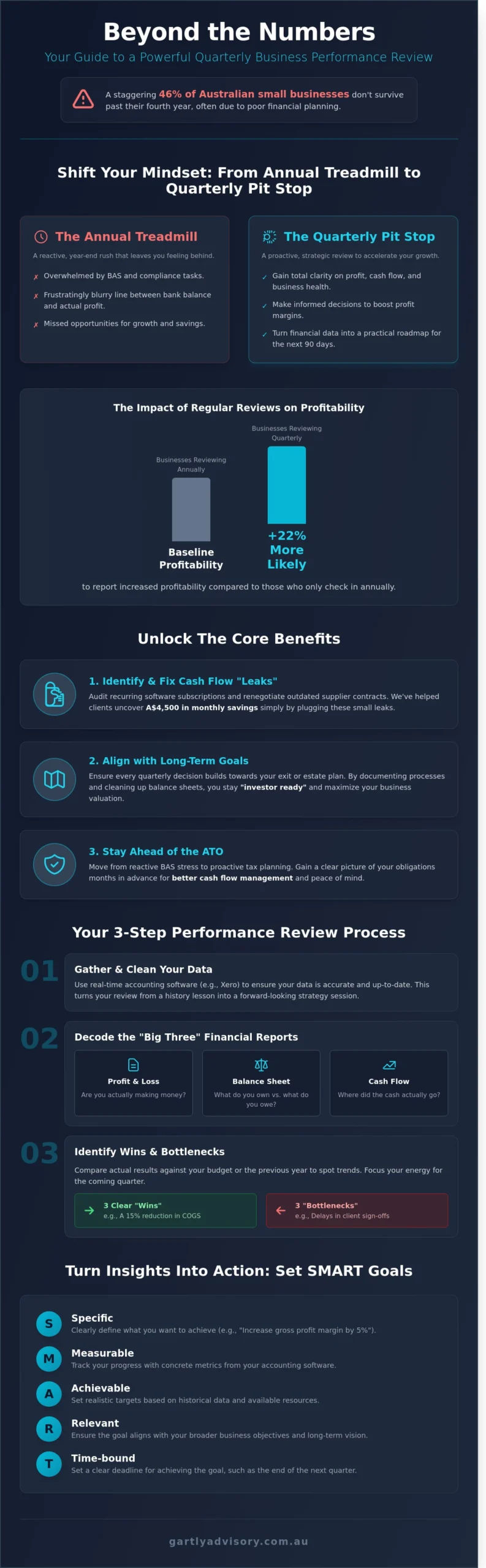
Think of a quarterly business performance review as a high-stakes pit stop for your company. In the fast-paced environments of Melbourne and Sydney, you can’t afford to wait until the end of the financial year to see if your engine is running hot. While a standard tax check-in focuses on what you owe the ATO, this review is about what you keep and how you grow. It’s a proactive look at your profit margins, operational efficiency, and market positioning. A 2023 survey of Australian small businesses found that those who review their financials quarterly are 22% more likely to report increased profitability compared to those who only check in annually.
This process is a vital component of Strategic Management, helping you implement long-term goals through short-term adjustments. In competitive hubs like the Sydney CBD or South Melbourne, market conditions shift rapidly. You might find that your labour costs have crept up by 5% due to local talent shortages, or your supply chain costs in New South Wales have spiked because of fuel price volatility. Catching these trends early allows you to adjust your pricing or processes before your year-end results deliver an unpleasant surprise.
Our “Beyond the Numbers” philosophy means we look at more than just the ledger. We examine your team culture and customer satisfaction levels. If your staff turnover is higher than the 14% national average, your recruitment costs are quietly eroding your bottom line. We also discuss your personal lifestyle goals. If you’re consistently working 65 hours a week, the business isn’t serving you; you’re serving it. We use these reviews to ensure the business is actually delivering the freedom you started it for in the first place.
The Core Benefits of Regular Reviews
Identifying “leaks” in cash flow is our first priority. We’ve helped clients uncover A$4,500 in monthly savings simply by auditing recurring software subscriptions and renegotiating outdated supplier contracts. These small leaks can drain your reserves if left unchecked for twelve months. By spotting them every 90 days, you keep your capital working for you rather than flowing out the door on services you don’t use.
Regular reviews also ensure your daily operations align with your long-term exit or estate planning goals. If you plan to sell your business in five years, every quarterly decision should focus on building a valuation that reflects its true worth. We help you document processes and clean up balance sheets so you’re always “investor ready.” This proactive approach means you aren’t scrambling to fix five years of mess when a buyer finally knocks on your door.
Finally, staying ahead of the ATO is a major stress-reliever. Rather than being reactive when a BAS is due, you’ll have a clear picture of your tax obligations months in advance. This allows for better cash flow management and ensures you’re taking full advantage of available incentives, such as the instant asset write-off or R&D tax offsets, at the moment they are most beneficial to your cash position.
A Step-by-Step How-To: Conducting Your Performance Review
Getting your numbers in order is the first hurdle for any business owner. We find that Xero accounting is your best friend here because it provides real-time insights rather than forcing you to look at data that’s months old. When your bank feeds are reconciled daily, your quarterly business performance review becomes a proactive strategy session instead of a history lesson. It’s about having a clear, honest conversation with your data so you can make informed decisions for the next 90 days.
Once your data is clean, you’ll need to analyse the “Big Three” reports. Your Profit and Loss statement shows if you’re actually making money; the Balance Sheet reveals what you own and owe; and the Statement of Cash Flows tells you where the cash actually went. Comparing these actual results against your budget or the same quarter from 2023 helps you spot trends before they become problems. Research suggests that effective performance reviews are built on this kind of objective, data-driven foundation. We recommend identifying three clear “wins”, like a 15% reduction in COGS, and three “bottlenecks”, such as a persistent delay in client project sign-offs, to focus your energy for the coming quarter.
Key Metrics (KPIs) to Track in Australia
You need to know what’s actually staying in your pocket at the end of the month. A gross profit margin of 60% looks great on paper, but it doesn’t help if your net profit is squeezed to 3% by high overheads. In competitive markets like Sydney or Melbourne, you must monitor your accounts receivable turnover. If clients are taking 48 days to pay instead of your 30-day terms, that’s cash you can’t use to grow. Keep a close eye on employee costs too. In Victoria, the payroll tax threshold is A$700,000, while in NSW it sits at A$1.2 million. Crossing these marks changes your cost structure instantly, so tracking your rolling 12-month payroll total is vital for scaling businesses.
Integrating Tax and Compliance
Your review is the perfect time to act as a safety check for the ATO. Reviewing your GST and IAS lodgements ensures you aren’t facing nasty surprises when the BAS is due. This is also the moment to verify your superannuation guarantee (SG) contributions for employees, which is currently 11.5% for the 2024/25 financial year. If your profit has spiked by 20% this quarter, use this review to assess if you need to adjust your PAYG instalments. Doing this now prevents a massive, unbudgeted tax bill at year-end. If you’re feeling uncertain about these moving parts, you can talk to us and let us help you find the right path forward.
Turning Insights into Action: Planning for the Next Quarter
The biggest hurdle for 42% of small business owners is finding the time to step away from daily operations. You might feel like you don’t have a spare second, but a productive quarterly business performance review doesn’t need to take all day. You can actually condense this process into a focused 60 minute session if you have your data ready. This hour is where you turn raw numbers into a roadmap for the next 90 days, ensuring your efforts align with your long term vision.
Start by setting SMART goals based on your findings. If your review showed that your Sydney branch outperformed Melbourne by 12% last month, a SMART goal might be to “Increase Sydney lead generation by 20% by June 30 through a targeted A$5,500 digital marketing campaign.” This is far more effective than a vague hope to grow. Proactive advice is essential here. For instance, if you’re eyeing expansion into the Gold Coast, you need to look at local consumer confidence trends and seasonal shifts before committing your capital. Setting these specific targets allows you to measure success with precision rather than guesswork.
Adjusting Your Growth Strategy
Knowing when to pivot is a hallmark of a seasoned owner. If a specific service line has seen profit margins drop below 15% for two consecutive quarters, it’s time to ask if it’s still viable for your portfolio. You might decide to reallocate that budget toward a new hire or a marketing push in a high growth area like Western Sydney. Tip: Open your calendar right now and book your next review date for exactly three months’ time. Momentum is lost the moment you stop measuring your progress.
The Value of a Trusted Partner
It’s easy to fall into the trap of founder bias, where you overlook flaws because you’re too close to the daily grind. Working with a business advisory Melbourne partner provides an objective lens to interpret complex data during your quarterly business performance review. We help you move beyond just doing the books and start using those numbers to scale your operations safely.
A Chartered Accountant doesn’t just look at what happened in the past; they help you predict what’s coming next. Whether it’s managing cash flow for a 12 person team or preparing for a major capital expenditure in the new financial year, having a safe pair of hands makes the process less daunting. We love the opportunity to support our clients by identifying hidden opportunities that may not be obvious on a standard profit and loss statement.
Ready to take control of your growth? We invite you to book a complimentary appointment with the Gartly Advisory team today. Let us be your trusted partner on your journey towards success by turning your business insights into a clear, strategic advantage.
Take the Next Step Toward Sustainable Growth
A quarterly business performance review isn’t just a box to tick for your accountant; it’s the engine room of your strategic growth. By consistently measuring your results against your goals, you can spot emerging risks and seize new opportunities before your competitors do. Successful Australian SMEs know that looking back at the last 90 days is only valuable if it informs the next 90. It’s about turning those raw numbers into a clear, actionable roadmap for your team.
Geoff Gartly and his team bring over 35 years of experience to every consultation. As Chartered Accountants and Business Valuebuilder Advisors, we provide the advice beyond the numbers that helps Melbourne and Sydney business owners thrive. Our track record is backed by more than 70 5-Star Google Reviews from clients who value our proactive, supportive approach. We’re ready to help you navigate the complexities of the Australian market with confidence and clarity.
Book a complimentary appointment with Geoff Gartly to review your business performance
Your business deserves a partner who cares as much about your success as you do. Let’s work together to make your next quarter the strongest one yet.
Frequently Asked Questions
Is a quarterly business performance review mandatory in Australia?
No, a quarterly business performance review isn’t a legal requirement under the Corporations Act 2001 for most private Australian companies. Even so, 80% of high growth firms in Melbourne and Sydney treat these sessions as essential governance. While you won’t face an ATO penalty for skipping a review, you risk missing the 28th of the month BAS deadlines or failing to spot a 12% profit leak before it impacts your year end results.
How long should a typical quarterly review meeting take?
A typical session should take between 60 and 90 minutes to remain effective. This window provides enough time to look beyond the numbers and discuss strategic shifts without causing mental fatigue. Our experience shows that meetings shorter than 45 minutes often miss critical data trends. Conversely, sessions lasting over 2 hours usually see a 30% drop in decision making quality. A focused 90 minute block keeps your team sharp and proactive.
What is the difference between a business review and a tax audit?
A quarterly business performance review is a proactive strategy session designed to help you seize opportunities, while a tax audit is a reactive investigation by the ATO. During our reviews, we act as your trusted partner to find ways to boost your A$250,000 revenue target. A tax audit simply verifies that your past A$15,000 GST claims are accurate. One focuses on your future success; the other is strictly about historical compliance and records.
Can I conduct a performance review by myself using Xero?
You can pull basic reports using Xero, but you’ll likely miss the proactive guidance that turns data into a roadmap for success. Xero is a fantastic tool for tracking your A$10,000 monthly overheads; yet, it can’t offer the seasoned advice needed to navigate complex business hurdles. Most owners who go it alone spend 5 hours reviewing spreadsheets without identifying the 3 key levers that actually drive growth. We provide the support to help you see what the software can’t.
Related Posts